



Sodium Formate 92% vs 95% vs 98%: Purity, Impurities, and Application Fit
By Tonmoy
2026-09-09Related Posts
Индивидуальные упаковочные решения от поставщика безводного ацетата натрия в Китае
2026-09-23
Тенденции применения безводного ацетата натрия для специального химического производства
2026-09-23

Безводный ацетат натрия для дубления кожи: улучшает равномерность окрашивания
2026-09-22
Formic Acid 85% for Animal Feed Preservation: Moisture and Storage Stability Guide
2026-09-21
For industrial buyers comparing sodium formate 92%, 95%, and 98%, the highest percentage is not automatically the best choice. The grade should be selected against the complete specification: assay basis, moisture, chloride, organic impurities, physical form, particle size, application requirements, and batch COA.
Under the same test basis, 98% sodium formate contains a smaller nominal non-assay fraction than 95% or 92%. However, the percentage alone does not identify the remaining materials or prove that one grade will perform better in every process. Supplier specifications can use different impurity categories, limits, and test methods, so each quotation should be reviewed on a like-for-like basis.
What 92%, 95%, and 98% mean on a sodium formate specification
Sodium formate grades described as 92%, 95%, or 98% generally refer to the stated assay or minimum sodium formate content of a solid product. The exact meaning depends on the supplier’s specification and analytical method.
Assuming the percentages use the same mass basis and comparable test method, the nominal comparison is:
| Grade | Stated sodium formate assay | Approximate non-assay fraction* | What it indicates |
|---|---|---|---|
| Sodium formate 92% | 92% | 8% | A larger fraction is not reported as sodium formate by the stated assay |
| Sodium formate 95% | 95% | 5% | Intermediate stated assay |
| Sodium formate 98% | 98% | 2% | Smaller nominal non-assay fraction |
\*Illustrative arithmetic only. The non-assay fraction is not automatically one specific impurity and should not be assumed to be water, chloride, organic material, or another defined substance.
A supplier specification should clarify whether the assay is a minimum or typical value, the test method, the sampling basis, and whether the product is a powder, granule, or another solid form. Do not compare a minimum assay from one supplier with a typical assay from another as though they were equivalent.
The chemical identity also needs to remain consistent. This comparison concerns solid sodium formate, not a sodium formate solution or another formate salt.
Sodium formate 92% vs 95% vs 98%: comparison at a glance
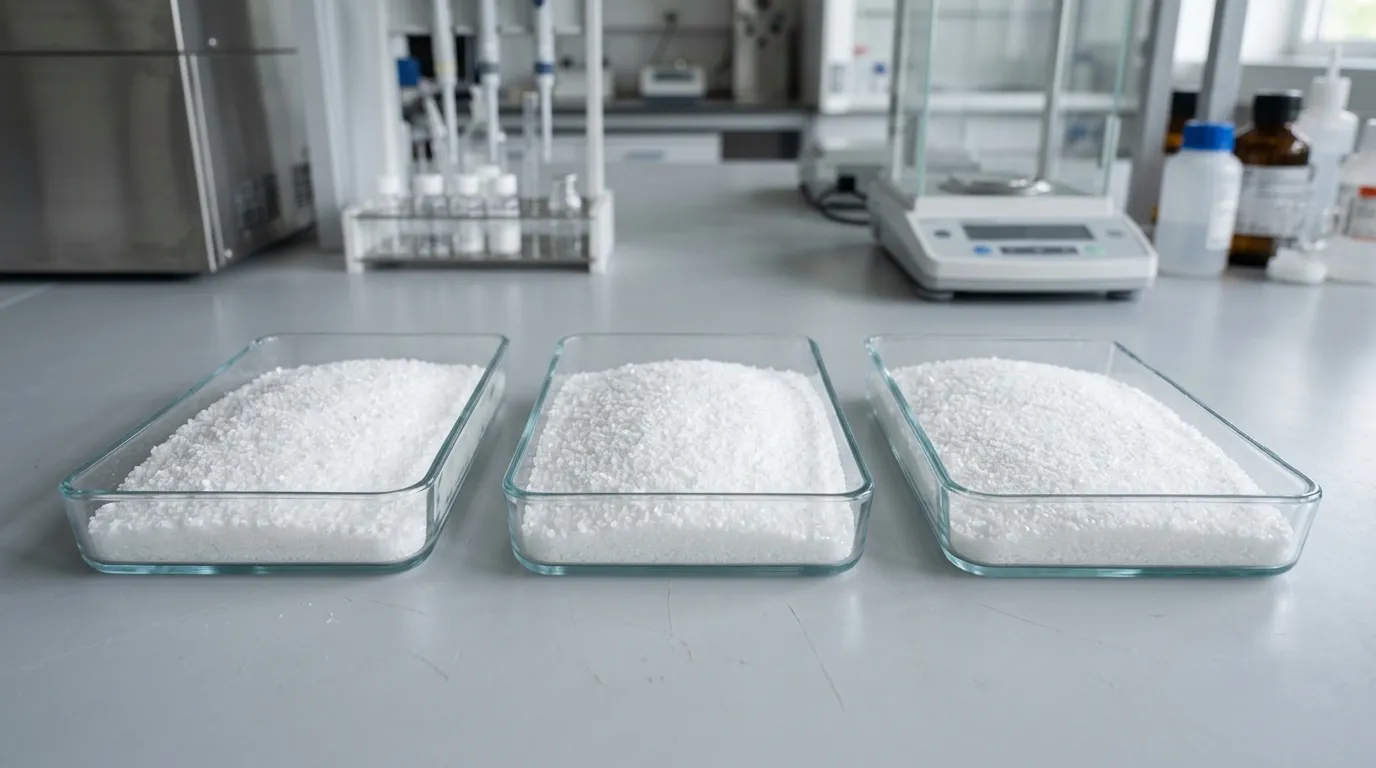
The practical difference between the grades is best understood as a specification and process-tolerance question rather than a simple ranking.
| Grade | Potential purchasing implication | What still needs checking | When it may be considered |
|---|---|---|---|
| 92% | May offer a lower assay option where the process accepts the complete specification | Moisture, chloride, organic impurities, physical form, particle size, and batch COA | Selected general-industrial applications with broader specification tolerance |
| 95% | Intermediate assay option that may balance assay and commercial requirements | Whether the process requires tighter impurity or moisture control | Applications where 92% is insufficient but 98% is not required by the approved specification |
| 98% | Smaller nominal non-assay fraction under a comparable assay basis | Whether the higher assay is accompanied by acceptable impurity, moisture, and physical properties | Processes that require a tighter assay or lower non-assay fraction, subject to full specification approval |
These are decision categories, not universal product specifications. One supplier’s 92%, 95%, or 98% limits should not be presented as the industry standard or transferred to another supplier’s material. For example, commercial specification tables may list separate limits for organic impurities, chloride, and moisture across different grades, but the actual values and test methods can vary by supplier. One supplier’s sodium formate grade table should therefore be treated as supplier-specific evidence rather than a universal standard.
The correct grade is the one that meets the approved process specification consistently, with suitable documentation and an acceptable total delivered cost.
Which impurities and specification fields should buyers compare?
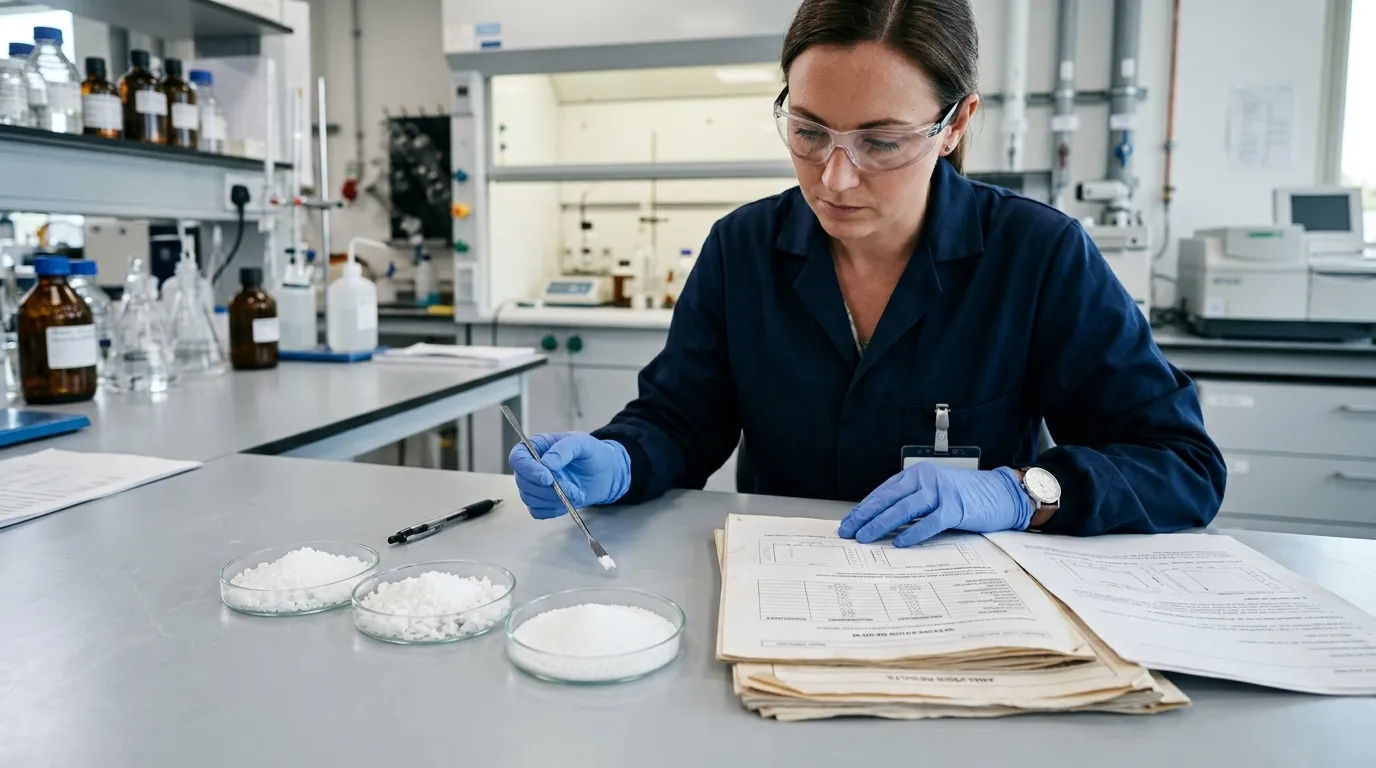
A grade percentage is only one line in a sodium formate specification. QA and procurement teams should compare the following fields where they are relevant to the application.
Assay basis and test method
Confirm whether the stated percentage is:
- Minimum or typical;
- Reported on an as-supplied basis or another basis;
- Measured by a named analytical method;
- Applicable to the quoted solid form and grade.
A difference in test method or reporting basis can make two percentages appear more comparable than they are.
Moisture or water content
Moisture can affect the amount of active sodium formate supplied per tonne and may influence storage, caking, flow, dissolution, or handling. It should be compared separately from assay rather than treated as an interchangeable value.
A product labeled 98% is not automatically equivalent to another 98% product if the moisture limits, test methods, or physical forms differ.
Chloride
Chloride may be an important control parameter where the process has chloride limits, corrosion concerns, downstream material restrictions, or a defined formulation specification. The relevant limit must come from the buyer’s application requirements or approved raw-material specification.
Do not assume that a higher assay grade automatically has a suitable chloride level. Request the actual limit and the batch result.
Organic impurities
Organic impurity limits can distinguish commercial grades, but the category must be defined by the supplier’s specification and method. A generic reference to “purity” does not explain which organic compounds are controlled or how they are measured.
If organic impurities matter to the process, compare the exact parameter, unit, maximum value, and test method across quotations.
Physical form and particle size
Powder, granular, and other physical forms may behave differently during conveying, feeding, dissolving, spreading, or storage. Particle-size distribution, appearance, and bulk density can therefore be relevant even when two products have the same assay.
These properties are not determined by the 92%, 95%, or 98% label alone.
COA and batch information
A current certificate of analysis should connect the quoted specification to a particular batch or lot. Check the:
- Product name and chemical identity;
- Grade and physical form;
- Batch or lot number;
- Assay result and method;
- Moisture result and method;
- Chloride and organic impurity results where specified;
- Appearance or particle-size information where relevant;
- Date of analysis and issuing entity.
A COA supports review of the reported batch. It does not by itself establish universal product approval, food or feed suitability, pharmaceutical suitability, drinking-water suitability, or regulatory compliance.
Is 98% sodium formate always better than 92% or 95%?
No. Sodium formate 98% may be the better fit when the process requires a tighter assay or a smaller non-assay fraction, but the higher number does not guarantee better performance.
A 98% grade should be evaluated against the complete specification. It may still be unsuitable if its chloride, moisture, particle size, physical form, or another controlled parameter does not meet the process requirement.
Sodium formate 95% may be adequate where the approved raw-material specification allows that assay and the impurity profile is acceptable. Sodium formate 92% may also be appropriate for selected industrial uses when the process tolerates the grade and the batch COA consistently meets the agreed limits.
The selection logic is therefore:
- Choose 98% when the process genuinely requires its tighter assay or associated specification, and the complete documentation passes review.
- Consider 95% when it satisfies the process specification and provides an acceptable balance between assay, impurity control, handling, and commercial terms.
- Consider 92% when the application accepts the broader specification and the supplier demonstrates consistent conformity.
- Reject any grade that fails a decision-critical parameter, regardless of its headline assay.
Price per tonne should also be normalized. For example, under the same assay basis, 1,000 kg of product nominally represents approximately 920 kg, 950 kg, or 980 kg of sodium formate at 92%, 95%, or 98%, respectively. This is an illustrative calculation, not a dosage recommendation or a tested performance result. Actual purchasing comparisons must also account for moisture, impurity limits, packaging, quantity, freight, and delivery terms.
How application requirements change the grade decision
The application determines which specification fields deserve the greatest attention. The 92/95/98 label should not replace an application-specific raw-material specification.
Deicing
For deicing formulations, buyers may need to examine moisture, chloride, physical form, storage behavior, and formulation requirements in addition to assay. A general grade label does not establish that a product is suitable for a particular deicing system.
Readers evaluating that use case can review the more specific sodium formate for de icing resource. Any grade recommendation should remain conditional on the formulation, storage requirements, and current product documentation.
Oil drilling
Oilfield applications require the buyer’s fluid specification and operating context to control the selection. A general industrial 92%, 95%, or 98% description should not be treated as universal oilfield approval.
For readers with a drilling-fluid requirement, the related sodium formate for oil drilling page can provide a separate application path. The grade decision should still be confirmed against the relevant technical specification and COA.
Textile, leather, and chemical production
These uses may have different tolerances for moisture, chloride, organic impurities, physical form, and dissolution behavior. The appropriate grade depends on the process and the buyer’s approved raw-material limits, not solely on the assay percentage.
For sodium hydrosulfite production, particle size and dissolution behavior may be relevant alongside assay. Detailed production considerations belong in the separate sodium formate for sodium hydrosulfite production resource rather than in this general grade comparison.
What to request before approving a sodium formate grade

Use a consistent approval sequence when comparing sodium formate 92%, 95%, and 98% quotations.
- Define the requirement. Specify sodium formate identity, solid form, target assay, application, and any process-critical impurity limits.
- Clarify the assay. Ask whether the quoted value is minimum or typical, which test method applies, and what reporting basis is used.
- Compare the full specification. Review moisture, chloride, organic impurities, appearance, particle size, physical form, and any other parameters required by the process.
- Request a current batch COA. Match the COA product name, grade, lot number, test results, methods, and analysis date to the quotation.
- Normalize the commercial comparison. Compare the amount of product supplied, nominal active content, moisture, packaging, quantity, freight, and delivery basis—not only the price per tonne.
- Obtain cross-functional approval. QA, operations, formulation, and procurement should confirm that the same specification is acceptable before the grade is approved.
For teams that need more detail on document interpretation, the how to read chemical COA guide can be used alongside the supplier’s current specification and batch documentation.
The following questions should be answered before purchase:
- Is the material solid, and is its physical form suitable for the process?
- Is the assay a minimum or typical value?
- Are the assay methods comparable between suppliers?
- What are the maximum moisture and chloride limits?
- Are organic impurities defined and reported?
- Is particle size controlled where handling or dissolution matters?
- Does the COA identify the quoted grade and batch?
- Is the quoted commercial basis comparable after considering assay and moisture?
Final grade-selection rule
For sodium formate 92% vs 95% vs 98%, select the lowest assay grade that consistently meets the complete process specification only when the application genuinely permits it. Select 98% when the tighter assay or associated quality requirements are necessary—not simply because the percentage is higher.
Before approving a quotation, compare the exact grade, physical form, assay basis, impurity limits, test methods, batch COA, packaging, and commercial basis. This approach gives procurement and QA teams a more reliable decision than ranking the three grades by assay alone.


Contact Us
In This Article
Related Posts
Индивидуальные упаковочные решения от поставщика безводного ацетата натрия в Китае
2026-09-23
Тенденции применения безводного ацетата натрия для специального химического производства
2026-09-23
Безводный ацетат натрия для дубления кожи: улучшает равномерность окрашивания
2026-09-22
Formic Acid 85% for Animal Feed Preservation: Moisture and Storage Stability Guide
2026-09-21


