



Sodium Formate Storage and Caking: Moisture Control and Warehouse Handling
By Tonmoy
2026-09-09Related Posts
Индивидуальные упаковочные решения от поставщика безводного ацетата натрия в Китае
2026-09-23
Тенденции применения безводного ацетата натрия для специального химического производства
2026-09-23

Безводный ацетат натрия для дубления кожи: улучшает равномерность окрашивания
2026-09-22
Formic Acid 85% for Animal Feed Preservation: Moisture and Storage Stability Guide
2026-09-21
Solid sodium formate should be stored dry, in well-closed packaging, and protected from humid air, condensation, wet floors, leaks, and damaged seals. Moisture exposure can reduce flowability and contribute to clumping or caking. For that reason, receiving inspection, package integrity, prompt resealing, and product-specific documentation are as important as the warehouse environment itself.
There is no universal temperature, relative-humidity, or shelf-life value that should be applied to every sodium formate product. Storage limits should come from the current documentation for the exact grade, solid form, packaging, and supplier. Where caking or moisture exposure is observed, the material should be assessed against the applicable quality criteria before it is issued or reconditioned.
Why sodium formate can cake during storage
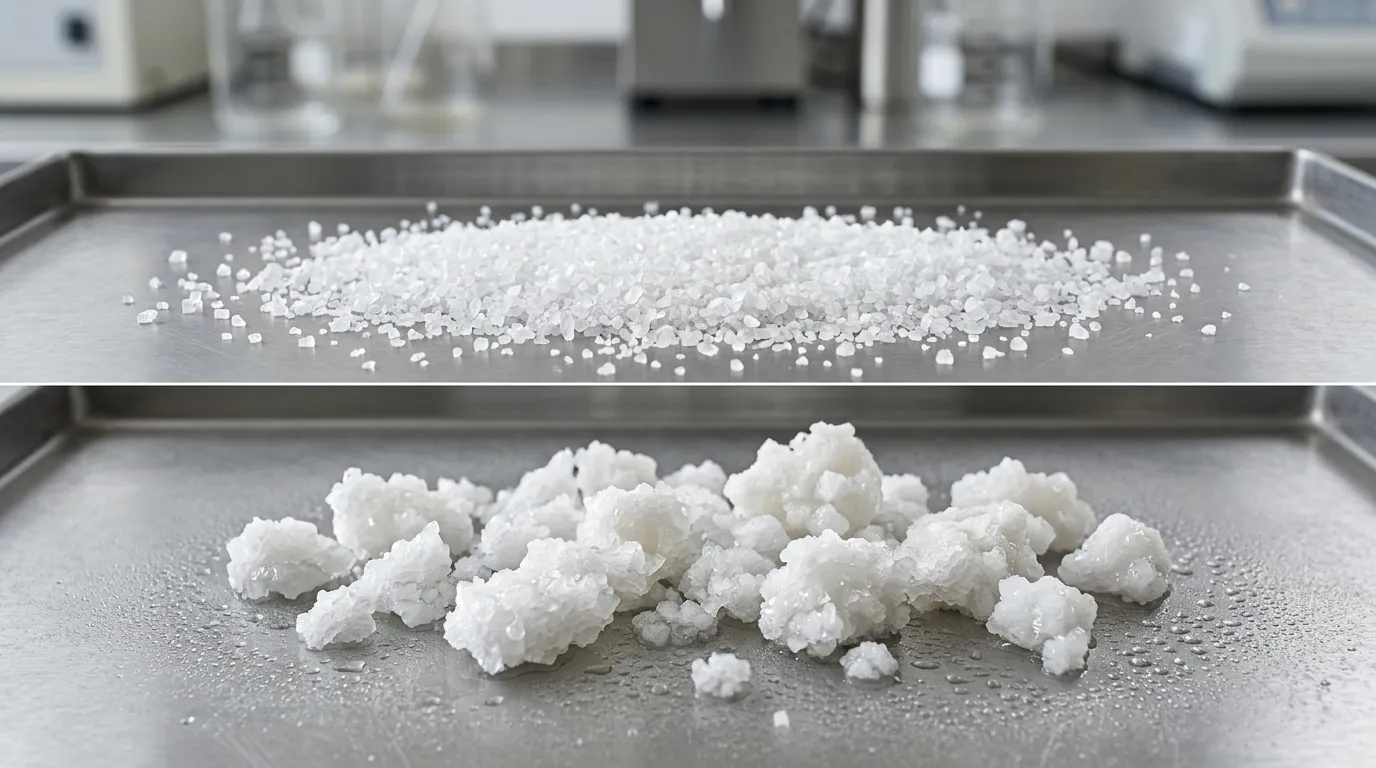
Sodium formate is identified as hygroscopic, meaning it can interact with moisture from the surrounding environment. In a warehouse, moisture may enter through an open package, a damaged bag, a broken closure, humid air, condensation, or contact with a wet floor.
Once moisture reaches the product, particles can adhere to one another and form soft clumps or harder agglomerates. This may affect:
- Powder flow during discharge or dosing
- Material transfer from bags, drums, or other containers
- Feeding consistency in production
- The effort required to empty or break up a package
- The uniformity of material presented for inspection
Caking is an observable physical condition. It does not, by itself, prove that the sodium formate has failed its assay specification, decomposed, or become contaminated. Those conclusions require the applicable product documentation, inspection criteria, and, where necessary, QA assessment.
| Potential exposure point | Possible consequence | Practical control |
|---|---|---|
| Open or incompletely resealed packaging | Moisture entry and clumping | Keep containers closed and reseal promptly |
| Torn, punctured, or wet packaging | Localized caking or contamination | Inspect and segregate affected material |
| Humid air or condensation | Reduced flowability and increased caking risk | Use a dry storage area and minimize exposure |
| Wet floor, leak, or wall condensation | Package damage and material exposure | Keep packages raised from the floor and away from leaks |
Storage controls that reduce moisture exposure
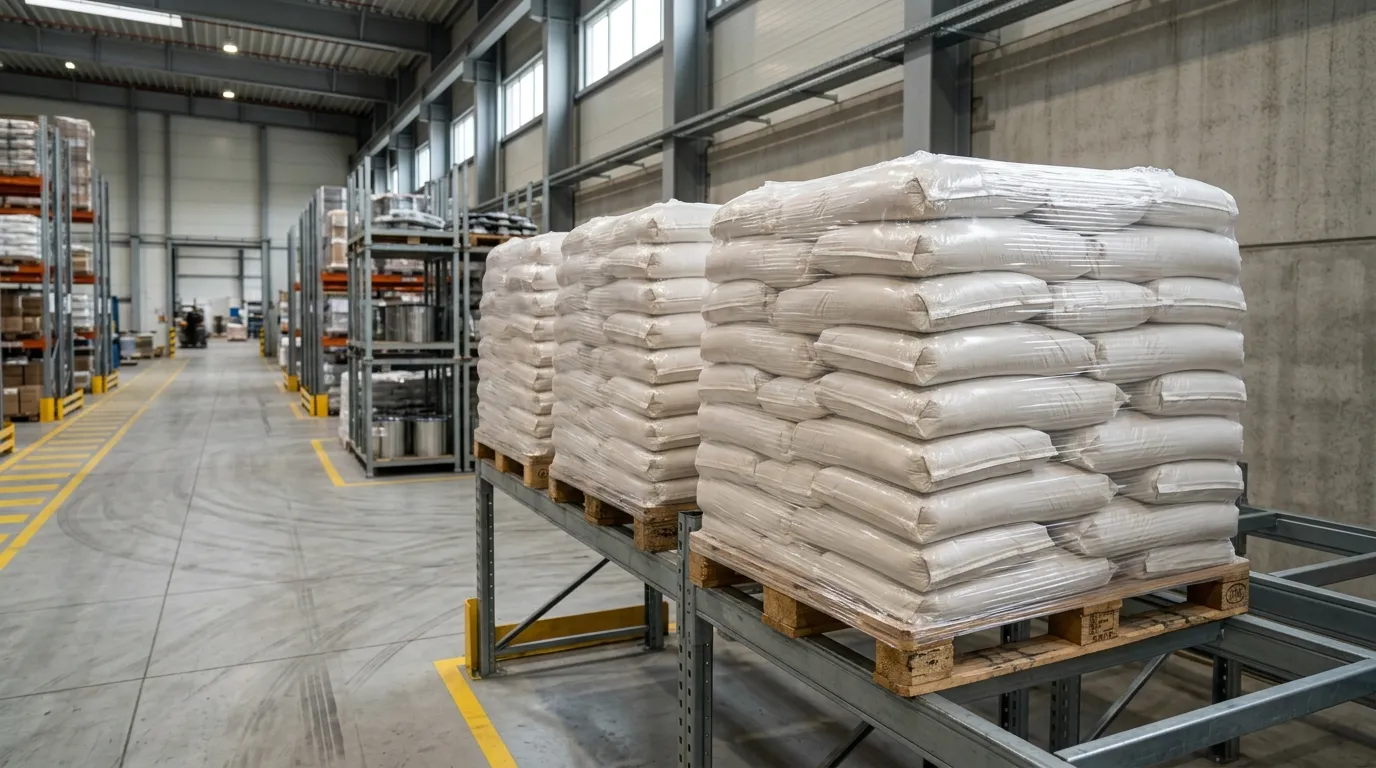
The basic storage approach is straightforward: keep solid sodium formate dry, closed, clean, and protected from avoidable environmental exposure.
Use the following controls as part of the warehouse procedure:
- Store the material in its original, tightly closed packaging unless the site has an approved repackaging procedure.
- Keep bags, containers, or pallets away from wet floors, drains, leaking roofs, open doors, and areas subject to condensation.
- Use suitable pallets or raised storage so packages are not placed directly on the floor.
- Maintain a clean warehouse with ventilation appropriate to the site’s chemical-handling procedures.
- Avoid opening packages before the material is needed.
- Reseal partially used packages promptly after dispensing.
- Keep packaging away from conditions that could cause puncture, abrasion, crushing, or loss of closure integrity.
- Apply stock rotation and record any damaged or moisture-exposed package.
- Prevent contaminated tools, water, or other materials from entering an opened package.
Storage conditions should be evaluated together with the package type and handling frequency. A sealed bag in a dry warehouse has a different exposure profile from a frequently opened container in a humid production area. Likewise, bulk handling may require different package-integrity and transfer controls from palletized bag handling. Broader considerations for packaging, transport, and handling can be reviewed in chemical packaging and logistics.
Do not treat “dry storage” as a substitute for a product-specific specification. The current SDS or TDS for the purchased sodium formate should remain the controlling reference where it provides more detailed instructions.
Packaging and opening practices
Packaging integrity is one of the first controls against moisture exposure. At receipt and before opening, inspect the exterior of each package or container for:
- Tears, punctures, abrasions, or broken seams
- Wet patches, water marks, or evidence of condensation
- Broken closures or damaged liners
- Caked material visible through the package, where applicable
- Unusual discoloration, foreign material, or contamination
- Missing or inconsistent identification
Open only the package required for the immediate task. After use, close it using the approved method for that packaging system. Do not return material that has been exposed, contaminated, or placed in an unclean vessel to an uncontaminated package without QA direction.
A supplier may describe moisture-resistant packaging and dry warehouse conditions as important controls for reducing caking risk. That statement should be treated as supplier-specific guidance rather than proof of a universal packaging performance standard. The exact package construction, liner, barrier properties, and closure system must be confirmed for the product being purchased.
Should sodium formate be stored at a specific temperature or humidity?
Exact temperature and relative-humidity limits should not be copied from one supplier’s page and applied to every sodium formate product.
Some supplier guidance for sodium formate 95% gives specific temperature and humidity recommendations. Those values belong to that supplier’s product and storage guidance unless independently confirmed for the exact material being handled. They should not be presented as universal requirements for all sodium formate grades or packages.
When reviewing a storage specification, confirm:
- The exact grade or assay designation
- Whether the product is solid, granular, powdered, or supplied in another form
- The packaging covered by the recommendation
- Whether the stated value is a limit, a target, or a general recommendation
- The measurement basis and units
- Whether the recommendation applies during transport, storage, or after opening
- The document version and date
If no product-specific temperature or humidity limit is available, the supportable general approach is to store the material dry, well closed, protected from condensation and leaks, and monitored for package damage or visible moisture exposure. Warehouse climate, building condition, local weather, package design, and opening frequency should be considered in the site’s own risk assessment.
Grade selection and grade-specific product information should remain separate from general storage advice. Readers comparing 92%, 95%, and 98% products can review sodium formate 92 vs 95 vs 98 rather than assuming that one grade’s storage data applies to another.
Receiving and pre-use inspection checklist

A controlled receiving process helps identify moisture exposure before the product enters normal stock.
- Confirm the identity and documentation. Match the product name, grade or form, lot or batch information, package labeling, purchase order, and accompanying documents. Review the applicable SDS, TDS, and COA where provided.
- Inspect the external package. Look for tears, punctures, wet patches, broken closures, leakage, crushing, or signs that the package has been exposed to condensation.
- Check the material condition. Note visible clumping, hard masses, discoloration, foreign material, or an unusual appearance compared with the product documentation.
- Record the condition. Photograph or document damaged packaging, affected lot numbers, location, and the apparent exposure history according to the site procedure.
- Segregate questionable material. Material with significant moisture exposure, contamination, damaged identity, or uncertain condition should be held for QA or supplier review.
- Release only against defined criteria. Use the applicable product specification and internal acceptance procedure rather than relying on appearance alone.
- Obtain a disposition before reconditioning. Do not automatically break up, dry, sieve, blend, or return caked material to normal stock without an approved decision.
This process is particularly important when the material will be metered, conveyed, or incorporated into a formulation where poor flowability can interrupt production. It also provides procurement teams with a practical basis for discussing package integrity and documentation requirements with a sodium formate supplier.
Warehouse handling and safety boundaries
Storage control does not replace the current SDS, site risk assessment, or emergency procedures. Personnel should follow the applicable instructions for the exact product and workplace.
Solid sodium formate dust should be managed during bag opening, transfer, cleanup, and other activities that may disperse fine particles. Avoid unnecessary dust generation, maintain suitable ventilation, and use the site’s approved controls and PPE requirements. Do not use compressed air in a way that disperses settled chemical dust unless the site procedure specifically permits it.
The International Chemical Safety Card identifies sodium formate as hygroscopic and recommends dry, well-closed storage. It also identifies separation from strong acids as a storage precaution and describes dust-related fire or explosion hazards under conditions where combustible dust becomes airborne. See the International Chemical Safety Card for sodium formate for the general substance-level guidance.
These precautions do not establish a universal transportation classification, exposure limit, or regulatory approval for a specific product. Local requirements and the exact SDS remain controlling.
What to do when sodium formate has caked
Caked sodium formate should be treated as a condition requiring assessment, not as automatic proof that the entire lot is unusable.
When caking is observed:
- Separate the affected package or lot from normal stock if its condition is uncertain.
- Record whether the packaging was intact, wet, torn, or open.
- Note whether the caking is limited to the surface, concentrated near a package wall, or present throughout the material.
- Check for visible contamination, unusual color, or evidence of liquid exposure.
- Review the applicable product specification and internal acceptance criteria.
- Ask QA or the supplier for a disposition before attempting reconditioning.
- Document the final decision and any restrictions placed on the material.
| Observed condition | Immediate action | Further decision |
|---|---|---|
| Intact package with minor clumping | Hold for inspection | Compare with product-specific acceptance criteria |
| Wet or damaged package | Segregate and document | Obtain QA or supplier review |
| Visible contamination or uncertain identity | Quarantine | Do not issue until formally assessed |
| Severe or hard caking | Avoid improvised treatment | Obtain an approved handling or disposition decision |
There is no evidence here to support a universal method for restoring caked sodium formate. Heating, drying, mechanical breakup, screening, blending, or dilution may affect the material, packaging, workplace safety, or product acceptance criteria. These actions should not be recommended without product-specific instructions and site approval.
Documentation to confirm before purchasing or receiving
Storage performance depends partly on the information available before the material arrives. Procurement and QA teams should request or verify the following for the exact product being purchased:
- Chemical identity and solid form
- Grade or assay designation
- Current SDS and TDS
- COA or batch documentation, where applicable
- Packaging type and closure method
- Moisture-protection or package-integrity information
- Recommended storage conditions
- Shelf-life statement, if supplied for the exact product
- Procedure for damaged, wet, contaminated, or caked material
- Any distinctions between bagged, palletized, and bulk delivery
Do not combine specifications from different grades. A 92%, 95%, or 98% product may have different documentation, packaging, or acceptance requirements, and the applicable instructions should remain attached to the exact grade and form.
For larger receipts or bulk handling, bulk sodium formate should be evaluated against its own packaging, transfer, and warehouse requirements rather than treated as identical to bagged material.
For most facilities, the practical control hierarchy is:
- Keep the material dry and well closed.
- Protect packages from leaks, condensation, wet floors, and damage.
- Minimize exposure when opening and dispensing.
- Inspect incoming and opened material.
- Hold and assess caked, wet, contaminated, or unidentified material.
- Use the exact SDS, TDS, COA, and internal QA criteria for the final decision.
If a storage or purchasing decision depends on a particular grade, packaging format, or documentation requirement, the inquiry should identify those details clearly before the material is ordered or received.


Contact Us
In This Article
Related Posts
Индивидуальные упаковочные решения от поставщика безводного ацетата натрия в Китае
2026-09-23
Тенденции применения безводного ацетата натрия для специального химического производства
2026-09-23
Безводный ацетат натрия для дубления кожи: улучшает равномерность окрашивания
2026-09-22
Formic Acid 85% for Animal Feed Preservation: Moisture and Storage Stability Guide
2026-09-21


