



Potassium Formate vs Sodium Formate: Key Differences and How to Choose
By LIN
2026-09-01Related Posts
Индивидуальные упаковочные решения от поставщика безводного ацетата натрия в Китае
2026-09-23
Тенденции применения безводного ацетата натрия для специального химического производства
2026-09-23

Безводный ацетат натрия для дубления кожи: улучшает равномерность окрашивания
2026-09-22
Formic Acid 85% for Animal Feed Preservation: Moisture and Storage Stability Guide
2026-09-21
Potassium formate vs sodium formate is an important comparison for buyers selecting formate salts for oilfield brines, deicing, chemical manufacturing and low-temperature industrial applications.
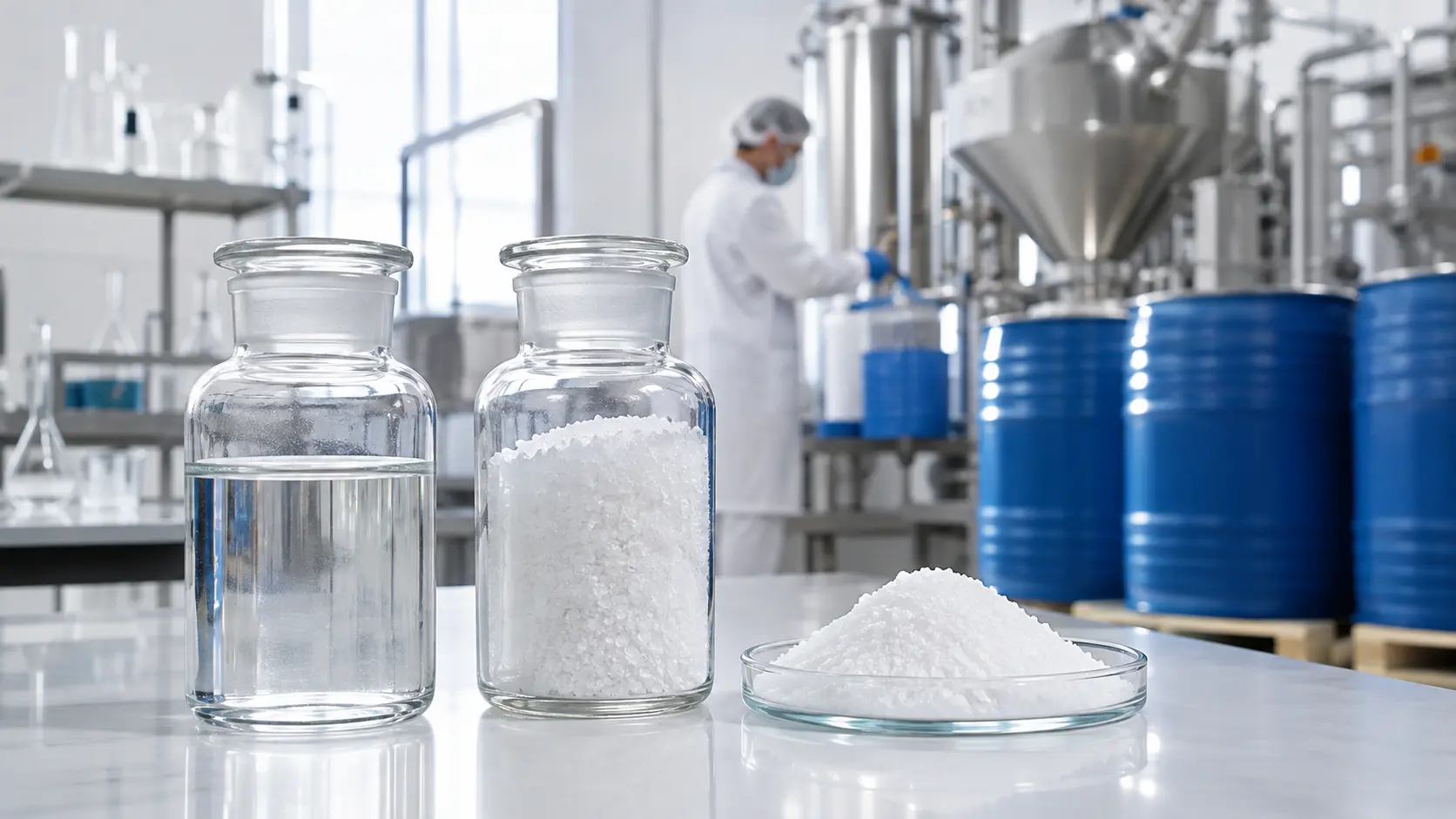
Both chemicals are salts of formic acid and contain the same formate ion, HCOO⁻. The key difference is the metal cation:
- Potassium formate contains potassium, K⁺.
- Sodium formate contains sodium, Na⁺.
That apparently small difference affects:
- Molecular weight
- Solubility and achievable concentration
- Brine density
- Crystallization behavior
- Commercial product form
- Low-temperature performance
- Application suitability
- Procurement cost
The practical answer is simple:
Choose potassium formate when higher-density brine, concentrated liquid handling or strong low-temperature solution performance matters.
Choose sodium formate when a dry solid, lower-density brine or economical formate source is more appropriate.
Neither is universally better.
Potassium Formate vs Sodium Formate at a Glance
| Property | Potassium Formate | Sodium Formate |
|---|---|---|
| Formula | HCOOK | HCOONa |
| CAS Number | 590-29-4 | 141-53-7 |
| Molecular Weight | 84.116 g/mol | 68.007 g/mol |
| Main Cation | Potassium | Sodium |
| Common Commercial Form | Concentrated liquid / solid | Solid powder / granules |
| Typical High-Strength Grade | 75% solution / 96% solid | Application-dependent solid grades |
| Brine Density Potential | Higher | Lower |
| Oilfield Use | High-density drilling/completion brines | Lower-density brines |
| Runway Deicing | Strong liquid-fluid application | Strong solid-deicer application |
| Heat Transfer / Refrigeration | Established specialty use | Less common |
| Typical Buying Priority | Density and low-temperature liquid performance | Economy and solid handling |
PubChem reports molecular weights of 84.116 g/mol for potassium formate and 68.007 g/mol for sodium formate.
What Is Potassium Formate?
Potassium formate is the potassium salt of formic acid.
Vanchor currently supplies potassium formate in forms including:
- 75% aqueous solution
- 96% solid potassium formate
The 75% solution is particularly useful where customers require:
- Direct pumping
- Accurate metering
- Liquid blending
- High-density brines
- Low-temperature fluid formulation
Vanchor's current 75% product is used in oilfield fluids, heat-transfer systems, refrigeration, deicing and industrial chemical processing.
What Is Sodium Formate?
Sodium formate is the sodium salt of formic acid.
It is commonly supplied as a white crystalline solid, powder or granule and is widely used in:
- Sodium hydrosulfite production
- Leather processing
- Solid deicers
- Detergents
- Industrial chemical production
- Lower-density oilfield brines
Vanchor currently lists sodium formate grades generally within the 92–98% purity range, depending on application and required specification.
Which Produces Higher-Density Brine?
This is one of the biggest practical differences.
Vanchor's current comparison data indicates approximate maximum practical single-salt brine densities around:
- Potassium formate: ~1.57 g/cm³
- Sodium formate: ~1.30 g/cm³
Therefore, potassium formate is usually preferred when the application requires a higher-density clear brine.
This is especially important in:
- Drilling fluids
- Completion fluids
- Workover fluids
- Well-intervention fluids
However, actual brine density depends on concentration and temperature.
Which Is Better for Oilfield Fluids?
Potassium Formate
Potassium formate is generally better suited to:
- Higher-density brines
- Solids-free drilling fluids
- Completion fluids
- Reservoir drill-in fluids
- Workover fluids
- Packer fluids
Its ability to produce concentrated, high-density aqueous brines gives it a significant advantage when hydrostatic pressure must be controlled without excessive suspended solids.
Sodium Formate
Sodium formate may be suitable when:
- Lower density is sufficient
- A dry solid is preferred
- Cost is important
- Sodium chemistry is acceptable
The correct selection should still consider formation compatibility, crystallization temperature, temperature, pressure and the complete fluid formulation.
Which Is Better for Deicing?
This depends strongly on whether the finished product is solid or liquid.
Sodium Formate for Solid Runway Deicing
FAA Engineering Brief 108, dated January 9, 2026, identifies sodium formate among the approved chemical bases for solid airfield deicing/anti-icing products meeting SAE AMS 1431.
Sodium formate is therefore well established for:
- Solid runway deicers
- Granular deicing products
- Dry winter-maintenance formulations
Potassium Formate for Liquid Runway Deicing
The same FAA guidance identifies potassium-formate-based fluids meeting SAE AMS 1435 among recommended liquid airfield deicing/anti-icing products.
Potassium formate is particularly suitable for:
- Liquid runway deicing
- Anti-icing fluid
- Road and bridge liquid deicers
- Automated spraying systems
Perstorp likewise commercially offers potassium-formate-based liquid and sodium-formate-based solid runway deicer technologies.
So for airport applications:
Solid deicer → sodium formate is especially established
Liquid deicing fluid → potassium formate is especially established
The final airport product must still meet the applicable SAE specification.
Can Sodium Formate Be Dissolved to Make a Liquid Runway Deicer?
This requires caution.
FAA Engineering Brief 108 specifically warns that simply mixing an SAE AMS 1431-compliant solid deicer with water does not automatically produce an SAE AMS 1435-compliant liquid runway deicer.
Therefore:
Approved solid sodium formate product + water ≠ automatically approved liquid airport fluid
The finished liquid product must be separately evaluated against the applicable specification.
Which Has Better Low-Temperature Liquid Performance?
For concentrated liquid applications, potassium formate generally has the advantage.
Vanchor's current technical comparison identifies potassium formate as better suited to concentrated low-temperature brines, while sodium formate is better suited to moderate-density systems.
This is one reason potassium formate is commonly considered for:
- Low-temperature heat-transfer fluids
- Secondary refrigeration
- Industrial cooling
- High-density oilfield brines
- Liquid deicers
However, concentration and formulation matter.
A concentrated potassium formate raw material can have different crystallization behavior from a diluted finished fluid.
Which Is Better for Refrigeration and Heat Transfer?
Potassium formate has the stronger established position in this application.
Vanchor currently lists Potassium Formate 75% for:
- Heat-transfer systems
- Refrigeration
- Industrial cooling
- Low-temperature circulation.
The main engineering considerations are:
- Crystallization temperature
- Viscosity
- Density
- Specific heat
- Thermal conductivity
- Corrosion
- Pumping power
Sodium formate is technically capable of forming aqueous solutions, but potassium formate is generally more attractive where concentrated, low-temperature secondary fluid performance is required.
Which Contains More Formate by Weight?
Because sodium formate has a lower molecular weight, pure sodium formate contains a greater proportion of formate ion by product weight.
Molecular weights are:
- Sodium formate: 68.007 g/mol
- Potassium formate: 84.116 g/mol
Both contain one formate ion per formula unit.
Therefore, substitution should not be made simply:
1 kg sodium formate = 1 kg potassium formate
A formulation should be recalculated on a molar, active-content or performance basis.
Can Sodium Formate Replace Potassium Formate?
Sometimes—but not automatically.
Before substitution, recalculate:
- Moles of formate
- Final concentration
- Brine density
- Crystallization temperature
- Sodium/potassium ion concentration
- Viscosity
- Application performance
In oilfield systems, also retest:
- Formation compatibility
- Shale response
- Fluid loss
- corrosion
- TCT/PCT
- additive compatibility
In deicing systems, test the complete finished formulation rather than comparing only the raw salts.
Which Is Cheaper?
Sodium formate is often selected where economy and dry-solid handling are priorities, while potassium formate normally carries a stronger value proposition where high brine density or concentrated liquid performance is required. Vanchor's existing technical comparison follows this same purchasing distinction.
However, prices change with:
- Purity
- Form
- Order quantity
- Packaging
- Freight
- Potassium and sodium raw-material markets
- Destination
Buyers should therefore compare delivered cost per usable formulation, not simply price per metric ton.
How to Choose Between Them
Choose Potassium Formate When You Need:
- Higher-density brine
- Drilling or completion fluid
- Concentrated liquid handling
- Liquid runway deicer formulation
- Low-temperature heat-transfer fluid
- Refrigeration secondary coolant
- Direct pumping and metering
Choose Sodium Formate When You Need:
- Solid formate salt
- Solid runway deicer
- Sodium hydrosulfite production
- Leather-processing chemical
- Lower-density oilfield brine
- Lower-cost dry-form formate source
Potassium and Sodium Formate From Vanchor
Vanchor currently supplies both sodium formate and potassium formate within its formate portfolio. Published company information lists potassium formate at approximately 74–96% and sodium formate at approximately 92–98%, with exact specifications depending on grade and application.
For a quotation, provide:
Product required
Application
Concentration or purity
Target density
Minimum operating temperature
Quantity
Packaging
Destination
For technical applications, buyers should also request:
- Current specification
- Batch-specific COA
- TDS
- SDS
Frequently Asked Questions
What is the main difference between potassium formate and sodium formate?
Potassium formate contains K⁺ while sodium formate contains Na⁺. This changes molecular weight, solution concentration, brine density and application performance.
Which formate produces higher-density brine?
Potassium formate. Vanchor's current comparison places practical single-salt potassium formate brine around 1.57 g/cm³ versus approximately 1.30 g/cm³ for sodium formate.
Which is better for oilfield applications?
Potassium formate is generally preferred for higher-density drilling and completion brines, while sodium formate can suit lower-density applications.
Which is better for runway deicing?
For FAA-recommended products, sodium formate is established in solid SAE AMS 1431 products, while potassium-formate-based fluids are recognized under SAE AMS 1435.
Which is better for refrigeration?
Potassium formate generally has the stronger application fit for concentrated low-temperature secondary refrigeration and heat-transfer systems.
Can one replace the other directly?
No. Molecular weight, concentration, density and application performance differ, so substitution requires recalculation and testing.
Conclusion
The potassium formate vs sodium formate decision depends primarily on the required product form and performance.
Choose potassium formate when the priority is:
Higher brine density
Concentrated liquid performance
Oilfield drilling/completion fluids
Liquid deicing
Low-temperature refrigeration and heat transfer
Choose sodium formate when the priority is:
Dry solid handling
Solid deicing
Chemical manufacturing
Leather processing
Lower-density brine
Cost efficiency
Neither chemical is universally better.
The correct choice should be based on density, concentration, operating temperature, application chemistry, product form and total delivered cost.


Contact Us
Related Posts
Индивидуальные упаковочные решения от поставщика безводного ацетата натрия в Китае
2026-09-23
Тенденции применения безводного ацетата натрия для специального химического производства
2026-09-23
Безводный ацетат натрия для дубления кожи: улучшает равномерность окрашивания
2026-09-22
Formic Acid 85% for Animal Feed Preservation: Moisture and Storage Stability Guide
2026-09-21


