



Potassium Formate vs Calcium Chloride: Deicing, Refrigeration, and Brine Comparison
By LIN
2026-09-01Related Posts
Индивидуальные упаковочные решения от поставщика безводного ацетата натрия в Китае
2026-09-23
Тенденции применения безводного ацетата натрия для специального химического производства
2026-09-23

Безводный ацетат натрия для дубления кожи: улучшает равномерность окрашивания
2026-09-22
Formic Acid 85% for Animal Feed Preservation: Moisture and Storage Stability Guide
2026-09-21
Potassium formate vs calcium chloride is an important comparison when selecting salts for deicing, refrigeration brines, industrial cooling or oilfield fluids.
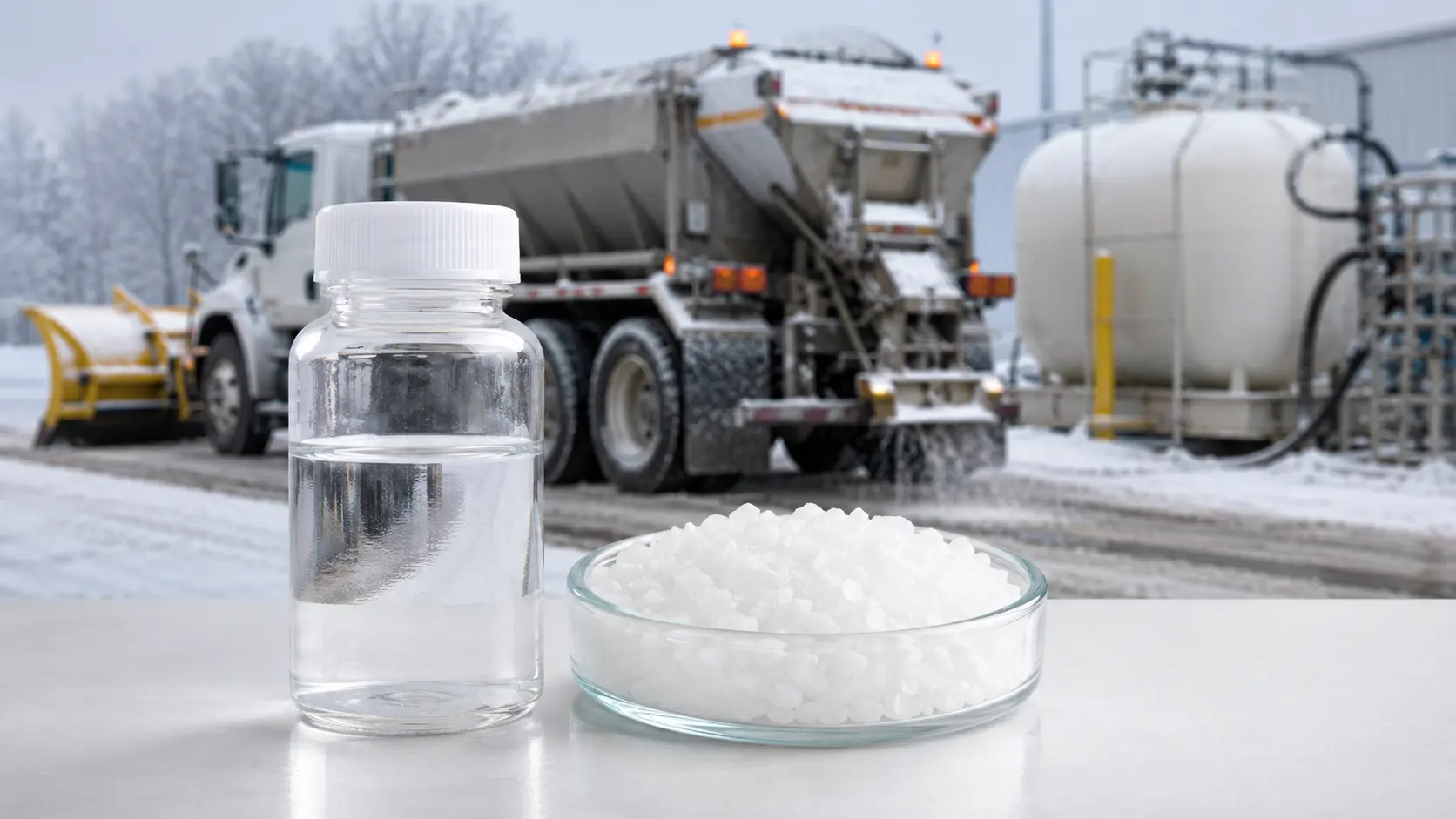
Both dissolve readily in water and can create concentrated low-temperature solutions, but their chemistry is fundamentally different:
- Potassium formate is a formate salt
- Calcium chloride is a chloride salt
That difference affects corrosion, infrastructure compatibility, brine formulation, application economics and long-term system performance.
The practical answer is:
Calcium chloride is often preferred where low raw-material cost and conventional chloride-brine performance are the main priorities.
Potassium formate becomes more attractive where reducing chloride exposure, obtaining concentrated formate brines or supporting specialized low-temperature and oilfield systems justifies the higher chemical cost.
Neither is universally better.
Potassium Formate vs Calcium Chloride at a Glance
| Factor | Potassium Formate | Calcium Chloride |
|---|---|---|
| Formula | HCOOK | CaCl₂ |
| CAS Number | 590-29-4 | 10043-52-4 |
| Molecular Weight | 84.116 g/mol | 110.98 g/mol |
| Chemistry | Formate salt | Chloride salt |
| Deicing | Yes | Yes |
| Refrigeration brine | Yes | Yes |
| Oilfield brine | Yes | Yes |
| Chloride loading | Low/trace impurity only | Intrinsic to chemistry |
| Corrosion control | Still required | Important |
| Typical cost position | Premium | More economical |
| Best fit | Specialized performance | Conventional bulk applications |
PubChem reports molecular weights of 84.116 g/mol for potassium formate and 110.98 g/mol for calcium chloride.
What Is Potassium Formate?
Potassium formate is the potassium salt of formic acid.
Vanchor currently supplies Potassium Formate 75% Solution for applications including:
- Oilfield fluids
- Heat-transfer fluids
- Refrigeration systems
- Deicing formulations
- Industrial processing.
The concentrated liquid can be pumped, metered and diluted directly, which makes it attractive for industrial fluid formulators.
What Is Calcium Chloride?
Calcium chloride is an inorganic chloride salt with the formula CaCl₂.
It has a long history in:
- Road deicing
- Anti-icing
- Refrigeration brines
- Oilfield clear brines
- Dust control
- Industrial processing
ASHRAE identifies calcium chloride and sodium chloride solutions as historically the most common salt-based refrigeration brines.
Which Is Better for Deicing?
Both chemicals can depress the freezing point of water.
Calcium Chloride
Calcium chloride is widely used for road snow and ice control.
FHWA data show that the calcium chloride-water system reaches a eutectic composition around 30% CaCl₂, with a eutectic temperature near −51°C. Calcium chloride is also hygroscopic, helping it absorb moisture and form brine.
These characteristics make it effective for:
- Road deicing
- Pre-wetting salt
- Anti-icing
- Cold-weather winter maintenance
Potassium Formate
Potassium formate is particularly suitable for liquid deicing formulations where operators want to reduce reliance on chloride salts.
Its advantages can include:
- Liquid pumping and spraying
- High water solubility
- Low-chloride formulation potential
- Airport and specialist pavement applications
- Preventive anti-icing
Therefore:
For economical general road deicing → calcium chloride often makes commercial sense.
For specialized non-chloride liquid formulations → potassium formate can be more attractive.
Which Creates More Corrosion Concern?
This is one of the most important differences.
Calcium chloride inherently introduces chloride ions into the treated environment.
Repeated chloride exposure can affect:
- Reinforcing steel
- Vehicles
- Guardrails
- Bridges
- Industrial equipment
FHWA specifically identifies aqueous calcium chloride and magnesium chloride deicers as contributors to recognized forms of chemical distress in concrete pavements.
FHWA research also discusses chemical reactions between calcium chloride and cement paste that can contribute to concrete deterioration.
Does That Mean Potassium Formate Is Non-Corrosive?
No.
Potassium formate should not be marketed as universally non-corrosive.
Corrosion still depends on:
- Concentration
- pH
- Trace chloride
- Temperature
- Material type
- Oxygen
- Inhibitor package
- Exposure time
Its main distinction is that chloride is not the primary anion.
That can reduce chloride-related concerns, but the finished formulation still needs corrosion testing.
Potassium Formate vs Calcium Chloride for Concrete
For infrastructure-sensitive deicing, this difference can become significant.
Calcium chloride may contribute to:
- Reinforcement corrosion
- Concrete chemical interaction
- Scaling or deterioration under repeated exposure
Potassium formate avoids using calcium chloride as the active deicing chemistry, but that does not automatically guarantee compatibility with every concrete formulation.
For either product, professional buyers should evaluate:
- Freeze-thaw performance
- Concrete scaling
- Joint sealants
- Surface residue
- Reinforcement exposure
- Finished-fluid concentration
Which Is Better for Refrigeration Brine?
Both can function as secondary coolants.
Calcium Chloride Refrigeration Brine
Calcium chloride is one of the traditional refrigeration brines.
ASHRAE provides extensive physical-property data for calcium chloride solutions and identifies it as one of the historically common refrigeration secondary coolants.
For example, ASHRAE gives a 22% calcium chloride solution with a freeze point around −22.1°C in one comparative secondary-coolant example.
Advantages include:
- Established engineering data
- Wide availability
- Relatively low chemical cost
- Long history in industrial refrigeration
Potassium Formate Refrigeration Fluid
Potassium formate is less common but has become a specialist option for low-temperature secondary refrigeration.
Published research on aqueous potassium formate found:
- Good thermodynamic properties
- Relatively low viscosity
- Good thermal conductivity
- Low toxicity
- Non-flammability
The low viscosity helped keep pumping-power requirements competitive in indirect refrigeration systems.
Therefore:
Calcium chloride remains a conventional, economical refrigeration brine.
Potassium formate can be attractive where low-temperature pumping performance and reduced chloride exposure are important.
Which Is Better for Long-Term Cooling Systems?
This depends heavily on the system metallurgy.
A refrigeration loop may contain:
- Carbon steel
- Stainless steel
- Copper
- Aluminum
- Pumps
- Valves
- Elastomers
With calcium chloride, chloride-related corrosion control becomes an important design issue.
Potassium formate may reduce chloride loading, but it still needs:
- Controlled raw-material purity
- Correct pH
- Suitable corrosion inhibitors
- Compatible dilution water
- Periodic fluid monitoring
Neither fluid should be charged into a critical industrial refrigeration loop without checking material compatibility.
Which Is Better for Oilfield Brines?
This application has already been covered in depth on Vanchor's existing Potassium Formate vs Calcium Chloride Brine page.
The broad distinction is:
Potassium Formate
Often considered when priorities include:
- High-density formate brine
- Shale-sensitive formations
- Reservoir compatibility
- Low-solids fluid systems
- Reduced chloride concerns
Calcium Chloride
Commonly used for:
- Completion fluids
- Workover fluids
- Packer fluids
- Well-kill fluids
- Conventional clear-brine systems
Vanchor currently describes calcium chloride as a practical option where moderate brine density is required, while potassium formate is used in more specialized high-performance drilling and completion systems.
For the detailed oilfield comparison, ===208 should internally link to the existing dedicated page rather than repeating that entire article.
Which Is Cheaper?
In general, calcium chloride is the more economical commodity chemical.
This contributes to its widespread use in:
- Road deicing
- Dust control
- Conventional refrigeration brines
- Oilfield fluids
Potassium formate is normally a more specialized and higher-cost chemical.
Its premium is easier to justify where the buyer values:
- Reduced chloride loading
- Concentrated liquid handling
- Low-temperature secondary cooling
- Specialized oilfield performance
- Corrosion-sensitive infrastructure
Buyers should compare:
Chemical price + inhibitor cost + equipment corrosion + maintenance + pumping energy + disposal + lifecycle cost
rather than price per ton alone.
Product Form and Handling
Potassium Formate
Vanchor currently offers 75% liquid potassium formate, with typical density around 1.57 g/cm³ at 20°C, subject to the actual product specification.
Liquid concentrate provides:
- Direct pumping
- Automatic dosing
- Easy dilution
- Reduced dust
- Rapid formulation
Calcium Chloride
Calcium chloride is commercially available in:
- Flakes
- Pellets
- Granules
- Concentrated solutions
Dry calcium chloride also releases heat when dissolved in water, which needs to be considered during brine preparation.
Which Should You Choose?
Choose Potassium Formate When:
Your priority is:
- Reduced chloride chemistry
- Specialized liquid deicing
- Corrosion-sensitive infrastructure
- Low-temperature heat-transfer fluid
- Industrial refrigeration
- High-performance oilfield brine
- Direct concentrated-liquid handling
Choose Calcium Chloride When:
Your priority is:
- Lower raw-material cost
- Conventional road deicing
- Established refrigeration brine
- Readily available bulk chemical
- Moderate-density oilfield clear brine
- Proven traditional system design
Compare Both When:
The application involves:
- Industrial refrigeration
- Bridge or pavement deicing
- Oilfield completion fluids
- Low-temperature process cooling
In these cases, whole-system cost is more meaningful than chemical cost alone.
Potassium Formate From Vanchor
Vanchor currently supplies Potassium Formate 75% Solution for oilfield, heat-transfer, refrigeration and deicing applications.
Current product information includes:
- CAS 590-29-4
- Approx. 75% concentration
- Liquid product form
- COA, SDS and TDS availability
- IBC and bulk-liquid supply options.
For a comparison or quotation, provide:
Application
Minimum operating temperature
Required density or concentration
System metallurgy
Quantity
Packaging
Destination
Frequently Asked Questions
What is the main difference between potassium formate and calcium chloride?
Potassium formate is a formate salt, while calcium chloride is a chloride salt. This difference affects corrosion, fluid compatibility and application selection.
Which is better for road deicing?
Calcium chloride is widely used and economical for conventional road deicing. Potassium formate is more attractive for specialized liquid systems where reducing chloride exposure is important.
Which is better for refrigeration?
Calcium chloride is a traditional refrigeration brine. Potassium formate can be attractive in specialized low-temperature systems because of its useful viscosity and heat-transfer characteristics.
Is potassium formate non-corrosive?
No. It reduces dependence on chloride chemistry but still requires corrosion and material-compatibility evaluation.
Does calcium chloride damage concrete?
Repeated calcium chloride exposure has been associated with chemical distress mechanisms in concrete pavement, so formulation and infrastructure compatibility should be considered.
Which is cheaper?
Calcium chloride is generally the lower-cost commodity option, while potassium formate is usually selected when specialized technical benefits justify its premium.
Conclusion
The potassium formate vs calcium chloride decision depends on the application.
Choose calcium chloride when the priority is:
Economical deicing
Traditional refrigeration brine
Established bulk supply
Conventional clear-brine applications
Choose potassium formate when the priority is:
Reduced chloride loading
Specialized low-temperature fluids
Industrial refrigeration
Corrosion-sensitive systems
High-performance oilfield applications
The best choice should therefore be based on temperature, corrosion risk, infrastructure, fluid properties, operating requirements and lifecycle cost—not raw-material price alone.


Contact Us
In This Article
Related Posts
Индивидуальные упаковочные решения от поставщика безводного ацетата натрия в Китае
2026-09-23
Тенденции применения безводного ацетата натрия для специального химического производства
2026-09-23
Безводный ацетат натрия для дубления кожи: улучшает равномерность окрашивания
2026-09-22
Formic Acid 85% for Animal Feed Preservation: Moisture and Storage Stability Guide
2026-09-21


