



Potassium Formate Brine vs Bromide Brine: Which Completion Fluid Should You Choose?
By LIN
2026-09-01Related Posts
Индивидуальные упаковочные решения от поставщика безводного ацетата натрия в Китае
2026-09-23
Тенденции применения безводного ацетата натрия для специального химического производства
2026-09-23

Безводный ацетат натрия для дубления кожи: улучшает равномерность окрашивания
2026-09-22
Formic Acid 85% for Animal Feed Preservation: Moisture and Storage Stability Guide
2026-09-21
Potassium formate brine vs bromide brine is an important comparison when selecting clear completion, workover, packer or reservoir drill-in fluids.
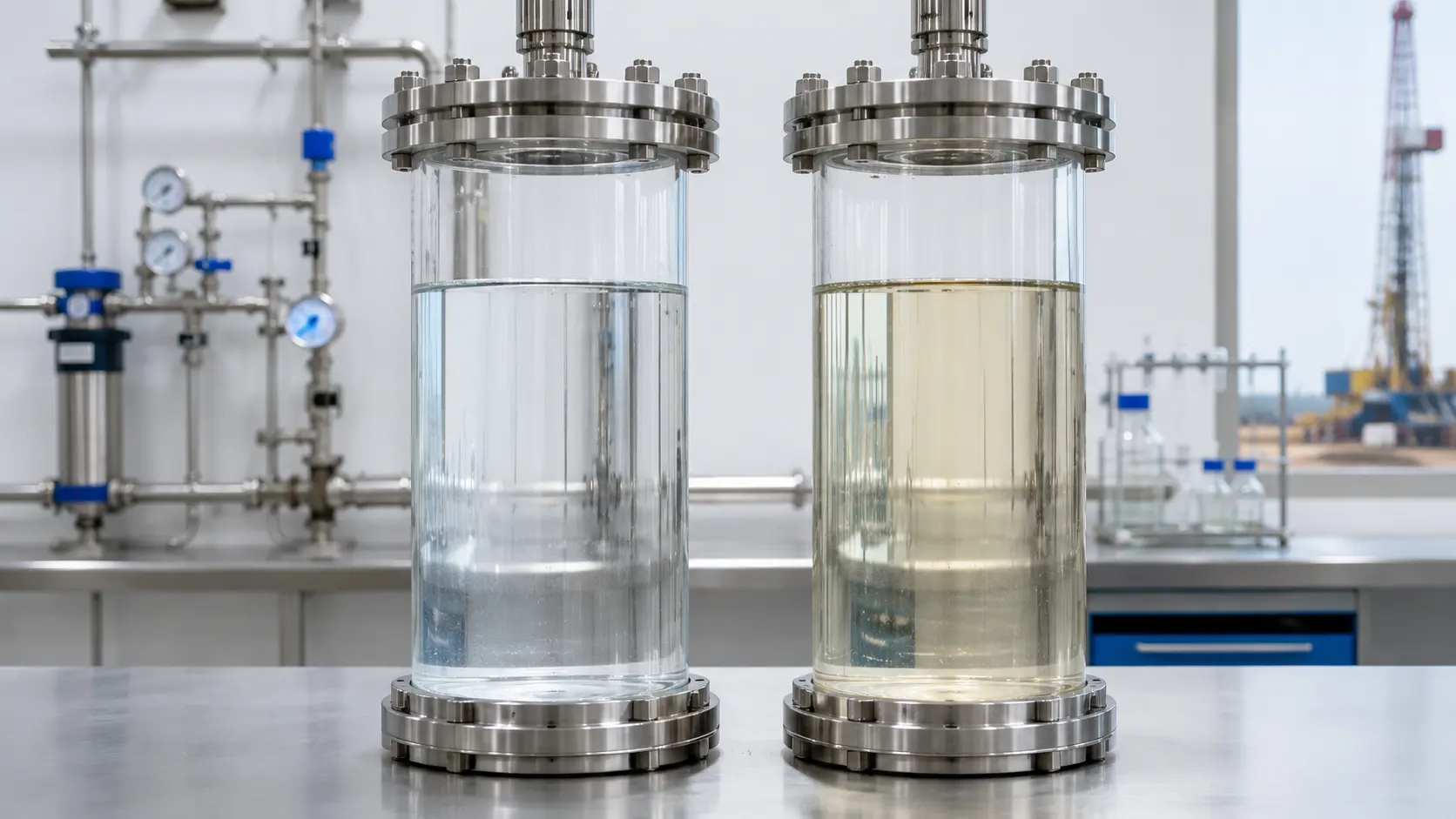
Both fluid families can provide hydrostatic pressure without relying on large amounts of suspended weighting solids. However, they differ significantly in:
- Achievable density
- Salt chemistry
- Crystallization behavior
- Corrosion control
- Reservoir compatibility
- Environmental management
- Fluid recovery
- Total system cost
The key point is that bromide brine is not one single fluid.
It may include:
- Sodium bromide, NaBr
- Calcium bromide, CaBr₂
- Zinc bromide, ZnBr₂
- CaBr₂/CaCl₂ blends
- ZnBr₂/CaBr₂ blends
SLB defines bromide brine as an aqueous solution of sodium, calcium or zinc bromide salts or mixtures used primarily for completion and workover operations.
Therefore, the correct comparison depends heavily on the required well-control density.
Potassium Formate vs Bromide Brine at a Glance
| Factor | Potassium Formate Brine | Bromide Brine |
|---|---|---|
| Main chemistry | HCOOK | NaBr, CaBr₂, ZnBr₂ or blends |
| Brine type | Monovalent formate | Monovalent/divalent bromide |
| Typical maximum density | ~13.1–13.2 ppg | ~12.5 to 20+ ppg depending on salt |
| Suspended weighting solids | Not required within brine density range | Not required within brine density range |
| Chloride/bromide loading | Formate-based | Bromide-based |
| Corrosion concerns | Must still be controlled | Can become significant, especially ZnBr₂ |
| Shale inhibition | Useful in selected formations | Depends strongly on bromide system |
| Very high-density service | Limited without heavier formates | Strong advantage |
| Purchase cost | Generally premium | Chemistry-dependent |
| Best fit | Medium/high-density specialized clear brine | High and ultra-high-density completion brines |
Published completion-fluid references place single-salt potassium formate around 1.57 g/cm³, sodium bromide around 1.50 g/cm³, calcium bromide around 1.70 g/cm³, and zinc bromide systems as high as approximately 2.30 g/cm³.
What Is Potassium Formate Brine?
Potassium formate brine is a clear aqueous solution of potassium formate, HCOOK.
Vanchor's current oilfield guidance places concentrated potassium formate brine at approximately:
1.58 g/cm³ / 13.2 ppg
depending on concentration and temperature.
Applications include:
- Completion fluids
- Workover fluids
- Reservoir drill-in fluids
- Packer fluids
- High-density clear brines
- Low-solids drilling-fluid systems
Its main attraction is achieving useful density using dissolved salt rather than conventional suspended weighting solids.
What Is Bromide Brine?
Bromide brines are traditional clear completion-fluid systems.
Sodium Bromide
NaBr can provide moderate brine density and is used for completion and workover applications.
Calcium Bromide
CaBr₂ provides substantially higher density. SLB describes calcium bromide systems used with calcium chloride for solids-free brines in approximately the 11.5–14.5 ppg range.
Zinc Bromide
ZnBr₂ is used when very high density is required.
SLB reports saturated zinc bromide at approximately 20 ppg, but also warns that its low pH can cause acidic corrosion and handling/HSE concerns.
This is why simply saying “bromide brine” is not enough when specifying a completion fluid.
Which Provides Higher Brine Density?
For wells requiring very high hydrostatic pressure, bromide systems have the broader density range.
Approximate density capability:
| Brine | Approximate Maximum Density |
|---|---|
| Sodium Bromide | ~1.50 g/cm³ |
| Potassium Formate | ~1.57 g/cm³ |
| Calcium Bromide | ~1.70 g/cm³ |
| Zinc Bromide | ~2.30 g/cm³ |
This gives a straightforward selection rule.
Potassium Formate
Strong fit when the required fluid density remains within roughly the 13.1–13.2 ppg range.
Calcium Bromide
Becomes attractive when a higher density is required.
Zinc Bromide Blends
Can reach substantially higher density for demanding HP/HT and high-pressure well-control conditions.
Therefore, potassium formate cannot replace every bromide brine.
Why Use Potassium Formate If Bromides Can Reach Higher Density?
Maximum density is only one design parameter.
Potassium formate may be selected because the project prioritizes:
- Monovalent brine chemistry
- Reduced reliance on halides
- Shale stabilization
- Lower-solids fluid design
- Corrosion management
- Polymer compatibility
- Reservoir protection
- Fluid recovery and reuse
Vanchor's current oilfield guidance specifically recommends evaluating potassium formate according to density, temperature, crystallization, reservoir compatibility and completion-equipment compatibility rather than maximum density alone.
Potassium Formate vs Bromide Brine Corrosion
Corrosion is one of the most important comparison points.
Traditional halide brines can create corrosion concerns under certain conditions.
Completion-fluid literature notes that chloride and bromide systems can contribute to pitting or stress-corrosion cracking of corrosion-resistant alloys, particularly when oxygen or carbon dioxide is present.
Zinc bromide deserves particular attention because it is acidic. SLB specifically warns about acidic corrosion and handling problems with concentrated zinc bromide.
Potassium formate normally operates under more alkaline conditions.
However:
Potassium formate should not be described as universally non-corrosive.
Actual corrosion still depends on:
- Temperature
- pH
- Dissolved oxygen
- Contamination
- Metallurgy
- Chloride impurities
- Corrosion inhibitors
- Contact time
One published comparison found lower L80 steel corrosion rates for potassium formate than calcium bromide under the specific tested conditions, but those results should not be generalized to every well.
TCT and PCT: Critical for Both Systems
Completion brine density cannot be designed without considering crystallization.
Important parameters include:
- True Crystallization Temperature — TCT
- First Crystal to Appear — FCTA
- Last Crystal to Dissolve — LCTD
- Pressure Crystallization Temperature — PCT
The actual requirement depends on operating conditions.
Both formate and bromide systems should be evaluated using the final fluid formulation rather than raw-salt data alone.
Bromide/chloride blends can be particularly sensitive because changing the bromide-to-chloride ratio can significantly affect crystallization behavior.
A good design sequence is:
Reservoir pressure → target density → brine chemistry → minimum temperature → TCT/PCT margin → compatibility testing
Reservoir Compatibility
Neither potassium formate nor bromide brine is automatically reservoir-safe.
Possible problems include:
- Salt precipitation
- Formation-water incompatibility
- Clay reactions
- Wettability changes
- Mineral dissolution
- Scale
- Pore plugging
An especially useful real-world example comes from Halliburton: during one high-density completion project, compatibility testing excluded both potassium formate and calcium bromide because neither was suitable for the shale mineralogy involved.
This demonstrates an important principle:
Laboratory compatibility results are more important than generic claims about which brine is “better.”
Formation Damage and Solids
Both systems can be formulated as clear, solids-free completion brines.
SLB defines clear brines as salt solutions containing few or no suspended solids, reducing the risk of plugging productive formations with conventional weighting solids.
However, “solids-free” does not mean “formation-damage-free.”
Damage can still occur through:
- Precipitation
- Incompatible ions
- Filtercake residues
- Scale
- Fluid invasion
- Clay reactions
Formation-water compatibility should therefore be tested before field use.
Which Is Better for HP/HT Wells?
Required density is often the deciding factor.
If the required brine density is:
Within ~13.2 ppg
Potassium formate can be a strong candidate.
Around 13–14.5 ppg
Both potassium formate and calcium-bromide-based systems may need evaluation depending on the exact target and formulation.
Significantly Above Potassium Formate's Density Range
Calcium bromide, zinc bromide blends or other high-density brine systems may be necessary.
A published study notes that zinc-containing bromide brines can achieve densities around 2.3 g/cm³, whereas potassium-formate-only systems are limited to approximately 1.58 g/cm³.
Cost Comparison
It is too simplistic to say bromide brine is always cheaper.
General halide brines can have lower chemical costs than specialty formate systems, but bromide systems—particularly high-density zinc bromide formulations—can themselves be expensive.
Total cost should include:
Base brine
Density adjustment
Corrosion inhibitors
Filtration
Transportation
Handling
Recovery
Disposal
Formation-damage risk
Rig time
Potassium formate's higher raw-material price may be justified if it provides operational benefits for a specific well.
Environmental and Disposal Considerations
Formate systems are often considered when operators want alternatives to conventional halide brines.
Published completion-fluid literature describes formate brines as having comparatively favorable environmental characteristics, but this should not be interpreted as meaning they are environmentally harmless.
Evaluation should include:
- Discharge regulations
- BOD/COD
- Local marine requirements
- Contaminants
- Additives
- Recovery potential
- Destination-specific disposal rules
Zinc-containing fluids deserve particular HSE attention. SLB specifically notes that the HSE issues associated with zinc bromide should be weighed against its density advantages.
Which Brine Should You Choose?
Choose Potassium Formate Brine When:
The project prioritizes:
- Density up to approximately 13.2 ppg
- Monovalent formate chemistry
- Low-solids completion fluid
- Reservoir drill-in fluid
- Shale-sensitive applications
- Reduced dependence on halides
- Specialized high-performance completion design
Consider Calcium Bromide When:
You require:
- Higher clear-brine density
- Conventional completion/workover service
- Density beyond practical potassium-formate-only limits
- An established calcium-based brine system
Consider Zinc Bromide Blends When:
The well requires:
- Very high hydrostatic density
- HP/HT well-control capability
- Density significantly beyond calcium bromide or potassium formate
But corrosion, HSE and compatibility requirements become increasingly important.
Potassium Formate Brine From Vanchor
Vanchor currently supplies:
- Potassium Formate 75% Solution
- Potassium Formate 96% Solid
for oilfield fluid preparation.
The 75% liquid is suitable for pumping and centralized blending, while 96% solid can be used where field or plant brine preparation requires greater flexibility.
Before selecting potassium formate instead of a bromide brine, provide:
Target brine density
Bottomhole temperature
Minimum surface temperature
Reservoir pressure
Formation mineralogy
Formation-water chemistry
Metallurgy
Application
Quantity
Destination
Frequently Asked Questions
What is the biggest difference between potassium formate and bromide brine?
Potassium formate is a monovalent formate brine, while bromide brines may contain sodium, calcium or zinc bromide. Bromide systems therefore cover a much wider density range.
Which brine reaches higher density?
Calcium and especially zinc bromide systems can exceed potassium formate. Potassium formate reaches approximately 13.1–13.2 ppg, while zinc bromide systems can approach 20 ppg.
Which causes less corrosion?
Potassium formate can offer advantages in some systems, while calcium and especially zinc bromide require careful corrosion control. However, actual performance must be tested using the target metallurgy and operating conditions.
Is potassium formate suitable for HP/HT completion fluids?
Yes, within its practical density range and after confirming temperature, TCT/PCT, reservoir and equipment compatibility.
Can potassium formate replace calcium bromide?
Sometimes, when the target density falls within the achievable potassium-formate range. It cannot replace calcium or zinc bromide where substantially higher density is required.
Which is cheaper?
It depends on the bromide chemistry, density and logistics. Compare total completion-fluid cost rather than chemical price alone.
Conclusion
The potassium formate brine vs bromide brine decision is primarily an engineering selection problem.
Choose potassium formate when the project needs:
Medium-to-high clear-brine density
Monovalent formate chemistry
Low-solids fluid design
Specialized completion or drill-in performance
Choose bromide brines when the project needs:
Higher density
Traditional clear-completion chemistry
Calcium bromide service
Very-high-density zinc bromide systems
The final decision should be based on:
Required density + TCT/PCT + reservoir compatibility + corrosion + metallurgy + HSE + total system cost
rather than selecting a brine only by its maximum published density.


Contact Us
In This Article
Related Posts
Индивидуальные упаковочные решения от поставщика безводного ацетата натрия в Китае
2026-09-23
Тенденции применения безводного ацетата натрия для специального химического производства
2026-09-23
Безводный ацетат натрия для дубления кожи: улучшает равномерность окрашивания
2026-09-22
Formic Acid 85% for Animal Feed Preservation: Moisture and Storage Stability Guide
2026-09-21


