



Potassium Formate Drilling Fluid Advantages: Why It Is Used in Challenging Wells
By LIN
2026-09-01Related Posts
Индивидуальные упаковочные решения от поставщика безводного ацетата натрия в Китае
2026-09-23
Тенденции применения безводного ацетата натрия для специального химического производства
2026-09-23

Безводный ацетат натрия для дубления кожи: улучшает равномерность окрашивания
2026-09-22
Formic Acid 85% for Animal Feed Preservation: Moisture and Storage Stability Guide
2026-09-21
The main potassium formate drilling fluid advantages come from combining high dissolved-salt density with strong shale inhibition, low suspended-solids loading and useful performance in demanding high-temperature drilling environments.
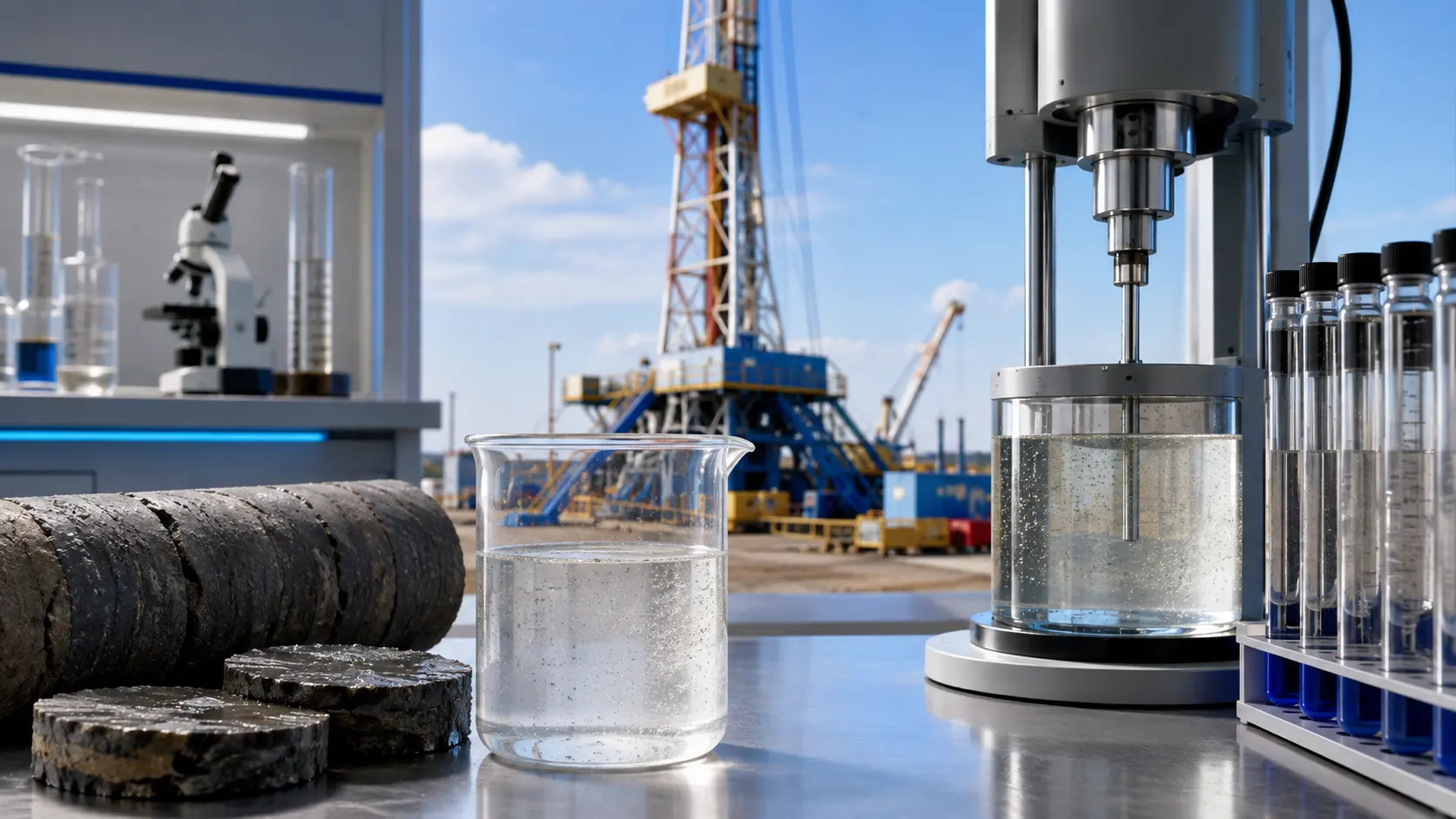
Unlike conventional weighted water-based muds that may depend heavily on barite or other insoluble weighting materials, potassium formate can provide significant density through the dissolved brine itself.
For suitable wells, this can support:
- High-density drilling fluids
- Low-solids or near-solids-free systems
- Reactive shale control
- Lower equivalent circulating density
- Improved polymer stability
- Reduced solids invasion
- Thin filter-cake design
- Reservoir drilling
- HPHT applications
These advantages are not automatic. The complete drilling-fluid formulation still has to be matched to the formation, temperature, pressure and required mud weight.
1. High Density Without Heavy Solids Loading
One of the biggest potassium formate drilling fluid advantages is its ability to generate density from dissolved salt.
Potassium formate brine can reach approximately 1.57–1.58 g/cm³, or about 13.1–13.2 ppg, depending on concentration and temperature. Vanchor currently positions potassium formate for high-density, clear and low-solids oilfield fluids.
This is important because conventional drilling fluids often require weighting solids such as:
- Barite
- Calcium carbonate
- Ilmenite
to reach higher mud weights.
Reducing dependence on suspended solids can help lower:
- Solids sag risk
- Abrasive equipment wear
- Filter-cake thickness
- Solids invasion
- Rheological instability
Published research also notes that potassium formate brine can achieve around 1.57 g/cm³ without conventional weighting agents, whereas KCl brine alone is much more limited in achievable density.
2. Strong Shale Inhibition
Reactive shale can absorb water, swell, disperse and weaken the wellbore.
Potassium formate helps address this through two important mechanisms:
Potassium Ion Effect
K⁺ interacts with clay minerals and can reduce hydration and swelling.
Reduced Water Activity
Concentrated formate brines have lower water activity, which can reduce water movement into shale and support osmotic stabilization.
Research on formate systems identifies potassium formate as an effective inhibitor for shale hydration and wellbore instability.
A 2026 molecular-dynamics study likewise describes monovalent formates, particularly potassium formate, as effective clay stabilizers because of their ionic interactions, reduced water activity and thermal robustness.
This can contribute to:
- Better cuttings integrity
- Reduced shale dispersion
- Less swelling
- Improved hole stability
- Lower waste volume from dispersed shale
However, inhibition performance varies with shale mineralogy and brine concentration, so laboratory shale-recovery and swelling tests remain necessary.
3. Lower Solids Can Mean Lower ECD
Equivalent circulating density is a major concern in:
- Extended-reach wells
- Long horizontal sections
- Narrow drilling margins
- Fragile formations
High suspended-solids loading and excessive rheology can increase circulating pressure.
Potassium formate systems can provide density while maintaining a relatively clean brine phase.
Perstorp currently markets potassium-formate drilling fluids specifically around lower ECD and reduced pump pressure, with densities up to approximately 13.1 ppg without conventional weighting solids.
Earlier field experience also reported lower circulating pressures in low-solids potassium formate systems.
The practical benefit may include:
Lower pressure losses → lower ECD → reduced fracture risk → greater drilling-window flexibility
Actual results depend on fluid rheology, flow rate, hole geometry and drilling conditions.
4. Improved Performance in High-Temperature Wells
High temperature can degrade:
- Xanthan
- Starch
- PAC
- Other fluid-loss and rheology polymers
Potassium formate has demonstrated useful compatibility with selected polymer systems at elevated temperatures.
A published high-temperature water-based drilling-fluid study found that potassium formate contributed to improved biopolymer stability; in the tested formulation, potassium formate alone protected the polymer system to around 150°C, while combinations with other stabilizing additives performed at even higher temperatures.
Research on formate-based fluids also reports improved thermal stability of polymers in potassium-formate systems.
This can be useful for:
- Deep wells
- HPHT sections
- Long circulation periods
- High-temperature reservoir drilling
But potassium formate should not be presented as making every polymer automatically HPHT-stable.
The actual formulation must undergo thermal-aging tests.
5. Reduced Formation Damage From Weighting Solids
When drilling through a productive interval, formation damage becomes a major concern.
Conventional weighted muds may introduce insoluble particles into:
- Pore throats
- Natural fractures
- Near-wellbore permeability pathways
Potassium formate can generate useful density from dissolved salts rather than large amounts of insoluble weighting material.
Vanchor's current oilfield guidance notes that clear or low-solids potassium formate systems can reduce reliance on weighting solids near formation-sensitive zones.
Research literature also identifies formate systems as attractive for reservoir drilling because of their low-solids design and compatibility with selected formations.
This does not mean potassium formate is automatically non-damaging.
Formation damage may still result from:
- Fluid invasion
- Scale precipitation
- Incompatible formation water
- Polymer residue
- Bridging solids
- Filtrate chemistry
Return-permeability and core-flow testing remain important.
6. Thin, Low-Solids Filter Cakes
Low-solids drilling systems can help create thinner filter cakes than heavily weighted conventional muds.
Historical field reports on potassium formate systems describe thin, tough filter cakes and low differential-sticking tendencies.
Potential operational benefits include:
- Easier filter-cake cleanup
- Reduced sticking tendency
- Less near-wellbore solids accumulation
- Better reservoir exposure
Filter-cake performance still depends on the bridging package, polymers and formation pore-size distribution.
7. Lower Differential-Sticking Risk
Differential sticking occurs when drillpipe is forced against the wellbore wall under differential pressure and becomes embedded in filter cake.
A thinner, low-solids filter cake can reduce this risk.
Published reviews of formate-based drilling fluids identify low differential-sticking potential as one of their operational advantages.
This can be valuable in:
- Deviated wells
- Extended-reach drilling
- Permeable formations
- High-overbalance intervals
It should still be combined with good fluid-loss control and drilling practices.
8. Useful Lubricity and Hydraulic Performance
Formate brines are frequently associated with favorable hydraulic and friction characteristics.
Field experience has reported:
- Reduced circulating pressure
- Increased rate of penetration
- Lower friction
- Improved hydraulic efficiency
in specific potassium-formate systems.
These benefits are especially relevant where:
- Hole diameter is small
- Laterals are long
- Pump pressure is limited
- Torque and drag are concerns
However, ROP improvement should not be treated as a guaranteed percentage because it depends heavily on formation, bit design, hydraulics and drilling parameters.
9. Good Fit for Reservoir Drill-In Fluids
Potassium formate can be particularly useful when drilling the productive interval.
Reservoir drill-in fluids generally aim to combine:
- Sufficient density
- Shale stability
- Controlled fluid loss
- Minimal solids invasion
- Removable filter cake
- Good cleanup
Vanchor currently identifies potassium formate for drilling, completion and reservoir-sensitive fluid systems, including low-solids designs.
This makes potassium formate especially relevant to:
- Reservoir drill-in fluids
- Horizontal reservoir sections
- Formation-sensitive wells
- Low-permeability reservoirs
10. Reduced Dependence on Chloride Chemistry
Potassium formate is a formate salt, not a chloride salt.
This distinguishes it from:
- KCl
- CaCl₂
- NaCl
and may be useful where reducing chloride loading is desirable.
However, “non-chloride chemistry” does not mean commercial potassium formate contains absolutely zero chloride.
Oilfield buyers should specify a measurable maximum chloride content, particularly where corrosion-sensitive metallurgy is involved.
Vanchor currently identifies chloride as one of the important purchasing specifications for oilfield potassium formate.
11. Fluid Recovery and Reuse Can Be Practical
Because formate systems can be designed with relatively low solids content, used brine may sometimes be:
- Filtered
- Reconditioned
- Adjusted in density
- Reused
Historical potassium-formate drilling projects have reported fluid recovery and reuse as an operational benefit.
Whether reuse is practical depends on:
- Contamination
- Solids loading
- Fluid chemistry
- Storage
- Economics
- Local waste rules
Potassium Formate vs Conventional Drilling Fluids
| Performance Factor | Potassium Formate System | Conventional Weighted WBM |
|---|---|---|
| Density source | Mainly dissolved salt | Often weighting solids |
| Suspended solids | Low possible | Often higher |
| Shale inhibition | Strong in suitable formations | Additive-dependent |
| ECD | Can be lower | Can increase with solids/rheology |
| Polymer thermal stability | Can be favorable | System-dependent |
| Reservoir solids invasion | Potentially lower | Greater risk with high solids |
| Raw-material cost | Higher | Usually lower |
| Fluid design complexity | Specialized | Widely familiar |
Potassium formate is therefore not automatically the cheapest fluid.
Its value is usually strongest where operational performance matters more than raw chemical price.
When Are the Advantages Most Valuable?
Potassium formate drilling fluids deserve serious evaluation for:
Reactive Shale Wells
Where swelling and dispersion threaten wellbore stability.
High-Angle and Horizontal Wells
Where ECD, hole cleaning and friction become critical.
HPHT Wells
Where conventional polymer systems experience thermal degradation.
Reservoir Sections
Where reducing insoluble weighting solids may help limit formation impairment.
Extended-Reach Drilling
Where pressure losses and torque/drag become increasingly important.
Important Limitations
The advantages of potassium formate should not be overstated.
Engineers must still evaluate:
- Target mud weight
- Shale mineralogy
- Formation-water chemistry
- Bottomhole temperature
- TCT/PCT
- Polymer compatibility
- Corrosion
- Elastomer compatibility
- Fluid loss
- Return permeability
- Total fluid cost
Vanchor's current oilfield guidance emphasizes that density, crystallization, reservoir compatibility and equipment compatibility should be assessed as part of the complete fluid system.
Potassium Formate Supply From Vanchor
Vanchor currently supplies:
- Potassium Formate 75% Solution
- Potassium Formate 96% Solid
for oilfield fluid preparation.
The 75% liquid suits applications requiring direct pumping, metering and rapid blending, while solid potassium formate offers greater flexibility for preparing customized brine concentrations.
Oilfield buyers should request:
- Potassium formate concentration/purity
- Density at a stated temperature
- Chloride
- Iron
- Insoluble matter
- pH
- COA
- TDS
- SDS
Frequently Asked Questions
What is the biggest advantage of potassium formate drilling fluid?
Its ability to provide relatively high density with low suspended-solids loading is one of its most important advantages.
Is potassium formate good for shale drilling?
Yes, potassium ions and reduced water activity can help limit shale hydration and swelling, although performance should be verified against actual shale samples.
Can potassium formate reduce ECD?
Low-solids potassium formate systems can reduce rheological and solids-related contributions to pressure loss, potentially supporting lower ECD.
Is potassium formate suitable for HPHT drilling?
It can be. Published studies show potassium formate can improve the thermal stability of selected polymer-based water-based drilling fluids.
Does potassium formate eliminate formation damage?
No. It can reduce solids-related damage, but filtrate chemistry, precipitation, polymers and formation compatibility still matter.
Is potassium formate better than KCl?
Not universally. KCl is economical and effective for conventional shale inhibition. Potassium formate becomes more attractive when higher density, lower solids loading and specialized reservoir or HPHT performance are required.
Conclusion
The main potassium formate drilling fluid advantages are:
High dissolved-salt density
Low-solids fluid design
Strong shale inhibition
Lower ECD potential
Improved polymer thermal stability
Reduced weighting-solids invasion
Thin filter-cake potential
Good fit for reservoir and HPHT drilling
These benefits explain why potassium formate is considered for technically demanding wells rather than simply as another potassium salt.
The strongest business case appears when wellbore stability, density, hydraulics, reservoir protection and high-temperature performance are more important than lowest raw-material cost.


Contact Us
In This Article
Related Posts
Индивидуальные упаковочные решения от поставщика безводного ацетата натрия в Китае
2026-09-23
Тенденции применения безводного ацетата натрия для специального химического производства
2026-09-23
Безводный ацетат натрия для дубления кожи: улучшает равномерность окрашивания
2026-09-22
Formic Acid 85% for Animal Feed Preservation: Moisture and Storage Stability Guide
2026-09-21


