



Potassium Formate vs Potassium Acetate: Which Is Better for Deicing and Heat Transfer?
By LIN
2026-09-01Related Posts
Индивидуальные упаковочные решения от поставщика безводного ацетата натрия в Китае
2026-09-23
Тенденции применения безводного ацетата натрия для специального химического производства
2026-09-23

Безводный ацетат натрия для дубления кожи: улучшает равномерность окрашивания
2026-09-22
Formic Acid 85% for Animal Feed Preservation: Moisture and Storage Stability Guide
2026-09-21
Potassium formate vs potassium acetate is a common comparison when selecting non-chloride salts for runway deicing, industrial winter maintenance, refrigeration and low-temperature heat-transfer systems.
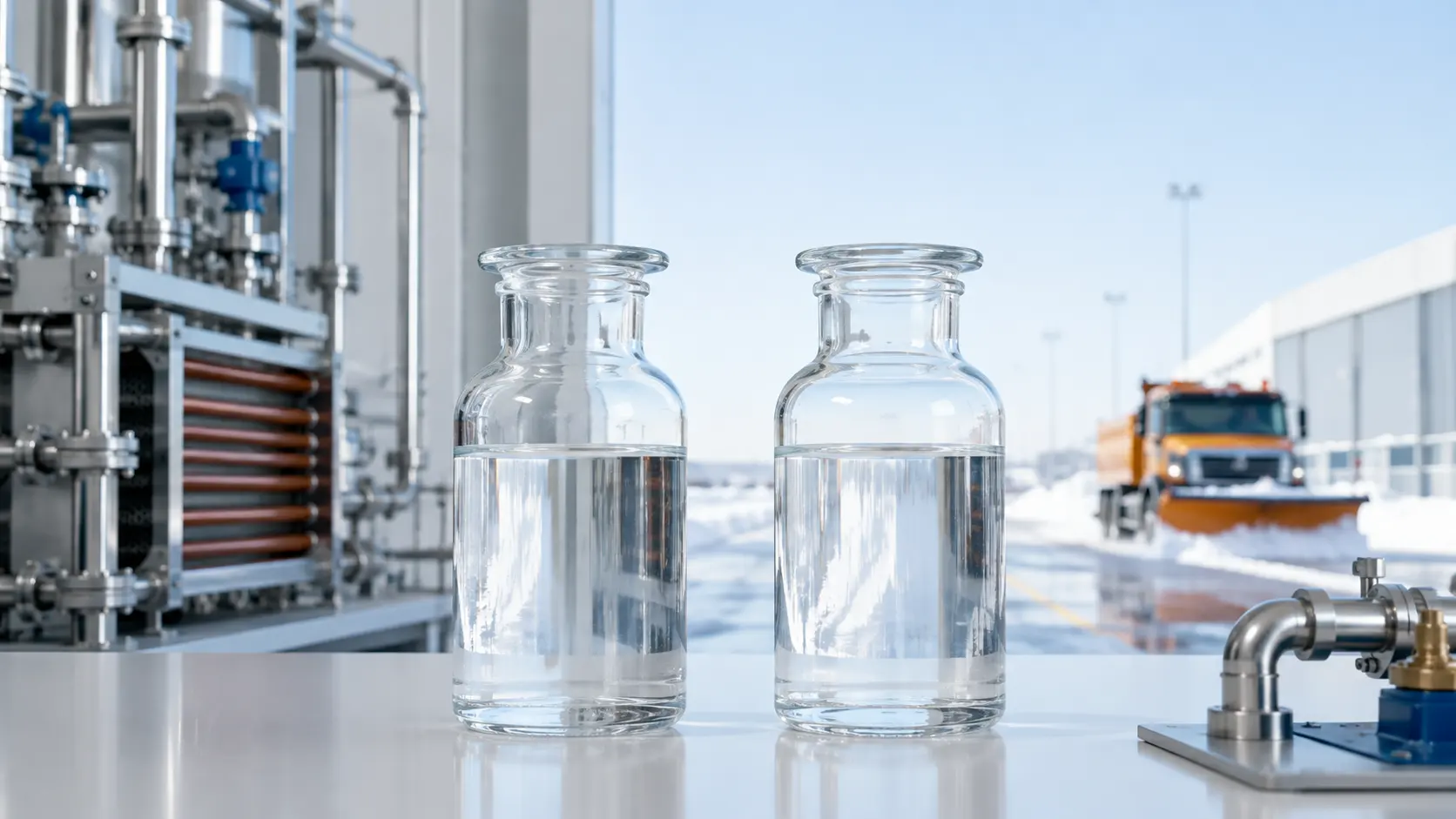
Both are highly water-soluble potassium salts, but they differ in molecular structure, concentration, fluid properties and established application patterns.
The better choice depends on whether the priority is:
- Airport runway deicing
- Industrial deicing
- Secondary refrigeration
- Low-temperature heat transfer
- Pumping performance
- Corrosion control
- Formulation economics
There is no single winner for every application.
Potassium Formate vs Potassium Acetate at a Glance
| Property | Potassium Formate | Potassium Acetate |
|---|---|---|
| Formula | HCOOK | CH₃COOK |
| CAS Number | 590-29-4 | 127-08-2 |
| Molecular Weight | 84.12 g/mol | 98.14 g/mol |
| Parent Acid | Formic acid | Acetic acid |
| Water Solubility | High | High |
| Runway Deicing | Yes | Yes |
| SAE AMS 1435 Fluid Chemistry | Recognized | Recognized |
| Secondary Refrigeration | Established application | Possible |
| Low-Temperature Heat Transfer | Strong application area | Possible |
| Typical Commercial Concentration | Application-dependent | Application-dependent |
PubChem lists molecular weights of approximately 84.116 g/mol for potassium formate and 98.14 g/mol for potassium acetate.
What Is Potassium Formate?
Potassium formate is the potassium salt of formic acid.
Vanchor currently supplies Potassium Formate 75% Solution as a concentrated industrial liquid used in:
- Heat-transfer systems
- Refrigeration systems
- Deicing formulations
- Oilfield fluids
- Industrial processing.
Commercial Potassium Formate 75% can be pumped, metered, diluted and blended without requiring solid dissolution.
Perstorp also specifically identifies Potassium Formate 75% for deicer and secondary heat-transfer-fluid applications.
What Is Potassium Acetate?
Potassium acetate is the potassium salt of acetic acid.
It has a long commercial history in liquid runway deicing.
Current commercial airport products are commonly formulated as aqueous potassium acetate solutions with corrosion inhibitors. For example, NASi's Alpine RF-11 is a 50% w/w potassium acetate formulation meeting SAE AMS 1435.
Clariant also currently supplies AMS 1435-certified liquid runway deicers based on both potassium acetate and potassium formate.
Which Is Better for Airport Runway Deicing?
For runway deicing, both can be valid chemistries.
FAA Engineering Brief 108, dated January 9, 2026, identifies recommended liquid airfield deicing/anti-icing products as including:
- Glycol-based fluids
- Potassium acetate-based fluids
- Potassium formate-based fluids
when the finished product meets SAE AMS 1435.
Therefore, the correct comparison is not simply:
potassium formate vs potassium acetate
but:
qualified potassium-formate formulation vs qualified potassium-acetate formulation
Airport buyers should compare the finished products for:
- Freezing performance
- Corrosion
- Material compatibility
- Pavement compatibility
- Environmental data
- Storage stability
- Application rate
- Total delivered cost
SAE AMS 1435 Applies to the Finished Fluid
SAE AMS 1435E, revised in March 2024, covers liquid runway deicing and anti-icing products.
This means:
Raw potassium formate or raw potassium acetate is not automatically an approved runway deicer.
A commercial airport formulation normally also includes:
- Water
- Corrosion inhibitors
- Performance additives
- Controlled concentration
The completed fluid must meet the relevant specification.
Low-Temperature Deicing Performance
Both potassium acetate and potassium formate can produce highly concentrated aqueous deicing solutions.
A commercial 50% potassium acetate runway fluid, for example, is published with a freezing point around -58°C to -60°C, depending on the formulation.
However, comparisons should be made at equivalent:
- Concentration
- Additive package
- Test method
- Temperature
A 75% raw potassium formate concentrate should not be directly compared with a 50% finished potassium acetate runway fluid without adjusting for concentration and formulation.
Which Is Better for Refrigeration?
This is where potassium formate becomes particularly interesting.
Research published in the International Journal of Refrigeration specifically evaluated aqueous potassium formate as a secondary refrigerant.
The study identified several useful properties:
- Good thermodynamic performance
- Relatively low viscosity
- Good thermal conductivity
- Low toxicity
- Non-flammability
Its lower viscosity helped maintain competitive pumping-power requirements even though volumetric heat capacity was lower than some conventional alternatives.
For applications such as:
- Cold storage
- Industrial refrigeration
- Food processing
- Process cooling
- Low-temperature circulation
potassium formate therefore has a strong technical case.
Potassium Formate vs Potassium Acetate Viscosity
For secondary refrigeration, viscosity matters because it directly affects:
- Pump energy
- Pressure drop
- Pipe sizing
- Flow regime
- Heat-transfer coefficients
Published refrigeration literature generally identifies potassium formate solutions as having particularly favorable low-viscosity characteristics.
A technical review of alternative secondary fluids notes that potassium acetate solutions tend to have higher viscosity than corresponding formate solutions, which can make potassium formate attractive for low-temperature pumping.
Therefore:
For low-temperature secondary refrigeration, potassium formate may have an advantage where pumping efficiency is important.
Heat Transfer Applications
Potassium formate is commercially established as a secondary heat-transfer-fluid raw material.
Perstorp currently identifies Potassium Formate 75% specifically for this application.
Vanchor also lists applications including:
- Industrial refrigeration
- Cold storage
- Food-processing refrigeration
- HVAC secondary circuits
- Process cooling
- Low-temperature circulation.
Potassium acetate can also be used in thermal systems, but its commercial visibility is particularly strong in airport deicing.
Concentration Matters More Than the Chemical Name Alone
Neither chemistry should be selected without considering concentration.
Changing concentration affects:
- Freezing/crystallization temperature
- Density
- Viscosity
- Specific heat
- Thermal conductivity
- Pumpability
For potassium formate, Vanchor currently supplies approximately 75% solution as concentrated feedstock that can be diluted according to the required freezing point, viscosity and heat-transfer performance.
Therefore:
Highest concentration ≠ best working fluid
The optimum concentration depends on the application.
Corrosion: Which Is Better?
Neither product should be marketed as universally non-corrosive.
Both potassium acetate and potassium formate are alkali-metal salts, and finished formulations can interact with:
- Steel
- Aluminum
- Copper alloys
- Electrical equipment
- Pavement infrastructure
SAE has even published AIR7988 specifically addressing the impact of alkali-metal runway deicers—including potassium acetate and potassium formate—on aircraft electrical systems.
Therefore, corrosion depends on:
- Concentration
- pH
- Trace contaminants
- Inhibitor package
- Exposed material
- Temperature
- Contact time
For runway applications, always compare qualified finished formulations, not raw salts.
Chloride-Free Chemistry
Neither potassium formate nor potassium acetate uses chloride as its primary anion.
This distinguishes them from:
- Sodium chloride
- Calcium chloride
- Magnesium chloride
However, commercial raw material can still contain trace chloride impurities.
For corrosion-sensitive applications, buyers should request an actual:
maximum chloride specification
rather than relying only on a “chloride-free” marketing description.
Environmental Considerations
Both chemistries are used partly because operators may want alternatives to conventional chloride salts.
However:
Neither should simply be described as environmentally harmless.
For airports, environmental assessment may consider:
- BOD
- COD
- Biodegradability
- Aquatic toxicity
- Application rate
- Runoff management
Finished-product formulation and dosage can matter as much as the base salt.
Potassium Formate vs Potassium Acetate for Storage
Storage should be evaluated using the exact commercial product.
Vanchor's current guidance notes that highly concentrated Potassium Formate 75% may require controlled storage because crystallization or salt-out can occur above 0°C depending on concentration and composition.
By comparison, some commercial 50% potassium acetate runway formulations publish freezing points near -60°C.
But this comparison illustrates an important principle:
Raw-material concentration and finished-product formulation matter enormously.
It does not prove potassium acetate is inherently “better at low temperature.”
Which One Should You Choose?
Choose Potassium Formate When:
Your priority includes:
- Secondary refrigeration
- Low-temperature circulation
- Heat-transfer systems
- Low viscosity
- Pumping efficiency
- Cold storage
- Industrial process cooling
- Concentrated liquid feedstock
Consider Potassium Acetate When:
Your priority includes:
- Established commercial runway deicing formulations
- Airport anti-icing
- Existing potassium-acetate equipment or supply chains
- A specific AMS 1435-certified commercial product
Either May Work When:
The application is:
- Runway deicing
- Pavement anti-icing
- Non-chloride winter maintenance
In these cases, compare the actual finished formulation rather than choosing only by chemical name.
Buying Potassium Formate From Vanchor
Vanchor currently supplies Potassium Formate 75% Solution for:
- Secondary heat-transfer fluids
- Industrial refrigeration
- Cold storage
- Deicing formulations
- Other industrial applications.
When comparing potassium formate with potassium acetate for a project, provide:
Application
Minimum operating temperature
Required concentration
System metallurgy
Deicing or refrigeration use
Quantity
Packaging
Destination
This allows the product to be evaluated against the actual operating requirements rather than chemical name alone.
Frequently Asked Questions
What is the main difference between potassium formate and potassium acetate?
Potassium formate is the potassium salt of formic acid, while potassium acetate is the potassium salt of acetic acid. Their different molecular structures lead to different solution and processing properties.
Which is better for runway deicing?
Both can be used in qualified liquid runway deicers. FAA guidance recognizes potassium-formate-based and potassium-acetate-based fluids meeting SAE AMS 1435.
Which is better for refrigeration?
Potassium formate has particularly attractive low-viscosity and thermal properties for secondary refrigeration and is commercially used as a secondary heat-transfer fluid.
Is potassium formate less viscous than potassium acetate?
Technical refrigeration literature generally identifies potassium formate solutions as having lower viscosity than comparable acetate-based secondary fluids.
Are potassium formate and potassium acetate chloride-free?
They are formate and acetate salts rather than chloride salts, although commercial products may contain trace chloride impurities.
Can potassium acetate directly replace potassium formate?
Not automatically. Concentration, molecular weight, freezing behavior, viscosity, corrosion and formulation performance should be recalculated and tested.
Conclusion
The potassium formate vs potassium acetate decision depends on the application.
For airport runway deicing, both chemistries can be used in qualified SAE AMS 1435 liquid formulations.
For secondary refrigeration and low-temperature heat transfer, potassium formate is especially attractive because of its relatively low viscosity and useful thermal conductivity.
The best selection should therefore be based on:
Operating temperature
Working concentration
Viscosity
Heat-transfer performance
Corrosion compatibility
Required certification
Storage conditions
Total system cost
Rather than asking which chemical is universally better, industrial buyers should ask:
Which formulation provides the best performance for this specific system?


Contact Us
In This Article
Related Posts
Индивидуальные упаковочные решения от поставщика безводного ацетата натрия в Китае
2026-09-23
Тенденции применения безводного ацетата натрия для специального химического производства
2026-09-23
Безводный ацетат натрия для дубления кожи: улучшает равномерность окрашивания
2026-09-22
Formic Acid 85% for Animal Feed Preservation: Moisture and Storage Stability Guide
2026-09-21


