



Potassium Formate Viscosity vs Temperature: Pumping and Hydraulic Considerations
By Tonmoy
2026-09-08Related Posts
Индивидуальные упаковочные решения от поставщика безводного ацетата натрия в Китае
2026-09-23
Тенденции применения безводного ацетата натрия для специального химического производства
2026-09-23

Безводный ацетат натрия для дубления кожи: улучшает равномерность окрашивания
2026-09-22
Formic Acid 85% for Animal Feed Preservation: Moisture and Storage Stability Guide
2026-09-21
For aqueous potassium formate solutions, viscosity generally decreases as temperature increases and increases as concentration increases. The practical consequence is that a colder or more concentrated brine may require more attention during transfer, startup, and pressure-drop evaluation.
However, there is no single universal potassium formate viscosity-temperature value. A usable viscosity result must identify the solution concentration or density, test temperature, viscosity type, units, and test method. Pumping performance also depends on flow rate, pipe geometry, fittings, elevation, density, and the behavior of the complete formulation.
This guide focuses on liquid potassium formate brine or solution. Solid potassium formate specifications should not be used as liquid pumping data.
How Potassium Formate Viscosity Changes with Temperature
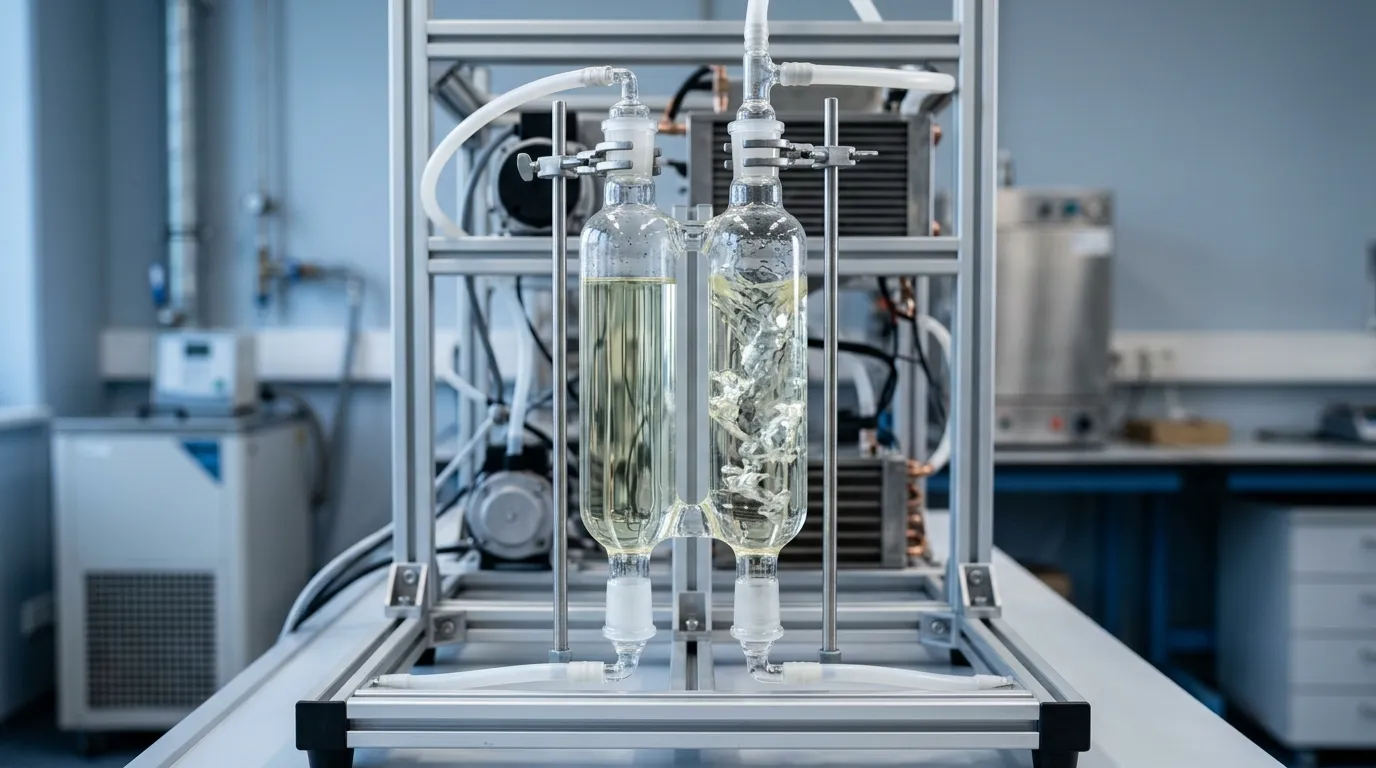
Temperature has an important effect on the flow resistance of an aqueous potassium formate solution. As the solution becomes warmer, its viscosity generally falls, allowing it to flow more readily. As it cools, viscosity generally rises.
Published thermophysical studies have measured viscosity for defined aqueous potassium formate compositions over specified temperature ranges. These measurements should be treated as composition-specific data rather than as a universal curve for every potassium formate product or brine.
The practical relationship can be summarized as follows:
- Higher temperature: generally lower solution viscosity.
- Lower temperature: generally higher solution viscosity.
- Higher potassium formate concentration: generally higher viscosity at a comparable temperature.
- Different concentration or density: potentially different viscosity-temperature behavior.
The magnitude of the change matters. A small temperature change may have limited impact in a dilute solution but become more important in a concentrated brine, a long transfer line, or a system operating close to its minimum design temperature.
A viscosity value should therefore never be copied from a general reference and applied to a different solution without checking the composition and measurement conditions.
Why Concentration and Reporting Basis Matter as Much as Temperature
The phrase “potassium formate viscosity” is incomplete unless it identifies which liquid is being measured. Potassium formate solutions can differ in concentration, density, additives, and application formulation. Those differences affect whether a reported value is relevant to a particular hydraulic calculation.
When comparing technical data, confirm the following:
| Data item | Why it matters |
|---|---|
| Potassium formate concentration or density | Identifies the composition being evaluated |
| Measurement temperature | Viscosity changes with temperature |
| Dynamic or kinematic viscosity | Prevents comparison of unlike property values |
| Units | Allows consistent engineering calculations |
| Test method | Helps determine whether results are comparable |
| Typical, minimum, maximum, or batch result | Defines the scope of the value |
| Simple brine or formulated fluid | Determines whether the data represent the actual process fluid |
Dynamic and kinematic viscosity should not be treated as interchangeable. If a supplier document reports one, the hydraulic calculation must use the appropriate property and units for the selected method.
For a concentration-specific product, such as a 75% solution, the concentration basis must remain attached to every property value. Do not assume that a value for one solution strength applies to a different product or to a blended drilling or completion fluid.
Readers evaluating a specific product form can review the relevant potassium formate 75 solution page, but the current technical document should still be checked for the exact concentration basis, measurement temperature, and test method.
Pumping Implications of Temperature-Dependent Viscosity
Higher viscosity increases resistance to flow. In a transfer system, that can contribute to greater frictional pressure loss, especially when the line is long, the diameter is small, the flow rate is high, or the system contains multiple valves and fittings.
Temperature can also affect startup conditions. A line may experience its highest viscosity during a cold start, before the fluid reaches the normal operating temperature. This condition may differ from steady-state operation and should be considered separately.
A practical pumping review should consider:
- required flow rate;
- potassium formate concentration or density;
- fluid temperature at the pump suction and along the line;
- pipe internal diameter and length;
- valves, fittings, strainers, and other local restrictions;
- elevation changes;
- pump type and operating envelope;
- expected flow regime;
- standby and cold-start conditions;
- possible crystallization or solids formation at low temperature.
Viscosity alone cannot establish a pump size, guarantee a flow rate, or prove that a particular pump is suitable. These decisions require system-specific hydraulic calculations and equipment information.
For high-density applications, the relevant high density potassium formate brine information should be reviewed separately from general potassium formate property discussions. A high-density brine may require concentration- and temperature-specific data rather than a generic solution value.
Hydraulic Evaluation: What Data Are Required for Pressure-Drop Analysis?

A pressure-drop calculation should begin with the actual fluid and operating condition rather than with a generic potassium formate property.
Use the following sequence:
- Define the liquid being pumped. Record the potassium formate concentration or density, whether the material is a simple aqueous brine or a formulated fluid, and the intended product basis.
- Obtain viscosity at the relevant condition. Identify whether the value is dynamic or kinematic, record the units, and confirm the test temperature.
- Define the piping system. Include flow rate, pipe internal diameter, straight-line length, fittings, valves, elevation, and any restrictions.
- Select the appropriate hydraulic model. The calculation method must reflect the fluid’s viscosity, density, flow regime, and rheology.
- Check operating extremes. Evaluate normal operation, the lowest expected temperature, startup, and any standby condition that could change the fluid state.
- Compare the result with equipment limits. Check the calculated system demand against the pump’s operating range and the applicable equipment constraints.
Published potassium formate measurements are tied to defined compositions and conditions; for example, one study reports aqueous potassium formate viscosity measurements over a specified temperature range rather than providing a universal value for all brines. The underlying study should be consulted when numerical data are required: Physical characterization of aqueous potassium formate and bicarbonate.
A calculated pressure drop should not be presented as tested product performance. It is an engineering result based on declared assumptions and input data. If the application is sensitive to pressure loss, startup behavior, or equipment selection, the calculation should be checked against current supplier or laboratory data for the actual solution.
Simple Brine Versus Formulated Drilling Fluid
A simple potassium formate brine and a formulated drilling or completion fluid are not automatically equivalent from a rheology perspective. Additives, suspended solids, polymers, and other formulation components can change flow behavior.
If the application involves a formulated oilfield fluid, obtain rheology data for that formulation rather than using the viscosity of a base potassium formate brine as a complete substitute. The separate potassium formate drilling fluid resource is more appropriate for readers whose question concerns the oilfield application rather than the base-solution property alone.
Viscosity Is Not the Same as Crystallization Temperature
Viscosity and crystallization temperature describe different aspects of low-temperature behavior.
| Property | What it indicates | What it does not establish |
|---|---|---|
| Viscosity | Resistance to flow under stated conditions | The temperature at which crystals form |
| Crystallization temperature | A low-temperature boundary for solids formation under defined conditions | Pump size or pressure drop |
| Density or concentration | Composition and an important hydraulic input | Viscosity without a temperature and test basis |
As a potassium formate solution cools, viscosity may increase before crystallization becomes the limiting concern. Conversely, a solution that has not crystallized may still be too viscous for the intended transfer system.
Cold-weather or low-temperature planning should therefore request both:
- viscosity at the relevant operating and startup temperatures; and
- concentration-specific crystallization or low-temperature data where applicable.
Do not interpret a viscosity value at one temperature as proof that the solution will remain pumpable under every colder condition. The exact concentration, formulation, and temperature range must remain attached to the assessment.
What to Request Before Approving a Potassium Formate Solution for Pumping

Before comparing products or approving a solution for a hydraulic application, request a technical data set that includes:
- exact chemical and liquid form;
- potassium formate concentration or density basis;
- dynamic or kinematic viscosity;
- temperature associated with every viscosity value;
- viscosity units;
- test method;
- whether the result is typical, minimum, maximum, or batch-specific;
- density and density measurement temperature;
- crystallization temperature or equivalent low-temperature information, where relevant;
- confirmation that the data apply to a simple brine or to the complete formulated fluid;
- document date or version.
This information makes it possible to determine whether two reported values are genuinely comparable. A viscosity value without concentration, temperature, or measurement basis may be insufficient for pump selection or pressure-drop analysis.
The same checks are useful when reviewing a potassium formate brine mixing guide. Mixing or preparation information should not be treated as a substitute for finished-solution viscosity data at the intended operating temperature.
For a product-specific discussion, the relevant potassium formate information should be considered together with the current technical documentation for the exact grade or solution being evaluated. The key decision is not simply whether a potassium formate solution has a published viscosity value, but whether the value matches the concentration, temperature, formulation, units, and hydraulic conditions of the intended application.


Contact Us
Related Posts
Индивидуальные упаковочные решения от поставщика безводного ацетата натрия в Китае
2026-09-23
Тенденции применения безводного ацетата натрия для специального химического производства
2026-09-23
Безводный ацетат натрия для дубления кожи: улучшает равномерность окрашивания
2026-09-22
Formic Acid 85% for Animal Feed Preservation: Moisture and Storage Stability Guide
2026-09-21


