



Potassium Formate Crystallization Temperature: Concentration and Winter Design Margin
By Tonmoy
2026-09-08Related Posts
Индивидуальные упаковочные решения от поставщика безводного ацетата натрия в Китае
2026-09-23
Тенденции применения безводного ацетата натрия для специального химического производства
2026-09-23

Безводный ацетат натрия для дубления кожи: улучшает равномерность окрашивания
2026-09-22
Formic Acid 85% for Animal Feed Preservation: Moisture and Storage Stability Guide
2026-09-21
Potassium formate does not have one universal crystallization temperature for every solution. The relevant temperature depends on the concentration, chemical form, formulation, test method, and—where applicable—the pressure used during testing.
Published values illustrate why product data must be interpreted carefully. A 75% technical-grade potassium formate solution is listed with an approximate crystallization temperature of 5°C, while secondary references report a freezing point of −60°C for a 52% solution. These figures are not interchangeable, and neither should be applied to a different product without confirming the concentration basis and measurement method.
For winter storage and transfer design, the practical rule is:
Use the crystallization result for the exact potassium formate solution being handled, then maintain a documented margin above that value based on the coldest credible system temperature and the consequences of crystal formation.
What the reported potassium formate crystallization temperatures mean
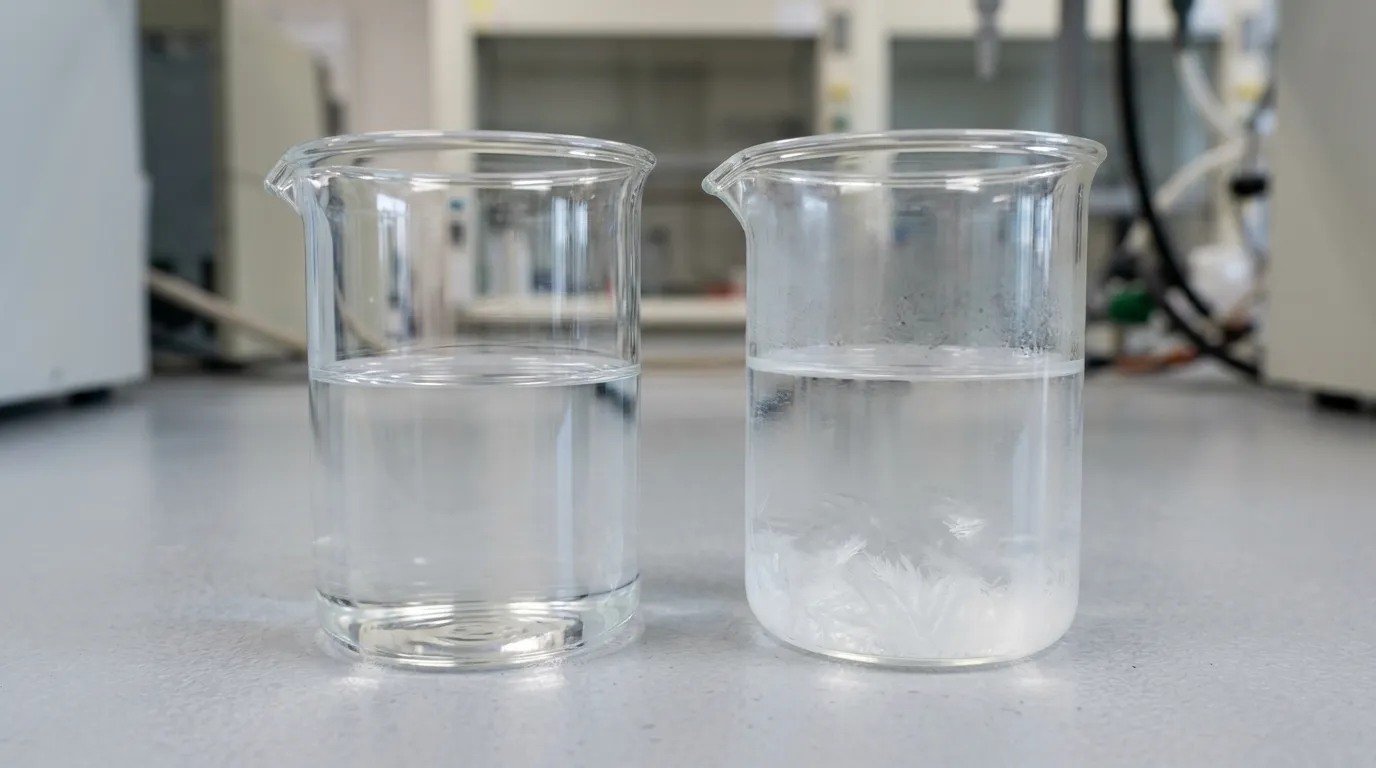
The first question is not simply “What is the crystallization temperature of potassium formate?” It is:
Which potassium formate product, at what concentration, measured by which method?
A temperature value without that context can lead to an incorrect storage or operating decision.
| Reported value | Solution context | Source terminology | What it indicates | Important limitation |
|---|---|---|---|---|
| Approximately 5°C | 75% technical-grade aqueous solution | Crystallization temperature | A product-specific reference for a concentrated solution | Not a universal value for all 75% solutions or all potassium formate brines |
| −60°C | 52% aqueous solution | Freezing point | A reported secondary reference value for that solution concentration | Not automatically equivalent to true crystallization temperature or TCT |
| 5–8°C | Highly concentrated solution in a Vanchor search-result statement | Crystallization-related product information | A site-stated indication requiring direct product-document verification | Not a confirmed universal or current Vanchor specification |
The approximately 5°C value should be treated as a specification associated with the referenced 75% technical-grade product, not as a general property of potassium formate. Similarly, the −60°C value should remain identified as a reported freezing point for a 52% solution. The available evidence does not establish whether the difference results only from concentration or also reflects test method, metastability, formulation details, or terminology.
This distinction matters when comparing a commercial potassium formate solution with a laboratory reference, another supplier’s brine, or a formulation prepared on site. A value from one concentration cannot be transferred automatically to another.
For product-specific context, readers evaluating concentrated material can review the potassium formate 75 solution page, but the applicable technical data should still be confirmed in the current product documentation.
Why concentration and test terminology change the answer
Concentration is a primary design variable
A potassium formate brine is an aqueous system. Its phase behavior depends on the relative amounts of potassium formate and water, as well as on any other components present. Therefore, “potassium formate solution” is not a sufficient description for thermal design.
The specification should identify whether concentration is expressed as:
- mass percent or another basis;
- assay of potassium formate;
- active content;
- supplied-product concentration; or
- a nominal formulation target.
These descriptions should not be treated as interchangeable. A nominal 75% solution, for example, should not be assumed to have exactly the same crystallization behavior as every other product described as “75% potassium formate.” Assay tolerance, water content, impurities, additives, and the test procedure may affect comparability.
A concentration value also does not establish the temperature at which crystals will first appear unless the relevant phase-behavior data have been measured under defined conditions.
Crystallization temperature is not automatically the same as freezing point
Industrial technical documents may use several related terms:
| Term | Practical meaning | Why it must be qualified |
|---|---|---|
| Freezing point | A temperature associated with liquid-to-solid transition behavior | The definition and test method may differ between sources |
| Crystallization temperature | The temperature at which crystals begin to form under specified conditions | The observed onset may depend on cooling history and measurement method |
| True crystallization temperature (TCT) | A brine-testing term used to characterize crystallization onset | It should be interpreted with the method and fluid composition |
| Pressurized crystallization temperature (PCT) | A pressure-dependent crystallization measurement relevant to some oilfield brines | It is not interchangeable with an atmospheric result |
Technical work on formate brines has highlighted the importance of crystallization measurement methodology and the possibility of metastable behavior. In practice, a liquid can remain apparently clear below an equilibrium-related transition temperature for a period of time, then form crystals when nucleation begins. That does not mean the lower observed temperature is a universal material constant.
This is especially important for oilfield fluids. Brine selection may consider density together with true or pressurized crystallization temperature. A potassium formate brine density chart can support density review, but density data do not replace a product-specific crystallization result.
Before using any published temperature in a formulation or winter plan, confirm:
- exact potassium formate concentration and basis;
- liquid or solid form;
- grade and product identity;
- whether the value is a typical, minimum, maximum, or approximate result;
- whether it is a freezing point, crystallization temperature, TCT, or PCT;
- test pressure and temperature conditions;
- test method and cooling or observation procedure;
- whether the result applies to the supplied product or to a generic reference solution.
What crystallization means for storage and transfer operations
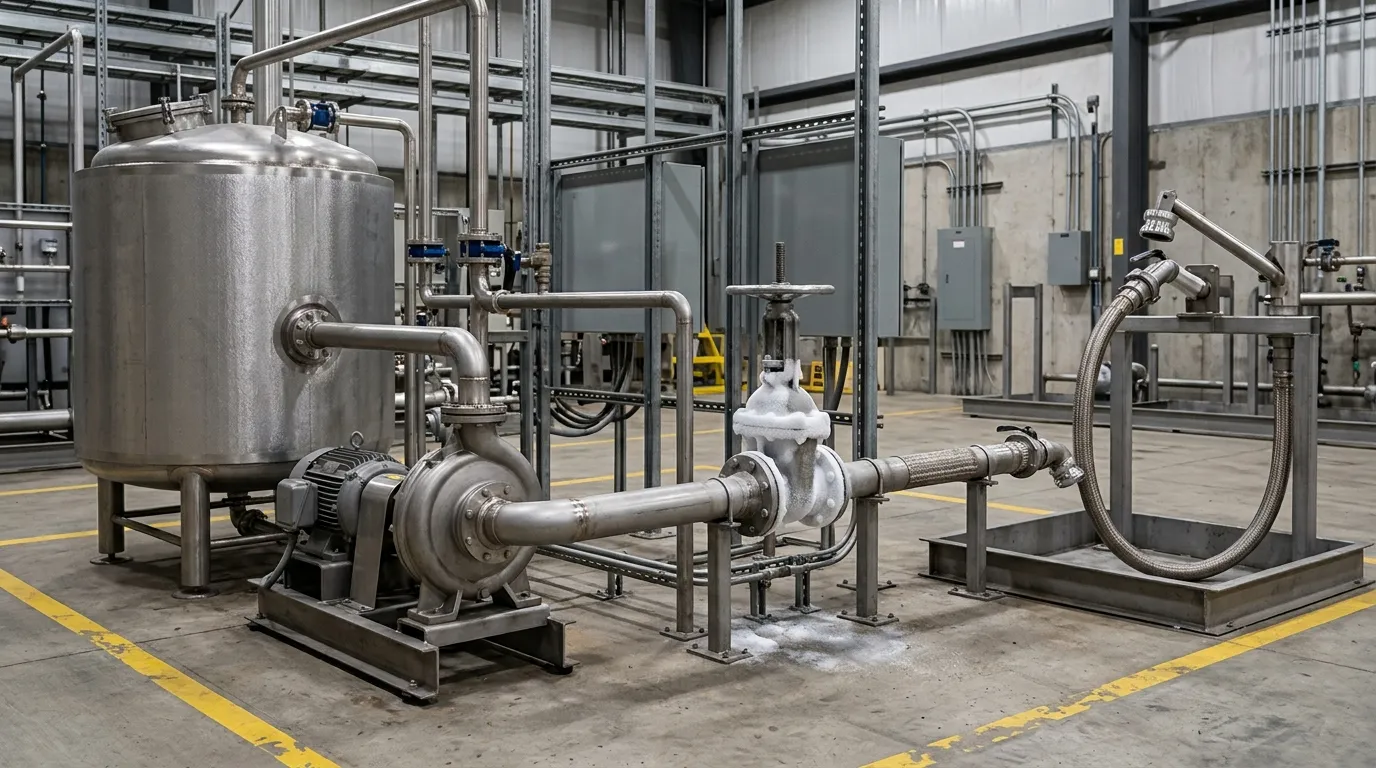
Crystallization is not only a laboratory property. In a plant, warehouse, transport system, or field operation, the location where crystals first form may be more important than the average temperature of the bulk liquid.
Potentially vulnerable points include:
- exposed transfer lines;
- loading and unloading connections;
- valves and strainers;
- pump suction points;
- tank outlets;
- dead legs and low-flow areas;
- small-bore instrumentation lines; and
- transport containers exposed to cold ambient conditions.
Cold storage can lead to crystal formation in liquid potassium formate systems. The consequences depend on the amount of crystallization, crystal distribution, equipment geometry, and whether the system is moving or stagnant.
Vanchor’s completion-fluid material associates crystallization with blocked transfer lines, pumping difficulties, valve obstruction, uneven concentration, and deposits in tanks. Those effects should be treated as application-specific operational risks rather than as a guaranteed outcome for every potassium formate formulation. Readers working specifically with completion fluids can review the potassium formate completion fluid resource for related application context.
A storage recommendation should also not be confused with a validated operating limit. A tank may remain above its stated storage threshold while a small exposed line or valve falls below the applicable crystallization temperature. Conversely, a measured bulk temperature does not prove that every part of the system has the same temperature.
The design question is therefore not only:
What is the lowest outdoor temperature?
It is also:
What is the lowest credible temperature of the potassium formate at the coldest relevant location during storage, transfer, transport, or operation?
How to set a potassium formate winter design margin
A winter design margin is the difference between the applicable crystallization threshold and the lowest temperature expected in the system. The margin should be documented rather than selected as an unsupported universal number.
A practical workflow is:
- Identify the exact liquid being designed or stored.
Record the product name, grade, potassium formate concentration, concentration basis, and whether the material is supplied as a solution, brine, or another form.
- Obtain the applicable crystallization result.
Confirm whether the reported value is a freezing point, crystallization temperature, TCT, or PCT. For oilfield applications, confirm whether the pressure basis matches the intended service.
- Define the coldest credible system temperature.
Consider the tank, exposed pipework, valves, pumps, loading points, transport conditions, and low-flow areas. Ambient air temperature alone may not represent the coldest fluid temperature.
- Compare the temperature basis with the product result.
The design temperature should remain above the applicable crystallization threshold by a margin appropriate to the measurement uncertainty, thermal variation, process consequences, and operating variability.
- Document the selected margin.
Record why the margin was chosen, who approved it, and which product document and test method support the crystallization value.
- Recheck the basis when the formulation changes.
A change in supplier, concentration, water content, blend composition, storage arrangement, or test method can invalidate a previous winter design decision.
The relationship can be expressed conceptually as:
Design temperature basis = expected minimum temperature + documented margin
This is a planning relationship, not a universal engineering standard. It does not establish a fixed margin for every potassium formate application, and it should not be used to claim freeze protection without product- and system-specific validation.
For concentrated brines, density may also be a design variable. A high-density product page such as high density potassium formate brine may be relevant to a separate brine-selection review, but high density alone does not establish crystallization performance.
What QA and procurement should verify before approving a potassium formate solution
A supplier’s nominal concentration is not enough to approve a substitution or set a winter operating limit. QA and procurement should request information that connects the temperature value to the exact product being purchased.
Product identity and concentration
Verify:
- chemical identity and CAS number where required;
- liquid or solid form;
- grade and intended specification;
- concentration or assay basis;
- minimum, maximum, typical, or approximate status;
- permitted concentration tolerance; and
- whether the value applies to the supplied product or to a general reference solution.
Potassium formate is identified as HCOOK and CAS 590-29-4, but chemical identity alone does not establish the crystallization temperature of a particular aqueous product.
Thermal-property evidence
Ask the supplier to identify:
- the reported crystallization or freezing terminology;
- the test method;
- pressure conditions, if applicable;
- sample concentration and preparation basis;
- whether the result is batch-specific or specification-based;
- the applicable temperature units; and
- the intended storage or operating scope.
For a completion-fluid or drilling-fluid application, confirm whether TCT or PCT data are required. Do not substitute an atmospheric freezing-point value for a pressure-specific result without technical justification.
Controlled documentation
The relevant technical package may include:
- a current technical data sheet;
- a certificate of analysis for the supplied batch;
- a controlled product specification;
- storage guidance; and
- a test report when the crystallization value is decision-critical.
A certificate of analysis should not be treated as universal approval for every future batch or application. Likewise, a generic product page should not be treated as a substitute for the current specification governing the material being purchased.
For sourcing follow-up, the potassium formate brine supplier page may be relevant, but any concentration, crystallization value, availability, or commercial condition should be confirmed directly in current technical documentation.
Final design decision
The correct potassium formate crystallization temperature is the value that applies to the exact solution, concentration, form, and test method under consideration—not the most convenient number found in a general reference.
Use the approximately 5°C value only within the scope of the referenced 75% technical-grade solution. Treat the −60°C figure as an attributed freezing-point reference for a 52% solution, not as a universal TCT for potassium formate. Before approving a winter storage or transfer design, match the product-specific crystallization data to the coldest credible system temperature and document the selected margin.


Contact Us
In This Article
Related Posts
Индивидуальные упаковочные решения от поставщика безводного ацетата натрия в Китае
2026-09-23
Тенденции применения безводного ацетата натрия для специального химического производства
2026-09-23
Безводный ацетат натрия для дубления кожи: улучшает равномерность окрашивания
2026-09-22
Formic Acid 85% for Animal Feed Preservation: Moisture and Storage Stability Guide
2026-09-21


