



Potassium Formate Solubility in Water: Concentration, Temperature, and Solution Preparation
By LIN
2026-09-01Related Posts
Индивидуальные упаковочные решения от поставщика безводного ацетата натрия в Китае
2026-09-23
Тенденции применения безводного ацетата натрия для специального химического производства
2026-09-23

Безводный ацетат натрия для дубления кожи: улучшает равномерность окрашивания
2026-09-22
Formic Acid 85% for Animal Feed Preservation: Moisture and Storage Stability Guide
2026-09-21
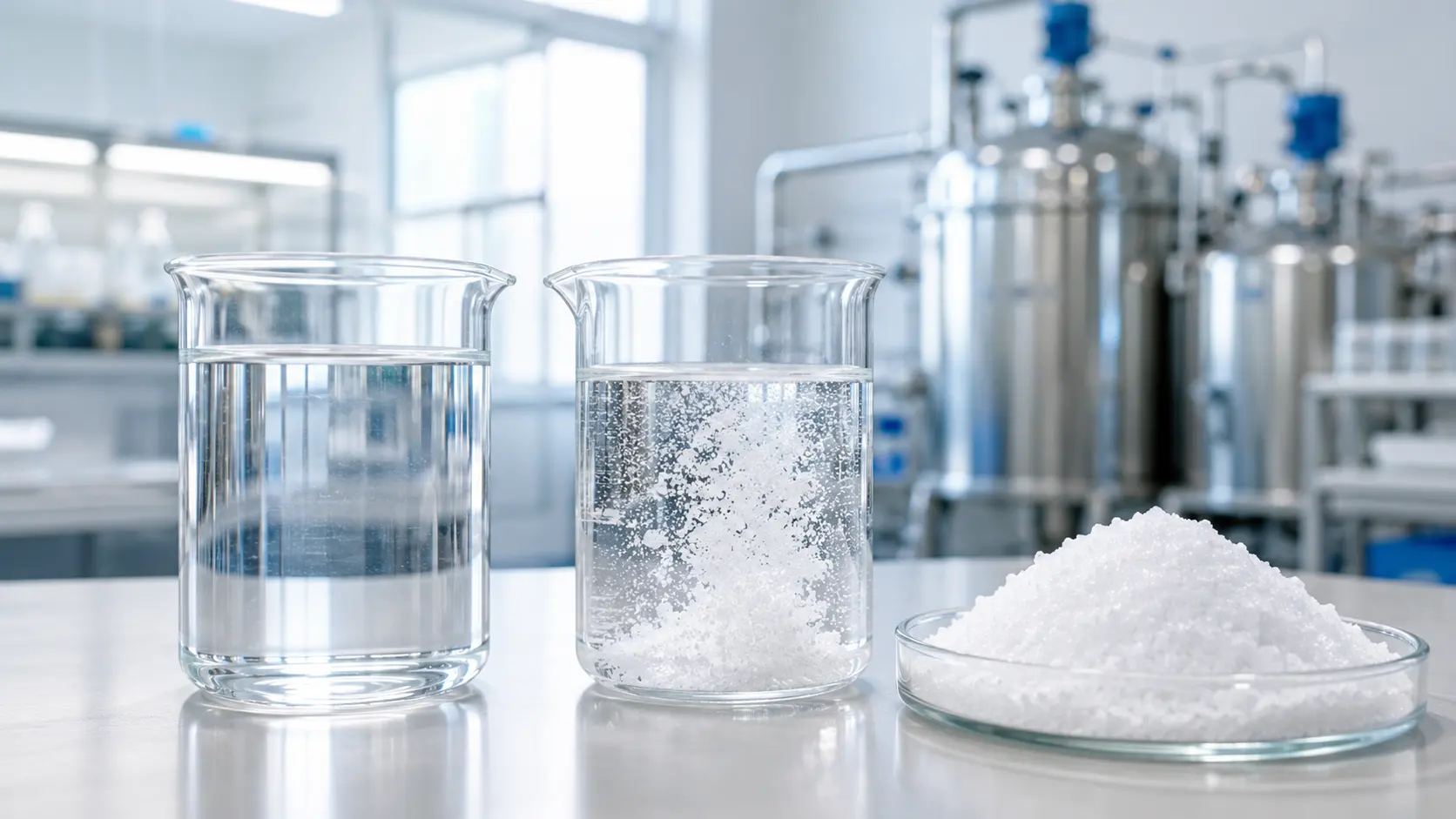
Potassium formate solubility in water is exceptionally high compared with many common inorganic and organic potassium salts.
Published reference data report approximately:
331 g potassium formate per 100 mL of water at 18°C
while commercial technical information gives a very similar value of approximately:
337 g per 100 mL at 20°C.
This high water solubility explains why potassium formate can be commercially supplied as concentrated aqueous solutions around 75 wt.% and why it is widely used in high-density brines, refrigeration fluids, deicing formulations and oilfield fluids.
However, solubility is strongly temperature-dependent.
Potassium Formate Solubility at Different Temperatures
NIST's IUPAC Solubility Database provides equilibrium data for the potassium formate-water system.
| Temperature | Approx. Potassium Formate in Saturated Liquid |
|---|---|
| -20°C | 72.8 wt.% |
| 18°C | 76.8 wt.% |
| 50°C | 80.7 wt.% |
| 90°C | 86.8 wt.% |
| 120°C | 92.0 wt.% |
| 140°C | 96.0 wt.% |
The trend is clear:
Higher temperature → greater potassium formate solubility
At 18°C, NIST reports an equilibrium liquid composition of approximately 76.8 wt.% potassium formate.
This is one reason commercial products around 75% concentration are common.
How Much Potassium Formate Dissolves in Water at Room Temperature?
A commonly cited reference value is:
331 g potassium formate / 100 mL water at 18°C.
Perstorp separately publishes approximately:
337 g / 100 mL at 20°C.
These values demonstrate that potassium formate is considerably more soluble than many other potassium salts.
For comparison, Perstorp reports approximate water solubilities at 20°C of:
| Potassium Salt | Solubility at 20°C |
|---|---|
| Potassium Formate | 337 g/100 mL |
| Potassium Acetate | 256 g/100 mL |
| Potassium Thiosulfate | 155 g/100 mL |
| Potassium Carbonate | 111 g/100 mL |
| Potassium Chloride | 34 g/100 mL |
This unusually high solubility is one of potassium formate's most important technical characteristics.
Why Is Potassium Formate So Soluble?
Potassium formate is an ionic salt consisting of:
K⁺ + HCOO⁻
Water is a highly polar solvent.
When potassium formate contacts water, water molecules hydrate and stabilize the potassium and formate ions, allowing large amounts of salt to remain dissolved.
The result is a concentrated, clear aqueous solution rather than a suspension of solid particles.
This characteristic is particularly useful in applications where:
- High dissolved-solids concentration is required
- Suspended weighting solids are undesirable
- Clear fluid is preferred
- Direct pumping and metering are needed
Why Is Potassium Formate Sold as a 75% Solution?
A commercial Potassium Formate 75% Solution contains approximately:
75 kg potassium formate + 25 kg water per 100 kg solution
NIST equilibrium data show that the saturated liquid phase at 18°C contains approximately 76.8 wt.% potassium formate.
So a nominal 75% commercial product sits relatively close to the high-concentration region achievable around room temperature.
Perstorp's current 75% product specification lists:
- Potassium formate: minimum 74%
- Density at 25°C: 1.57–1.58 g/cm³
- pH at 25°C: 9–10.
Vanchor similarly supplies nominal 75% Potassium Formate Solution for oilfield, refrigeration, heat-transfer and deicing applications.
High Solubility Does Not Mean Zero Crystallization Risk
This distinction is important.
A chemical can be highly soluble in water and still crystallize when:
- Temperature decreases
- Water evaporates
- Concentration becomes too high
- The solution enters an unfavorable phase-equilibrium region
Perstorp recommends storing its Potassium Formate 75% product above 10°C to reduce the possibility of crystallization.
Therefore:
“Highly soluble in water” does not mean a 75% concentrate remains crystal-free at every temperature.
This is particularly important for bulk tanks, IBCs and winter transportation.
Temperature Effect on Solubility
Potassium formate becomes substantially more soluble as temperature increases.
PubChem cites:
- 331 g/100 cc water at 18°C
- 657 g/100 cc water at 80°C.
NIST data show the same general trend, with the potassium-formate mass fraction of the saturated liquid increasing from 76.8% at 18°C to 86.8% at 90°C.
This has practical consequences.
A solution prepared at elevated temperature may contain more dissolved potassium formate than can remain dissolved after cooling.
As the fluid cools:
solubility decreases → supersaturation may develop → potassium formate crystals may form
Therefore, manufacturers should not simply dissolve the maximum possible amount at high temperature and assume the solution will remain stable at ambient storage conditions.
Solubility vs Concentration
These terms are related but not identical.
Solubility
The maximum quantity of potassium formate that can remain dissolved under specified equilibrium conditions.
Concentration
The actual quantity of potassium formate present in a given solution.
For example:
A 50% potassium formate solution is well below room-temperature saturation.
A 75% solution is much closer to the high-concentration solubility region.
This distinction becomes important for:
- Storage
- Dilution
- Refrigeration fluid design
- Oilfield brine design
Preparing Potassium Formate Solution From Solid
Vanchor currently supplies both concentrated liquid potassium formate and solid grades.
When preparing solution from solid potassium formate, a general process is:
- Add the required amount of clean water to the mixing tank.
- Start agitation.
- Add potassium formate gradually.
- Allow the material to dissolve completely.
- Verify final concentration.
- Measure density at a defined temperature.
- Adjust with water or additional potassium formate if required.
Avoid using solubility data alone to determine the final formulation.
The target concentration should reflect the actual application.
Why Solubility Matters in Oilfield Brines
High water solubility allows potassium formate to generate substantial brine density through dissolved salt.
This supports:
- Drilling fluids
- Completion brines
- Workover fluids
- Reservoir drill-in fluids
- Packer fluids
Potassium formate brine can reach approximately 1.57–1.58 g/cm³, or around 13.1–13.2 ppg, depending on concentration and temperature.
The advantage is that density can be increased without relying entirely on suspended materials such as barite.
However, engineers must still evaluate:
- Required density
- TCT/PCT
- Minimum temperature
- Shale compatibility
- Corrosion
- Formation-water compatibility
Why Solubility Matters in Refrigeration
High solubility also allows potassium formate to create concentrated aqueous heat-transfer fluids.
But the highest possible concentration is not automatically the best refrigeration concentration.
Changing concentration affects:
- Crystallization temperature
- Viscosity
- Density
- Specific heat
- Thermal conductivity
- Pumping power
A refrigeration engineer should therefore select concentration based on:
Required freeze protection → viscosity → heat-transfer performance → pump requirements
rather than maximum solubility.
Why Solubility Matters in Deicing
Potassium formate's high solubility supports concentrated liquid deicing and anti-icing formulations.
Advantages of liquid formulation include:
- Easy spraying
- Accurate dosing
- Rapid pavement coverage
- Simple bulk transfer
But finished deicing performance also depends on:
- Working concentration
- Pavement temperature
- Dilution by snow and ice
- Corrosion inhibitors
- Finished-product qualification
Raw potassium formate solution should not automatically be treated as a qualified airport runway deicer.
Water Quality Matters
Because potassium formate is highly soluble, impurities introduced through dilution water also remain in the fluid.
Poor-quality water can introduce:
- Chloride
- Calcium
- Magnesium
- Iron
- Suspended solids
These contaminants may affect:
- Corrosion
- Scaling
- Fluid clarity
- Heat exchangers
- Oilfield compatibility
For critical industrial formulations, use controlled dilution water and test the finished solution.
Potassium Formate 75% vs 96% Solid
75% Solution
Best suited where buyers want:
- Direct pumping
- Metering
- Rapid blending
- No dissolution stage
- Consistent concentrated liquid feedstock
96% Solid
Better suited where buyers need:
- Lower transported water content
- Local brine preparation
- Flexible final concentration
- Dry-product storage
Because potassium formate solid is hygroscopic and highly water-soluble, moisture-controlled packaging is important.
Frequently Asked Questions
What is potassium formate solubility in water?
Reference data report approximately 331 g per 100 mL water at 18°C, while another commercial reference gives about 337 g/100 mL at 20°C.
Is potassium formate completely soluble in water?
It is extremely soluble, but every temperature has an equilibrium solubility limit. “Completely miscible” is most appropriately used when describing an existing potassium formate aqueous solution mixing with additional water.
How soluble is potassium formate at 18°C?
NIST reports a saturated liquid composition of approximately 76.8 wt.% potassium formate at 18°C.
Does potassium formate solubility increase with temperature?
Yes. NIST reports approximately 76.8 wt.% at 18°C, 80.7 wt.% at 50°C and 86.8 wt.% at 90°C for the saturated liquid phase.
Why can 75% potassium formate crystallize if it is highly soluble?
Because solubility decreases as temperature falls. A highly concentrated solution can approach its saturation boundary and form crystals during cold storage.
Can solid potassium formate be used to prepare brine?
Yes. Its high water solubility makes solid potassium formate suitable for preparing customized aqueous brines where suitable mixing equipment is available.
Conclusion
Potassium formate is exceptionally soluble in water.
At around room temperature, published data place its solubility near:
331–337 g potassium formate per 100 mL water
and NIST reports a saturated liquid composition of approximately 76.8 wt.% at 18°C.
Its high solubility explains why potassium formate is useful for:
High-density oilfield brines
Secondary refrigeration fluids
Liquid deicing formulations
Concentrated industrial solutions
However, solubility increases with temperature, so concentrated solutions prepared or stored under changing temperature conditions must also be evaluated for crystallization, density and final application performance.


Contact Us
In This Article
Related Posts
Индивидуальные упаковочные решения от поставщика безводного ацетата натрия в Китае
2026-09-23
Тенденции применения безводного ацетата натрия для специального химического производства
2026-09-23
Безводный ацетат натрия для дубления кожи: улучшает равномерность окрашивания
2026-09-22
Formic Acid 85% for Animal Feed Preservation: Moisture and Storage Stability Guide
2026-09-21


