



Potassium Formate Freezing Point: Concentration, Crystallization, and Low-Temperature Performance
By LIN
2026-09-01Related Posts
Индивидуальные упаковочные решения от поставщика безводного ацетата натрия в Китае
2026-09-23
Тенденции применения безводного ацетата натрия для специального химического производства
2026-09-23

Безводный ацетат натрия для дубления кожи: улучшает равномерность окрашивания
2026-09-22
Formic Acid 85% for Animal Feed Preservation: Moisture and Storage Stability Guide
2026-09-21
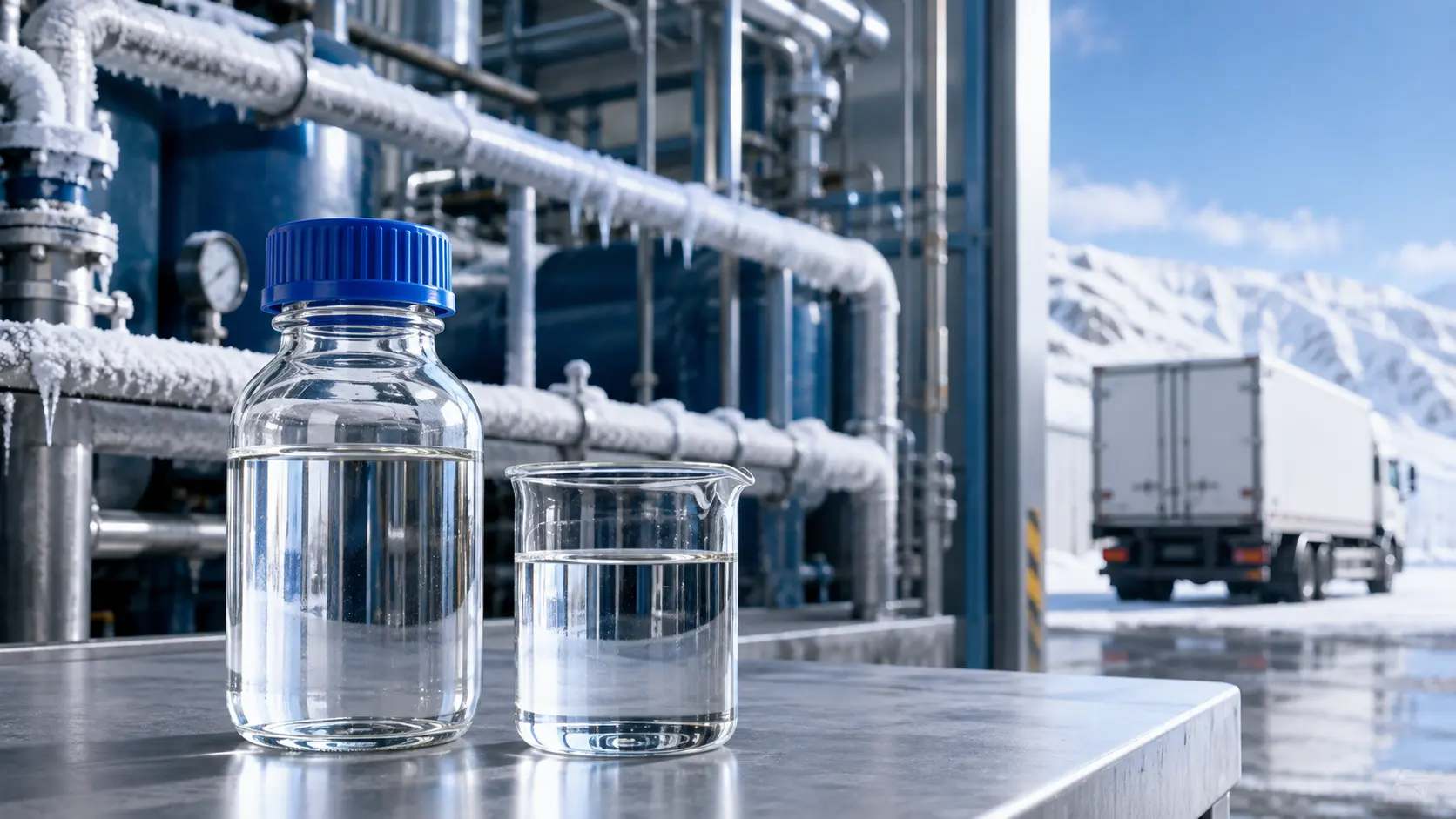
The potassium formate freezing point is not one fixed temperature.
Potassium formate is normally used as an aqueous solution, and its freezing or crystallization behavior depends strongly on the percentage of potassium formate in water.
This creates an important but sometimes misunderstood relationship:
Adding potassium formate initially lowers the freezing point of water, but increasing concentration beyond the optimum range does not continue lowering it indefinitely.
At approximately 50 wt.% potassium formate, commercial formulations can reach freezing temperatures close to -60°C. At substantially higher concentrations, the crystallization temperature rises again.
What Is the Freezing Point of Potassium Formate Solution?
A useful simplified guide is:
| Potassium Formate Concentration | Approximate Freezing Behavior |
|---|---|
| ~20 wt.% | Around -7°C |
| ~30 wt.% | Around -20°C |
| ~40 wt.% | Around -45°C |
| ~44–48 wt.% | Around -50 to -60°C |
| ~50 wt.% | Approximately -58 to -60°C in some formulations |
| >60 wt.% | Freezing/crystallization temperature begins rising |
| ~75 wt.% concentrate | May crystallize at temperatures well above 0°C |
Historical potassium-formate/water property data show approximately:
- 20% → about -16°C? Wait — concentration tables vary by source and formulation.
- 30% → around -20°C
- 40% → around -45°C to -50°C
- 44–48% → approximately -50°C or lower
Because published datasets and commercial inhibited products differ, engineers should use the actual supplier phase diagram or finished-fluid TDS, rather than treating one generic table as universal.
Why Does Potassium Formate Lower the Freezing Point?
When potassium formate dissolves in water, it dissociates into:
K⁺ + HCOO⁻
These dissolved ions interfere with the ability of water molecules to organize into an ice crystal structure.
This causes freezing-point depression.
As more potassium formate is added:
water freezing point decreases → reaches a low-temperature optimum → then crystallization behavior changes at higher concentrations
This is why the relationship is not linear.
Does More Potassium Formate Always Mean a Lower Freezing Point?
No.
This is one of the most important technical points.
In many potassium formate/water systems, the lowest practical freezing or crystallization temperature occurs around the intermediate concentration range rather than at maximum concentration.
A 2023 experimental study found that the pour point decreased as potassium formate concentration increased, reached approximately -60°C near 60% in that particular test, and then increased again; the 75% solution recorded a much higher pour point of approximately -40°C in that study. The authors considered approximately 45–60% useful for very low-temperature refrigeration applications.
Exact values vary because pour point, freezing point, crystallization point, formulation and additives are not identical measurements.
Why Can 75% Potassium Formate Crystallize Above 0°C?
This often surprises buyers.
A commercial 75% potassium formate concentrate contains much more salt than a typical low-temperature finished coolant.
At this high concentration, the solution approaches a salt-rich region of the potassium formate-water phase diagram.
As temperature decreases, potassium formate crystals may begin to form before water itself would normally freeze.
Perstorp's current Potassium Formate 75% product data sheet recommends storage above 10°C to prevent possible crystallization.
This means:
75% potassium formate concentrate is not automatically the best low-temperature operating fluid.
It is commonly a concentrated feedstock that is diluted to the required working concentration.
50% Potassium Formate Freezing Point
Around 50 wt.% potassium formate is particularly important in deicing and low-temperature fluid applications.
Perstorp's commercial potassium-formate runway deicer contains approximately 50% potassium formate and specifies a freezing temperature of:
-58 ±2°C.
Other published technical sources place the approximate potassium formate/water eutectic region near 50 wt.%, with temperatures around -60°C.
This does not mean every 50% product freezes at exactly -60°C.
Finished-product additives, purity and test methods can shift the result.
Freezing Point vs Crystallization Temperature
These terms are often used interchangeably in marketing, but engineers should distinguish them.
Freezing Point
Typically refers to the temperature at which a liquid begins forming a solid phase.
Crystallization Temperature
For concentrated salt solutions, this may refer specifically to the temperature at which salt or ice crystals begin appearing.
Pour Point
The lowest temperature at which the fluid still flows under a specified test.
These values may not be identical.
For concentrated potassium formate, crystallization behavior is usually more useful than a simple water-style freezing-point number.
TCT, FCTA, and PCT in Oilfield Brines
Oilfield completion fluids require more detailed crystallization analysis.
Common terms include:
TCT — True Crystallization Temperature
A general crystallization-temperature reference for completion brines.
FCTA — First Crystal to Appear
The temperature at which crystals are first observed during cooling.
LCTD — Last Crystal to Dissolve
The temperature at which the final crystal disappears during reheating.
PCT — Pressure Crystallization Temperature
Crystallization behavior under elevated pressure.
These measurements matter because a fluid may travel through very different temperature and pressure conditions between:
- Surface storage
- Risers
- Wellbore
- Reservoir
For critical completion-fluid design, use actual laboratory TCT/PCT testing rather than generic potassium formate freezing-point charts.
Why Freezing Point Matters in Refrigeration
Potassium formate is used as a secondary refrigeration and heat-transfer fluid because suitable concentrations can remain liquid at strongly sub-zero temperatures.
Published research has identified potassium formate as a useful secondary refrigerant because of:
- Good thermodynamic properties
- Relatively low viscosity
- Good thermal conductivity
- Non-flammability
- Low-temperature capability.
Applications can include:
- Cold storage
- Industrial refrigeration
- Food-processing cooling
- Process cooling
- HVAC secondary loops
However, the concentration should be selected around the required minimum operating temperature, not simply around maximum salt content.
Selecting the Correct Refrigeration Concentration
A practical design sequence is:
Lowest system temperature
↓
Required safety margin
↓
Target freezing/crystallization point
↓
Potassium formate concentration
↓
Check viscosity and thermal properties
This matters because increasing concentration also changes:
- Viscosity
- Density
- Specific heat
- Thermal conductivity
- Pumping power
A refrigeration fluid with the lowest possible freezing point is not necessarily the most energy-efficient fluid.
Why Freezing Point Matters in Deicing
A deicing or anti-icing fluid must remain liquid under winter operating conditions.
For runway and pavement applications, potassium formate formulations around the optimum concentration can provide very low freezing temperatures.
A commercially qualified 50% potassium-formate runway fluid with a freezing temperature near -58°C demonstrates why potassium formate is used in liquid airfield deicing systems.
However, deicing effectiveness also depends on:
- Dilution from snow and ice
- Pavement temperature
- Application rate
- Residual concentration
- Finished-fluid formulation
As ice melts, water dilutes the deicer and raises the mixture's freezing point.
Why Freezing Point Matters in Oilfield Brines
In oilfield operations, crystallization can create serious problems.
Crystal formation may affect:
- Pumps
- Valves
- Flow lines
- Risers
- Downhole circulation
- Fluid density consistency
Therefore, completion brine concentration should provide an adequate crystallization-temperature margin below the minimum expected fluid temperature.
The highest-density potassium formate brine is not automatically the safest formulation.
Storage Temperature vs Operating Temperature
These should never be confused.
For example:
75% potassium formate concentrate
may require relatively warm storage to avoid salt crystallization.
But after dilution to approximately:
40–50% working concentration
the resulting fluid can remain liquid at much lower temperatures.
Therefore:
Concentrate storage temperature ≠ finished coolant operating temperature
This distinction is especially important for refrigeration-fluid buyers.
What Affects Potassium Formate Freezing Point?
The main variables are:
- Potassium formate concentration
- Water content
- Product purity
- Other salts
- Corrosion inhibitors
- Other formulation additives
- Test method
Commercial inhibited products may therefore show slightly different freezing behavior from pure potassium-formate/water laboratory data.
How Should Buyers Specify Low-Temperature Performance?
Instead of requesting only:
“Potassium Formate 75%”
provide:
Minimum operating temperature
Required crystallization point
Application
Target concentration
System metallurgy
Quantity
For oilfield applications also provide:
- Required density
- Bottomhole temperature
- Minimum surface temperature
- Pressure conditions
- TCT/PCT requirements
For refrigeration systems provide:
- Supply temperature
- Return temperature
- Freeze-protection margin
- Pumping requirements
Frequently Asked Questions
What is the freezing point of potassium formate?
There is no single freezing point because potassium formate is normally used as an aqueous solution. The temperature depends strongly on concentration.
What is the freezing point of 50% potassium formate?
Commercial 50% potassium-formate formulations can reach approximately -58 to -60°C, depending on formulation and testing method.
Does higher potassium formate concentration always lower the freezing point?
No. After reaching an optimum concentration range, further concentration can raise the crystallization temperature.
What is the freezing point of 75% potassium formate?
A single universal value should not be used. Highly concentrated 75% products can crystallize at temperatures above 0°C, which is why some commercial 75% products recommend storage above approximately 10°C.
Why is 75% potassium formate used if 50% has better low-temperature performance?
Because 75% solution is a concentrated feedstock. It reduces transported water and can later be diluted to the required working concentration.
Is freezing point the same as crystallization temperature?
Not always. For concentrated salt solutions and oilfield brines, crystallization behavior, FCTA, LCTD and PCT may provide more useful engineering information than a generic freezing-point number.
Conclusion
The key fact about the potassium formate freezing point is:
It depends on concentration, and more potassium formate does not always mean a lower freezing temperature.
Around the optimum intermediate concentration range, potassium-formate/water solutions can remain liquid at temperatures approaching -60°C.
But highly concentrated products such as Potassium Formate 75% may crystallize at much warmer temperatures and are generally better treated as concentrated formulation feedstock rather than automatically as the final low-temperature coolant.
For refrigeration, deicing and oilfield applications, select concentration according to:
Required operating temperature + crystallization margin + viscosity + density + system performance
rather than choosing the highest available potassium formate concentration.


Contact Us
In This Article
Related Posts
Индивидуальные упаковочные решения от поставщика безводного ацетата натрия в Китае
2026-09-23
Тенденции применения безводного ацетата натрия для специального химического производства
2026-09-23
Безводный ацетат натрия для дубления кожи: улучшает равномерность окрашивания
2026-09-22
Formic Acid 85% for Animal Feed Preservation: Moisture and Storage Stability Guide
2026-09-21


