



Potassium Formate Solution Density: Concentration, Temperature, and Practical Use
By LIN
2026-09-01Related Posts
Индивидуальные упаковочные решения от поставщика безводного ацетата натрия в Китае
2026-09-23
Тенденции применения безводного ацетата натрия для специального химического производства
2026-09-23

Безводный ацетат натрия для дубления кожи: улучшает равномерность окрашивания
2026-09-22
Formic Acid 85% for Animal Feed Preservation: Moisture and Storage Stability Guide
2026-09-21
Potassium formate solution density is an important property for oilfield brines, refrigeration fluids, deicing formulations and industrial chemical processing.
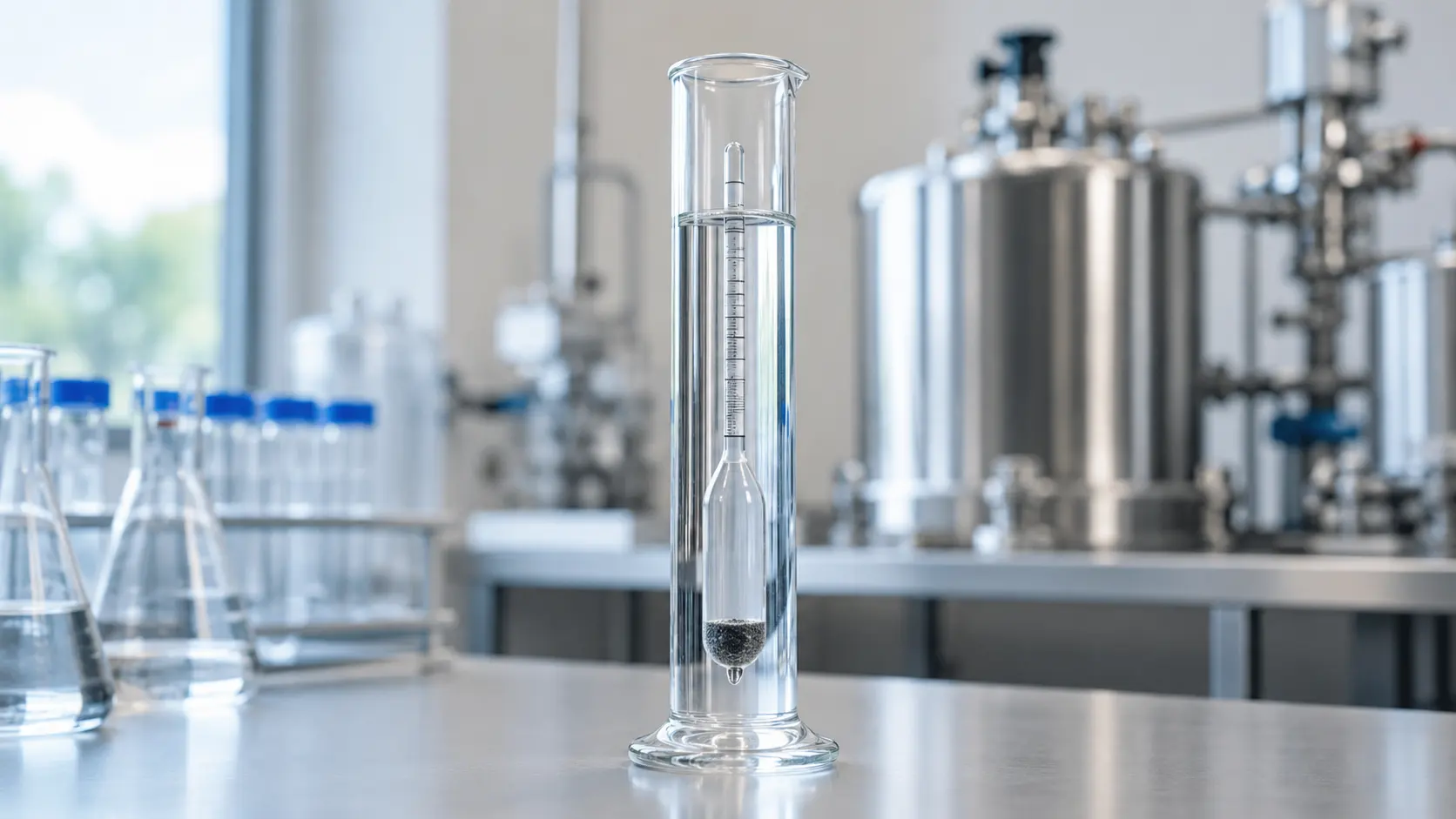
For a concentrated 75% potassium formate solution, a typical density is approximately:
1.57–1.58 g/cm³
under commonly specified room-temperature test conditions.
However, density is not a fixed number for every potassium formate solution.
It depends mainly on:
- Potassium formate concentration
- Temperature
- Product purity
- Dissolved impurities
- Measurement method
For this reason, any meaningful density specification should always state both concentration and measurement temperature.
Typical Density of Potassium Formate 75% Solution
Vanchor's current technical information describes Potassium Formate 75% Solution with a density or specific gravity of approximately 1.57–1.58 g/cm³, depending on the exact product specification and test temperature.
An independent technical data sheet for 75% potassium formate likewise specifies a specific gravity of at least 1.57 at 25°C.
Typical reference information:
| Parameter | Typical Information |
|---|---|
| Chemical name | Potassium Formate |
| Formula | HCOOK |
| CAS No. | 590-29-4 |
| Concentration | Approx. 75 wt.% |
| Density | Approx. 1.57–1.58 g/cm³ |
| Density condition | Must state test temperature |
| Appearance | Clear liquid |
| Solubility | Highly soluble / miscible in water |
The exact batch value should be confirmed on the COA.
Why Does Potassium Formate Solution Have High Density?
Water has a density close to 1.00 g/cm³ under ordinary conditions.
When potassium formate dissolves in water, a large amount of dissolved salt is added to the liquid phase.
As potassium formate concentration increases:
more dissolved HCOOK → greater solution mass per unit volume → higher density
This is one reason potassium formate is valuable in clear oilfield brines.
High hydrostatic density can be achieved through dissolved salt rather than relying entirely on suspended weighting materials.
How Does Concentration Affect Density?
In general:
Higher potassium formate concentration = higher solution density
A diluted potassium formate solution will therefore have a lower density than a concentrated 75% product.
This relationship is useful for:
- Brine preparation
- Dilution control
- Batch verification
- Tank blending
- Oilfield fluid design
- Refrigeration-fluid preparation
However, density should not be used as a universal concentration conversion without a validated concentration-density table.
The relationship is not simply:
50% concentration = 50% of the density of a 100% solution
Solution properties are not linear in that way.
Can Density Be Used to Check Concentration?
Yes, density is commonly used as a practical process-control indicator.
Vanchor currently notes that density can help verify potassium formate solution concentration, but values should only be compared when measured under equivalent temperature conditions.
For example, if a production batch is intended to be approximately 75% potassium formate but its measured density is significantly below the expected range, possible causes could include:
- Excess dilution water
- Incorrect blending
- Contamination
- Sampling problems
- Temperature differences
However:
Density is a useful verification tool, but it should not replace an assay measurement when exact potassium formate concentration is required.
A batch COA should report the agreed analytical specification.
Temperature Has a Major Effect on Density
Liquid density normally decreases as temperature increases.
Therefore, potassium formate density measured at:
10°C
cannot be directly compared with a value measured at:
25°C
without applying an appropriate correction.
Vanchor specifically advises that potassium formate density values should include the measurement temperature and should not be compared unless the test conditions are equivalent.
A professional specification should therefore say:
Density: X.XX g/cm³ at 20°C
or:
Specific Gravity @ 25°C: X.XX
rather than simply listing:
Density: X.XX
Density vs Specific Gravity
These two terms are related but technically different.
Density
Density is mass divided by volume.
Typical units include:
- g/cm³
- kg/m³
For example:
1.57 g/cm³ = approximately 1,570 kg/m³
Specific Gravity
Specific gravity compares the density of the liquid with the density of water under defined conditions.
It is dimensionless.
In commercial chemical documents, density and specific gravity are sometimes used loosely, so buyers should always check:
- Test method
- Temperature
- Units
- Reference conditions
Converting Potassium Formate Density to Oilfield Units
Oilfield fluids often use:
ppg — pounds per gallon
A useful approximate conversion is:
1.00 g/cm³ ≈ 8.345 ppg
Therefore:
1.57 g/cm³ × 8.345 ≈ 13.1 ppg
and:
1.58 g/cm³ × 8.345 ≈ 13.2 ppg
This is why concentrated potassium formate brine is often described as reaching approximately 13.1–13.2 ppg. Vanchor's current high-density brine page uses the same approximate range.
Why Density Matters in Drilling and Completion Fluids
In oilfield fluids, density determines hydrostatic pressure.
The hydrostatic pressure generated by the fluid column must be sufficient to help control formation pressure.
Potassium formate is valuable because concentrated brines can provide significant density while remaining clear and relatively low in suspended solids.
Potential applications include:
- Drilling fluids
- Completion fluids
- Workover fluids
- Reservoir drill-in fluids
- Packer fluids
Vanchor currently describes its 75% solution as suitable for preparing high-density, low-solids and clear-brine oilfield systems.
Density Is Not the Only Oilfield Design Parameter
A fluid engineer should not simply choose the highest possible potassium formate density.
Increasing concentration also changes:
- Crystallization temperature
- Viscosity
- Water activity
- Polymer behavior
- Corrosion performance
For completion fluids, engineers should therefore evaluate:
Required hydrostatic density + TCT/PCT + operating temperature + formation compatibility
rather than density alone.
Why Density Matters in Refrigeration Fluids
Density also influences secondary refrigeration and heat-transfer systems.
Changing potassium formate concentration changes:
- Density
- Viscosity
- Specific heat
- Thermal conductivity
- Crystallization point
- Pump requirements
Vanchor currently notes that concentrated potassium formate can be diluted to achieve the required combination of freezing point, viscosity and heat-transfer performance.
For refrigeration engineers, maximum density is therefore not the objective.
The goal is to find the concentration that provides the required:
freeze protection + hydraulic performance + heat-transfer efficiency
75% Solution Density vs Final Working Fluid Density
This distinction is particularly important.
Potassium Formate 75% Solution is often purchased as a concentrated raw material.
It can then be diluted to create a working fluid.
For example:
75% concentrate → controlled dilution → lower working concentration → lower final density
Therefore, the density printed on the supplier's 75% TDS is not necessarily the same density used in the operating refrigeration or oilfield system.
The final fluid should be measured after blending.
Does High Density Mean High Purity?
Not necessarily.
Density is influenced strongly by concentration, but other dissolved materials can also affect it.
A contaminated solution may still show a relatively high density.
Therefore, professional quality control should include:
- Potassium formate assay
- Density
- pH
- Chloride
- Iron
- Insoluble matter
- Appearance
Vanchor recommends checking these parameters through the product specification and batch-specific COA.
Density and Crystallization Are Connected
Higher concentration can produce higher density, but it can also move the solution toward a different region of its crystallization curve.
Vanchor currently notes that some highly concentrated commercial 75% potassium formate solutions can have salt-out or crystallization temperatures around 5–8°C, depending on exact concentration and composition.
This means:
Higher density does not automatically mean better low-temperature storage performance.
Concentrated raw material storage and diluted working-fluid temperature behavior should be treated separately.
How Should Density Be Measured?
Common industrial methods include:
- Digital density meter
- Hydrometer
- Laboratory pycnometer
For accurate results:
- Take a representative sample.
- Confirm the sample temperature.
- Remove excessive trapped air.
- Use calibrated equipment.
- Record density and temperature together.
- Compare against a temperature-matched specification.
For critical applications, laboratory testing is preferred over approximate field readings.
What Should Buyers Ask a Supplier?
When purchasing potassium formate solution, ask for:
Concentration
For example, nominal 75 wt.%.
Density
Including measurement temperature.
Acceptable Tolerance
Do not rely only on a single typical value.
Batch-Specific COA
This shows the actual shipment result.
TDS
For typical physical and technical properties.
SDS
For safe handling and storage.
Additional quality parameters may include:
- Chloride
- Iron
- Insoluble matter
- pH
- Crystallization behavior
Frequently Asked Questions
What is the density of 75% potassium formate solution?
A typical 75% solution is approximately 1.57–1.58 g/cm³ under commonly specified room-temperature conditions. Exact values depend on concentration, temperature and supplier specification.
What is 1.57 g/cm³ in ppg?
Approximately 13.1 ppg.
Does potassium formate density increase with concentration?
Generally yes. Increasing dissolved potassium formate concentration increases solution density.
Does temperature affect potassium formate density?
Yes. Density changes with temperature, so values should always be compared at the same measurement temperature.
Can density be used to calculate potassium formate concentration?
It can be used to estimate or verify concentration when a validated temperature-specific density-concentration relationship is available. For exact quality control, use analytical assay data.
Is the density of 75% concentrate the same as the operating fluid?
Not necessarily. If the concentrate is diluted, the final working fluid will have a different concentration and density.
Conclusion
Potassium formate solution density depends primarily on:
Concentration
Temperature
Product composition
Measurement conditions
A typical 75% potassium formate solution has a density of approximately:
1.57–1.58 g/cm³, equivalent to roughly 13.1–13.2 ppg.
But density should never be interpreted alone.
For oilfield applications, evaluate:
density + hydrostatic requirement + TCT/PCT + formation compatibility
For refrigeration applications, evaluate:
density + viscosity + crystallization temperature + thermal properties + pump performance
And for procurement, always compare density at the same temperature and confirm the actual shipment using a batch-specific COA.


Contact Us
In This Article
Related Posts
Индивидуальные упаковочные решения от поставщика безводного ацетата натрия в Китае
2026-09-23
Тенденции применения безводного ацетата натрия для специального химического производства
2026-09-23
Безводный ацетат натрия для дубления кожи: улучшает равномерность окрашивания
2026-09-22
Formic Acid 85% for Animal Feed Preservation: Moisture and Storage Stability Guide
2026-09-21


