



Potassium Formate Shale Inhibitor: How It Works in Water-Based Drilling Fluids
By LIN
2026-09-02Related Posts
Индивидуальные упаковочные решения от поставщика безводного ацетата натрия в Китае
2026-09-23
Тенденции применения безводного ацетата натрия для специального химического производства
2026-09-23

Безводный ацетат натрия для дубления кожи: улучшает равномерность окрашивания
2026-09-22
Formic Acid 85% for Animal Feed Preservation: Moisture and Storage Stability Guide
2026-09-21
A potassium formate shale inhibitor is used in water-based drilling fluids to help reduce shale hydration, clay swelling and cuttings dispersion while also providing useful brine density.
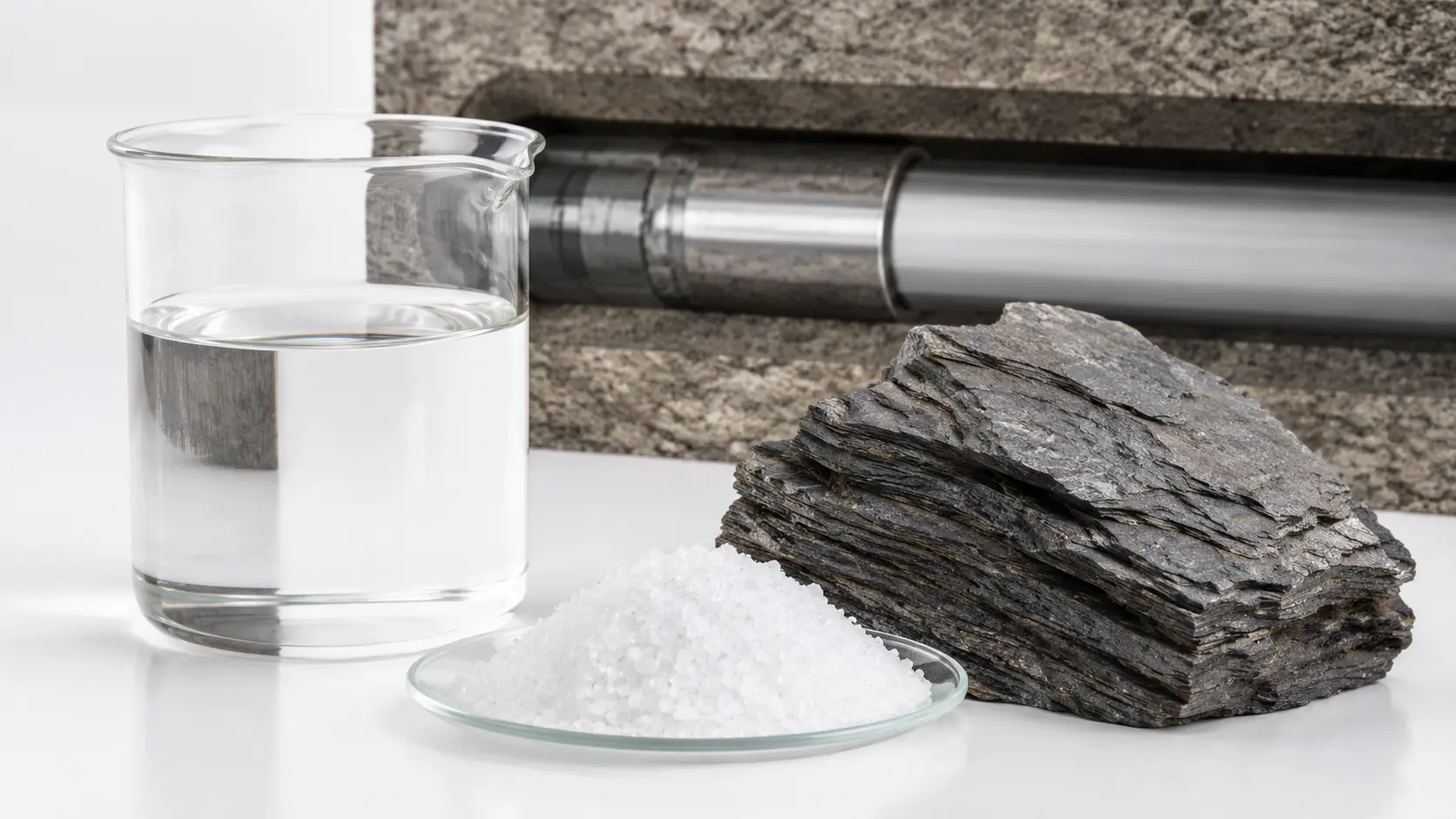
Reactive shale is one of those drilling problems that can look manageable at the surface and become expensive very quickly downhole.
When water-sensitive clay minerals contact an unsuitable drilling fluid, they may absorb water, swell, soften or disperse. The result can be poor cuttings integrity, tight hole, bit balling, increased torque and drag, or even serious wellbore instability.
Potassium formate can help control these problems.
But its shale-inhibition mechanism is broader than simply saying “potassium stops swelling.”
The performance comes from a combination of potassium-ion effects, high salinity, reduced water activity and the physical behavior of concentrated formate brines.
Why Does Shale Hydration Cause Drilling Problems?
Many shale formations contain clay minerals such as smectite, illite and mixed-layer clays.
Their reaction to water varies greatly.
Some formations show relatively little change. Others can hydrate quickly when exposed to water-based drilling fluid.
Typical operational symptoms include:
- Shale swelling
- Cuttings dispersion
- Sloughing
- Tight hole
- Bit balling
- Increased torque and drag
- Higher solids loading
- Poor hole cleaning
- Unstable wellbore conditions
The objective of a shale inhibitor is therefore not necessarily to make the shale completely waterproof.
That would be unrealistic.
The practical goal is to slow water interaction enough that the shale remains mechanically stable during the time the well is being drilled.
How Does Potassium Formate Inhibit Shale?
Potassium formate, chemical formula HCOOK, dissociates in water into potassium and formate ions.
Its shale-control behavior involves several mechanisms working together.
Main Inhibition Mechanisms
| Mechanism | Practical Effect |
|---|---|
| Potassium ion interaction | Can reduce hydration and swelling of certain clay minerals |
| Lower water activity | Reduces the chemical tendency for water to enter shale |
| High brine salinity | Helps control osmotic water movement |
| Higher filtrate viscosity | Can slow pressure and filtrate penetration |
| Reduced shale water uptake | Helps preserve mechanical integrity |
| Low-solids brine design | Reduces additional solids-related wellbore problems |
Published work on concentrated formate systems reports that potassium formate can reduce shale swelling pressure, shale water content and pore-pressure development. Studies have also found potassium formate to be one of the more effective monovalent formate salts for shale stabilization.
This is why potassium formate is better understood as a brine-based inhibition system, not simply another potassium salt.
The Role of Potassium Ions
Potassium is already familiar in drilling fluids because KCl has been used for many years in inhibitive water-based muds.
Potassium ions can interact with clay surfaces and interlayer sites, helping limit hydration of certain clay minerals.
For reactive shale, this may improve:
- Cuttings hardness
- Cuttings integrity
- Hole gauge
- Shale recovery
- Resistance to dispersion
However, potassium concentration alone does not tell the whole story.
Potassium formate behaves differently from KCl because the formate brine can be used at much higher dissolved density and lower water activity.
So the fluid gets potassium inhibition together with concentrated-brine effects.
Water Activity Is a Big Part of the Story
Water naturally tends to move toward a region where its chemical activity is lower.
If drilling-fluid water activity is poorly matched to a reactive shale, water may move into the formation.
Concentrated formate brines have low water activity.
This can reduce the driving force for water entering the shale and, under suitable conditions, may even promote osmotic water movement away from the near-wellbore shale.
Research comparing formate salts with amine inhibitors found that formates mainly suppress clay hydration by reducing solution activity, whereas polyether diamines act more strongly through adsorption and changes to clay interlayer behavior.
That distinction matters.
Potassium formate and polyamine do not necessarily compete for exactly the same job.
They can be complementary.
Potassium Formate vs KCl for Shale Inhibition
KCl remains one of the most widely used shale inhibitors because it is simple, inexpensive and familiar.
Potassium formate has a different value proposition.
| Factor | Potassium Formate | KCl |
|---|---|---|
| Potassium source | Yes | Yes |
| Shale inhibition | Yes | Yes |
| Low water activity potential | Strong at high concentration | More limited |
| Maximum clear-brine density | About 13.1 ppg | Much lower |
| Chloride based | No | Yes |
| Low-solids high-density mud | More suitable | More difficult |
| Cost | Usually higher | Usually lower |
| Best fit | Advanced inhibitive / low-solids systems | Conventional inhibitive WBM |
Laboratory studies have reported strong inhibition performance for potassium formate, but that does not mean it should automatically replace KCl.
If the well only needs a simple potassium-inhibited freshwater mud, KCl may be perfectly adequate.
Potassium formate becomes more attractive when the drilling program also values:
- Higher dissolved density
- Lower solids loading
- Reservoir protection
- Low water activity
- Specialized HPHT fluid design
Basically, the extra chemistry should solve an extra problem.
Potassium Formate vs Polyamine Shale Inhibitors
Polyamines work differently.
Certain amine inhibitors adsorb strongly on clay surfaces and can reduce clay hydration at relatively low treatment concentrations.
Research comparing polyether diamine with sodium and potassium formates found the diamine was more effective at reducing hydrated clay interlayer spacing at low concentration, while the formates mainly inhibited hydration through reduced water activity.
That is why a modern inhibitive system may contain both.
For example:
Potassium formate
Provides brine density, low water activity and potassium chemistry.
Polyamine
Provides strong surface and interlayer inhibition.
PHPA or encapsulating polymer
Helps preserve cuttings integrity and reduce dispersion.
This multi-mechanism approach can be more effective than expecting one chemical to solve every shale problem.
Is Potassium Formate a Stand-Alone Shale Inhibitor?
Sometimes it can provide substantial inhibition by itself, especially at high brine concentration.
But in a real drilling mud, it is usually more accurate to treat potassium formate as one part of the inhibition package.
A typical system may include:
- Potassium formate brine
- PHPA
- Polyamine
- Brine-compatible viscosifier
- Fluid-loss polymer
- Lubricant
Published formate drilling-fluid work has specifically used potassium formate together with PHPA, giving the formulation more than one inhibitive mechanism.
The correct combination depends heavily on shale mineralogy.
Concentration Matters
Potassium formate inhibition should not be discussed without concentration.
A lightly treated potassium formate mud will not behave the same way as a concentrated potassium formate brine.
High-salinity formate systems tend to produce stronger water-activity and osmotic effects.
Older shale-stability research also points out that many of the strongest formate-brine benefits depend on using sufficiently concentrated solutions.
This is one reason laboratory testing should use the actual planned brine concentration.
Do not test 5% potassium formate and assume the result represents a 60% or 70% brine system.
How Should Shale Inhibition Be Tested?
Supplier claims are useful for screening.
Actual shale is better.
Common Laboratory Tests
| Test | What It Helps Evaluate |
|---|---|
| Linear swelling test | Degree and rate of clay swelling |
| Hot-rolling shale recovery | Cuttings integrity after fluid exposure |
| Dispersion test | Resistance to shale breakdown |
| Accretion test | Tendency of shale to stick to metal surfaces |
| Water-activity measurement | Osmotic inhibition potential |
| Pressure-transmission test | Fluid-pressure penetration into shale |
| Rheology after contamination | Fluid response to drilled solids |
| Thermal aging | Performance after high-temperature exposure |
Linear swelling and shale-recovery testing are commonly used when evaluating potassium formate inhibition.
For an important well, representative core or cuttings from the actual formation are preferable to generic commercial bentonite.
Shale is not one material.
What About High-Temperature Drilling?
High temperature makes shale-control formulation harder because the inhibitors are only one part of the mud.
The viscosifier and fluid-loss additives also need to survive.
Potassium formate can be incorporated into high-performance and high-temperature water-based drilling systems, but complete-fluid aging is essential.
After aging, engineers should recheck:
- Rheology
- HTHP fluid loss
- Shale recovery
- Dispersion
- Mud weight
- Polymer stability
A fluid that inhibits shale well at room temperature but loses all rheology after hot rolling is not a useful drilling fluid.
Liquid or Solid Potassium Formate?
For drilling-fluid formulators, potassium formate can be sourced as a concentrated liquid or high-content solid.
Vanchor currently supplies 75% potassium formate solution and ≥96% solid potassium formate. The liquid grade can be pumped and blended directly, while solid material gives the mud plant more flexibility when preparing different brine concentrations locally.
The 75% liquid grade has a typical density of approximately 1.57–1.58 g/cm³ at 25°C.
For shale-inhibition projects, the final working concentration should be determined by the fluid engineer rather than simply using the supplied concentration unchanged.
What Should Buyers Ask For?
For an oilfield shale-inhibition application, an RFQ might state:
Product: Potassium Formate
Application: Shale-Inhibitive Water-Based Drilling Fluid
Product Form: 75% Solution
Target Brine Concentration: Project specific
Bottomhole Temperature: 140°C
Quantity: 40 MT
Required Documents: COA, TDS and SDS
Special Requirements: Controlled chloride and low insoluble matter
The drilling-fluid company should then pilot-test the potassium formate with the planned polymer and inhibitor package.
Final Thoughts
A potassium formate shale inhibitor works through more than one mechanism.
Potassium ions can help control clay hydration.
Concentrated brine reduces water activity.
Formate systems can reduce shale water uptake, swelling pressure and pressure penetration.
Together, these properties can help maintain better cuttings integrity and wellbore stability.
But potassium formate should not be marketed as a magic anti-shale chemical.
Sometimes KCl is enough.
Sometimes a polyamine is more effective.
And in difficult formations, the best result may come from potassium formate combined with PHPA, amines or another dedicated shale inhibitor.
The right answer comes from the shale test.
Not from the product name.
FAQ
Is potassium formate a shale inhibitor?
Yes. Potassium formate can help reduce hydration, swelling and dispersion of reactive shale and is used in inhibitive water-based drilling systems.
How does potassium formate inhibit shale?
Its performance comes from potassium-ion interaction together with reduced water activity, osmotic effects and slower fluid-pressure penetration.
Is potassium formate better than KCl?
Not in every application. KCl is inexpensive and effective for conventional inhibition. Potassium formate becomes more attractive when higher brine density, lower solids and strong water-activity control are also desired.
Can potassium formate replace polyamine?
Not necessarily. Polyamines and formates work through different mechanisms and may be used together in demanding shale-control systems.
Does higher potassium formate concentration improve shale inhibition?
Concentration strongly influences water activity and osmotic behavior, but the optimum level should be determined through actual shale and drilling-fluid testing.
How should potassium formate shale inhibition be tested?
Linear swelling, shale recovery, hot-rolling dispersion, accretion and pressure-transmission tests are useful depending on the drilling program.


Contact Us
In This Article
Related Posts
Индивидуальные упаковочные решения от поставщика безводного ацетата натрия в Китае
2026-09-23
Тенденции применения безводного ацетата натрия для специального химического производства
2026-09-23
Безводный ацетат натрия для дубления кожи: улучшает равномерность окрашивания
2026-09-22
Formic Acid 85% for Animal Feed Preservation: Moisture and Storage Stability Guide
2026-09-21


