



Potassium Formate Brine Density: Concentration, Temperature and Oilfield Use
By LIN
2026-09-02Related Posts
Индивидуальные упаковочные решения от поставщика безводного ацетата натрия в Китае
2026-09-23
Тенденции применения безводного ацетата натрия для специального химического производства
2026-09-23

Безводный ацетат натрия для дубления кожи: улучшает равномерность окрашивания
2026-09-22
Formic Acid 85% for Animal Feed Preservation: Moisture and Storage Stability Guide
2026-09-21
Potassium formate brine density is one of the most important parameters when this fluid is used in drilling, completion, workover or reservoir drill-in applications.
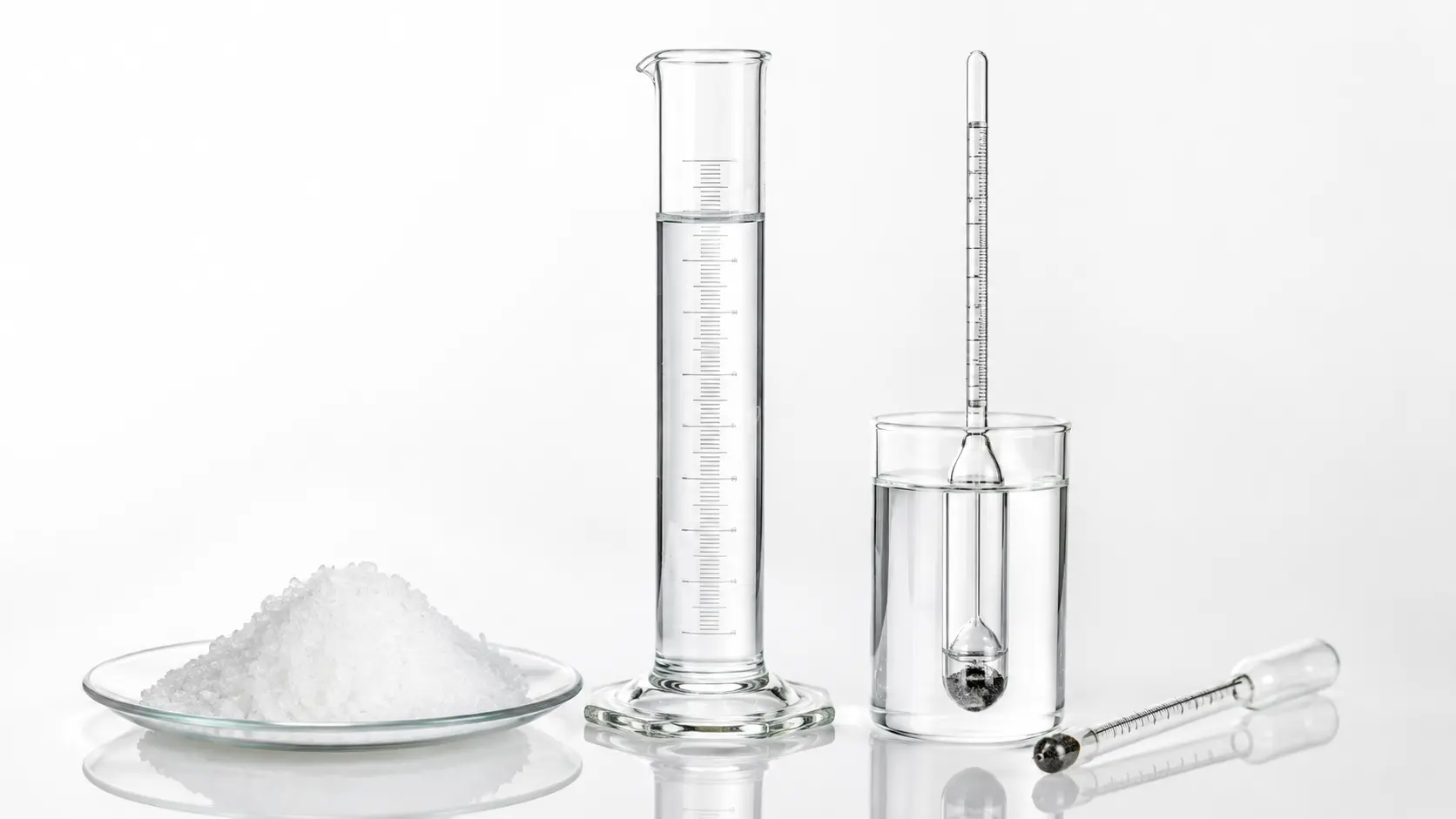
In oilfield work, density is not just a laboratory number.
It directly affects hydrostatic pressure.
If the brine is too light, it may not provide enough pressure to control the well. If it is unnecessarily heavy, it can increase overbalance, fluid invasion or even contribute to losses in weak formations.
Potassium formate is attractive because it is highly soluble in water and can form relatively dense clear brines without relying on suspended weighting solids.
A clear potassium formate solution can reach approximately 1.58 g/cm³ as a single-salt brine. SLB lists sodium, potassium and cesium formate clear solutions at maximum densities of approximately 1.32, 1.58 and 2.4 g/cm³ respectively.
But that 1.58 number should not be used for every potassium formate solution.
Density depends strongly on concentration and temperature.
What Does Potassium Formate Brine Density Mean?
Density describes how much mass is contained in a certain volume of fluid.
For potassium formate brines, density may be reported as:
- g/cm³
- kg/L
- Specific gravity, or SG
- lb/gal, commonly called ppg in oilfield applications
For practical liquid systems, a density of 1.50 g/cm³ is also approximately an SG of 1.50.
Oilfield engineers often prefer ppg because drilling and completion calculations are commonly based on pounds per gallon.
A concentrated potassium formate solution around 1.58 g/cm³ corresponds to roughly 13.2 ppg.
Different units, same fluid.
Common Density Units
| Unit | Typical Use |
|---|---|
| g/cm³ | Laboratory and technical data |
| kg/L | Industrial chemical handling |
| Specific gravity | Product specification and field checking |
| ppg | Drilling and completion operations |
When comparing supplier specifications, always check which unit is being used.
A number without a unit is not very helpful.
How Concentration Affects Potassium Formate Density
As more potassium formate is dissolved in water, the mass of dissolved salt per unit volume increases.
So, in general:
higher potassium formate concentration = higher solution density
A 40% solution will therefore be less dense than a 60% solution, and a 75% concentrate will be denser again.
Vanchor's current 75% potassium formate solution is specified at approximately 1.57–1.58 g/cm³ at 25°C.
Simplified Concentration-Density Relationship
| Brine Condition | Expected Density Trend |
|---|---|
| Dilute potassium formate solution | Relatively low |
| Medium concentration | Moderate density |
| High concentration | Higher density |
| Around 75% solution | About 1.57–1.58 g/cm³ at 25°C |
| Near practical single-salt limit | Around 1.58 g/cm³ |
This table is intentionally qualitative except for the 75% reference value.
Why?
Because an exact density-concentration table should come from the supplier's current technical data and should state the measurement temperature.
Different product purity, temperature and test methods can shift the result slightly.
Why Temperature Matters
Density changes with temperature.
As a liquid becomes warmer, it normally expands slightly.
That means the same potassium formate brine may show a lower density at a higher temperature.
When the fluid cools, density normally rises.
This is why a proper technical specification should never simply say:
Density: 1.58
It should say something like:
Density: approximately 1.57–1.58 g/cm³ at 25°C
Vanchor's current 75% solution uses this type of temperature-specific specification.
This becomes especially important when field measurements are compared with laboratory or COA values.
A hot brine sampled from a blending tank should not necessarily be expected to show exactly the same reading as a laboratory measurement performed at 25°C.
Why Density Matters in Oilfield Brines
The primary oilfield reason for controlling brine density is hydrostatic pressure.
Completion and workover brines are designed to help control reservoir pressure while avoiding unnecessary damage to the producing formation.
Clear brines obtain their density from dissolved salts and contain few or no suspended solids. SLB notes that these fluids are selected according to density, crystallization behavior and clarity, and that formate salts can create high-density, solids-free systems.
Potassium formate is therefore useful in:
- Completion fluids
- Workover fluids
- Drill-in fluids
- Reservoir drilling systems
- Packer fluids
- Other low-solids well-control fluids
The correct density depends on the actual well.
It should not simply be the highest concentration the supplier can manufacture.
Density and Hydrostatic Pressure
In a well, denser fluid creates greater hydrostatic pressure for the same vertical depth.
That can help balance formation pressure.
But increasing density too much is not automatically safer.
Excessive overbalance may contribute to:
- Fluid invasion
- Lost circulation
- Formation damage
- Higher completion-fluid losses
So a fluid engineer normally starts with the required well-control pressure and works backward to the required brine density.
Then the potassium formate concentration is adjusted to match that target.
This is much better than starting with “75% brine” and hoping it fits the well.
Is 1.58 g/cm³ the Maximum Potassium Formate Density?
For a single-salt clear potassium formate brine, approximately 1.58 g/cm³ is a useful practical reference limit.
That does not mean a finished drilling fluid containing potassium formate can never be heavier.
There are two different questions:
How dense can clear potassium formate brine become?
About 1.58 g/cm³ as a single-salt clear solution.
How heavy can a finished drilling-fluid system become?
Potentially heavier, depending on additional weighting materials or other brine chemistry.
If a project requires a much higher-density solids-free brine, engineers may consider formate blends involving cesium formate or another suitable brine system.
That distinction prevents a common technical mistake.
Density Is Not the Only Design Parameter
Oilfield buyers sometimes focus so strongly on density that other important properties get ignored.
A concentrated brine also needs to remain stable at expected temperatures.
Clear-brine design commonly considers:
- Density
- TCT
- PCT
- Clarity
- Compatibility
- Corrosion
- Filtration
SLB specifically states that clear brines are blended according to required density, True Crystallization Temperature, pressure-temperature crystallization behavior and clarity.
A brine can have exactly the correct density and still be a poor field choice if it crystallizes during winter storage.
So density should always be evaluated together with the operating temperature window.
How Is Potassium Formate Brine Density Measured?
For clean brines with no gel strength, a hydrometer can be used.
A hydrometer floats in the liquid, and the depth at which it settles indicates fluid density. SLB specifically notes that hydrometers are appropriate for brines but are less reliable in drilling fluids that develop gel strength.
Other laboratory or plant methods may use digital density meters.
The key is consistency.
Good Density Measurement Practice
| Check | Why It Matters |
|---|---|
| Record sample temperature | Density changes with temperature |
| Use clean equipment | Contamination changes results |
| Remove bubbles | Air can distort measurement |
| Mix sample uniformly | Prevents concentration differences |
| Use appropriate instrument | Brine and gelled mud may need different methods |
| Compare with COA / target | Confirms blending accuracy |
For a completion brine, density should also be rechecked after dilution, contamination or recovered-fluid conditioning.
Preparing a Target-Density Brine
Potassium formate may be supplied as concentrated liquid or solid product.
Vanchor currently supplies 75% liquid potassium formate, with a typical density of about 1.57–1.58 g/cm³ at 25°C, as well as ≥96% solid potassium formate for local preparation of customized brine concentrations.
A fluid plant may therefore prepare the required density in two ways.
From Liquid Concentrate
The concentrate can be diluted with suitable water until the target density is reached.
This is convenient for rapid field blending.
From Solid Potassium Formate
Solid material can be dissolved into water to prepare the required concentration.
This provides more flexibility but requires dissolution equipment and controlled mixing.
In both cases, the final brine should be measured.
Do not rely only on calculated mixing volumes.
Why COA Density Matters
A supplier's TDS usually gives a standard or typical density range.
The COA gives information about the actual delivered batch.
For example, an oilfield buyer may request:
- Potassium formate assay
- Density at specified temperature
- pH
- Chloride
- Carbonate
- Iron
- Insoluble matter
If density is critical to the final brine formulation, the batch COA is more useful than relying only on a generic website value.
Field personnel can then verify the brine again after dilution or blending.
What Should Buyers Include in an RFQ?
A practical inquiry might look like:
Product: Potassium Formate
Application: Completion Brine
Target Brine Density: 1.45 g/cm³
Supply Form: 75% Liquid Concentrate
Quantity: 40 MT
Packaging: IBC
Required Documents: COA, TDS and SDS
Measurement Requirement: Density reported at 25°C
This is much clearer than asking:
What is your potassium formate density?
The supplier now knows the actual application and target fluid condition.
Final Thoughts
Potassium formate brine density is mainly controlled by concentration and temperature.
A concentrated single-salt potassium formate brine can reach approximately 1.58 g/cm³, while a typical 75% commercial solution is around 1.57–1.58 g/cm³ at 25°C.
But the most important number is not always the maximum density.
It is the density the well actually needs.
Good brine design starts with the hydrostatic requirement, then checks concentration, temperature, crystallization margin, compatibility and field handling.
In other words, don't start by asking how heavy potassium formate can become.
Start by asking how heavy the fluid needs to be.
FAQ
What is the density of 75% potassium formate brine?
A typical 75% potassium formate solution has a density of approximately 1.57–1.58 g/cm³ at 25°C.
What is the maximum density of potassium formate brine?
A clear single-salt potassium formate solution can reach approximately 1.58 g/cm³.
Does potassium formate density increase with concentration?
Yes. As potassium formate concentration increases, solution density generally increases.
Does temperature affect potassium formate brine density?
Yes. Density normally decreases as temperature rises, so the measurement temperature should always be stated.
How is potassium formate brine density measured?
Clean brines may be measured with a hydrometer or suitable digital density meter. The sample temperature should be recorded.
Is the highest-density potassium formate brine always the best choice?
No. The correct density should be based on well-control requirements, temperature, crystallization behavior and formation conditions.


Contact Us
In This Article
Related Posts
Индивидуальные упаковочные решения от поставщика безводного ацетата натрия в Китае
2026-09-23
Тенденции применения безводного ацетата натрия для специального химического производства
2026-09-23
Безводный ацетат натрия для дубления кожи: улучшает равномерность окрашивания
2026-09-22
Formic Acid 85% for Animal Feed Preservation: Moisture and Storage Stability Guide
2026-09-21


