



Potassium Formate Packer Fluid: Properties, Benefits and Long-Term Well Considerations
By LIN
2026-09-02Related Posts
Индивидуальные упаковочные решения от поставщика безводного ацетата натрия в Китае
2026-09-23
Тенденции применения безводного ацетата натрия для специального химического производства
2026-09-23

Безводный ацетат натрия для дубления кожи: улучшает равномерность окрашивания
2026-09-22
Formic Acid 85% for Animal Feed Preservation: Moisture and Storage Stability Guide
2026-09-21
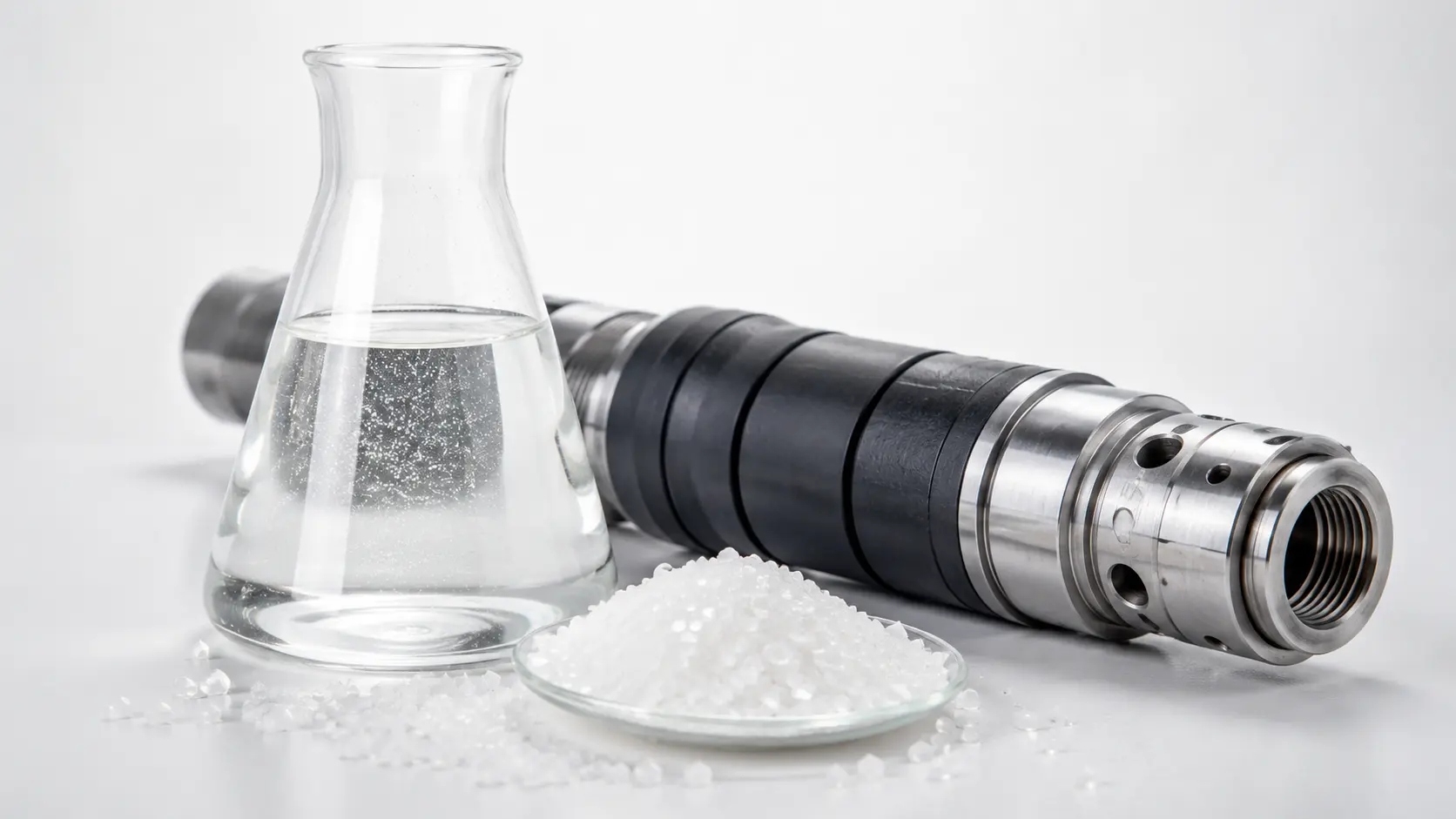
A potassium formate packer fluid is a brine-based fluid placed in the annular space between production tubing and casing, usually above a packer, where it may remain for a very long time.
That last part is important.
A drilling fluid is circulated. A completion fluid may only stay in the well during completion work. A packer fluid, on the other hand, can sit almost completely static for months or even years.
Because of this, choosing a packer fluid is not just about getting the right density on day one.
The fluid also needs to remain stable, non-damaging and reasonably predictable after long exposure to temperature, pressure, casing, tubing and elastomeric sealing materials.
Potassium formate can be considered as a packer-fluid base because it forms dense, clear brines with very low suspended solids. But like any long-term annular fluid, it should be tested for the actual well conditions before placement.
What Is a Packer Fluid?
A packer separates parts of the well and seals the annular space between tubing and casing.
After the completion is installed, fluid remains in the annulus above the packer.
This is called the packer fluid.
Its main jobs may include:
- Providing hydrostatic pressure
- Reducing differential pressure across the packer
- Helping protect casing from collapse
- Protecting tubing and casing from corrosion
- Supporting long-term well integrity
- Providing a stable annular environment
SLB describes packer fluid as the fluid left in the annulus between tubing and outer casing above the packer. It should generally have enough density for the completion, remain solids-free, resist long-term viscosity changes and avoid corrosion of completion components.
So this fluid has a pretty quiet job.
But it has to keep doing that job for a long time.
Why Use Potassium Formate as a Packer Fluid?
Potassium formate, chemical formula HCOOK and CAS No. 590-29-4, is highly soluble in water.
At sufficiently high concentration it produces a clear, relatively dense brine.
Potential advantages for packer-fluid applications include:
- High water solubility
- Useful dissolved density
- Very low suspended-solids content
- Easy filtration
- Adjustable concentration
- Good potential for long-term clear-brine systems
- Compatibility with selected completion-fluid additives
The density comes mainly from dissolved potassium formate rather than suspended barite or other weighting solids.
That matters because a packer fluid may sit without circulation for years.
Suspended solids that slowly settle over time can create undesirable deposits, so a clear brine can be attractive.
Basic Packer Fluid Requirements
| Requirement | Why It Matters |
|---|---|
| Correct density | Maintains required annular hydrostatic pressure |
| Low solids | Reduces long-term settling |
| Thermal stability | Fluid may remain at elevated temperature for years |
| Corrosion control | Protects tubing and casing |
| Stable viscosity | Avoids major changes during long static periods |
| Crystallization control | Prevents salt deposition |
| Elastomer compatibility | Helps protect packer sealing elements |
| Chemical stability | Reduces long-term reactions and deposits |
Density is therefore only one item on a fairly long checklist.
Long-Term Static Stability Is Critical
One major difference between a packer fluid and a drilling fluid is circulation.
Drilling mud is continuously mixed and circulated during normal operations.
A packer fluid can stay almost completely still.
Any component that tends to:
- Settle
- Separate
- Polymerize
- Precipitate
- Degrade
can become more problematic over long static periods.
This is one reason a clear potassium formate brine can be interesting.
Because the density is created by dissolved salt, there are no conventional weighting particles that need to remain suspended.
That doesn't mean the fluid can simply be mixed once and forgotten.
If viscosifiers, corrosion inhibitors or other additives are included, their long-term behavior also needs to be evaluated.
Density Selection
Packer-fluid density is normally chosen according to the pressure requirements of the well and completion.
The fluid can help reduce differential pressure across the packer and provide hydrostatic support in the annulus.
Potassium formate brine can reach approximately 1.57–1.58 SG, depending on concentration and temperature.
That density range may be suitable for many packer-fluid applications.
If significantly higher density is required, another brine system or a higher-density formate blend may need to be considered.
Simplified Density Selection
| Well Requirement | Possible Direction |
|---|---|
| Lower annular density | Diluted potassium formate brine |
| Medium density | Moderate potassium formate concentration |
| Around 1.5 SG | Concentrated potassium formate may be suitable |
| Near 1.58 SG | High-concentration potassium formate |
| Substantially above 1.58 SG | Evaluate another brine or formate blend |
The actual design should be calculated from well conditions rather than selected from a generic table.
More density is not automatically safer.
Corrosion Control May Be the Biggest Long-Term Issue
A packer fluid may remain in contact with tubing and casing for years.
That makes corrosion management extremely important.
Potential factors include:
- Dissolved oxygen
- Temperature
- pH
- Chloride contamination
- Metal type
- Exposure duration
- Carbon dioxide
- Hydrogen sulfide
- Microbiological activity
Even a brine that produces a relatively low corrosion rate during a short laboratory test may behave differently after a long static exposure.
A potassium formate packer fluid should therefore be evaluated using the actual metallurgy planned for the well.
Possible components include:
- Carbon steel
- Stainless steel
- CRA tubing
- Nickel alloys
The corrosion-control program needs to be compatible with potassium formate.
This should never be assumed.
Some conventional corrosion inhibitors used in other brines may not be suitable for formate systems.
Don't Just Add Any Corrosion Inhibitor
This is one of those small details that can create a large problem.
Oilfield corrosion inhibitors are designed for specific fluid environments.
A product that works in a chloride brine may not perform the same way in potassium formate.
Some commercial corrosion-inhibitor technical information explicitly excludes use in packer fluids or formate brines. That is why compatibility needs to be checked before adding a treatment package.
In other words:
More chemicals does not automatically mean more protection.
The inhibitor package should be tested in the actual potassium formate formulation.
Temperature and Thermal Stability
Packer fluids may spend years at elevated downhole temperatures.
The brine itself may remain chemically stable, but any additional additives need to survive the same environment.
Long-term thermal exposure can affect:
- Corrosion inhibitors
- Polymers
- Biocides
- Oxygen scavengers
- pH-control additives
This means short-term mixing tests are not enough.
A packer-fluid qualification program may use long-duration aging at representative temperature.
The fluid can then be checked for:
- Appearance
- Precipitation
- Density
- pH
- Corrosion
- Viscosity
- Deposit formation
A fluid that looks perfect after four hours may look quite different after several months.
Obviously, nobody wants to discover that downhole.
Crystallization Behavior
Concentrated potassium formate brine can crystallize if exposed to unsuitable temperature conditions.
This matters during:
- Mixing
- Winter transportation
- Surface storage
- Well displacement
- Long-term well service
The selected concentration should provide a suitable temperature margin.
Crystallization can create:
- Deposits
- Blocked lines
- Incorrect density
- Difficult future circulation
- Annular solids
For a packer fluid, stable crystallization behavior is especially important because the fluid may remain undisturbed for long periods.
If the well will experience large temperature cycles during shutdown and restart, that should be included in the fluid design.
Solids-Free Does Not Mean Maintenance-Free
Potassium formate brine can be prepared as a very clean fluid.
But field handling can introduce contamination.
Common contamination sources include:
- Rust
- Cement residue
- Drilling mud
- Pipe scale
- Dirty tanks
- Dirty transfer hoses
Before being placed as packer fluid, the brine should be prepared and handled through clean equipment.
Typical Qualification Checks
| Parameter | Reason for Checking |
|---|---|
| Density | Confirms annular pressure requirement |
| Potassium formate concentration | Confirms brine strength |
| pH | Supports chemical and corrosion control |
| Chloride | Relevant to corrosion |
| Iron | May indicate contamination or corrosion |
| Insoluble matter | Important for long-term cleanliness |
| Crystallization behavior | Helps avoid salt deposits |
| Corrosion rate | Protects tubing and casing |
| Thermal aging | Confirms long-term fluid stability |
| Elastomer compatibility | Protects packer materials |
For a long-life completion, these tests are much more valuable than simply checking the product assay.
Compatibility With Packers and Elastomers
The word “packer fluid” sometimes makes people focus only on the steel tubing and casing.
The packer itself contains sealing materials.
Depending on the completion, elastomers may be exposed to the fluid under high pressure and temperature for years.
Testing may therefore consider:
- Swelling
- Shrinkage
- Hardness changes
- Chemical degradation
- Mechanical-property changes
A brine that has low steel corrosion but damages the packer elastomer is obviously not a good packer fluid.
Supplier recommendations and packer-manufacturer compatibility information should be reviewed during fluid qualification.
Packer Fluid vs Completion Fluid
These terms are related but not identical.
| Factor | Completion Fluid | Packer Fluid |
|---|---|---|
| Main timing | During completion operations | After packer installation |
| Circulation | Often circulated | Usually static |
| Residence time | Hours to days/weeks | Months to years |
| Main focus | Well control + formation protection | Long-term annular stability |
| Solids | Very low | Preferably very low |
| Corrosion importance | High | Extremely important long term |
| Thermal aging | Important | Especially important |
| Elastomer compatibility | Important | Critical |
A potassium formate brine that works well as a temporary completion fluid should therefore not automatically be approved as a long-term packer fluid.
Additional testing may be required.
How Is Potassium Formate Packer Fluid Prepared?
The fluid can be made from concentrated liquid potassium formate or solid potassium formate.
A simplified preparation process may include:
- Clean the mixing and storage tanks.
- Add suitable process water if needed.
- Add potassium formate concentrate or dissolve solid material.
- Adjust to the required density.
- Add only approved compatible treatments.
- Test pH and required chemistry.
- Filter the final fluid.
- Conduct final density and quality checks.
- Displace the fluid into the annulus.
For long-term service, fluid cleanliness during displacement is just as important as cleanliness during mixing.
How to Request Potassium Formate for Packer Fluid
A useful RFQ should include the actual service conditions.
For example:
Product: Potassium Formate
Application: Long-Term Packer Fluid
Required Density: 1.45 SG
Bottomhole Temperature: 140°C
Quantity: 30 MT
Preferred Form: 75% Liquid Concentrate
Required Documents: COA, TDS and SDS
Additional Requirement: Low insoluble matter and controlled chloride
You may also need to provide:
- Tubing metallurgy
- Packer elastomer
- Expected service life
- Maximum temperature
- Corrosion target
The more demanding the completion, the more useful this information becomes.
Final Thoughts
A potassium formate packer fluid can provide a clean, relatively dense brine for long-term placement in the tubing-casing annulus above a packer.
Its main advantages include:
- Dissolved density
- Low suspended solids
- Flexible concentration
- Good clear-brine characteristics
But a successful packer fluid has to do much more than look clear on the day it is mixed.
It needs to remain stable.
It needs to avoid crystallization.
It needs to protect tubing and casing.
It needs to remain compatible with packer elastomers.
And ideally, it should do all of that for years without anyone needing to think about it very much.
That long-term stability is what really separates packer-fluid design from ordinary brine selection.
FAQ
What is potassium formate packer fluid?
It is a potassium formate-based brine placed in the annulus above a packer to provide hydrostatic pressure and protect completion components during long-term well service.
Why is potassium formate useful as a packer fluid?
It can provide useful density through dissolved salt while maintaining very low suspended-solids content.
Does packer fluid remain in the well permanently?
It may remain in the annulus for months or years, depending on the completion design and well life.
Is corrosion testing important?
Yes. Long-term contact with tubing and casing makes corrosion one of the most important packer-fluid qualification issues.
Can normal completion brine be used as packer fluid?
Sometimes, but it should not be assumed. Long-term thermal stability, corrosion and elastomer compatibility may require additional testing.
What should be tested before using potassium formate packer fluid?
Density, thermal aging, corrosion, crystallization behavior, solids, pH, contamination and packer/elastomer compatibility should be considered.


Contact Us
In This Article
Related Posts
Индивидуальные упаковочные решения от поставщика безводного ацетата натрия в Китае
2026-09-23
Тенденции применения безводного ацетата натрия для специального химического производства
2026-09-23
Безводный ацетат натрия для дубления кожи: улучшает равномерность окрашивания
2026-09-22
Formic Acid 85% for Animal Feed Preservation: Moisture and Storage Stability Guide
2026-09-21


