



Potassium Formate Oilfield Chemical: Applications, Grades and Buying Guide
By LIN
2026-09-02Related Posts
Индивидуальные упаковочные решения от поставщика безводного ацетата натрия в Китае
2026-09-23
Тенденции применения безводного ацетата натрия для специального химического производства
2026-09-23

Безводный ацетат натрия для дубления кожи: улучшает равномерность окрашивания
2026-09-22
Formic Acid 85% for Animal Feed Preservation: Moisture and Storage Stability Guide
2026-09-21
Potassium formate oilfield chemical is widely used as a high-performance raw material in drilling, completion, workover and clear-brine fluid systems.
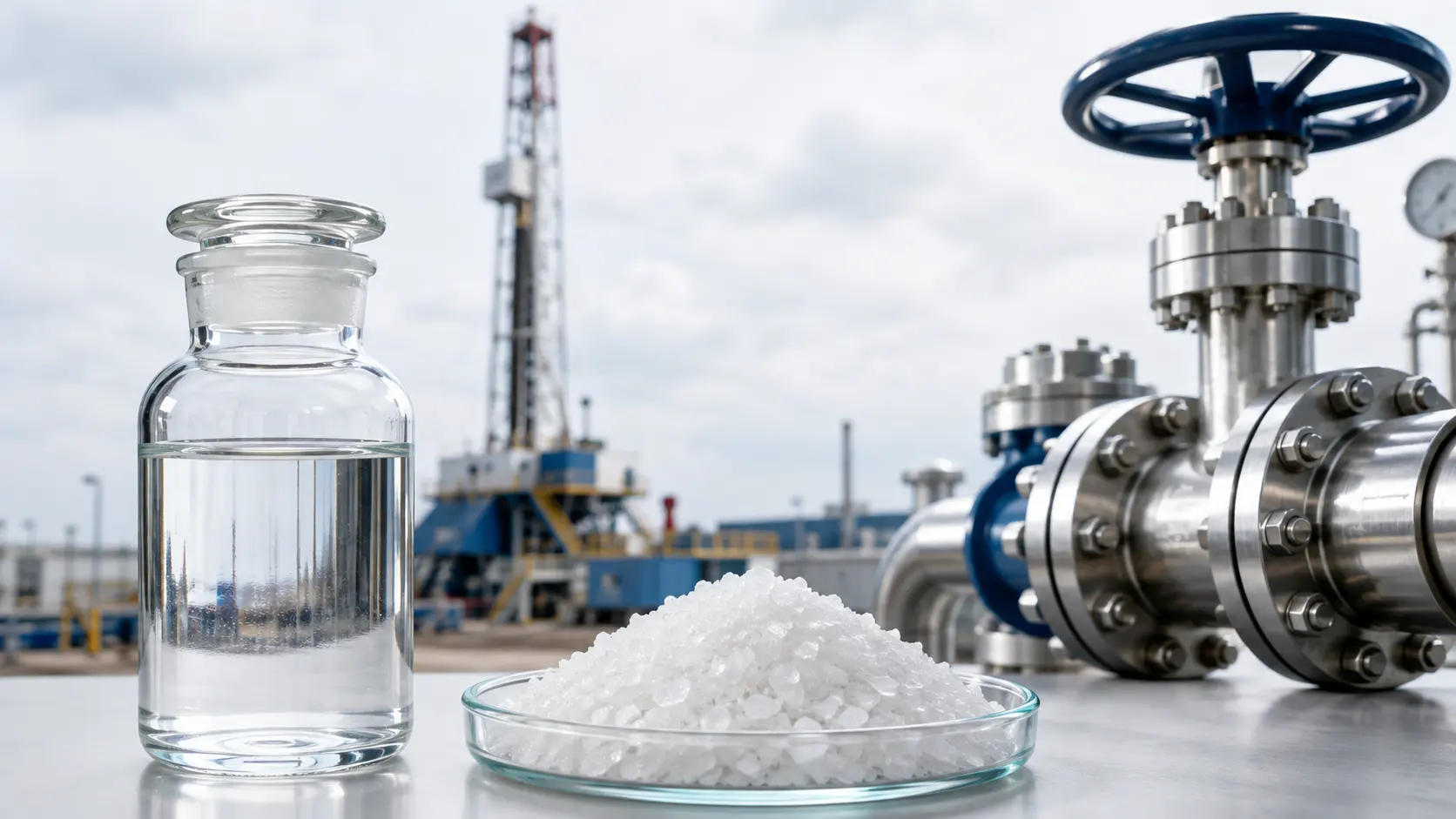
For an oilfield chemical buyer, potassium formate is interesting because it can do several jobs at the same time. It provides dissolved brine density, supports low-solids fluid design and supplies potassium ions that may help in shale-control systems.
That combination is useful, especially in wells where conventional salt systems or heavily solids-weighted fluids are not the best fit.
Still, potassium formate should not be treated as some kind of universal oilfield chemical that automatically solves every drilling or completion problem.
Its performance depends on concentration, fluid formulation, formation chemistry, temperature and compatibility with other additives.
In practice, the best results come when potassium formate is selected as part of a complete fluid program rather than simply purchased as a bulk salt.
What Is Potassium Formate?
Potassium formate is the potassium salt of formic acid.
Its chemical formula is HCOOK, and its CAS number is 590-29-4.
Commercial oilfield potassium formate is commonly supplied as:
- 70–75% concentrated liquid solution
- Approximately 96% solid potassium formate
- Customized concentrated brine
- Technical or industrial grade material
Potassium formate is highly soluble in water. This allows relatively dense clear brines to be prepared without using large quantities of suspended weighting solids.
Formate salts including sodium, potassium and cesium formate are used in engineered clear-brine systems because they are highly water soluble and can form high-density, solids-free fluids.
Where Is Potassium Formate Used in the Oilfield?
Potassium formate may appear at several stages of well construction and intervention.
Main Oilfield Applications
| Application | Role of Potassium Formate |
|---|---|
| Drilling fluids | Brine density and potassium-based chemistry |
| Reservoir drill-in fluids | Low-solids base fluid |
| Completion fluids | Clear brine for well control |
| Workover fluids | Solids-free or low-solids intervention fluid |
| Shale-control systems | Potassium source for inhibition strategy |
| High-temperature fluids | Brine base for thermally stable formulations |
| Packer / intervention fluids | Project-dependent brine chemistry |
| Fluid-loss systems | Can serve as compatible base brine |
One of its strongest advantages is flexibility.
The same potassium formate raw material can be used to build different fluid systems depending on concentration and additive package.
Potassium Formate in Drilling Fluids
In drilling applications, potassium formate is commonly used as part of a water-based fluid rather than as a complete mud on its own.
The brine provides the liquid phase and some of the density.
Other additives may then be introduced for:
- Rheology
- Fluid-loss control
- Lubricity
- Shale inhibition
- Corrosion control
- Filtercake design
- Hole cleaning
A formate-based drilling fluid can be useful where engineers want to control total suspended solids.
Conventional drilling fluids often rely on barite or other weighting materials to increase mud weight.
That works very well in many wells, but those solids also increase the solids loading of the fluid.
Potassium formate creates much of its density through dissolved salt instead.
For reservoir sections, this can be particularly attractive.
Shale Inhibition
Potassium chemistry has long been used in water-based drilling fluids for reactive shale formations.
Potassium ions can contribute to strategies designed to reduce clay hydration and dispersion.
Potential drilling problems associated with reactive shale include:
- Swelling
- Sloughing
- Tight hole
- Bit balling
- Poor cuttings integrity
- Increased torque and drag
Potassium formate provides potassium ions while also functioning as a concentrated brine.
However, it is important not to oversell this point.
Potassium formate is normally only one part of the shale-control program.
Dedicated inhibitors, encapsulating polymers or other additives may still be required depending on the shale mineralogy.
Basically, potassium formate can help, but the rock gets the final vote.
Reservoir Drill-In Fluids
Reservoir drilling is another important use.
When drilling the productive interval, operators often want to reduce formation damage as much as possible.
A reservoir drill-in fluid may be designed for:
- Thin filtercake
- Low filtrate invasion
- Controlled solids
- Good cleanup
- Formation compatibility
- Stable rheology
Potassium formate brine can provide the liquid base for these systems.
Compatible polymers and bridging materials are then added to build the finished fluid.
Modern reservoir drill-in systems are specifically engineered around protecting the productive interval, rather than simply drilling as quickly as possible.
Potassium Formate in Completion Fluids
Once drilling is finished, the fluid requirements change.
Completion fluids are generally designed to control reservoir pressure while limiting damage to the producing formation.
A completion fluid is typically a highly filtered, solids-free liquid used during operations such as:
- Setting screens
- Running production liners
- Installing packers
- Installing downhole valves
- Perforating
Clear brines are widely used because their density comes from dissolved salts rather than suspended weighting solids.
Potassium formate is one of the available formate brines.
Its usefulness comes from combining clear-fluid behavior with relatively high dissolved density.
Workover and Intervention Fluids
Potassium formate may also be used in workover or intervention operations.
An existing producing well sometimes needs maintenance or repair.
During these operations, operators may need a fluid that:
- Controls formation pressure
- Minimizes additional solids
- Is compatible with completion equipment
- Can be filtered
- Can potentially be recovered and reused
Depending on well conditions, potassium formate can serve as the brine base.
This can be valuable in wells where the producing interval is sensitive to contamination.
How Dense Can Potassium Formate Brine Be?
Density is one reason oilfield buyers are interested in potassium formate.
Concentrated potassium formate brine can reach roughly 1.57–1.58 SG, approximately 13.1 ppg, depending on concentration and temperature.
This covers a useful range of drilling and completion applications.
But pure potassium formate does have a practical density limit.
For significantly higher fluid densities, engineers may need another brine system or blends involving higher-density formates.
So the correct question is not:
How much potassium formate can we add?
It is:
What fluid density does this well actually require?
Potassium Formate vs Traditional Oilfield Brines
Potassium formate competes with several traditional brine systems.
General Comparison
| Factor | Potassium Formate | KCl / NaCl Brines | Bromide Brines |
|---|---|---|---|
| Clear brine capability | Yes | Yes | Yes |
| Potassium source | Yes | KCl only | Normally no |
| Dissolved density | Relatively high | Lower | Can be very high |
| Suspended solids needed | No for clear brine | No for clear brine | No |
| Chloride content | Not chloride based | High in chloride systems | Bromide based |
| Cost | Higher than simple salts | Usually lower | Often higher |
| Reservoir use | Project dependent | Project dependent | Project dependent |
| Compatibility testing | Required | Required | Required |
There is no universal winner.
Simple chloride brines can be very economical.
Bromide brines can achieve higher density.
Potassium formate becomes attractive when the project values a combination of potassium chemistry, high dissolved density and low-solids performance.
Oilfield Grade vs Standard Industrial Grade
Buyers often ask for “oilfield grade potassium formate.”
That phrase is useful, but it should not replace an actual technical specification.
Oilfield customers may require tighter control over certain impurities because the chemical will be used in sensitive fluid systems.
Typical Oilfield Purchasing Parameters
| Parameter | Why It Matters |
|---|---|
| Potassium formate content | Confirms active material |
| Density | Important for liquid concentrate |
| pH | Relevant to fluid chemistry |
| Chloride | May affect corrosion and compatibility |
| Carbonate | Can influence formulation behavior |
| Iron | Important in clean-brine systems |
| Insoluble matter | Important for fluid cleanliness |
| Turbidity | Useful for clear liquid grades |
| Moisture | Important for solid potassium formate |
| Batch consistency | Important for repeat formulations |
A general industrial-grade product may still be perfectly suitable if it meets these requirements.
So again, look at the COA rather than relying only on the grade name.
Liquid or Solid Potassium Formate?
Oilfield chemical companies can buy potassium formate in either liquid or solid form.
75% Liquid Solution
The major advantage is convenience.
It can normally be pumped directly from an IBC or storage tank into a blending system.
This can save:
- Dissolution time
- Dry chemical handling
- Mixing labor
- Dust exposure
96% Solid Potassium Formate
Solid material provides more active potassium formate per metric ton shipped.
That makes it attractive for long-distance transportation or centralized fluid-blending plants.
The buyer does, however, need:
- Dry storage
- Moisture protection
- Dissolution tanks
- Mixing equipment
For an offshore supply base that needs brine quickly, liquid may be easier.
For a large regional mud plant with good blending equipment, solid can make more economic sense.
High-Temperature Fluid Systems
Potassium formate brines are also used in demanding high-temperature fluid programs.
But there is an important detail here.
A stable brine does not automatically create a stable high-temperature drilling fluid.
The polymers and other additives also need to survive the downhole temperature.
Current commercial high-temperature water-based systems are specifically formulated with additives designed to remain compatible with oilfield brines, including formate brines.
This is why complete-fluid laboratory aging is more useful than checking potassium formate alone.
Compatibility Testing Is Essential
Potassium formate does not work with every formation or every chemical package.
Compatibility work may include:
- Formation mineralogy
- Formation water
- Crude oil
- Polymer additives
- Corrosion inhibitors
- Elastomers
- Cement
- Scale tendency
There are documented field projects where potassium formate was evaluated but rejected after testing showed incompatibility with the formation mineralogy.
That is not a weakness of potassium formate.
It is how proper oilfield fluid selection should work.
Test first.
Then choose.
Documents Oilfield Buyers Should Request
Before purchasing potassium formate in bulk, request at least:
TDS – Technical Data Sheet
For standard product specifications.
COA – Certificate of Analysis
For actual batch or representative quality results.
SDS – Safety Data Sheet
For handling, storage and transport information.
For a new supplier, requesting a sample for laboratory fluid testing is also useful.
The sample can be tested inside the actual drilling or completion formulation before a full-container order is released.
How to Request an Oilfield Potassium Formate Quote
A good inquiry may look like:
Product: Potassium Formate Oilfield Chemical
Form: 75% Liquid Solution
Application: Completion / Drilling Fluid
Quantity: 40 MT
Packaging: IBC
Required Documents: COA, TDS and SDS
Special Requirements: Controlled chloride and insoluble matter
Destination: Houston
If you already know the target brine density, include it.
If you have an internal specification, attach it.
That saves time for both sides.
Final Thoughts
Potassium formate oilfield chemical is a versatile raw material used across drilling, reservoir drill-in, completion and workover fluid systems.
Its main technical strengths include:
- High water solubility
- Useful brine density
- Low-solids fluid design
- Potassium-containing chemistry
- Clear-brine capability
But none of these benefits removes the need for proper fluid engineering.
Oilfield applications depend heavily on formation chemistry, pressure, temperature and additive compatibility.
For buyers, the best approach is to choose the potassium formate grade according to the actual project, review the TDS and COA, and test the complete fluid before field use.
In oilfield chemistry, the cheapest salt is not always the cheapest fluid.
And the most advanced chemical is not always the right one either.
The right product is the one that works in the well.
FAQ
What is potassium formate used for in the oilfield?
It is used in drilling, reservoir drill-in, completion and workover fluid systems as a brine base, density source and potassium-containing fluid component.
Is potassium formate an oilfield drilling chemical?
Yes. It can be used as a raw material in water-based drilling and drill-in fluid formulations.
Can potassium formate be used in completion fluids?
Yes. Clear potassium formate brines can be used in completion and workover systems where low suspended solids are important.
What forms of potassium formate are available?
Common commercial options include concentrated liquid solutions around 70–75% and high-content solid potassium formate around 96%.
Is oilfield grade potassium formate different from industrial grade?
It may have tighter impurity requirements, but there is no single universal definition. Buyers should compare actual assay and impurity limits.
What documents should oilfield buyers request?
A COA, TDS and SDS should normally be reviewed, and representative samples can be tested before large-volume purchasing.


Contact Us
In This Article
Related Posts
Индивидуальные упаковочные решения от поставщика безводного ацетата натрия в Китае
2026-09-23
Тенденции применения безводного ацетата натрия для специального химического производства
2026-09-23
Безводный ацетат натрия для дубления кожи: улучшает равномерность окрашивания
2026-09-22
Formic Acid 85% for Animal Feed Preservation: Moisture and Storage Stability Guide
2026-09-21


