



Potassium Formate Brine for Completion Fluids: Selection, Preparation and Field Use
By LIN
2026-09-02Related Posts
Индивидуальные упаковочные решения от поставщика безводного ацетата натрия в Китае
2026-09-23
Тенденции применения безводного ацетата натрия для специального химического производства
2026-09-23

Безводный ацетат натрия для дубления кожи: улучшает равномерность окрашивания
2026-09-22
Formic Acid 85% for Animal Feed Preservation: Moisture and Storage Stability Guide
2026-09-21
A potassium formate brine for completion fluids is used when a well needs enough hydrostatic pressure for safe completion operations while keeping suspended solids close to the producing formation as low as practical.
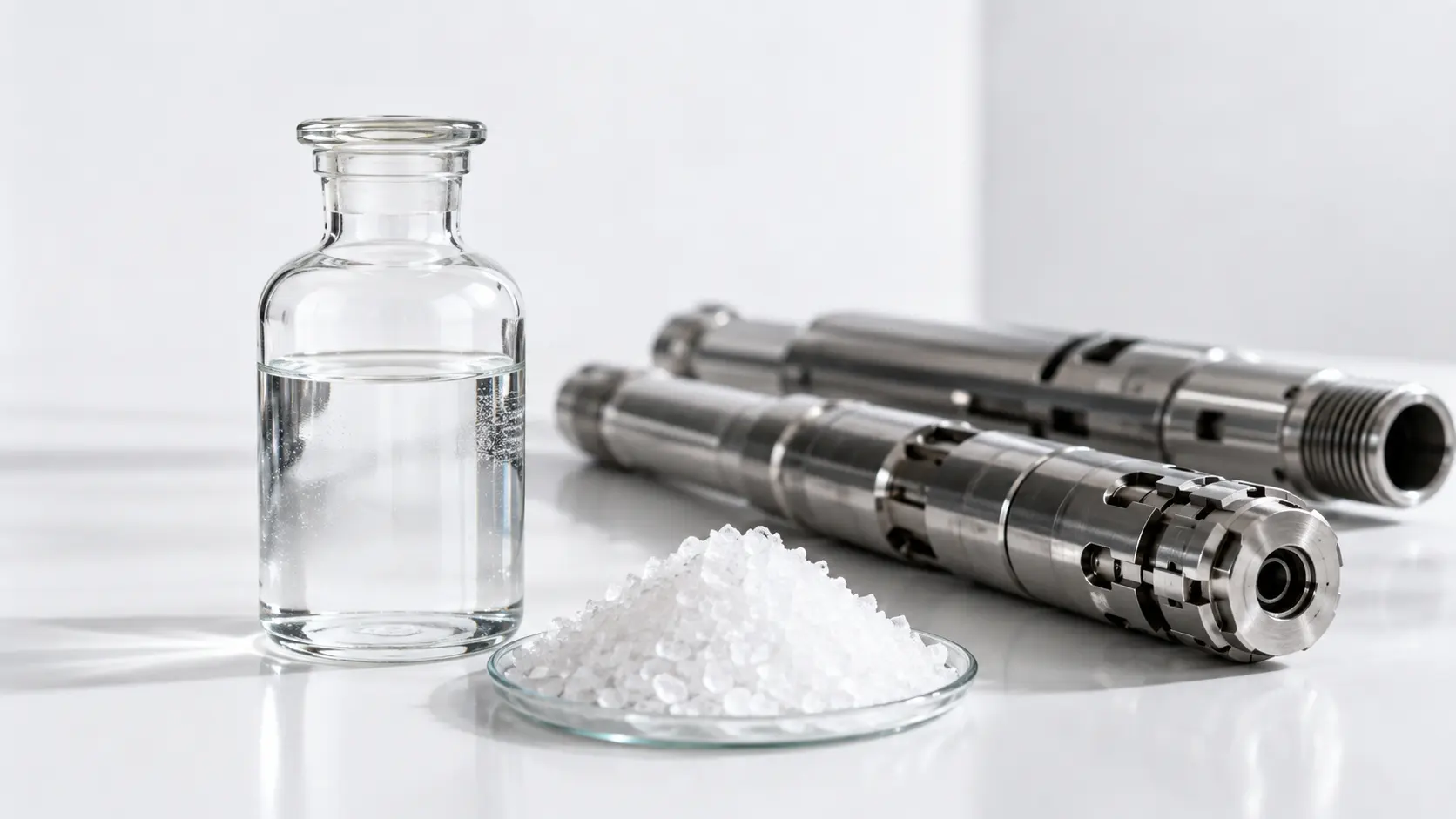
That combination is important.
During drilling, a fluid may contain weighting materials, drilled solids and other components needed to clean the hole and maintain stability. Once the well moves into completion, the priorities change. The producing interval is now much more sensitive to contamination, plugging and incompatible fluids.
This is why clear brines are commonly used.
Potassium formate is highly soluble in water and can form relatively dense, solids-free brines. SLB describes formate brines as high-density solutions that reduce the need for conventional weighting agents and are used in completion-fluid systems designed to minimize formation damage.
But choosing a potassium formate brine is not simply a matter of ordering the highest concentration available.
Density, crystallization temperature, filtration, formation-water compatibility and field cleanliness all need to be considered.
What Is Potassium Formate Completion Brine?
Potassium formate has the chemical formula HCOOK and CAS No. 590-29-4.
When dissolved in water, it forms a clear aqueous brine. In completion operations, that brine can act as the well-control fluid during operations such as:
- Setting screens
- Running liners
- Installing packers
- Perforating
- Displacing drilling fluid
- Wellbore cleanup
- Workover operations
A completion fluid is normally intended to control reservoir pressure without unnecessarily damaging the producing formation. SLB defines completion fluid as a typically solids-free liquid that should be chemically compatible with the reservoir and filtered to avoid introducing solids into the near-wellbore region.
Main Characteristics of Potassium Formate Completion Brine
| Property | Practical Meaning |
|---|---|
| Brine base | Potassium formate dissolved in water |
| Fluid type | Clear aqueous brine |
| Density source | Dissolved salt |
| Suspended weighting solids | Normally not required |
| Main use | Completion and workover fluid base |
| Key objective | Well control with low formation-damaging solids |
| Field preparation | Concentrate dilution or solid dissolution |
| Important controls | Density, TCT, clarity, compatibility and filtration |
So the brine is more than just potassium formate plus water.
It becomes part of the complete completion program.
Why Use Potassium Formate Brine in Completion Fluids?
One major reason is the ability to create density without adding large quantities of suspended weighting solids.
In a producing zone, unnecessary solids can create problems such as:
- Pore plugging
- Screen plugging
- Reduced permeability
- Increased cleanup work
- Formation damage
Clear brines are attractive because salts provide density while remaining dissolved in the water phase.
SLB specifically notes that clear brines are formulated around required density, clarity and crystallization characteristics, with formate systems among the engineered options used for completion work.
Potassium formate can therefore be useful where the completion team wants a clean fluid but still needs meaningful hydrostatic pressure.
Density Selection Comes First
A completion brine should not simply be made as heavy as possible.
Its density is selected to provide enough hydrostatic pressure to control the well.
Too little density may create well-control risk.
Too much density can increase overbalance and may contribute to:
- Fluid invasion
- Lost circulation
- Excessive pressure on the formation
- Higher completion-fluid losses
The correct density depends on reservoir pressure, true vertical depth and the required safety margin.
Potassium formate can reach approximately 1.58 g/cm³, or around 13.1–13.2 ppg, as a concentrated single-salt brine. If a project needs substantially higher density, another brine chemistry or a blended formate system may be required.
Potassium Formate Brine vs Drilling Mud
The difference is worth making clear.
| Factor | Potassium Formate Completion Brine | Conventional Drilling Mud |
|---|---|---|
| Primary purpose | Complete and control the well | Drill the well |
| Suspended solids | Very low or none by design | Often contains significant solids |
| Cuttings transport | Secondary concern | Major function |
| Formation protection | Very high priority | Important but balanced with drilling needs |
| Density | Mainly dissolved salt | Dissolved salts + weighting solids |
| Filtration | Usually high level | Different solids-control approach |
| Typical timing | After reservoir drilling | During drilling |
Regular drilling fluid is rarely ideal as a completion fluid because its solids content and chemistry may not be suitable near the producing formation.
This is why the well is usually displaced to a properly designed completion brine before final completion operations begin.
Formation Compatibility Is Just as Important as Density
A clear brine can look perfect at surface and still cause problems downhole.
This happens because formation damage is not only caused by visible solids.
The completion brine may contact:
- Formation water
- Reservoir minerals
- Crude oil
- Completion additives
- Cement
- Scale-forming ions
If these materials are chemically incompatible, precipitation or other undesirable reactions may occur.
Halliburton has reported a project in which potassium formate was evaluated but ruled out after compatibility testing showed problems with the shale mineralogy. That is a useful reminder that brine selection should follow actual reservoir testing, not just a generic product recommendation.
Typical compatibility work can include:
- Brine and formation-water mixing
- Mineral compatibility
- Scale tendency
- Core-flow testing
- Crude-oil interaction
- Elastomer compatibility
- Corrosion evaluation
One well may work very well with potassium formate.
Another may not.
Filtration Is Essential for Completion Brines
Potassium formate brine may leave the blending plant very clean.
Then it enters a storage tank that previously held drilling mud.
Now you have a different fluid.
Contamination can come from:
- Rust
- Pipe scale
- Mud residue
- Cement particles
- Dirty hoses
- Tank sediment
- Dust
This is why completion fluids are normally filtered to a high degree before entering sensitive parts of the well.
A completion-fluid program should therefore include not just brine quality, but also:
- Tank cleaning
- Transfer-line cleanliness
- Filter selection
- Turbidity monitoring
- Final fluid inspection
Buying an expensive clean brine and pumping it through dirty equipment doesn't make much sense.
True Crystallization Temperature Matters
Density often gets the most attention, but TCT — True Crystallization Temperature — can be equally important.
Highly concentrated brines may begin to crystallize if the temperature falls too low.
This can lead to:
- Blocked lines
- Pumping difficulty
- Solids forming in tanks
- Density changes
- Operational delays
SLB states that clear-brine design considers density together with TCT and pressure/temperature crystallization behavior.
This is particularly important for:
- Offshore winter operations
- Northern Europe
- Canada
- Cold surface storage
- Exposed transfer lines
The downhole temperature may be high, but surface equipment can be much colder.
So completion-fluid design should consider the coldest part of the operation, not only bottomhole temperature.
How Is Potassium Formate Completion Brine Prepared?
Completion-fluid companies may prepare the brine in two main ways.
They can purchase a concentrated liquid potassium formate solution and dilute it.
Or they can purchase solid potassium formate and dissolve it locally.
Vanchor currently supplies both 75% potassium formate solution and 96% solid potassium formate, giving completion-fluid blenders different options depending on local equipment and logistics.
A simplified preparation process may involve:
- Clean the blending tank and lines.
- Add suitable process water if dilution is required.
- Add liquid concentrate or dissolve solid potassium formate.
- Mix until uniform.
- Measure final density.
- Check pH and required impurity parameters.
- Filter the finished brine.
- Confirm field-ready quality before displacement.
The quality of the makeup water matters too.
Dirty or highly mineralized water can introduce contaminants into a brine that was originally very clean.
Liquid Concentrate or Solid Potassium Formate?
The right choice is mostly operational.
Comparison for Completion-Fluid Blenders
| Factor | 75% Liquid Solution | 96% Solid |
|---|---|---|
| Pumping | Direct | Requires dissolution |
| Active content | Lower | Higher |
| Freight efficiency | Lower | Higher |
| Preparation time | Shorter | Longer |
| Storage | IBC / tank | Dry warehouse |
| Density adjustment | Easy by dilution | Flexible during dissolution |
| Best for | Fast field blending | Centralized brine plants |
| Main handling concern | Storage temperature | Moisture absorption |
A fluid company that prepares several different brine densities may prefer solid potassium formate because concentration can be adjusted during local mixing.
A company that needs rapid liquid transfer may prefer the 75% solution.
There really isn't one answer for every project.
Fluid Loss Still Needs Attention
Even a clear completion brine can invade a permeable formation if fluid losses are not controlled.
Excessive completion-fluid loss may contribute to increased water saturation, scaling, emulsions or fines migration, all of which can hurt production.
Depending on the completion design, engineers may use:
- Solids-free fluid-loss systems
- Viscous pills
- Temporary bridging systems
- Other completion-compatible treatments
The fluid-loss strategy should be designed around the reservoir and completion method.
Again, potassium formate is the brine base.
It does not solve every completion problem by itself.
What Should Buyers Check Before Ordering?
For completion-fluid use, procurement teams should go beyond purity.
Recommended Purchase Checks
| Parameter | Why It Matters |
|---|---|
| Potassium formate content | Confirms active material |
| Density | Important for brine design |
| pH | Relevant to fluid chemistry |
| Chloride | May affect corrosion and contamination limits |
| Iron | Important for clear-fluid quality |
| Insoluble matter | Important near producing formations |
| TCT information | Important for low-temperature operations |
| Batch COA | Confirms delivered quality |
| TDS | Provides product technical information |
| SDS | Supports handling and logistics |
The customer's actual completion specification should always take priority over a generic supplier specification.
Requesting a Potassium Formate Completion-Brine Quote
A more useful inquiry looks like this:
Product: Potassium Formate
Application: Completion Brine
Required Brine Density: 1.50 SG
Preferred Form: 75% Solution
Quantity: 40 MT
Packaging: IBC
Operating Environment: Offshore Completion
Required Documents: COA, TDS and SDS
Special Requirement: Low insoluble matter and controlled chloride
If TCT or special impurity limits are important, include them from the beginning.
That normally saves several rounds of technical emails.
Final Thoughts
A potassium formate brine for completion fluids can provide a useful combination of hydrostatic density, fluid clarity and low suspended-solids content.
That makes it attractive for completion and workover operations where well control has to be maintained without unnecessarily contaminating the producing formation.
But the salt concentration alone does not define a good completion fluid.
The real design needs to consider:
- Correct density
- Formation compatibility
- Filtration
- TCT
- Fluid loss
- Corrosion
- Field contamination
- Brine preparation quality
Potassium formate can be a very capable completion-brine base.
The best results come when it is treated as part of the entire well-completion system rather than simply as another bulk chemical.
FAQ
Why is potassium formate brine used in completion fluids?
It can provide hydrostatic density through dissolved salt while keeping suspended weighting solids low, which is useful near producing formations.
Is potassium formate completion brine solids-free?
The properly prepared base brine can be essentially solids-free, although contamination may be introduced during storage and field handling.
How dense can potassium formate completion brine become?
Concentrated single-salt potassium formate brine can reach approximately 1.58 g/cm³, or about 13.1–13.2 ppg.
Does completion brine need filtration?
Yes. High-quality filtration helps remove rust, scale, mud residue and other contaminants before the fluid enters sensitive completion zones.
Why is TCT important?
A concentrated brine may crystallize if exposed to sufficiently low temperatures. TCT helps engineers confirm that the fluid will remain usable during storage and field operations.
Should potassium formate be tested with formation water?
Yes. Compatibility testing is important because chemical reactions between brine and formation fluids or minerals may create precipitates or other problems.


Contact Us
In This Article
Related Posts
Индивидуальные упаковочные решения от поставщика безводного ацетата натрия в Китае
2026-09-23
Тенденции применения безводного ацетата натрия для специального химического производства
2026-09-23
Безводный ацетат натрия для дубления кожи: улучшает равномерность окрашивания
2026-09-22
Formic Acid 85% for Animal Feed Preservation: Moisture and Storage Stability Guide
2026-09-21


