



Potassium Formate Brine for Drilling: Properties, Benefits and Field Applications
By LIN
2026-09-02Related Posts
Индивидуальные упаковочные решения от поставщика безводного ацетата натрия в Китае
2026-09-23
Тенденции применения безводного ацетата натрия для специального химического производства
2026-09-23

Безводный ацетат натрия для дубления кожи: улучшает равномерность окрашивания
2026-09-22
Formic Acid 85% for Animal Feed Preservation: Moisture and Storage Stability Guide
2026-09-21
Potassium formate brine for drilling is mainly used when engineers want a dense, water-based brine with very low suspended solids and good flexibility for building a more complete drilling-fluid system.
It is especially interesting in reservoir sections, high-angle wells, reactive formations and other situations where keeping solids under control becomes important.
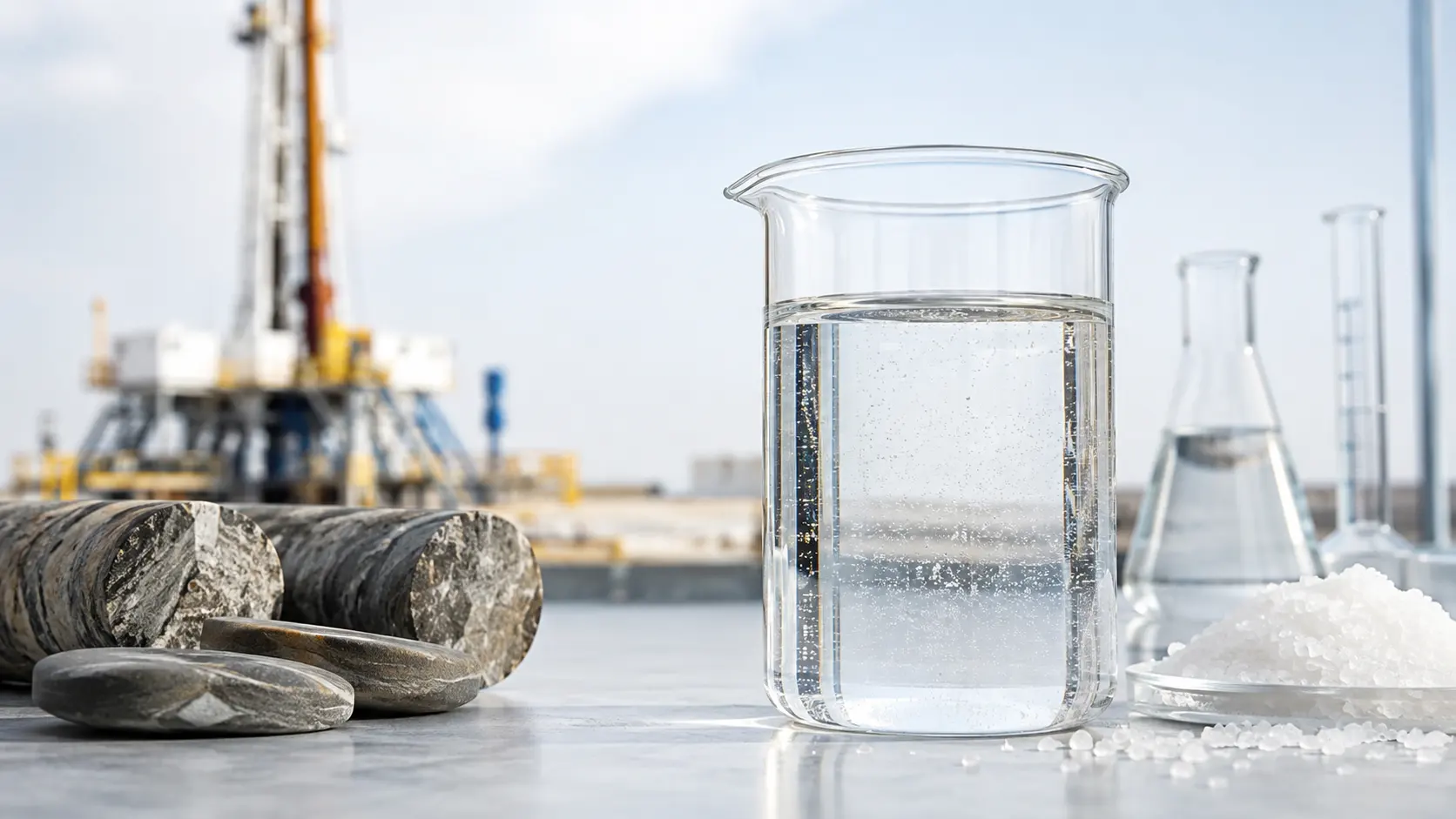
Potassium formate brine itself is not really a complete drilling mud.
Think of it more as the base liquid phase.
The brine provides dissolved density and potassium-containing chemistry. Viscosifiers, fluid-loss additives, lubricants, shale inhibitors and bridging materials can then be added according to what the well actually needs.
That difference is important because quite a few people hear “potassium formate drilling fluid” and assume the brine can simply be pumped downhole without any additional engineering.
Usually, that's not how it works.
What Is Potassium Formate Brine?
Potassium formate is the potassium salt of formic acid.
Its chemical formula is HCOOK, and its CAS number is 590-29-4.
When potassium formate is dissolved in water at sufficiently high concentration, it forms a clear, dense aqueous brine.
Oilfield clear brines are generally salt solutions containing few or no suspended solids. Formate salts are particularly useful because of their very high water solubility, allowing relatively dense brines to be prepared without relying entirely on solid weighting agents.
Basic Characteristics
| Property | Typical Description |
|---|---|
| Base chemical | Potassium Formate |
| Formula | HCOOK |
| Fluid type | Clear aqueous brine |
| Density mechanism | Dissolved salt |
| Suspended weighting solids | None in the base brine |
| Main drilling role | Base fluid, density and fluid chemistry |
| Common applications | Drilling, reservoir drill-in and completion-related fluids |
| Physical form | Clear liquid |
This relatively simple brine can then become the foundation of a much more sophisticated drilling-fluid system.
Why Use a Brine-Based Drilling Fluid?
Density is one of the main reasons.
Every drilling fluid needs enough mud weight to provide the required hydrostatic pressure and help keep formation fluids from flowing uncontrollably into the well.
Mud weight is basically the mass per unit volume of the drilling fluid, and excessive mud weight can also create problems such as lost circulation.
Traditional water-based muds may use barite to increase density.
That works very well and remains standard practice across the industry.
The problem is that barite is a suspended solid.
In some reservoir sections, operators would rather avoid carrying more solids than necessary because those solids can affect rheology, filtercake properties and potentially the producing formation.
Potassium formate achieves much of its density through dissolved salt.
That gives engineers another way of building mud weight.
How Dense Can Potassium Formate Brine Become?
Concentrated potassium formate solution can reach roughly 1.57–1.58 SG, or about 13.1 ppg, depending on concentration and temperature.
That is enough for many medium-density drilling and reservoir applications.
But it does have a limit.
If the required mud weight goes significantly above the practical range of potassium formate, engineers may need another weighting strategy or a higher-density formate blend.
This is why the required drilling-fluid density should be established before deciding that potassium formate is the correct brine.
Simplified Brine Selection Logic
| Required Condition | Possible Direction |
|---|---|
| Moderate density, conventional drilling | Standard salt brine may be sufficient |
| Need potassium + higher dissolved density | Potassium formate becomes attractive |
| Reservoir section, low solids important | Potassium formate brine may be useful |
| Density approaching potassium formate limit | Evaluate formulation carefully |
| Much higher density required | Consider another brine or weighting strategy |
The objective is not to use the fanciest brine available.
It is to use enough density without making the system unnecessarily complicated.
Low-Solids Drilling Is a Major Advantage
One of the strongest reasons to use potassium formate brine is the ability to formulate a relatively low-solids drilling system.
High solids can increase:
- Plastic viscosity
- Pump pressure
- Solids-control workload
- Equivalent circulating density
- Filtercake thickness
- Potential formation invasion
A low-solids brine does not magically eliminate all of these problems, but it gives the mud engineer a cleaner starting point.
SLB notes that formate salts can form high-density, solids-free brines and reduce the need for weighting agents.
This becomes particularly interesting when drilling through the reservoir itself.
At that stage, the goal changes slightly.
You still need to drill efficiently, but you also don't want to damage the zone you're hoping to produce from later.
Potassium Formate Brine in Reservoir Drill-In Fluids
Reservoir drill-in fluids, often called RDFs, are designed specifically for drilling the productive interval.
Their priorities usually include:
- Wellbore stability
- Hole cleaning
- Low fluid invasion
- Thin filtercake
- Easy cleanup
- Formation compatibility
Potassium formate brine can serve as the base fluid.
Then the drilling-fluid company adds suitable viscosifiers, filtration-control additives and bridging materials.
SLB describes reservoir drill-in fluids as systems engineered to drill reservoir sections while minimizing formation damage, and it also uses formate-compatible technologies in high-temperature reservoir applications.
This is one area where the difference between “brine” and “drilling fluid” becomes very clear.
The potassium formate is the foundation.
The final RDF is the complete engineered system.
What Else Goes Into the Drilling Fluid?
A potassium formate brine may need several additional additives before it becomes field-ready.
| Component | Main Function |
|---|---|
| Potassium formate brine | Base fluid and dissolved density |
| Viscosifier | Suspension and hole cleaning |
| Fluid-loss additive | Controls filtrate invasion |
| Shale inhibitor | Reduces hydration and dispersion |
| Lubricant | Helps manage torque and drag |
| Bridging material | Builds controlled filtercake |
| Corrosion inhibitor | Protects metal where needed |
| Defoamer | Controls unwanted foam |
| pH adjustment | Maintains fluid chemistry |
This is where laboratory formulation work becomes important.
A polymer that performs nicely in freshwater may behave very differently in concentrated brine.
High salinity changes polymer hydration and rheology.
So additives need to be selected for brine compatibility.
SLB, for example, markets high-temperature polymers specifically designed to remain compatible with formate and other oilfield brines.
Shale Stability and Potassium Formate
Potassium is useful in many water-based drilling systems because potassium ions can help reduce hydration and dispersion of certain reactive clay formations.
This can help control problems such as:
- Swelling shale
- Gumbo
- Sloughing
- Bit balling
- Tight hole
- Poor cuttings integrity
But potassium formate should not be presented as the only shale inhibitor in a modern high-performance mud.
Dedicated shale inhibitors or encapsulating polymers may still be required.
The actual inhibition package should be selected after testing representative shale or cuttings.
Basically, potassium chemistry helps.
It doesn't remove the need for mud engineering.
High-Temperature Drilling
Potassium formate brines are also considered in high-temperature water-based drilling systems.
The brine itself may remain useful under demanding temperature conditions, but temperature performance depends heavily on the polymer package.
Viscosifiers and fluid-loss additives have to survive the same downhole temperature as the brine.
For example, modern high-temperature water-based systems are formulated with polymers designed to maintain rheology and filtration performance while remaining compatible with formate brines.
This matters a lot.
A brine can be perfectly stable while the polymer system slowly falls apart.
Then the drilling fluid still fails.
Always evaluate the complete mud at the expected bottomhole temperature.
How Is Potassium Formate Brine Prepared?
The brine can be supplied as a concentrated liquid or prepared locally from solid potassium formate.
A typical preparation sequence may involve:
- Adding suitable process water to a clean mixing tank.
- Starting agitation.
- Adding potassium formate concentrate or solid material gradually.
- Mixing until the system is uniform.
- Measuring density.
- Adjusting concentration as required.
- Adding compatible drilling-fluid additives.
- Testing the finished fluid before use.
For reservoir applications, water quality deserves some attention.
Dirty makeup water can introduce calcium, magnesium, iron or suspended solids into a brine system that was supposed to be clean.
That is not a great start.
What Should Be Monitored in the Field?
The brine concentration matters, but the circulating drilling fluid changes as soon as drilling begins.
It picks up drilled solids and may become contaminated by formation water, cement or other fluids.
Field checks may therefore include:
- Mud weight
- Rheology
- Fluid loss
- pH
- Solids content
- Brine concentration
- Shale condition
- Filtrate quality
- Lubricity
- Temperature stability
Mud weight deserves continuous attention because both insufficient and excessive density can create drilling problems.
A good mud program isn't something that gets mixed once and forgotten.
It gets maintained throughout the section.
Potassium Formate Brine vs KCl Brine
KCl is another well-known potassium-based drilling salt.
It is inexpensive, familiar and useful in many shale-inhibition systems.
Potassium formate offers something different.
It can provide substantially more dissolved density and support low-solids high-density formulations.
KCl may still make more economic sense in a conventional low-density inhibitive mud.
Potassium formate becomes more interesting when the project needs several benefits at the same time:
- Potassium chemistry
- Higher dissolved density
- Low solids
- Reservoir compatibility
- Clear-brine capability
There is no reason to make this into a “KCl bad, formate good” argument.
Both have a place.
What Should Buyers Specify?
If you're buying potassium formate specifically for drilling, don't request only a price.
A useful RFQ should include:
Product: Potassium Formate
Application: Drilling Brine
Required Form: 75% Liquid or 96% Solid
Target Fluid Density: Project specific
Quantity: 40 MT
Packaging: IBC / bags
Documents: COA, TDS and SDS
Special Requirements: Chloride, insoluble matter or other project limits
Depending on the fluid design, buyers may also check:
- Potassium formate assay
- Density
- pH
- Chloride
- Carbonate
- Iron
- Insoluble matter
- Batch consistency
Vanchor supplies potassium formate in concentrated liquid and solid forms for drilling, completion and industrial brine applications. Buyers can request technical specifications, COA, TDS, SDS, packaging information and bulk quotations based on required project conditions.
Final Thoughts
Potassium formate brine for drilling is best understood as a high-performance base brine rather than a complete drilling mud.
It offers dissolved density, very low suspended solids and potassium-containing chemistry that can support demanding water-based drilling systems.
Its strongest applications are usually where several requirements overlap: density, shale stability, reservoir protection and low solids.
But good results depend on the whole formulation.
Viscosifiers have to work in the brine. Fluid-loss additives must remain stable. Shale inhibitors need to match the formation. The final mud weight has to fit the pressure window.
Potassium formate can give the drilling-fluid engineer a very good starting point.
The rest still comes down to good fluid design.
FAQ
What is potassium formate brine used for in drilling?
It can serve as the base liquid and dissolved-density source in water-based drilling and reservoir drill-in fluid systems.
Is potassium formate brine solids-free?
The base brine can contain few or no suspended solids because density comes from dissolved salt. A finished drilling fluid may still contain polymers, bridging materials and drilled solids.
How dense can potassium formate brine become?
Concentrated potassium formate brine can reach roughly 1.57–1.58 SG, or around 13.1 ppg, depending on concentration and temperature.
Can potassium formate brine help with shale stability?
Yes, potassium-containing chemistry can contribute to shale-control strategies, but additional dedicated shale inhibitors may still be required.
Is potassium formate brine used in reservoir drilling?
Yes. Formate brines can be used as the base phase of reservoir drill-in fluids where low solids and formation protection are important.
Is potassium formate brine better than KCl brine?
Not in every well. KCl is economical and widely used, while potassium formate is more attractive where higher dissolved density and low-solids performance are also required.


Contact Us
In This Article
Related Posts
Индивидуальные упаковочные решения от поставщика безводного ацетата натрия в Китае
2026-09-23
Тенденции применения безводного ацетата натрия для специального химического производства
2026-09-23
Безводный ацетат натрия для дубления кожи: улучшает равномерность окрашивания
2026-09-22
Formic Acid 85% for Animal Feed Preservation: Moisture and Storage Stability Guide
2026-09-21


