



Potassium Formate for Oil Drilling: Benefits, Applications and Selection Guide
By LIN
2026-09-02Related Posts
Индивидуальные упаковочные решения от поставщика безводного ацетата натрия в Китае
2026-09-23
Тенденции применения безводного ацетата натрия для специального химического производства
2026-09-23

Безводный ацетат натрия для дубления кожи: улучшает равномерность окрашивания
2026-09-22
Formic Acid 85% for Animal Feed Preservation: Moisture and Storage Stability Guide
2026-09-21
Potassium formate for oil drilling is mainly used when drilling engineers want a water-based fluid with useful density, low solids and good flexibility in demanding well conditions.
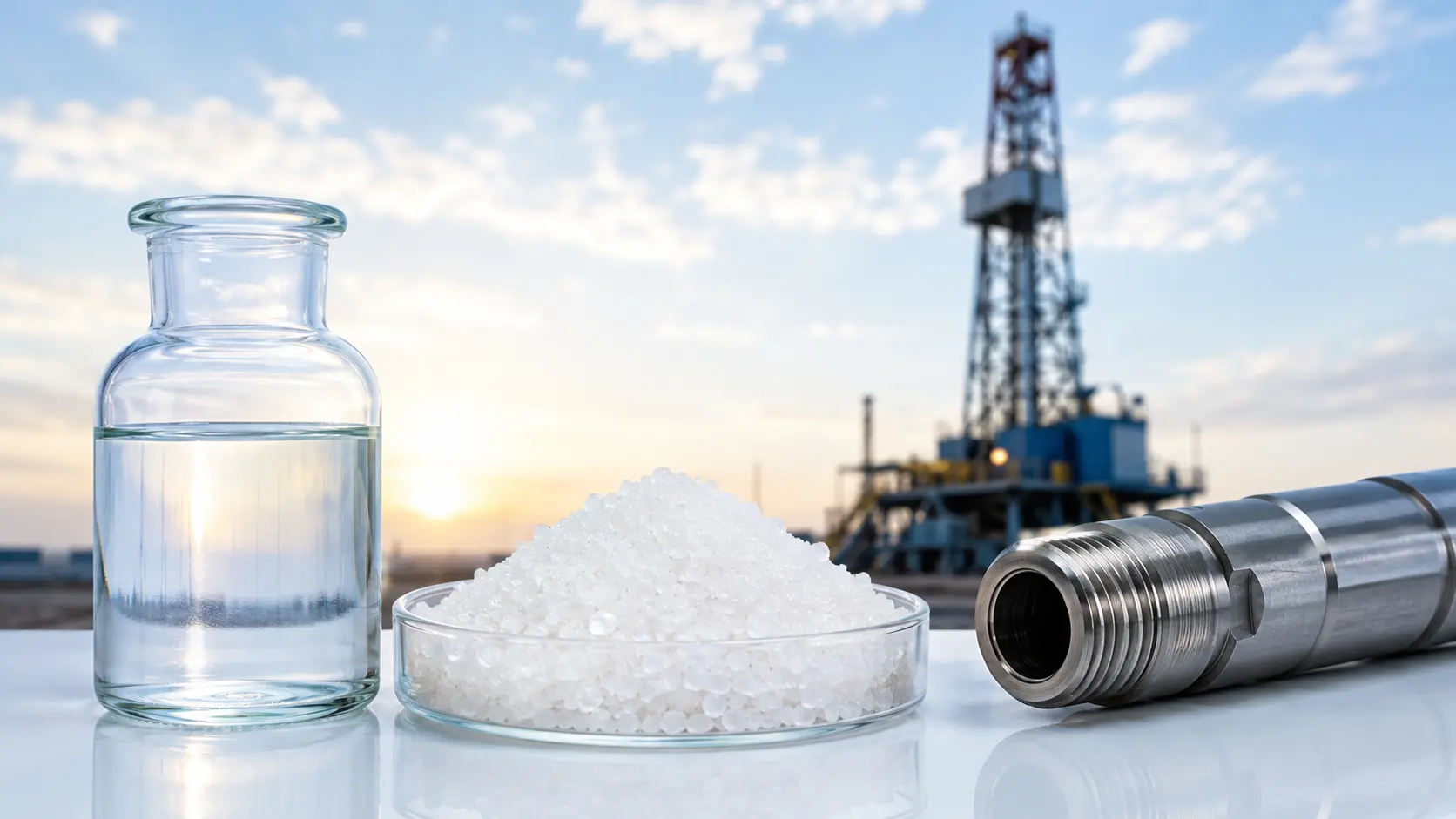
It is not a complete drilling mud by itself.
Potassium formate is normally dissolved in water to form a concentrated brine, and that brine becomes part of a larger drilling-fluid system. Viscosifiers, fluid-loss additives, shale inhibitors, lubricants and other chemicals are then added depending on the formation and drilling program.
This is an important distinction.
Simply adding potassium formate to water does not automatically produce a high-performance drilling fluid. What it does provide is a very useful chemical base that engineers can build around.
For reservoir drilling, directional wells and some high-temperature operations, that can be quite valuable.
What Is Potassium Formate?
Potassium formate is the potassium salt of formic acid.
Its chemical formula is HCOOK, and its CAS number is 590-29-4.
It is highly soluble in water and is commercially available as both concentrated liquid and solid material.
Common oilfield supply forms include:
- 70–75% potassium formate solution
- Approximately 96% solid potassium formate
- Customized concentrated brines
Because potassium formate dissolves rather than remaining suspended in the fluid, it can provide density without introducing large quantities of conventional weighting solids.
That is one of the main reasons oilfield fluid companies are interested in it.
Why Use Potassium Formate for Oil Drilling?
A drilling fluid has to do several things at once.
It needs to:
- Control formation pressure
- Carry cuttings to surface
- Stabilize the wellbore
- Control fluid loss
- Lubricate the drillstring
- Protect the reservoir where possible
- Maintain suitable rheology
Potassium formate mainly contributes to the liquid phase, density and potassium chemistry of the system.
Main Benefits in Oil Drilling
| Benefit | Practical Value |
|---|---|
| High water solubility | Allows concentrated brines |
| Dissolved density | Reduces dependence on weighting solids |
| Potassium chemistry | Can support shale-control strategies |
| Low-solids potential | Useful in reservoir drilling |
| Clear brine capability | Useful for drill-in and completion-related systems |
| Flexible concentration | Density can be adjusted for project needs |
| Liquid or solid supply | Gives buyers logistics options |
The value of each benefit depends on the well.
A shallow conventional well may not need an expensive formate system at all.
A complex reservoir section may justify it.
Potassium Formate Helps Build Density
Mud weight is one of the most basic parameters in drilling.
The fluid must provide enough hydrostatic pressure to help control formation pressure.
Traditional drilling fluids often use barite or another solid weighting material when additional mud weight is needed.
This works very well, and barite is still used all over the world.
However, increasing solid content can also affect:
- Plastic viscosity
- Equivalent circulating density
- Solids-control equipment
- Filtercake characteristics
- Formation invasion
Potassium formate creates density through dissolved salt instead.
A concentrated potassium formate brine can reach around 1.58 SG, approximately 13.1 ppg, depending on concentration and temperature.
That covers a useful range for many drilling applications.
For much higher density, another brine or weighting strategy may be required.
Low-Solids Drilling Systems
Low solids can be especially important when drilling through the reservoir.
During the earlier sections of a well, formation protection may not be the first priority.
Once the drill bit enters the productive zone, things change.
You are drilling through the rock that eventually needs to produce oil or gas.
Excessive fine solids entering that formation can potentially contribute to:
- Pore plugging
- Reduced permeability
- Thick filtercake
- Increased cleanup requirements
- Lower productivity
Potassium formate brine gives engineers a way to obtain part of the required density without loading the fluid with additional suspended weighting solids.
This is one reason formate systems are frequently discussed in reservoir drill-in fluid design.
Potassium Formate in Reservoir Drill-In Fluids
A reservoir drill-in fluid, or RDF, needs to satisfy both drilling and reservoir requirements.
It must still clean the hole and maintain stability, but it should also minimize damage to the productive interval.
A potassium formate-based RDF may include:
| Component | Main Function |
|---|---|
| Potassium formate brine | Base fluid and density |
| Viscosifier | Cuttings suspension and transport |
| Fluid-loss polymer | Controls filtrate invasion |
| Bridging material | Builds a thin filtercake |
| Shale inhibitor | Helps stabilize reactive formations |
| Lubricant | Controls torque and drag |
| pH control | Maintains fluid chemistry |
| Breaker system | Helps clean filtercake later |
This is where formulation becomes more complicated than simply mixing salt and water.
All additives need to perform under high salinity.
Some polymers that work very well in freshwater lose performance in concentrated brines.
Laboratory testing should therefore use the real potassium formate concentration planned for the well.
Shale Stability
Potassium is already familiar to drilling engineers because potassium-based fluids are commonly used around reactive shales.
Some clay minerals can hydrate when they contact water.
This may contribute to:
- Swelling
- Dispersion
- Sloughing
- Tight hole
- Bit balling
- Poor cuttings condition
Potassium ions can help reduce hydration of certain clay systems.
Potassium formate therefore combines potassium chemistry with a dense formate brine.
But it is not accurate to say potassium formate alone completely solves shale instability.
Modern drilling systems may still use dedicated inhibitors, encapsulating polymers or polyamine chemistry.
Formation mineralogy matters.
A fluid that performs beautifully in one shale may behave very differently in another.
Potassium Formate for High-Temperature Wells
High temperature puts stress on the entire drilling-fluid system.
As bottomhole temperature increases, engineers need to worry about:
- Polymer degradation
- Fluid-loss increase
- Rheology changes
- Additive stability
- Corrosion
- Long static periods
Potassium formate brine can be used as the base of high-temperature water-based fluid systems.
There are field applications of mixed sodium/potassium formate reservoir drill-in fluids at temperatures above 300°F.
However, the brine is only one piece of the puzzle.
The polymers must also survive those temperatures.
A stable salt solution with a failed fluid-loss polymer is still a failed drilling fluid.
So high-temperature qualification should test the complete formulation after hot rolling or static aging at representative field conditions.
Potassium Formate vs KCl for Oil Drilling
KCl is probably the more familiar potassium salt in conventional water-based drilling fluids.
Both can contribute potassium ions, but they are not identical products.
| Factor | Potassium Formate | KCl |
|---|---|---|
| Potassium source | Yes | Yes |
| Shale-control contribution | Yes | Yes |
| Dissolved density potential | Higher | Lower |
| High-density clear brine use | Strong advantage | Limited |
| Chloride-based | No | Yes |
| Cost | Usually higher | Usually lower |
| Reservoir drill-in use | Attractive in suitable systems | Also possible |
| Best fit | Higher-performance low-solids systems | Cost-effective conventional inhibition |
If the only requirement is basic potassium inhibition at relatively low mud weight, KCl may be perfectly adequate and cheaper.
Potassium formate becomes more interesting when the operator also wants higher dissolved density and lower suspended solids.
In other words, don't use an expensive chemistry unless the well actually needs it.
Liquid or Solid Potassium Formate?
Oilfield chemical buyers normally have two practical choices.
75% Liquid Potassium Formate
The liquid grade can be pumped directly into tanks and blending systems.
Advantages include:
- Faster fluid preparation
- Less dry-chemical handling
- No dissolution step
- Easy dosing
The downside is that part of every ton shipped is water.
96% Solid Potassium Formate
Solid material contains more active potassium formate per ton.
Advantages include:
- Better freight efficiency
- Lower transported water
- Flexible local brine preparation
- Easier long-distance distribution
The customer needs proper dry storage and dissolution equipment.
For an offshore mud plant preparing brine quickly, liquid may be easier.
For a regional blending plant importing containers over a long distance, solid may make more sense.
Water Quality During Brine Preparation
This part often gets less attention than it should.
If solid potassium formate or concentrate is diluted locally, the makeup water becomes part of the final drilling fluid.
Poor-quality water may introduce:
- Calcium
- Magnesium
- Iron
- Chloride
- Suspended solids
- Other contaminants
For a general drilling fluid, some contamination may be manageable.
For a carefully designed reservoir drill-in fluid, it can create unnecessary problems.
Using clean, tested process water gives the mud engineer much better control.
Laboratory Testing Before Field Use
Potassium formate should be tested in the complete planned drilling-fluid formulation.
Typical evaluations may include:
- Mud weight
- Rheology
- HTHP fluid loss
- Shale recovery
- Dispersion testing
- Thermal aging
- Lubricity
- Formation-water compatibility
- Filtercake quality
- Corrosion behavior
Do not assume that because potassium formate has worked in another oilfield, it will automatically work in yours.
Even similar wells can have different shale mineralogy and formation-water chemistry.
Lab work is cheaper than solving a bad fluid problem at rig time.
What Should Buyers Check?
When purchasing potassium formate for oil drilling, review more than the product price.
Oilfield Purchasing Checklist
| Parameter | Why It Matters |
|---|---|
| Potassium formate content | Confirms active material |
| Physical form | Determines handling method |
| Density | Important for liquid grades |
| Chloride | Relevant to fluid chemistry |
| Carbonate | May affect formulation |
| Iron | Important for clean systems |
| Insoluble matter | Helps control fluid cleanliness |
| Moisture | Important for solid grade |
| Batch consistency | Important for repeat mud formulations |
| COA / TDS / SDS | Required for technical and safety review |
If the project has an internal specification, send it with the RFQ.
That is much more useful than simply asking for “best oilfield grade.”
How to Request a Quote
A practical inquiry might look like:
Product: Potassium Formate for Oil Drilling
Form: 75% Liquid Solution
Application: Reservoir Drill-In Fluid
Target Mud Density: Project specific
Quantity: 40 MT
Packaging: IBC
Required Documents: COA, TDS and SDS
Special Requirements: Controlled chloride and low insoluble matter
For solid material, replace the concentration with the required assay and specify the bag size.
The clearer the RFQ, the more useful the quotation.
Final Thoughts
Potassium formate for oil drilling is most useful when a drilling program needs more than just a basic salt.
It can provide dissolved density, potassium chemistry and a low-solids foundation for advanced water-based drilling and reservoir drill-in fluids.
Its strongest value often appears in demanding wells where engineers need to balance:
- Well control
- Shale stability
- Hole cleaning
- Low solids
- Reservoir protection
- High-temperature performance
But potassium formate is not automatically the right choice for every well.
Good fluid design still depends on the formation, required density, temperature and compatible additive package.
Use potassium formate when it solves a real drilling problem.
That's usually a much better reason than using it simply because it sounds like a premium oilfield chemical.
FAQ
Why is potassium formate used in oil drilling?
It provides dissolved brine density, potassium-containing chemistry and a low-solids base for certain high-performance water-based drilling systems.
Can potassium formate help stabilize shale?
Potassium ions can contribute to shale-inhibition strategies, although additional dedicated inhibitors may still be required.
How dense can potassium formate brine be?
Concentrated potassium formate brine can reach approximately 1.58 SG, or around 13.1 ppg.
Is potassium formate better than KCl?
Not always. KCl is cheaper and well established, while potassium formate is more attractive where higher dissolved density and low-solids performance are also required.
Is liquid or solid potassium formate better for drilling?
Liquid is easier to pump and blend, while solid provides better freight efficiency. The best option depends on the mud plant and logistics.
What should be tested before field use?
The complete fluid should be tested for rheology, fluid loss, shale compatibility, thermal stability, formation compatibility and other project-specific properties.


Contact Us
In This Article
Related Posts
Индивидуальные упаковочные решения от поставщика безводного ацетата натрия в Китае
2026-09-23
Тенденции применения безводного ацетата натрия для специального химического производства
2026-09-23
Безводный ацетат натрия для дубления кожи: улучшает равномерность окрашивания
2026-09-22
Formic Acid 85% for Animal Feed Preservation: Moisture and Storage Stability Guide
2026-09-21


