



Potassium Formate for Gas Drilling: Benefits, Applications and Fluid Selection
By LIN
2026-09-02Related Posts
Индивидуальные упаковочные решения от поставщика безводного ацетата натрия в Китае
2026-09-23
Тенденции применения безводного ацетата натрия для специального химического производства
2026-09-23

Безводный ацетат натрия для дубления кожи: улучшает равномерность окрашивания
2026-09-22
Formic Acid 85% for Animal Feed Preservation: Moisture and Storage Stability Guide
2026-09-21
Potassium formate for gas drilling is mainly used as a high-performance brine component in water-based drilling and reservoir drill-in fluids, especially where engineers need good density, low solids and stable fluid behavior under demanding well conditions.
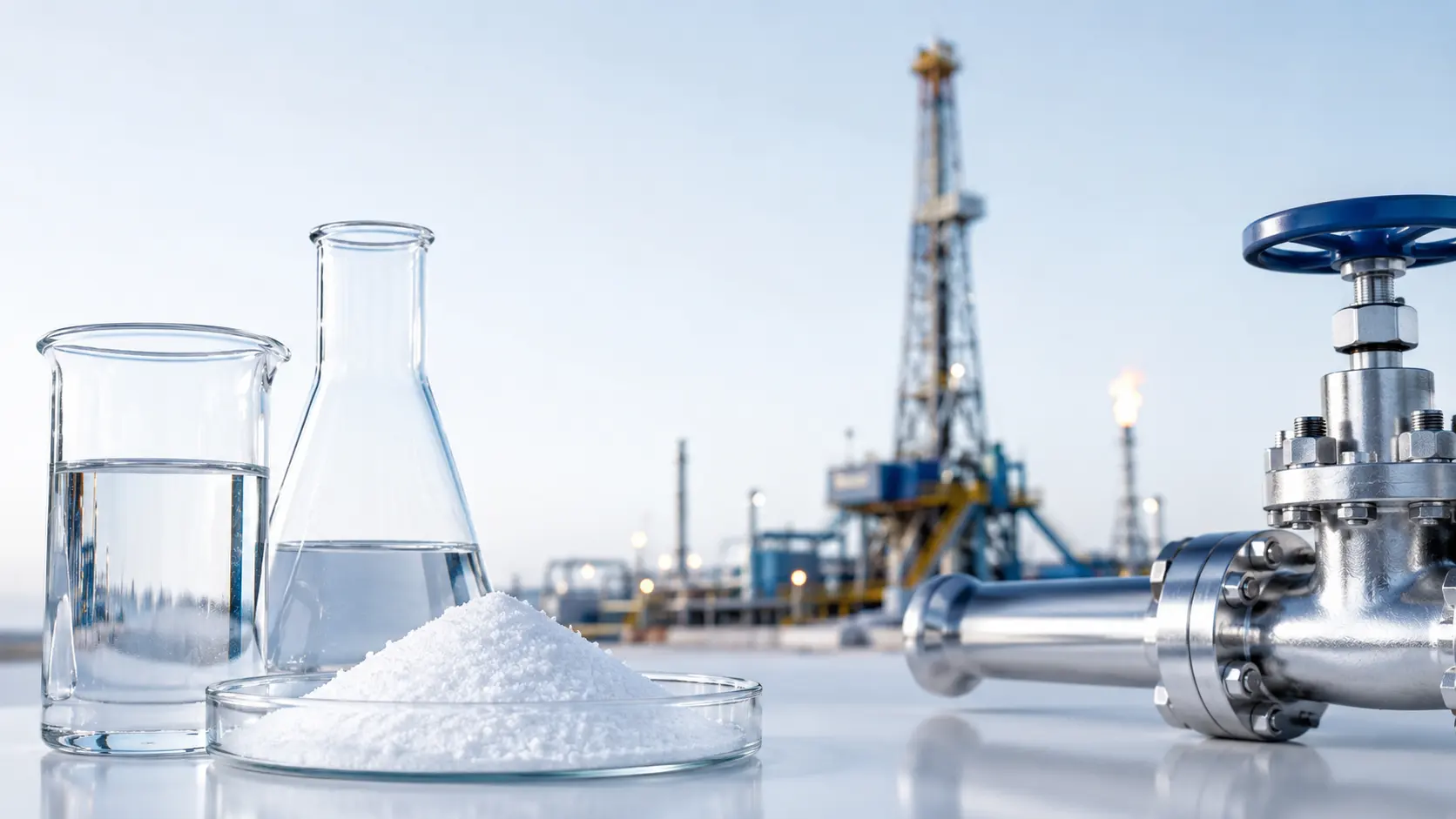
Gas wells can be difficult drilling environments.
Some are deep and hot. Others have reactive shale, narrow pressure windows or formations that are easily damaged by excessive solids and filtrate invasion. High-pressure/high-temperature gas reservoirs can make all of these problems happen at the same time.
Potassium formate does not solve every one of them by itself.
What it does provide is a highly soluble potassium-based brine that can serve as a strong base for a carefully engineered drilling-fluid system.
For the right gas well, that can be very useful.
What Is Potassium Formate?
Potassium formate is the potassium salt of formic acid.
Its chemical formula is HCOOK, and its CAS number is 590-29-4.
In oil and gas operations, potassium formate is commonly supplied as:
- 70–75% concentrated solution
- Approximately 96% solid potassium formate
- Customized formate brine
- Part of sodium/potassium or other formate blends
Potassium formate is highly soluble in water.
A clear concentrated potassium formate solution can reach a density of about 1.58 g/cm³, making it useful as a medium-to-high-density brine for drilling, drill-in and completion applications.
Typical Role in Gas-Well Fluids
| Requirement | What Potassium Formate Can Contribute |
|---|---|
| Fluid density | Density through dissolved salt |
| Low-solids design | Reduces dependence on weighting solids within its density range |
| Shale control | Provides potassium ions for inhibition strategies |
| Reservoir protection | Supports cleaner drill-in fluid design |
| HPHT fluid systems | Can be used with compatible high-temperature polymers |
| Clear brine capability | Useful during reservoir and completion-related operations |
The important phrase here is “can contribute.”
The finished drilling fluid still needs proper engineering.
Why Gas Wells Can Be Hard on Drilling Fluids
A gas reservoir does not automatically require potassium formate.
But some gas wells present exactly the kind of conditions where formate-based fluids become interesting.
Typical challenges can include:
- High formation pressure
- High bottomhole temperature
- Reactive shale
- Narrow drilling margins
- Long horizontal sections
- Reservoir sensitivity
- Fluid losses
- Long static periods during logging or casing operations
There are documented HPHT gas wells where predicted bottomhole temperatures reached around 360°F (182°C), with operators needing water-based systems capable of maintaining stable rheology and filtration under those conditions.
At those temperatures, the question isn't just whether the salt survives.
The whole fluid has to survive.
Polymers, fluid-loss additives and other chemicals have to remain stable too.
Density Without Excessive Suspended Solids
Gas wells require enough hydrostatic pressure to help control formation pressure.
Traditionally, drilling-fluid density may be increased using barite or other weighting solids.
That works very well and remains standard practice.
However, higher solids loading can also increase:
- Plastic viscosity
- Equivalent circulating density
- Solids-control demand
- Barite sag risk
- Filtercake solids
- Formation invasion
Potassium formate provides density through dissolved material.
Within the practical potassium formate density range, this can help engineers build lower-solids systems.
This becomes especially interesting when drilling through the producing gas reservoir.
There, the fluid has to drill the hole but ideally should not leave behind unnecessary damage that reduces future gas flow.
Potassium Formate in Gas Reservoir Drill-In Fluids
Reservoir drill-in fluids are designed differently from general drilling muds.
The productive interval is already being exposed.
A good RDF therefore needs to balance drilling performance with reservoir protection.
Typical requirements include:
- Stable rheology
- Good hole cleaning
- Low fluid loss
- Thin filtercake
- Controlled solids
- Easy cleanup
- Formation compatibility
Formate-based brines can be used as the liquid phase in these systems.
Other additives are then added for viscosity, filtration control and bridging.
Typical Potassium Formate RDF Components
| Component | Purpose |
|---|---|
| Potassium formate brine | Base fluid and density |
| Viscosifier | Hole cleaning and suspension |
| Fluid-loss polymer | Reduces filtrate invasion |
| Sized bridging material | Builds controlled filtercake |
| Shale inhibitor | Improves wellbore stability |
| Lubricant | Reduces torque and drag |
| Corrosion treatment | Used where required |
| Breaker system | Helps remove filtercake before production |
Formate-compatible high-temperature RDF systems have been used in demanding reservoir sections, including mixed sodium/potassium formate systems at temperatures above 300°F.
That does not mean every standard polymer works in potassium formate.
High salinity changes polymer behavior, so the formulation needs laboratory qualification.
High-Temperature Gas Drilling
Temperature is one of the biggest reasons gas-well fluid design can become difficult.
At high bottomhole temperatures, conventional polymers may slowly degrade.
This can lead to:
- Loss of viscosity
- Increased fluid loss
- Poor suspension
- Thick or weak filtercake
- Changes during long static periods
Modern high-temperature water-based drilling-fluid systems use specialized polymers specifically designed to maintain rheology and filtration performance, including in formate-containing brines.
This leads to an important point.
A supplier should not sell potassium formate by saying:
“It is suitable for 180°C drilling.”
That statement is too simple.
Potassium formate may be part of a fluid designed for that environment, but the complete formulation needs to be tested at the expected bottomhole temperature.
Shale Stability in Gas Wells
Many gas wells pass through long shale intervals before reaching the reservoir.
Reactive shale can cause:
- Swelling
- Dispersion
- Sloughing
- Tight hole
- Bit balling
- Poor cuttings integrity
- Increased torque and drag
Potassium-based drilling systems are used because potassium ions can contribute to reducing hydration of certain clay minerals.
Potassium formate provides potassium ions while also supplying high dissolved brine density.
This can be a useful combination.
However, it is not accurate to describe potassium formate as the complete shale-inhibition package.
Depending on the formation, engineers may still use:
- Polyamines
- Encapsulating polymers
- Dedicated shale inhibitors
- Glycol-type additives
- Other stabilizing chemistry
Gas-well shale can vary enormously from one field to another.
Laboratory testing with representative cuttings or core material is much more useful than relying on a generic claim.
Narrow Pressure Windows
Some deep gas wells have relatively little margin between pore pressure and fracture pressure.
This makes equivalent circulating density, or ECD, important.
A fluid with excessive solids or poor rheology can create higher circulating pressure than desired.
A low-solids formate-based fluid can sometimes help engineers manage this problem by providing a portion of the required density through dissolved salts.
That doesn't automatically solve ECD issues.
Flow rate, rheology, annular geometry and cuttings loading still matter.
But it can give the drilling team another tool when designing the fluid.
Reservoir Damage Matters a Lot in Gas Wells
A gas reservoir needs permeability.
Even relatively small changes around the wellbore can affect production, particularly in lower-permeability formations.
Potential damage can come from:
- Fine solids
- Excessive filtrate invasion
- Incompatible brine
- Scale precipitation
- Poorly removable filtercake
- Lost-circulation materials
Industry case studies have documented gas wells where drilling-related damage became serious enough to require later intervention to restore access to the formation.
This is why low-solids reservoir fluids receive so much attention.
Potassium formate can support that approach, but the filtercake and bridging system still have to be designed correctly.
Potassium Formate vs KCl in Gas Drilling
KCl is probably the more common potassium salt in conventional water-based drilling.
It is inexpensive and well understood.
Potassium formate offers a different performance profile.
| Factor | Potassium Formate | KCl |
|---|---|---|
| Potassium source | Yes | Yes |
| Shale-control contribution | Yes | Yes |
| Dissolved density | Higher | Lower |
| Low-solids high-density design | More attractive | More limited |
| Chloride-based | No | Yes |
| Cost | Usually higher | Usually lower |
| HPHT/RDF use | Attractive in engineered systems | Common in conventional WBM |
| Best choice | Depends on well | Depends on well |
If the gas well only needs basic potassium inhibition, KCl may make much better economic sense.
Potassium formate becomes more attractive when the project also needs higher dissolved density, reservoir protection or more specialized brine chemistry.
Liquid or Solid Potassium Formate?
Gas-drilling fluid companies can purchase potassium formate in two common forms.
75% liquid solution is convenient for rapid fluid preparation.
It can be pumped directly into blending tanks.
96% solid potassium formate contains more active chemical per ton shipped and may be more economical for long-distance transportation.
Solid material does require:
- Dry storage
- Moisture protection
- Dissolution equipment
- Mixing time
The choice is mainly operational.
A remote mud plant with good blending equipment may prefer solid.
An offshore fluid facility that needs brine quickly may prefer liquid concentrate.
What Should Be Tested Before Field Use?
A potassium formate gas-drilling fluid should be tested as a complete system.
Typical laboratory work may include:
- Mud weight
- Rheology
- HTHP fluid loss
- Thermal aging
- Shale recovery
- Dispersion testing
- Lubricity
- Filtercake quality
- Formation-water compatibility
- Corrosion behavior
For HPHT gas wells, static aging is especially important because the fluid may sit downhole for extended periods during logging, trips or casing operations.
A fluid that looks perfect after 30 minutes in the lab may behave very differently after many hours at high temperature.
Buying Potassium Formate for Gas Drilling
A useful RFQ should include actual project information.
For example:
Product: Potassium Formate
Application: Gas-Well Reservoir Drill-In Fluid
Form: 75% Solution
Required Density: Project specific
Quantity: 40 MT
Packaging: IBC
Required Documents: COA, TDS and SDS
Special Requirements: Controlled chloride and low insoluble matter
Oilfield buyers may also review:
- Potassium formate content
- Density
- pH
- Chloride
- Carbonate
- Iron
- Insoluble matter
- Batch consistency
If an internal oilfield specification already exists, send it to the supplier.
That is much better than asking for “best gas drilling grade.”
Final Thoughts
Potassium formate for gas drilling can be a useful raw material for high-performance water-based drilling and reservoir drill-in systems.
Its main value comes from combining:
- Dissolved density
- Low-solids potential
- Potassium chemistry
- Clear-brine capability
- Compatibility with properly engineered HPHT systems
This can be particularly valuable in deep gas wells, reactive shale sections and sensitive reservoir intervals.
But potassium formate should never be selected only because the well is a gas well.
The formation pressure, bottomhole temperature, shale mineralogy, density window and reservoir compatibility have to justify the chemistry.
For the right gas well, potassium formate can provide a very good base fluid.
For another well, a simpler and cheaper brine may do the job perfectly well.
Good drilling-fluid design starts with the well conditions, not the chemical brochure.
FAQ
Why is potassium formate used in gas drilling?
It can provide dissolved brine density, potassium-based chemistry and a low-solids base for high-performance water-based drilling fluids.
Is potassium formate suitable for HPHT gas wells?
It can be used as part of engineered HPHT drilling-fluid systems, but the complete polymer and additive package must be tested at the expected downhole temperature.
Can potassium formate help control shale?
Potassium ions can contribute to shale-inhibition strategies, although additional dedicated shale-control additives may be required.
How dense can potassium formate brine become?
Concentrated potassium formate clear solution can reach about 1.58 g/cm³, depending on concentration and temperature.
Is potassium formate better than KCl for gas drilling?
Not always. KCl is economical and widely used. Potassium formate becomes more attractive when higher dissolved density and low-solids performance are also needed.
Should potassium formate be tested before field use?
Yes. The full drilling-fluid formulation should be tested for rheology, HTHP fluid loss, thermal stability, shale compatibility and reservoir compatibility before field deployment.


Contact Us
In This Article
Related Posts
Индивидуальные упаковочные решения от поставщика безводного ацетата натрия в Китае
2026-09-23
Тенденции применения безводного ацетата натрия для специального химического производства
2026-09-23
Безводный ацетат натрия для дубления кожи: улучшает равномерность окрашивания
2026-09-22
Formic Acid 85% for Animal Feed Preservation: Moisture and Storage Stability Guide
2026-09-21


