



High Density Potassium Formate Drilling Fluid: Performance, Applications and Fluid Design
By LIN
2026-09-02Related Posts
Индивидуальные упаковочные решения от поставщика безводного ацетата натрия в Китае
2026-09-23
Тенденции применения безводного ацетата натрия для специального химического производства
2026-09-23

Безводный ацетат натрия для дубления кожи: улучшает равномерность окрашивания
2026-09-22
Formic Acid 85% for Animal Feed Preservation: Moisture and Storage Stability Guide
2026-09-21
A high density potassium formate drilling fluid is mainly used when a well requires relatively high mud weight but engineers also want to keep suspended solids under better control.
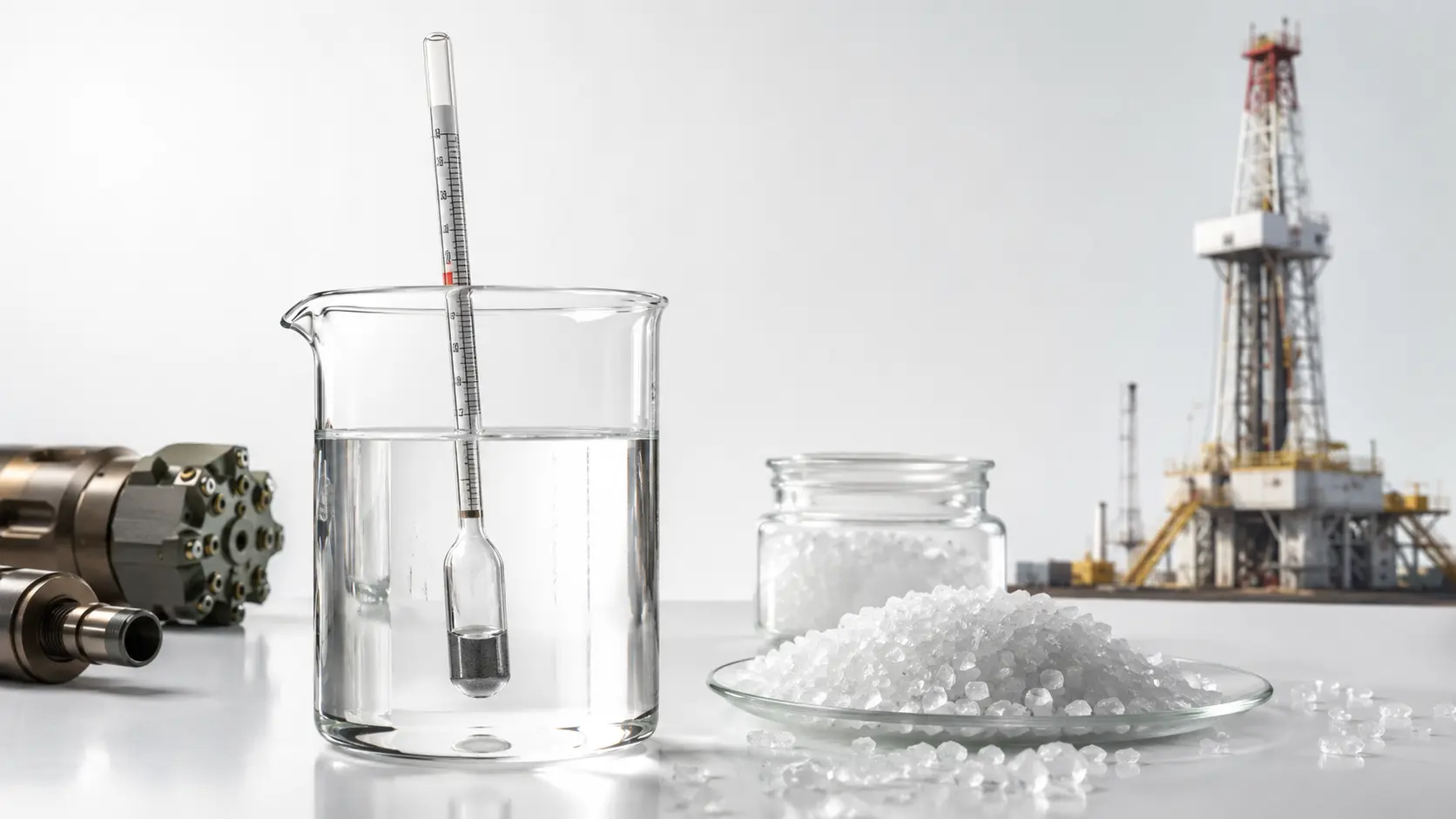
This combination can be useful in deep wells, reservoir sections, high-temperature drilling and wells with a narrow operating window between pore pressure and fracture pressure.
Potassium formate is highly soluble in water. Instead of obtaining all drilling-fluid density by adding barite or another solid weighting agent, part of the mud weight can come directly from dissolved potassium formate.
That sounds like a small difference, but it can change the way the entire fluid behaves.
Lower weighting-solid concentration may help with rheology, solids management and reservoir protection. At the same time, the drilling fluid still needs enough density to control formation pressure.
The trick is finding the right balance.
What Is High Density Potassium Formate Drilling Fluid?
Potassium formate is the potassium salt of formic acid.
Its chemical formula is HCOOK, and its CAS number is 590-29-4.
A concentrated potassium formate brine can reach approximately 1.58 g/cm³, which is roughly 13.1 ppg. Industry references identify sodium, potassium and cesium formates as clear brines capable of about 1.32, 1.58 and 2.4 g/cm³ respectively.
That does not mean every potassium formate drilling fluid must be 13.1 ppg.
It means potassium formate gives engineers a relatively dense liquid base.
The final mud may be lighter or, when properly engineered, may be weighted further using other components.
Basic High-Density Formate Fluid Concept
| Component | Main Function |
|---|---|
| Potassium formate brine | Base fluid and dissolved density |
| Viscosifier | Hole cleaning and suspension |
| Fluid-loss additive | Controls filtrate invasion |
| Shale inhibitor | Improves reactive formation stability |
| Lubricant | Reduces torque and drag |
| Bridging material | Helps control reservoir fluid invasion |
| Weighting agent if needed | Raises finished mud weight beyond base brine density |
| pH / corrosion treatment | Maintains suitable fluid chemistry |
So potassium formate should be viewed as the dense brine foundation rather than the entire drilling-fluid system.
Why High Density Matters
Mud weight controls hydrostatic pressure in the wellbore.
If the drilling fluid is too light, formation fluids may enter the well.
If it is too heavy, the additional pressure can fracture weaker formations and contribute to lost circulation.
This means the objective is not simply:
Make the drilling fluid as heavy as possible.
The real objective is:
Maintain enough mud weight to control the well while staying below the formation's fracture limit.
SLB notes that mud weight is one of the primary controls on wellbore hydrostatic pressure and that excessive mud weight can contribute to lost circulation.
This becomes particularly important in deep and high-pressure wells.
Why Use Potassium Formate Instead of Only Adding More Barite?
Barite is a proven and widely used drilling-fluid weighting material.
There is nothing wrong with barite.
The issue appears when a high mud weight requires a very large concentration of suspended solids.
As solids increase, the fluid may become more difficult to manage.
Potential concerns include:
- Higher plastic viscosity
- Increased ECD
- Greater solids-control load
- Higher risk of sag in some weighted systems
- Thicker filtercake
- More solids reaching the reservoir section
Potassium formate provides density through dissolved ions.
Formate salts are extremely soluble and can form high-density, solids-free brines, which reduces the amount of weighting material needed in suitable systems.
Notice the word reduces.
It does not necessarily eliminate weighting solids from every high-density drilling fluid.
Brine Density vs Finished Mud Density
This distinction is probably the most important part of the topic.
A pure concentrated potassium formate brine has a practical density around 13.1 ppg.
But a finished drilling fluid based on potassium formate may be engineered to a different mud weight.
For example, the fluid engineer may use potassium formate brine as the base and then add a suitable weighting material when additional density is required.
Alternatively, another formate such as cesium formate may be considered when a clear brine itself needs much higher density.
Simplified Density Strategy
| Required Mud Condition | Possible Fluid Direction |
|---|---|
| Below potassium formate maximum | Adjust potassium formate concentration |
| Around 11–13 ppg | High-concentration potassium formate may provide most density |
| Above potassium brine limit | Engineer a weighted formate drilling fluid |
| Need very high-density clear brine | Evaluate higher-density formate blends |
| Narrow pressure window | Optimize density, rheology and ECD together |
This is why saying “potassium formate drilling fluid can only reach 13.1 ppg” is not quite correct.
The brine has that approximate single-salt limit.
The finished mud is an engineered system.
High Density Fluids and ECD
Equivalent circulating density becomes increasingly important in deeper wells and long horizontal sections.
A static drilling fluid may have a safe mud weight, but when it starts circulating, friction adds extra pressure.
The formation effectively sees a higher bottomhole pressure.
If rheology is unnecessarily high, ECD can increase.
A high-density fluid with a large amount of weighting solids may therefore become harder to manage in a narrow drilling window.
Using a dense formate brine can sometimes reduce the amount of solid weighting material required and give the fluid engineer more flexibility.
But potassium formate does not magically solve ECD.
ECD is still influenced by:
- Mud weight
- Rheology
- Flow rate
- Hole geometry
- Cuttings loading
- Temperature
- Annular restrictions
The whole hydraulic system needs to be modeled.
Reservoir Drilling Applications
High-density potassium formate fluids can be particularly interesting when drilling through the reservoir.
Here, the engineer needs enough mud weight for well control but also wants to minimize unnecessary formation damage.
Excessive suspended solids may contribute to:
- Pore plugging
- Filtercake buildup
- Reduced permeability
- Difficult cleanup
- Lower well productivity
A formate-based reservoir drill-in fluid can obtain much of its density from the brine phase while using carefully sized bridging particles for filtration control.
This gives the engineer more control over which solids actually enter the fluid.
Instead of carrying a large amount of weighting material simply to achieve density, the solids package can focus more specifically on filtercake design.
High-Temperature Drilling
Potassium formate is also relevant to some high-temperature water-based drilling systems.
But high temperature places stress on far more than the brine.
The fluid may also contain:
- Xanthan or other viscosifiers
- Starch derivatives
- Synthetic polymers
- Fluid-loss additives
- Lubricants
- Bridging materials
All of these have to remain functional after extended exposure to bottomhole temperature.
A documented mixed sodium/potassium formate reservoir drill-in fluid was used at 11.5–11.8 ppg and tested at bottomhole temperatures up to 340°F (171°C) while maintaining stable fluid behavior with a suitable temperature-stabilizing additive package.
That is an important example because it shows how formate works in practice.
Not as a stand-alone chemical.
As part of a complete engineered fluid.
Shale Stability
Potassium formate also provides potassium ions.
This can be useful in drilling sections containing reactive shale.
Potassium-based chemistry may help reduce hydration and dispersion of some clay formations, supporting better:
- Cuttings integrity
- Wellbore stability
- Hole condition
- Bit performance
However, high density does not automatically mean strong inhibition.
A complete system may still require dedicated shale-control additives.
If the formation contains highly reactive shale, representative cuttings should be tested using the actual planned fluid.
There is no substitute for laboratory work here.
Rheology Still Needs Careful Control
One possible mistake when designing a high-density fluid is focusing almost completely on mud weight.
A drilling fluid still has to move.
It needs enough viscosity and low-shear structure to transport cuttings, but it cannot become so viscous that pumping pressure becomes excessive.
Typical monitoring may include:
- Plastic viscosity
- Yield point
- Gel strengths
- Low-shear rheology
- HTHP fluid loss
- Mud weight
The high ionic concentration of potassium formate may also affect polymer hydration.
That means additives should be selected specifically for brine compatibility.
Freshwater polymer performance cannot simply be assumed to transfer directly to a concentrated formate system.
Liquid vs Solid Potassium Formate
High-density drilling-fluid plants may purchase either concentrated liquid or solid potassium formate.
| Factor | 75% Liquid | 96% Solid |
|---|---|---|
| Fluid preparation | Faster | Requires dissolution |
| Active content per ton | Lower | Higher |
| Freight efficiency | Lower | Higher |
| Pump handling | Direct | After dissolution |
| Storage | IBC / bulk tank | Dry warehouse |
| Field blending | Convenient | More preparation needed |
| Long-distance transport | More water shipped | More active chemical shipped |
A liquid mud plant that needs to prepare brine quickly may prefer 75% concentrate.
A centralized blending facility with good dissolution equipment may prefer solid potassium formate.
The best option often comes down to logistics rather than chemistry.
What Should Be Tested Before Field Use?
A high-density potassium formate drilling fluid should be qualified as a complete system.
Typical tests may include:
- Mud weight
- Rheology
- HTHP filtration
- Thermal aging
- Sag behavior when weighting solids are added
- Shale inhibition
- Lubricity
- Formation compatibility
- Filtercake quality
- Corrosion
For reservoir drilling, return permeability or core-flow testing may also be considered.
One kilogram of potassium formate can tell you its chemical purity.
It cannot tell you whether the complete drilling fluid will protect the reservoir.
What Should Buyers Specify?
For a high-density drilling project, an RFQ should include more than product concentration.
A useful inquiry might state:
Product: Potassium Formate
Application: High Density Drilling Fluid
Product Form: 75% Liquid Solution
Target Finished Mud Weight: 14.0 ppg
Quantity: 40 MT
Packaging: IBC
Required Documents: COA, TDS and SDS
Special Requirements: Controlled chloride and low insoluble matter
Notice that the RFQ separates:
Potassium formate product concentration
from
final drilling-fluid density.
This avoids a lot of technical misunderstanding.
Final Thoughts
A high density potassium formate drilling fluid gives drilling engineers another way to obtain mud weight without relying entirely on suspended weighting solids.
Concentrated potassium formate brine itself can reach around 1.58 SG or 13.1 ppg. For higher finished mud weights, the formate brine can become the base of a more heavily engineered drilling-fluid system.
The main potential advantages are:
- High dissolved density
- Lower solids loading
- Flexible fluid design
- Potassium-based chemistry
- Good fit for some reservoir and high-temperature applications
But high density alone does not make a good drilling fluid.
Rheology, ECD, filtration, thermal stability, shale compatibility and formation protection still have to work together.
The best formate fluid is not necessarily the one with the highest mud weight.
It is the one that gives the well enough pressure control without creating new drilling problems.
FAQ
How dense can potassium formate brine become?
Concentrated single-salt potassium formate brine can reach approximately 1.58 SG, or about 13.1 ppg.
Can a potassium formate drilling fluid be heavier than 13.1 ppg?
Yes. The base potassium formate brine has an approximate 13.1 ppg limit, but a finished drilling fluid can be engineered to higher density using an appropriate weighting strategy.
Why use potassium formate in high-density drilling fluid?
It provides density through dissolved salt, potentially reducing the amount of suspended weighting solids required.
Can potassium formate help reduce ECD?
It may help engineers design lower-solids systems, but ECD also depends on rheology, flow rate, geometry and cuttings loading.
Is potassium formate suitable for HPHT drilling?
It can be used as part of properly engineered high-temperature systems, but the complete polymer and additive package must be qualified at expected downhole conditions.
Is potassium formate better than barite?
They perform different roles. Potassium formate provides dissolved density, while barite is a powerful solid weighting material. Many engineered systems may use both depending on required mud weight.


Contact Us
In This Article
Related Posts
Индивидуальные упаковочные решения от поставщика безводного ацетата натрия в Китае
2026-09-23
Тенденции применения безводного ацетата натрия для специального химического производства
2026-09-23
Безводный ацетат натрия для дубления кожи: улучшает равномерность окрашивания
2026-09-22
Formic Acid 85% for Animal Feed Preservation: Moisture and Storage Stability Guide
2026-09-21


