



Potassium Formate Liquid Ice Melt: Performance, Applications and Buying Guide
By LIN
2026-09-02Related Posts
Индивидуальные упаковочные решения от поставщика безводного ацетата натрия в Китае
2026-09-23
Тенденции применения безводного ацетата натрия для специального химического производства
2026-09-23

Безводный ацетат натрия для дубления кожи: улучшает равномерность окрашивания
2026-09-22
Formic Acid 85% for Animal Feed Preservation: Moisture and Storage Stability Guide
2026-09-21
Potassium formate liquid ice melt is a liquid winter-maintenance solution used to loosen ice, reduce ice-to-pavement bonding and help keep roads, bridges, industrial yards and other paved areas safer during freezing weather.
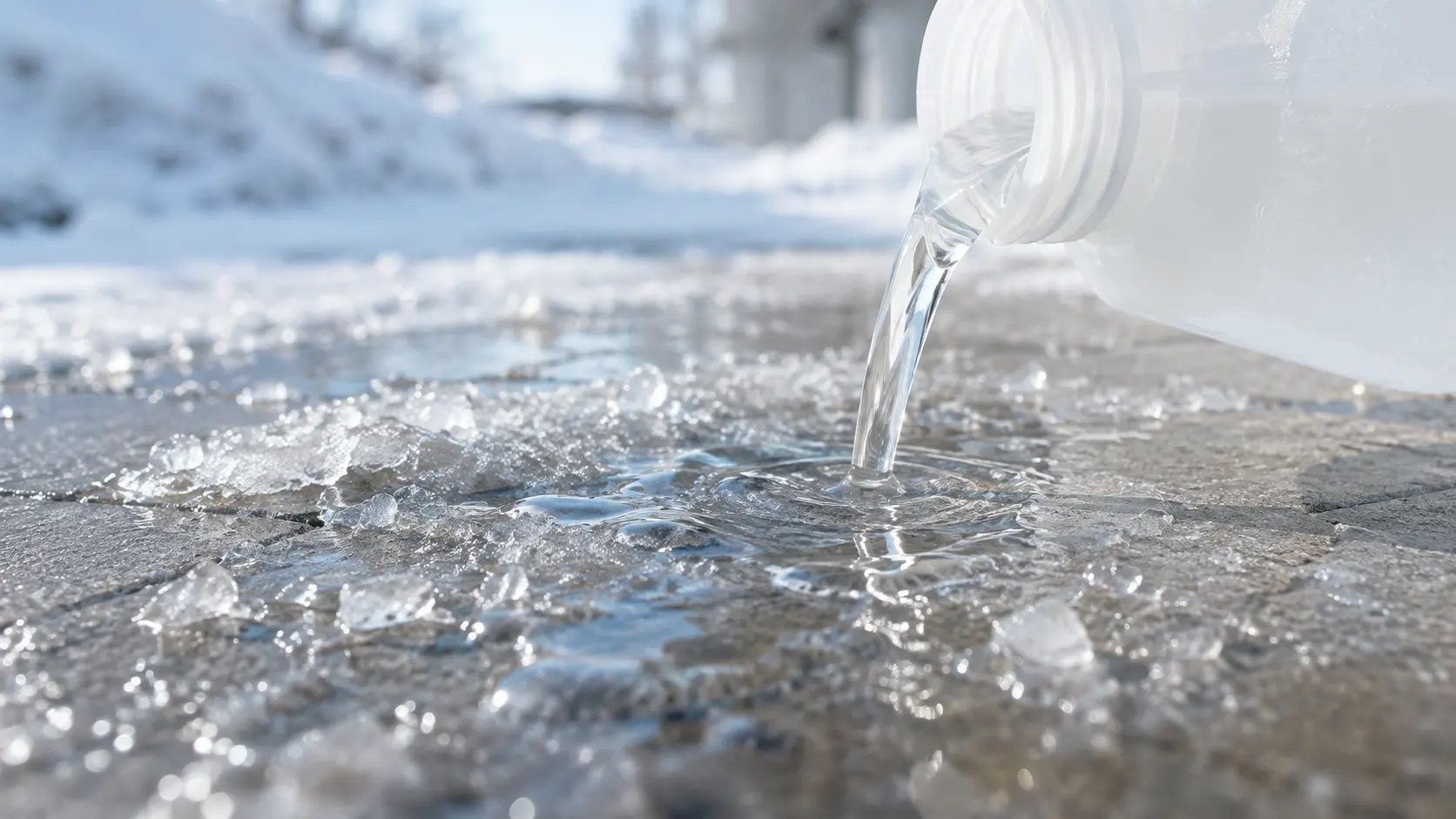
Compared with traditional dry road salt, liquid ice melt has one obvious advantage: it is already in solution.
That means the active chemical can spread across the surface immediately rather than waiting for a solid salt to dissolve first. For preventive treatment, this can be especially useful because a controlled liquid layer can be applied before frost or ice becomes firmly bonded to the pavement.
Potassium formate is well suited to this type of formulation because it is highly soluble in water and uses formate rather than chloride as its main active chemistry.
For manufacturers producing winter-maintenance fluids, concentrated Potassium Formate 75% Solution can be used as a liquid feedstock and then adjusted to the required working concentration.
The final ice-melt formulation, however, should be selected according to pavement temperature, weather conditions, corrosion performance and application equipment.
What Is Potassium Formate Liquid Ice Melt?
Potassium formate has the chemical formula HCOOK and CAS No. 590-29-4.
In liquid ice-melt products, potassium formate is dissolved in water at a controlled concentration.
The finished formulation may also include:
- Corrosion inhibitors
- pH-control components
- Performance additives
- Stabilizing components
- Clean process water
The result is normally a clear or nearly colorless liquid that can be applied through spray bars, nozzles, tank trucks or fixed anti-icing equipment.
Vanchor's dedicated Potassium Formate Liquid Deicer guide describes potassium formate liquids as suitable for spraying, pre-wetting and automated winter-maintenance systems.
Main Functions of Liquid Ice Melt
| Function | Practical Benefit |
|---|---|
| Freezing-point depression | Keeps water liquid below its normal freezing point |
| Ice penetration | Helps reach the ice-pavement interface |
| Ice-bond weakening | Makes mechanical removal easier |
| Liquid spreading | Gives more uniform surface coverage |
| Anti-icing | Helps prevent strong ice bonding |
| Deicing | Helps loosen existing frost and ice |
The chemical does not need to completely dissolve every layer of snow to be useful.
Sometimes weakening the bond between ice and pavement is enough to make snowplows and sweepers much more effective.
How Does Potassium Formate Melt Ice?
When potassium formate dissolves in water, the dissolved ions lower the solution's freezing point.
When the liquid contacts ice, it begins mixing with water at the ice surface.
This creates a brine with a freezing temperature below 0°C.
As the solution penetrates deeper, it can weaken the bond between the frozen layer and the pavement underneath.
Performance depends on:
- Potassium formate concentration
- Pavement temperature
- Ice thickness
- Snow or rain dilution
- Application rate
- Contact time
This is why manufacturers should avoid claiming one universal minimum working temperature without specifying the actual formulation.
The relationship between concentration and freezing behavior is discussed in more detail in Vanchor's Potassium Formate Freezing Point guide.
More concentrate is not always better.
A properly designed working concentration is more important than simply using the strongest product available.
Liquid Ice Melt vs Dry Ice Melt
Traditional winter-maintenance products are often supplied as solid salts.
Both formats can work, but they behave differently.
| Factor | Potassium Formate Liquid Ice Melt | Dry Road Salt |
|---|---|---|
| Product state | Already dissolved | Solid |
| Surface coverage | Uniform spray possible | Granules distributed across pavement |
| Initial action | No dissolution step required | Must form brine first |
| Anti-icing | Very suitable | Possible with pre-wetting |
| Automated systems | Easy to integrate | Less convenient |
| Bounce and scatter | Low | Can occur |
| Application control | Precise dosing possible | Depends on spreader calibration |
FHWA winter-maintenance guidance notes that liquid chemicals can provide uniform pavement coverage and can be applied to dry pavement before a storm to help prevent bonded snow and ice.
This preventive capability is one reason liquid ice-melt products are popular for bridges and other high-risk areas.
Deicing and Anti-Icing
A potassium formate liquid can perform two related jobs.
Deicing
The fluid is applied after ice has already formed.
The objective is to loosen or melt:
- Frost
- Thin ice
- Compacted ice
- Bonded snow
Anti-Icing
The fluid is applied before or during the early stage of freezing.
Its purpose is to keep ice from bonding strongly to the pavement.
For many sites, prevention is easier than trying to remove a thick frozen layer later.
When Each Strategy Makes Sense
| Situation | Preferred Strategy |
|---|---|
| Frost forecast overnight | Anti-icing |
| Bridge expected to freeze | Anti-icing |
| Thin ice already present | Deicing |
| Compacted snow on pavement | Deicing + mechanical removal |
| Regular winter industrial access | Planned anti-icing program |
| Heavy snowfall | Chemical + plowing |
A liquid ice-melt program normally works best when it is combined with accurate weather monitoring and mechanical snow removal.
Why Use Potassium Formate Instead of Chloride Brine?
Sodium chloride brine is much cheaper and is still the standard choice for many road systems.
Potassium formate should not be promoted as a replacement for road salt everywhere.
Its value becomes clearer where operators care about reducing chloride exposure.
Chloride salts can contribute to corrosion of:
- Vehicles
- Steel structures
- Reinforced concrete
- Pumps
- Electrical equipment
- Sensitive infrastructure
Potassium formate is based on formate chemistry instead of chloride.
This makes it attractive for specialized applications such as:
- Bridge decks
- Industrial facilities
- Logistics terminals
- Sensitive parking structures
- Selected airport-side pavement systems
Still, potassium formate should not simply be called “non-corrosive.”
The finished product needs proper corrosion testing because pH, impurities, concentration and corrosion inhibitors all affect actual performance.
Where Is Potassium Formate Liquid Ice Melt Used?
Potassium formate formulations may be considered for:
Roads and Bridges
High-risk areas include:
- Bridge decks
- Elevated ramps
- Intersections
- Steep approaches
- Tunnel entrances
Bridges are particularly suitable because they can freeze earlier than nearby ground-level roads.
Industrial Sites
Possible locations include:
- Factory roads
- Loading docks
- Warehouse entrances
- Emergency access roads
- Outdoor production areas
Maintaining access can be more important than minimizing chemical cost at these sites.
Logistics Facilities
Distribution centers and container yards need reliable vehicle movement.
Liquid treatment can help keep:
- Loading lanes
- Truck approaches
- Parking areas
- Yard roads
usable during winter conditions.
Airport-Related Areas
Potassium formate chemistry is also used in qualified airfield pavement products.
However, standard industrial potassium formate should not automatically be described as a certified runway deicer.
Finished aviation formulations have separate performance, corrosion and qualification requirements.
Choosing the Right Concentration
One of the biggest mistakes is assuming that a 75% potassium formate concentrate should simply be sprayed at 75%.
A manufacturer may buy a strong concentrate because it simplifies shipping and storage.
The concentrate can then be diluted according to:
- Minimum pavement temperature
- Expected precipitation
- Required ice-melting rate
- Pump viscosity
- Corrosion performance
- Product economics
A working solution that is too dilute may lose effectiveness quickly when mixed with melting snow.
A formulation that is unnecessarily concentrated can increase cost without providing a meaningful improvement.
The correct concentration should come from actual performance testing.
Storage and Spray Equipment
A liquid ice melt needs to remain pumpable throughout the winter season.
Important storage issues include:
- Crystallization
- Tank temperature
- Long-term stability
- Precipitation
- Contamination
- Pump compatibility
Application equipment should also be checked.
Typical systems include:
- Truck-mounted spray bars
- Nozzle systems
- Fixed bridge sprayers
- Automated anti-icing equipment
Insoluble contamination can block filters or spray nozzles, so raw-material quality and clean storage matter.
What Should Buyers Check?
For potassium formate used in liquid ice-melt production, purchasing teams should normally review more than assay.
Raw-Material Purchasing Checklist
| Parameter | Why It Matters |
|---|---|
| Potassium formate concentration | Confirms active content |
| Density | Helps verify liquid consistency |
| pH | Influences finished formulation |
| Chloride | Important for low-chloride positioning |
| Iron | Supports quality consistency |
| Insoluble matter | Helps protect spray equipment |
| Appearance | Useful incoming QC check |
| Batch consistency | Supports repeatable finished products |
| COA | Confirms batch quality |
| TDS / SDS | Supports technical review and handling |
For the final ice-melt product, manufacturers should also test freezing behavior, corrosion, storage stability and actual ice-control performance.
Liquid or Solid Potassium Formate?
Manufacturers have two main sourcing options.
75% liquid potassium formate is easier when immediate liquid blending is the priority.
≥96% solid potassium formate can improve freight efficiency because less water is transported, but the manufacturer needs dissolution equipment.
For a large liquid ice-melt plant, 75% concentrate may simplify production.
For a manufacturer importing potassium formate over a long distance and already equipped with dissolution tanks, solid product can also make sense.
The cheapest price per ton is not necessarily the lowest cost per ton of finished ice melt.
How to Request a Quote
A useful inquiry might look like:
Product: Potassium Formate
Application: Liquid Ice Melt Manufacturing
Preferred Form: 75% Liquid Concentrate
Quantity: 80 MT
Packaging: IBC / Flexitank
Required Documents: COA, TDS and SDS
Special Requirements: Controlled chloride and insoluble matter
End Use: Road, Bridge and Industrial Winter Maintenance
Providing the end use helps the supplier understand that the product will be used in a deicing formulation rather than a general industrial process.
Final Thoughts
A potassium formate liquid ice melt offers a practical combination of high water solubility, liquid spray application, freezing-point depression and non-chloride formate chemistry.
Its strongest applications are usually not the cheapest general road-salt markets.
Instead, it tends to make more sense for:
- Bridges
- High-risk road sections
- Industrial facilities
- Logistics sites
- Specialized winter-maintenance programs
The liquid format also makes preventive anti-icing easier.
But raw potassium formate is only the starting material.
The finished product still needs the correct concentration, good corrosion behavior, stable winter storage and accurate application.
Good liquid ice melt is not just about how much potassium formate is in the tank.
It is about how efficiently that formulation keeps ice from becoming a problem.
FAQ
What is potassium formate liquid ice melt?
It is an aqueous potassium formate formulation used to melt or loosen ice and reduce the bond between frozen precipitation and pavement.
Is potassium formate suitable for anti-icing?
Yes. Liquid potassium formate formulations can be applied before freezing conditions to help prevent strong ice-pavement bonding.
Is potassium formate better than road salt?
Not for every application. Road salt is cheaper, while potassium formate is more attractive for specialized sites where liquid application and reduced chloride exposure are important.
Can 75% potassium formate be used directly as liquid ice melt?
It is better considered a concentrated feedstock. The final working concentration should be selected according to winter temperature, corrosion and performance requirements.
Is potassium formate liquid ice melt non-corrosive?
Not automatically. It avoids chloride as the main active salt, but the complete formulation still needs corrosion and material-compatibility testing.
What should buyers request from a supplier?
Buyers should normally request a COA, TDS and SDS and review concentration, density, pH, chloride, iron, insoluble matter and batch consistency.


Contact Us
In This Article
Related Posts
Индивидуальные упаковочные решения от поставщика безводного ацетата натрия в Китае
2026-09-23
Тенденции применения безводного ацетата натрия для специального химического производства
2026-09-23
Безводный ацетат натрия для дубления кожи: улучшает равномерность окрашивания
2026-09-22
Formic Acid 85% for Animal Feed Preservation: Moisture and Storage Stability Guide
2026-09-21


