



Potassium Formate Commercial Deicer: Applications, Performance and Buying Guide
By LIN
2026-09-02Related Posts
Индивидуальные упаковочные решения от поставщика безводного ацетата натрия в Китае
2026-09-23
Тенденции применения безводного ацетата натрия для специального химического производства
2026-09-23

Безводный ацетат натрия для дубления кожи: улучшает равномерность окрашивания
2026-09-22
Formic Acid 85% for Animal Feed Preservation: Moisture and Storage Stability Guide
2026-09-21
A potassium formate commercial deicer is a liquid or formulated winter-maintenance product used by businesses, property managers, industrial sites and logistics operators to control ice on paved surfaces.
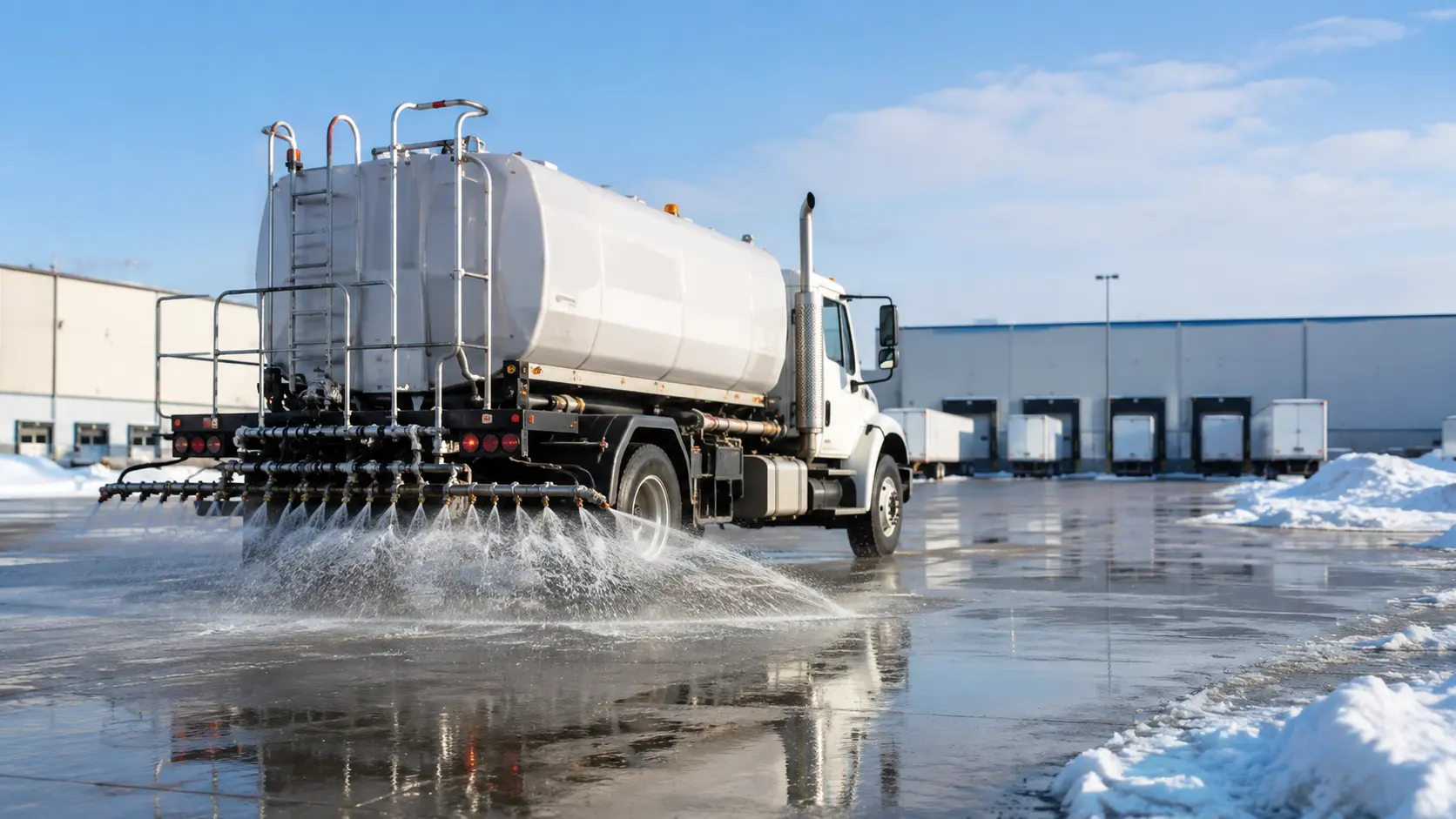
Commercial deicing is a little different from treating a public highway.
A warehouse, shopping center, factory or distribution terminal may have smaller areas to maintain, but those areas can be operationally critical. A frozen loading dock or truck entrance can delay deliveries, create slip hazards and stop normal operations very quickly.
Potassium formate is attractive in these environments because it is highly soluble in water, works well in liquid spray systems and uses formate rather than chloride as its primary active chemistry.
For manufacturers preparing commercial liquid products, concentrated Potassium Formate 75% Solution can be used as a feedstock and then adjusted to the working concentration required for the final deicer.
The key is to treat potassium formate as the active raw material rather than assuming one concentration fits every commercial site.
What Is a Commercial Deicer?
A commercial deicer is a snow- and ice-control product intended for professional rather than household use.
Common users include:
- Warehouses
- Distribution centers
- Shopping centers
- Factories
- Office parks
- Hotels
- Parking facilities
- Industrial yards
- Transport terminals
- Commercial property contractors
These customers usually care about more than simply melting ice.
They also need predictable application, bulk availability, reasonable storage requirements and compatibility with their maintenance equipment.
Potassium formate fits especially well into liquid commercial deicing programs where operators already use tanks, pumps and spray equipment.
How Does Potassium Formate Melt Ice?
Potassium formate has the chemical formula HCOOK.
When dissolved in water, it lowers the freezing point of the solution.
Applied to icy pavement, the liquid begins interacting with water at the ice surface and can create a brine that remains liquid below the normal freezing point of water.
This can help:
- Melt frost and thin ice
- Weaken compacted ice
- Reduce pavement-ice bonding
- Make scraping and plowing easier
- Slow refreezing under suitable conditions
The performance of a commercial formulation depends on several things:
- Potassium formate concentration
- Surface temperature
- Ice thickness
- Application rate
- Dilution from snow or rain
- Contact time
There is no useful one-number answer for the lowest temperature at which every potassium formate deicer works.
The finished formulation needs to be tested.
Commercial Deicing vs Anti-Icing
A commercial property can use potassium formate in two ways.
Deicing
The product is applied after frost or ice has already formed.
This is the traditional approach.
Anti-Icing
The liquid is applied before or early in a freezing event to prevent a strong ice-pavement bond.
FHWA guidance describes anti-icing as the timely application of a freezing-point depressant to prevent bonded snow and ice. It also notes that liquid chemicals can be applied uniformly to dry pavement before a storm when conditions are appropriate.
For commercial sites, that preventive approach can be valuable because it helps maintenance teams treat critical areas before employees, customers or delivery vehicles arrive.
Deicing vs Anti-Icing
| Factor | Deicing | Anti-Icing |
|---|---|---|
| Timing | After ice forms | Before strong bonding |
| Purpose | Remove or loosen ice | Reduce ice adhesion |
| Chemical demand | Often higher | Can be lower |
| Mechanical removal | Usually needed | Often easier later |
| Weather planning | Helpful | Very important |
| Best use | Corrective treatment | Preventive maintenance |
A commercial winter program may use both.
Where Is Potassium Formate Commercial Deicer Used?
Potassium formate formulations can be particularly useful where maintaining access is more important than using the cheapest possible deicing chemical.
Distribution Centers
Truck traffic cannot simply stop because a loading lane freezes.
Potential treatment areas include:
- Truck entrances
- Loading docks
- Trailer staging lanes
- Gate areas
- Internal roads
Industrial Plants
Manufacturing sites may need to keep:
- Emergency routes
- Forklift areas
- Employee access
- Outdoor process areas
- Loading points
available throughout winter.
Parking Facilities
Liquid deicers can be used on:
- Parking decks
- Ramps
- Entry lanes
- Pedestrian access zones
The actual surface material and drainage system should be evaluated before adopting any new formulation.
Commercial Property Complexes
Hotels, shopping centers and office campuses may value fast, controlled treatment because public access begins early in the morning.
A preventive liquid application can sometimes be easier than dealing with bonded ice once the property is already busy.
Why Choose Potassium Formate Instead of Rock Salt?
Rock salt remains cheaper.
That needs to be said clearly.
For a large open parking area where cost per treated square meter is the main priority, sodium chloride may remain the practical choice.
Potassium formate becomes more interesting where the operator cares about other factors.
General Comparison
| Factor | Potassium Formate | Sodium Chloride |
|---|---|---|
| Main chemistry | Formate | Chloride |
| Liquid application | Very suitable | Brine also widely used |
| Raw-material cost | Higher | Low |
| Chloride exposure | Avoided as active salt | High |
| Controlled spray dosing | Easy | Easy in brine form |
| Specialized commercial sites | Attractive | Common |
| Broad low-cost use | Less economical | Strong advantage |
The business case is therefore not simply “potassium formate melts ice better.”
It may instead be:
We want a controlled liquid system and want to reduce reliance on chloride-based deicers around selected infrastructure.
That is a more realistic reason to choose it.
Why Liquid Commercial Deicer Can Be Useful
Liquid application can be convenient for professional maintenance contractors and large facilities.
A liquid product can be applied using:
- Tank trucks
- Utility vehicles
- Spray bars
- Hand-held spraying systems
- Fixed application equipment
FHWA guidance notes that liquid application can provide relatively uniform pavement placement at practical spreading speeds.
For a commercial facility, this can make dosing easier to control.
It can also reduce the scatter associated with granular salts.
For more details on the liquid formulation side, Vanchor's Potassium Formate Liquid Deicer guide covers concentrated liquid feedstock and deicing applications in greater depth.
Potassium Formate Does Not Mean Zero Corrosion
One common marketing shortcut is to call non-chloride deicers “non-corrosive.”
That is too simple.
Potassium formate avoids chloride as the primary active anion, which can reduce chloride-related concerns. But the final commercial formulation can still interact with metals and other materials.
Actual corrosion behavior depends on:
- Potassium formate concentration
- Chloride impurities
- pH
- Inhibitor package
- Surface material
- Exposure time
- Temperature
A commercial deicer should therefore be evaluated against the equipment and surfaces it will actually contact.
This may include:
- Steel
- Aluminum
- Concrete
- Pumps
- Storage tanks
- Spray equipment
Concentration Should Match the Job
A manufacturer may purchase a 75% potassium formate concentrate.
That does not mean every commercial customer should use it directly at 75%.
The working formulation may be adjusted according to:
- Expected pavement temperature
- Required deicing rate
- Anti-icing strategy
- Viscosity
- Spray equipment
- Cost
- Storage conditions
Higher concentration means more active potassium formate, but it also increases product cost.
A professional formulation should provide the required performance without simply maximizing chemical concentration.
Basically, the goal is not to put the most potassium formate on the pavement.
It is to use enough to do the job reliably.
75% Liquid vs 96% Solid Potassium Formate
Commercial deicer manufacturers can source potassium formate in liquid or solid form.
Vanchor also offers Potassium Formate 96% Solid for formulators that prefer to dissolve the chemical locally.
| Factor | 75% Liquid | ≥96% Solid |
|---|---|---|
| Pump directly | Yes | No |
| Dissolution needed | No | Yes |
| Production speed | Faster | More preparation |
| Active content per ton | Lower | Higher |
| Freight efficiency | Lower | Higher |
| Local concentration flexibility | Good | Very high |
| Best fit | Liquid production plant | Equipped chemical blender |
For domestic production close to the chemical source, liquid may be simpler.
For long-distance international shipping, solid material can sometimes reduce freight per ton of active potassium formate.
Commercial Cost Should Be Calculated per Treated Area
Buying price per ton is only one part of commercial deicer cost.
A facility operator should also think about:
- Application rate
- Labor
- Equipment
- Number of treatments
- Mechanical removal
- Storage
- Infrastructure maintenance
- Runoff management
A more expensive chemical can still make economic sense on a small critical area if it simplifies preventive treatment or reduces other maintenance problems.
On the other hand, treating hundreds of kilometers of ordinary roadway with a premium product may not be economically reasonable.
Use the chemistry where the value is.
Storage and Equipment Considerations
Commercial deicer may sit in storage tanks for several months.
The formulation needs to remain stable and pumpable.
Check:
- Low-temperature storage behavior
- Crystallization
- Tank compatibility
- Pump compatibility
- Filters
- Spray nozzles
- Long-term contamination
Clean storage is particularly important because insoluble debris can block liquid spray systems.
Commercial operators should also calibrate equipment rather than assuming that more liquid always means better deicing.
FHWA emphasizes that chemical treatment rates should be adjusted according to pavement temperature, weather and local operating conditions rather than applied as a fixed universal rate.
Environmental Considerations
Potassium formate chemistry is biodegradable, but commercial users should still manage runoff.
Any deicing chemical can be carried away by melting snow and stormwater.
Good commercial practice includes:
- Applying only the amount required
- Avoiding unnecessary overspray
- Protecting drains where needed
- Understanding local discharge rules
- Monitoring sensitive nearby water areas
The simplest way to reduce environmental loading is usually to avoid overapplication in the first place.
What Should Commercial Deicer Manufacturers Check?
For bulk potassium formate purchasing, useful raw-material parameters include:
| Parameter | Why It Matters |
|---|---|
| Potassium formate content | Confirms active material |
| Density | Supports liquid QC |
| pH | Influences formulation |
| Chloride | Relevant to low-chloride positioning |
| Iron | Helps monitor quality consistency |
| Insoluble matter | Protects filters and nozzles |
| Batch consistency | Supports repeatable production |
| COA | Confirms delivered batch quality |
| TDS | Provides technical properties |
| SDS | Supports storage and handling |
The finished commercial deicer should then be tested separately for its intended use.
How to Request a Commercial Deicer Raw Material Quote
A practical RFQ might look like:
Product: Potassium Formate
Application: Commercial Deicer Manufacturing
Preferred Form: 75% Liquid Solution
Quantity: 80 MT
Packaging: IBC / Flexitank
Required Documents: COA, TDS and SDS
Special Requirements: Controlled chloride and insoluble matter
End Use: Logistics Centers, Parking Areas and Industrial Facilities
This gives the supplier much more useful information than simply asking for “commercial deicer price.”
Final Thoughts
A potassium formate commercial deicer is best suited to professional winter-maintenance applications where controlled liquid treatment, non-chloride chemistry and reliable access are more important than achieving the absolute lowest chemical cost.
Potential commercial applications include:
- Warehouses
- Distribution centers
- Factories
- Parking facilities
- Commercial campuses
- Critical access routes
Potassium formate can support both deicing and preventive anti-icing strategies.
But it should be used where the economics make sense.
For a huge low-cost road network, conventional salt may still win.
For a loading ramp that absolutely needs to stay open at 5 a.m., the calculation can look very different.
That is where commercial deicing becomes less about the price of salt and more about the cost of keeping the business running.
FAQ
What is potassium formate commercial deicer?
It is a professional winter-maintenance formulation using potassium formate to help melt ice or reduce ice bonding on commercial and industrial paved surfaces.
Where can potassium formate commercial deicer be used?
Typical applications include warehouses, logistics centers, parking facilities, industrial sites, commercial campuses and critical access roads.
Is potassium formate better than rock salt?
Not for every application. Rock salt is cheaper, while potassium formate may be more suitable where controlled liquid application and reduced chloride exposure are priorities.
Can potassium formate be used for anti-icing?
Yes. Properly formulated liquid potassium formate can be applied preventively before strong ice-pavement bonding develops.
Is potassium formate non-corrosive?
No deicer should automatically be described that way. Potassium formate avoids chloride as its primary salt, but finished-product corrosion still needs to be evaluated.
Should deicer manufacturers buy liquid or solid potassium formate?
Liquid is convenient for direct formulation, while solid provides higher active content per shipment and can be attractive when the buyer has suitable dissolution equipment.


Contact Us
In This Article
Related Posts
Индивидуальные упаковочные решения от поставщика безводного ацетата натрия в Китае
2026-09-23
Тенденции применения безводного ацетата натрия для специального химического производства
2026-09-23
Безводный ацетат натрия для дубления кожи: улучшает равномерность окрашивания
2026-09-22
Formic Acid 85% for Animal Feed Preservation: Moisture and Storage Stability Guide
2026-09-21


