



Potassium Formate Pavement Deicer: Performance, Applications and Surface Considerations
By LIN
2026-09-02Related Posts
Индивидуальные упаковочные решения от поставщика безводного ацетата натрия в Китае
2026-09-23
Тенденции применения безводного ацетата натрия для специального химического производства
2026-09-23

Безводный ацетат натрия для дубления кожи: улучшает равномерность окрашивания
2026-09-22
Formic Acid 85% for Animal Feed Preservation: Moisture and Storage Stability Guide
2026-09-21
A potassium formate pavement deicer is a liquid winter-maintenance product used to melt frost and ice, weaken ice-to-pavement bonding, and support preventive anti-icing on roads, bridge decks, parking areas and commercial paved surfaces.
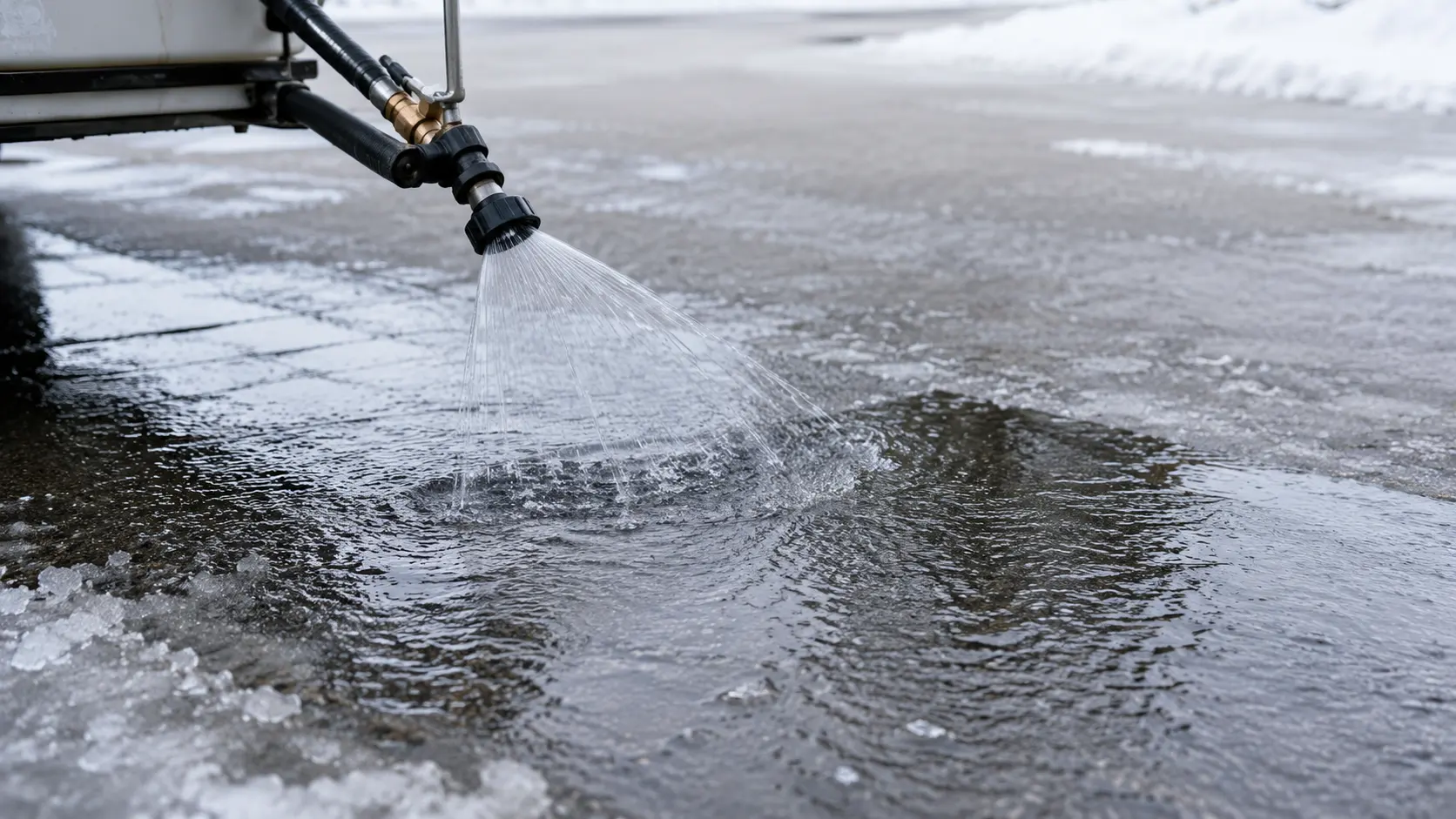
Potassium formate is particularly suitable for liquid application because it is highly soluble in water. Instead of waiting for granular salt to dissolve on a wet surface, a potassium formate solution is already in liquid form and can begin spreading across the pavement immediately.
That makes it useful for both corrective deicing and preventive anti-icing.
For manufacturers preparing liquid pavement products, concentrated Potassium Formate 75% Solution can be used as the active feedstock and diluted or formulated according to the required winter operating conditions.
The final working solution still needs to consider pavement temperature, surface material, corrosion, drainage and application rate.
A stronger concentrate is not automatically a better pavement deicer.
How Does Potassium Formate Work on Pavement?
Potassium formate has the chemical formula HCOOK.
When dissolved in water, it lowers the freezing point of the solution.
Applied to an icy pavement, the liquid can penetrate the frozen layer and form a brine at the interface between the pavement and ice.
This helps:
- Melt frost and thin ice
- Weaken bonded ice
- Reduce ice adhesion
- Make plowing or brushing easier
- Delay refreezing under suitable conditions
For anti-icing, the fluid is applied before a strong frozen bond develops.
FHWA describes anti-icing as the application of freezing-point-depressing chemicals to prevent a strong bond between pavement and snow or frost, keeping the surface wetter or slushier and making later mechanical removal easier.
This is often a more efficient use of liquid deicer than waiting until a thick layer of compacted ice has formed.
Where Can Potassium Formate Pavement Deicer Be Used?
Potential applications include:
- Road pavement
- Bridge decks
- Parking areas
- Parking ramps
- Industrial yards
- Logistics terminals
- Loading areas
- Commercial access roads
- Tunnel entrances
- High-risk intersections
It is especially interesting for targeted treatment.
Using potassium formate across thousands of kilometers of ordinary highway may be difficult to justify economically when inexpensive sodium chloride is available.
Using it on a critical bridge, parking structure or industrial access route can be a different calculation.
In these areas, the total cost of corrosion, traffic disruption and operational downtime may matter more than simply buying the cheapest deicing salt.
Pavement Deicing vs Pavement Anti-Icing
Potassium formate can support both approaches.
Deicing
Deicing is performed after ice has already formed.
The fluid works on the existing frozen layer and helps separate it from the pavement.
Anti-Icing
Anti-icing is preventive.
The solution is applied before or early in freezing weather so that frozen precipitation does not bond strongly to the surface.
FHWA guidance notes that liquid chemicals can be spread uniformly over pavement and can also be placed on dry pavement as a pre-storm treatment when weather conditions are suitable.
| Factor | Deicing | Anti-Icing |
|---|---|---|
| Timing | After ice formation | Before strong bonding |
| Main goal | Melt or loosen ice | Prevent adhesion |
| Chemical requirement | Often higher | Often lower |
| Mechanical removal | Usually required | Easier afterward |
| Weather information | Helpful | Very important |
| Main use | Corrective maintenance | Preventive maintenance |
Application timing matters almost as much as chemistry.
If a liquid is applied just before heavy rain, for example, much of it may simply be washed away.
Why Use Potassium Formate Instead of Chloride Deicers?
Sodium chloride, calcium chloride and magnesium chloride are established pavement deicers.
They are widely available and normally less expensive than potassium formate.
Potassium formate offers a different chemistry.
It uses formate rather than chloride as the active anion, making it interesting where infrastructure owners want to reduce direct chloride exposure.
This may matter around:
- Reinforced structures
- Steel equipment
- Vehicles
- Electrical systems
- Parking structures
- Sensitive bridge components
However, “non-chloride” should not be translated into “harmless to pavement” or “non-corrosive.”
Every finished deicing formulation should still be assessed for the actual pavement and materials it contacts.
Concrete Pavement Needs Special Attention
Concrete pavement is exposed to several stresses during winter:
- Freeze-thaw cycling
- Water saturation
- Traffic loading
- Chemical exposure
Some deicing brines can contribute to pavement deterioration under certain conditions.
FHWA has specifically documented chemical-deicer distress associated with aqueous calcium chloride and magnesium chloride exposure in concrete pavements.
This does not mean potassium formate automatically solves every concrete durability issue.
Concrete quality, age, air entrainment, permeability, surface condition and repeated chemical exposure all matter.
For sensitive concrete surfaces, a potassium formate pavement formulation should therefore be evaluated through suitable material-compatibility testing before large-scale use.
The right claim is:
Potassium formate avoids chloride as the main active salt.
Not:
Potassium formate can never affect concrete.
That distinction keeps the technical information realistic.
What About Asphalt Pavement?
Asphalt generally responds differently from hydraulic cement concrete, but formulation compatibility still matters.
Potential concerns can include:
- Surface contamination
- Repeated wetting
- Residue
- Drainage
- Interaction with pavement sealers or repair materials
A potassium formate formulation intended for parking lots or asphalt roads should therefore be tested under realistic conditions.
For commercial products, it may also be useful to test:
- Surface friction
- Residue after drying
- Tracking by vehicles
- Spray distribution
- Refreezing behavior
A liquid that melts ice but leaves an undesirable slippery residue is not a very good pavement product.
Why Liquid Application Is Useful
Liquid deicing and anti-icing systems allow relatively precise application.
Equipment may include:
- Truck-mounted spray bars
- Multi-nozzle systems
- Fixed bridge sprayers
- Utility vehicles
- Automated pavement-treatment systems
FHWA notes that liquid systems can place chemicals uniformly across pavement at practical spreading speeds.
This is useful for critical pavement where the operator wants to control exactly where the chemical goes.
Compared with granular salts, liquid application can also reduce bounce and scatter away from the target surface.
For more detail on formulation and spraying, Vanchor's Potassium Formate Liquid Deicer Guide covers liquid-feedstock use for winter-maintenance products.
Concentration and Pavement Temperature
One of the most important formulation decisions is concentration.
Higher potassium formate concentration generally provides stronger freezing-point depression, but it also changes:
- Density
- Viscosity
- Crystallization behavior
- Chemical cost
- Spray behavior
The optimum concentration depends on the expected pavement temperature rather than simply using the highest concentration available.
FHWA emphasizes that anti-icing decisions should consider pavement temperature, precipitation type, weather trend and treatment timing.
A manufacturer purchasing a 75% potassium formate concentrate may therefore dilute it to create a different working solution.
For more background on this relationship, see Vanchor's Potassium Formate Freezing Point Guide.
Potassium Formate vs Common Pavement Deicers
| Factor | Potassium Formate | Sodium Chloride | Calcium Chloride |
|---|---|---|---|
| Main ion system | Formate | Chloride | Chloride |
| Liquid application | Very suitable | Common as brine | Common |
| Raw-material cost | Higher | Low | Moderate |
| Chloride exposure | Low as active chemistry | High | High |
| General highway use | More specialized | Very common | Common |
| Critical infrastructure | Attractive | Application dependent | Application dependent |
| Material testing | Required | Required | Required |
The best chemical depends on the project.
Potassium formate is usually more attractive when the buyer wants controlled liquid application and is willing to pay more to reduce reliance on chloride chemistry.
Storage and Spray Equipment Matter
A pavement deicer may remain in tanks for most of the winter.
The formulation needs to remain stable and pumpable.
Manufacturers and operators should check:
- Crystallization behavior
- Storage temperature
- Tank compatibility
- Pump performance
- Filter cleanliness
- Spray-nozzle blockage
- Long-term precipitation
Clean raw material is especially important for liquid systems because insoluble material can interfere with filters and fine spray nozzles.
Application equipment should also be calibrated.
More liquid is not automatically better.
The correct amount depends on weather, pavement temperature and the severity of the event.
Runoff and Environmental Management
After application, some pavement deicer will eventually leave the surface with melting snow or stormwater.
Potassium formate is biodegradable, but that does not mean unrestricted release has no environmental effect.
Commercial and municipal operators should consider:
- Drainage location
- Nearby surface water
- Application rate
- Stormwater collection
- Local discharge requirements
- Repeated seasonal loading
The easiest way to reduce unnecessary environmental loading is also the easiest way to reduce cost:
do not overapply the product.
Good weather information and calibrated spraying help with both.
What Should Pavement-Deicer Manufacturers Check?
For bulk potassium formate purchasing, useful specifications include:
| Parameter | Why It Matters |
|---|---|
| Potassium formate content | Confirms active material |
| Density | Supports liquid QC |
| pH | Influences formulation |
| Chloride | Relevant to non-chloride positioning |
| Iron | Supports batch consistency |
| Insoluble matter | Protects filters and spray equipment |
| Appearance | Useful incoming inspection |
| Batch consistency | Supports repeatable formulations |
| COA | Confirms batch quality |
| TDS / SDS | Supports technical and safety review |
The finished pavement deicer should then be separately evaluated for its target surface and temperature range.
How to Request a Quote
A useful RFQ could look like:
Product: Potassium Formate
Application: Pavement Deicer / Anti-Icing Fluid
Preferred Form: 75% Liquid Concentrate
Quantity: 80 MT
Packaging: IBC / Flexitank
Required Documents: COA, TDS and SDS
Special Requirements: Controlled chloride and insoluble matter
End Use: Bridges, Parking Areas and Commercial Pavement
Providing the pavement application helps the supplier understand that the material will be used in a formulated winter-maintenance product.
Final Thoughts
A potassium formate pavement deicer is best viewed as a specialty liquid winter-maintenance option rather than a universal replacement for road salt.
Its advantages include:
- High water solubility
- Precise liquid spraying
- Effective deicing and anti-icing
- Reduced reliance on chloride chemistry
- Good suitability for targeted pavement treatment
Potential applications include bridges, parking structures, industrial yards and high-value commercial pavement.
But pavement compatibility still needs attention.
Concrete, asphalt, reinforcement, drainage systems and application equipment all form part of the real operating environment.
A good pavement deicer should control ice without creating a different maintenance problem later.
That is why concentration, surface compatibility and application rate matter just as much as the chemical name.
FAQ
What is potassium formate pavement deicer?
It is a potassium formate-based liquid formulation used to melt ice or prevent strong ice bonding on roads, bridges, parking surfaces and other pavement.
Can potassium formate be used for pavement anti-icing?
Yes. Liquid formulations can be applied before freezing conditions to reduce the formation of bonded snow and ice.
Is potassium formate safe for concrete?
It should not automatically be described as harmless to every concrete surface. Pavement condition, formulation and repeated exposure matter, so compatibility testing is recommended for sensitive applications.
Is potassium formate better than calcium chloride?
Not always. Calcium chloride is usually cheaper, while potassium formate may be attractive when reducing chloride exposure is an important project objective.
Can 75% potassium formate be applied directly to pavement?
It is better treated as concentrated feedstock. The working concentration should be selected according to pavement temperature, performance and formulation requirements.
What should pavement-deicer buyers request?
Buyers should normally request a COA, TDS and SDS and review concentration, density, pH, chloride, iron, insoluble matter and batch consistency.


Contact Us
In This Article
Related Posts
Индивидуальные упаковочные решения от поставщика безводного ацетата натрия в Китае
2026-09-23
Тенденции применения безводного ацетата натрия для специального химического производства
2026-09-23
Безводный ацетат натрия для дубления кожи: улучшает равномерность окрашивания
2026-09-22
Formic Acid 85% for Animal Feed Preservation: Moisture and Storage Stability Guide
2026-09-21


