



Potassium Formate Deicer Advantages: Why It Is Used for Liquid Deicing and Anti-Icing
By LIN
2026-09-01Related Posts
Индивидуальные упаковочные решения от поставщика безводного ацетата натрия в Китае
2026-09-23
Тенденции применения безводного ацетата натрия для специального химического производства
2026-09-23

Безводный ацетат натрия для дубления кожи: улучшает равномерность окрашивания
2026-09-22
Formic Acid 85% for Animal Feed Preservation: Moisture and Storage Stability Guide
2026-09-21
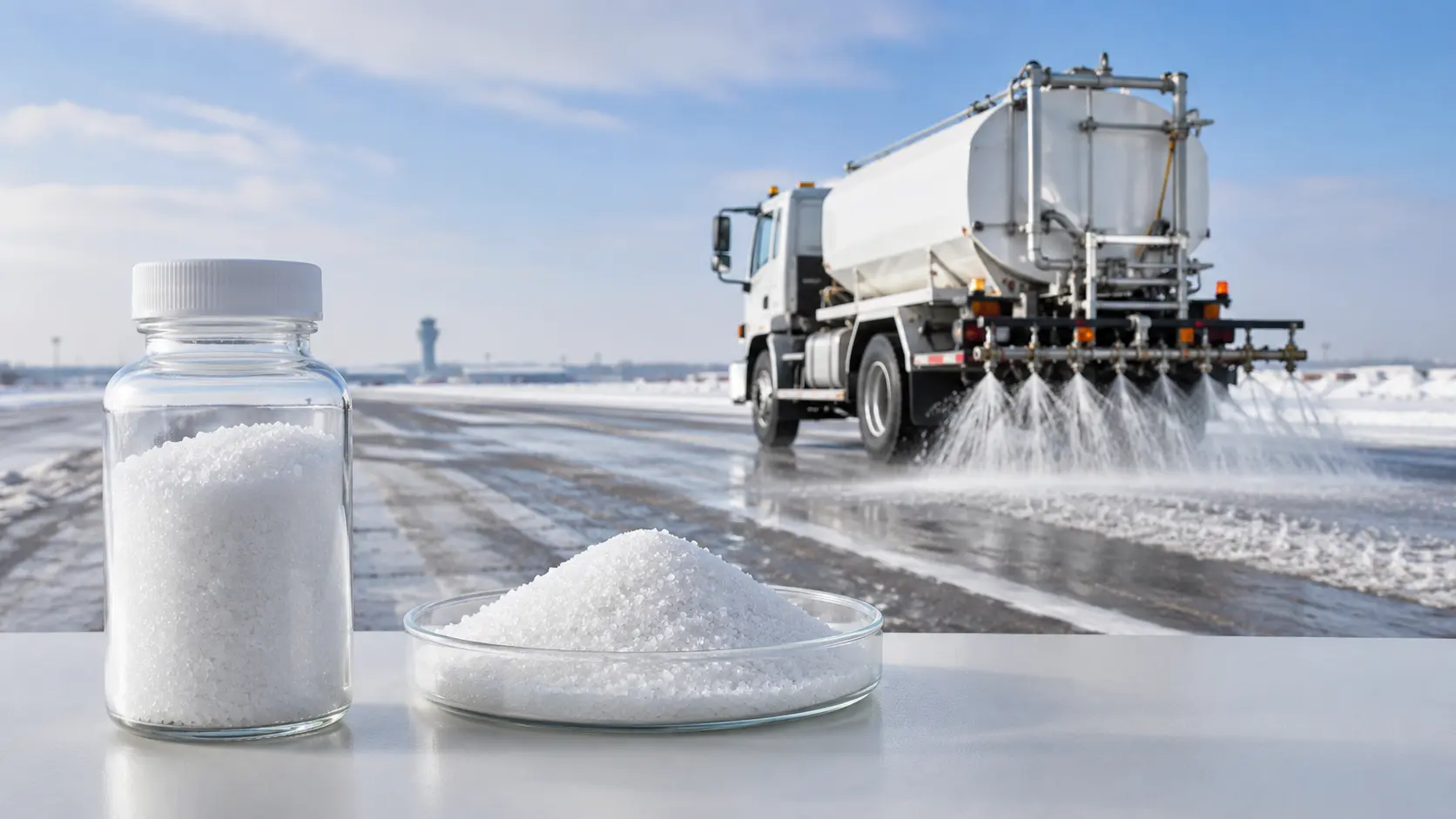
The main potassium formate deicer advantages come from its ability to form highly soluble liquid deicing and anti-icing solutions with strong low-temperature performance, rapid surface coverage and reduced dependence on conventional chloride salts.
Potassium formate, HCOOK, is particularly suitable for applications where liquid treatment is preferred, including:
- Airport runways and taxiways
- Roads and bridges
- Logistics terminals
- Industrial yards
- Loading areas
- Other winter-maintenance surfaces
For airport applications, the distinction between raw potassium formate and a qualified finished deicer is critical. FAA Engineering Brief 108 identifies potassium-formate-based fluids meeting SAE AMS 1435 among the recommended liquid airfield deicing and anti-icing product categories.
Raw potassium formate alone is not automatically an approved runway deicer.
1. Strong Low-Temperature Performance
One of the biggest advantages of potassium formate is its ability to significantly depress the freezing point of water.
Correctly formulated potassium formate fluids can remain effective at strongly sub-zero temperatures.
This makes the chemistry useful for:
- Frost
- Freezing rain
- Thin ice
- Compacted snow
- Refreezing prevention
Low-temperature performance is particularly valuable where ordinary salt brines become less practical.
However, performance depends on concentration.
More potassium formate does not continuously produce a lower freezing point. The finished formulation must be designed around the required operating temperature.
2. Excellent Water Solubility
Potassium formate is extremely soluble in water.
This makes it well suited to concentrated liquid formulations and allows deicer manufacturers to prepare clear solutions without suspended solid particles.
Advantages include:
- Rapid blending
- Accurate concentration control
- Easy dilution
- Stable liquid delivery
- Minimal solid residue in properly formulated fluids
Vanchor currently identifies high water solubility as one reason potassium formate is suitable for liquid deicing systems.
3. Fast and Uniform Liquid Application
Liquid potassium formate can be applied through:
- Spray bars
- Deicing trucks
- Automated spreaders
- Fixed spray systems
- Spot-treatment equipment
Compared with granular materials, liquid treatment can provide rapid and relatively uniform surface coverage.
This is particularly useful for:
- Runways
- Bridges
- Intersections
- Ramps
- High-risk pavement areas
Liquid application also eliminates particle bounce and scatter associated with some dry deicers.
4. Useful for Both Deicing and Anti-Icing
Potassium formate can support two different winter-maintenance strategies.
Deicing
Applied after ice has formed to:
- Weaken the ice-pavement bond
- Melt frost or thin ice
- Support plowing and brushing
- Help restore surface conditions
Anti-Icing
Applied before or early in a winter-weather event to:
- Reduce ice adhesion
- Delay strong bonding
- Make mechanical removal easier
- Reduce refreezing risk
This flexibility is one of the main advantages of a liquid potassium formate system.
Vanchor's existing deicer guidance specifically identifies both corrective deicing and preventive anti-icing uses.
5. Reduced Ice-to-Pavement Bonding
Winter maintenance is not only about melting large quantities of snow.
Preventing ice from strongly bonding to the pavement can be even more valuable.
A potassium formate anti-icing layer can help reduce adhesion between frozen precipitation and the treated surface.
This can improve the effectiveness of:
- Plows
- Brushes
- Sweepers
- Snow-removal equipment
The result may be faster surface recovery when chemical treatment is integrated with mechanical removal.
6. No Chloride Salt as the Primary Deicing Chemistry
Potassium formate is a formate salt, not a chloride salt.
That distinguishes it from:
- Sodium chloride
- Calcium chloride
- Magnesium chloride
This can be advantageous where an operator wants to reduce long-term chloride loading on:
- Reinforcing steel
- Vehicles
- Bridges
- Drainage infrastructure
- Industrial equipment
However, potassium formate should not be marketed as universally non-corrosive.
Commercial products can contain trace chloride, and corrosion still depends on:
- Concentration
- pH
- Inhibitor package
- Temperature
- Material type
- Exposure time
The more accurate benefit is:
reduced reliance on chloride-based deicing chemistry, not “zero corrosion.”
7. Potential Environmental Advantages
Formate chemistry can offer environmental advantages compared with some conventional deicing chemicals.
EPA reports that formate:
- Can undergo relatively rapid aerobic biodegradation
- Can also degrade anaerobically
- Has slightly lower BOD/COD than acetate
- Has lower BOD/COD than ethylene and propylene glycol.
This can be attractive where winter-maintenance runoff enters:
- Airport drainage systems
- Wastewater treatment plants
- Surface-water management systems
Perstorp also markets its potassium-formate runway deicer around low COD and biodegradability.
However:
Potassium formate is not environmentally harmless.
Formate biodegradation consumes dissolved oxygen, so concentrated runoff can still affect aquatic environments. EPA specifically identifies oxygen demand as an environmental concern.
8. Suitable for Qualified Airport Runway Fluids
Airport pavement deicing has stricter requirements than ordinary road treatment.
FAA Engineering Brief 108, issued January 9, 2026, identifies potassium-formate-based liquid products meeting SAE AMS 1435 among recommended airfield deicer/anti-icer categories.
This establishes potassium formate as a recognized base chemistry for qualified airfield liquids.
But the correct supply chain is:
Potassium formate raw material
→ formulated liquid deicer
→ corrosion/material testing
→ SAE AMS 1435 compliance
→ finished airport product
Vanchor therefore should position itself as a potassium formate supplier for airport deicer formulations, unless a finished certified deicer is separately documented.
9. Convenient Pumping and Bulk Handling
Liquid potassium formate systems are suited to industrial handling.
They can be:
- Pumped
- Metered
- Transferred
- Stored in tanks
- Delivered through automated equipment
- Blended to controlled concentration
This can reduce manual handling during large winter-maintenance programs.
Vanchor's current deicer page highlights pumping, spraying, bulk storage and automated liquid application among the operational benefits.
10. Compatible With Automated Winter Maintenance
Modern winter operations increasingly rely on:
- Pavement-temperature sensors
- Weather forecasting
- Calibrated application equipment
- Preventive treatment
- Automated spreading
Liquid potassium formate fits this operational model well because application rates can be controlled precisely.
Operators can adjust treatment according to:
surface temperature + weather forecast + precipitation + residual treatment
rather than applying a fixed amount of solid chemical.
11. Reduced Dust and Granular Residue
Because potassium formate can be applied as a clear liquid, it avoids dust associated with some granular deicers.
Potential operational advantages include:
- Cleaner application equipment
- Reduced airborne particles
- No granular bounce
- Better controlled coverage
- Less dry residue
This can be particularly useful around logistics facilities, airport operating surfaces and high-traffic industrial areas.
12. Flexible Concentration
Potassium formate can be supplied as concentrated feedstock and adjusted according to the finished formulation.
This allows manufacturers to design for:
- Target freezing point
- Application temperature
- Viscosity
- Spray performance
- Storage stability
But the highest concentration is not automatically the best.
Concentrated raw material and finished deicer may have very different crystallization behavior.
Potassium Formate vs Chloride Deicer Advantages
| Factor | Potassium Formate | Chloride Deicers |
|---|---|---|
| Primary anion | Formate | Chloride |
| Liquid application | Excellent fit | Common |
| Anti-icing | Yes | Yes |
| Chloride loading | Low when controlled | Intrinsic |
| Corrosion risk | Requires control | Chloride-related concerns |
| Biodegradation | Formate biodegrades | Chloride persists |
| Raw-material cost | Generally higher | Usually lower |
Potassium formate therefore makes the strongest case where technical or lifecycle considerations justify paying more than for commodity chloride salts.
Potassium Formate vs Glycol Deicers
Formate also has environmental differences from glycol.
EPA reports lower BOD/COD for formate than ethylene and propylene glycol.
However, these products are not always direct substitutes.
For aviation especially:
- Runway/pavement deicing and
- Aircraft wing/fuselage deicing
are separate applications with different technical standards.
Potassium-formate runway fluid should never be presented as an aircraft-wing deicing fluid.
When Are the Advantages Most Valuable?
Potassium formate deserves consideration when the priority is:
Airports
Where qualified liquid pavement deicing, fast application and low-chloride chemistry matter.
Bridges
Where repeated chloride exposure is a concern.
Logistics Facilities
Where automated spraying and rapid reopening are valuable.
Industrial Sites
Where nearby equipment makes chloride exposure undesirable.
Preventive Anti-Icing
Where operators want treatment before strong ice bonding develops.
Important Limitations
Potassium formate also has disadvantages.
Buyers should consider:
- Higher chemical cost than common chlorides
- Crystallization behavior
- Storage-temperature requirements
- Corrosion-inhibitor needs
- Runoff oxygen demand
- Need for finished-product qualification in airport use
This is why potassium formate should not be marketed simply as:
“better than salt.”
Its value depends on the site.
What Should Buyers Evaluate?
For a potassium-formate-based deicer, check:
- Potassium formate concentration
- Freezing/crystallization point
- Density
- Viscosity
- pH
- Chloride
- Corrosion performance
- Pavement compatibility
- Environmental data
- Storage conditions
- COA
- TDS
- SDS
For airport use, verify that the finished product meets the required SAE specification.
Frequently Asked Questions
What is the main advantage of potassium formate deicer?
Its combination of low-temperature liquid performance, high water solubility, rapid spraying and reduced reliance on chloride salts is the main advantage.
Is potassium formate better than calcium chloride?
Not universally. Calcium chloride is usually less expensive. Potassium formate may be preferable when reducing chloride exposure and using specialized liquid treatment are more important.
Is potassium formate suitable for airport runways?
Yes, as a base chemistry for qualified liquid runway deicers. FAA recommends potassium-formate-based fluids meeting SAE AMS 1435.
Is potassium formate environmentally friendly?
It is biodegradable and can have lower BOD/COD than glycol deicers, but biodegradation still consumes oxygen. Runoff management remains necessary.
Is potassium formate non-corrosive?
No. It avoids chloride as the primary chemistry, but finished formulations still require corrosion and material-compatibility testing.
Can potassium formate be used for anti-icing?
Yes. Liquid formulations can be applied preventively to reduce ice bonding before or during early winter precipitation.
Conclusion
The main potassium formate deicer advantages include:
Strong low-temperature performance
High water solubility
Rapid liquid coverage
Effective anti-icing capability
Reduced ice bonding
Reduced reliance on chloride salts
Potential environmental advantages
Easy pumping and automated application
These characteristics make potassium formate particularly attractive for specialized liquid winter-maintenance systems, including airport pavement, bridges and industrial infrastructure.
However, it should not be presented as universally safer, non-corrosive or environmentally harmless.
The strongest technical position is:
Potassium formate is a high-performance non-chloride deicing chemistry that can provide operational and environmental advantages when the finished formulation, application rate, corrosion control and runoff management are properly engineered.


Contact Us
In This Article
Related Posts
Индивидуальные упаковочные решения от поставщика безводного ацетата натрия в Китае
2026-09-23
Тенденции применения безводного ацетата натрия для специального химического производства
2026-09-23
Безводный ацетат натрия для дубления кожи: улучшает равномерность окрашивания
2026-09-22
Formic Acid 85% for Animal Feed Preservation: Moisture and Storage Stability Guide
2026-09-21


