



Technical Grade Potassium Formate: Specifications, Uses and Buying Guide
By LIN
2026-09-02Related Posts
Индивидуальные упаковочные решения от поставщика безводного ацетата натрия в Китае
2026-09-23
Тенденции применения безводного ацетата натрия для специального химического производства
2026-09-23

Безводный ацетат натрия для дубления кожи: улучшает равномерность окрашивания
2026-09-22
Formic Acid 85% for Animal Feed Preservation: Moisture and Storage Stability Guide
2026-09-21
Technical grade potassium formate is widely used in industrial applications where consistent chemical performance is required, but pharmaceutical or ultra-high-purity material is unnecessary.
Typical users include oilfield chemical companies, deicing formulators, heat-transfer fluid manufacturers, chemical blenders and industrial distributors.
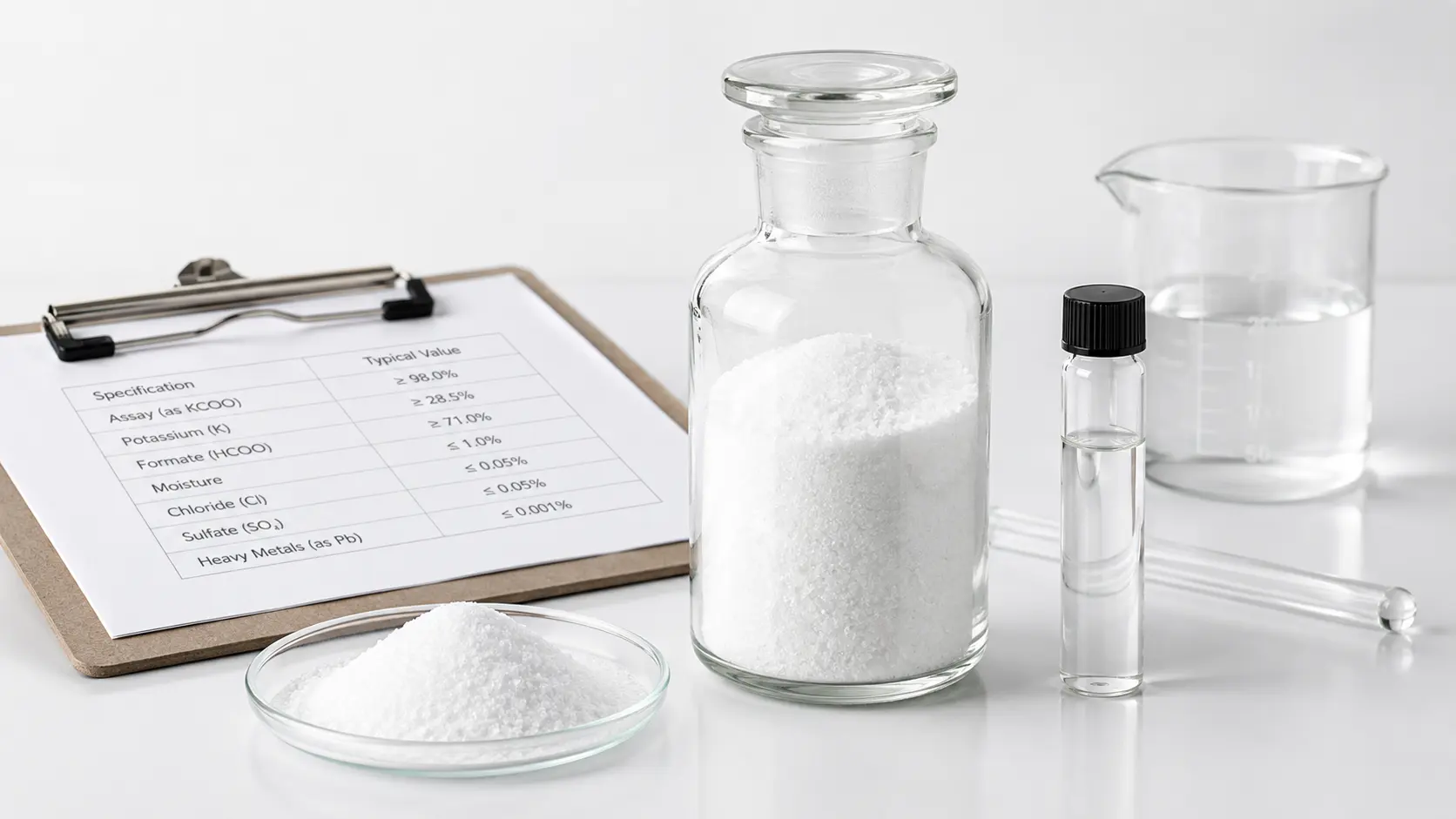
One thing buyers should understand from the beginning is that “technical grade” does not have one universal purity specification accepted by every manufacturer.
One supplier may describe a 96% solid potassium formate as technical grade, while another may offer a slightly higher-purity specification. Liquid potassium formate can also be supplied as a technical-grade concentrated solution.
So when buying technical grade potassium formate, the grade name is useful, but the actual specification matters much more.
The COA tells you what you are really buying.
What Is Technical Grade Potassium Formate?
Potassium formate is the potassium salt of formic acid.
Its chemical formula is HCOOK, and its CAS number is 590-29-4.
It is available commercially as either a solid material or concentrated aqueous solution.
Technical-grade material is produced for industrial processes where parameters such as potassium formate content, chloride, carbonate, moisture and insoluble matter need to remain within controlled limits.
Common physical forms include:
- White crystalline powder
- White crystalline solid
- Concentrated clear solution
- Customized industrial solution
Unlike reagent or laboratory grades, technical grade is generally designed around industrial performance and commercial-scale economics.
In simple terms, the buyer pays for the specification that the process actually needs rather than unnecessary analytical purity.
Typical Technical Grade Specifications
The exact specification depends on the manufacturer, production process and application.
A general solid technical-grade specification may look something like this:
| Parameter | Typical Requirement |
|---|---|
| Product | Potassium Formate |
| Chemical formula | HCOOK |
| CAS No. | 590-29-4 |
| Physical form | White crystalline solid or powder |
| Potassium formate content | Commonly around 96% or higher |
| Water solubility | Highly soluble |
| Moisture | Controlled according to grade |
| Chloride | Controlled |
| Carbonate | Controlled |
| Insoluble matter | Low |
| Storage characteristic | Hygroscopic |
These values should not be treated as a universal specification.
For example, one customer may need very low chloride because the potassium formate will be used in a corrosion-sensitive fluid system.
Another customer manufacturing a general industrial formulation may accept wider impurity limits.
Both products could still be sold as technical grade.
That is why procurement should be specification-driven.
Technical Grade vs Industrial Grade Potassium Formate
The terms technical grade and industrial grade are sometimes used almost interchangeably in chemical trading.
Other suppliers use technical grade to describe material with somewhat tighter purity or impurity control than their basic industrial product.
This can get confusing pretty quickly.
A better approach is to compare the actual numbers.
| Factor | General Industrial Grade | Technical Grade |
|---|---|---|
| Main purpose | General industrial use | Controlled technical applications |
| Purity | Supplier dependent | Usually tighter specification |
| Impurity control | Basic | More clearly defined |
| Batch consistency | Important | Usually more critical |
| Technical documents | COA / SDS | COA / SDS / TDS normally expected |
| Typical buyer | General manufacturer | Oilfield, fluid blender, technical formulator |
| Selection basis | Cost + basic specification | Performance + specification |
Do not reject a product only because one supplier calls it “industrial” instead of “technical.”
Likewise, don't approve something simply because “technical grade” is printed on the quotation.
Look at the specification.
Solid Technical Grade Potassium Formate
Solid potassium formate is attractive to buyers who want high active chemical content and better transportation efficiency.
Because there is much less water being transported compared with a 70% or 75% solution, more active potassium formate can be loaded into each shipment.
This can be especially useful for:
- International distributors
- Oilfield blending plants
- Deicing manufacturers
- Heat-transfer fluid producers
- Chemical formulators
The solid material can then be dissolved locally to prepare the required potassium formate concentration.
This gives the customer considerable formulation flexibility.
One plant may use the same solid raw material to prepare several different brines depending on each project.
Technical Grade Potassium Formate Solution
Not every customer wants solid material.
Technical-grade potassium formate can also be supplied as a concentrated aqueous solution.
Liquid material is convenient because it can normally be:
- Pumped
- Metered
- Transferred through hoses
- Stored in tanks or IBCs
- Blended directly into liquid systems
The customer avoids a separate dry-powder dissolution stage.
For a fluid plant processing large volumes every day, that can save quite a bit of labor.
The trade-off is freight.
A liquid solution contains water, so transportation efficiency per ton of active potassium formate is lower than with solid material.
Application in Oilfield Fluids
Oilfield applications are an important market for technical-grade potassium formate.
Potassium formate can be used in professionally designed:
- Drilling fluids
- Completion fluids
- Workover fluids
- Clear brines
- Drill-in fluids
- Shale-inhibition systems
Its high water solubility allows clear or low-solids fluids to be prepared at relatively high densities.
However, an oilfield buyer should not focus on purity alone.
A product listed as 96% potassium formate can still have impurity differences that matter to the final fluid.
For technical oilfield applications, parameters such as chloride, carbonate, iron and insoluble matter may deserve closer attention.
This is one reason an actual project specification is more useful than simply writing “oilfield grade” on an RFQ.
Why Impurity Control Matters
Imagine two potassium formate products.
Both have almost the same main assay.
One contains noticeably more chloride and insoluble material.
For a general chemical process, the difference may not matter very much.
For a clean completion brine, it may matter quite a lot.
Potential impurities can affect:
- Corrosion behavior
- Fluid clarity
- Filtration
- Formation compatibility
- Storage stability
- Final formulation consistency
This does not mean every technical-grade buyer requires extremely low impurity levels.
It means impurity limits should match the application.
Buying a much higher specification than necessary costs money.
Buying a lower specification than necessary can create technical problems.
Neither is particularly clever.
Use in Deicing Formulations
Technical grade potassium formate is also used as a raw material in liquid and solid deicing formulations.
Potential applications include:
- Road deicing
- Bridge anti-icing
- Industrial yards
- Logistics facilities
- Winter maintenance products
- Specialized runway formulations
Potassium formate is attractive because concentrated solutions provide useful freezing-point depression and offer an alternative to traditional chloride-based deicers.
However, raw technical-grade potassium formate should not automatically be described as an approved airport deicer.
Finished aviation deicing products may require specific corrosion inhibitors, performance testing and compliance with relevant requirements.
The raw material and the finished deicer are two different things.
Heat-Transfer Fluid Manufacturing
Another use is the manufacture of secondary refrigeration and heat-transfer fluids.
Potassium formate-based fluids may be used in:
- Cold-storage systems
- Food-processing facilities
- Industrial refrigeration
- HVAC secondary circuits
- Process cooling
Technical-grade material can be dissolved or diluted to the required working concentration.
The finished heat-transfer fluid may then include corrosion inhibitors and other additives.
For these applications, consistency matters.
If the raw material concentration changes noticeably from batch to batch, the manufacturer may need to keep adjusting its formulation.
That wastes time and complicates QC.
A stable specification is often more useful than chasing the absolute highest purity.
Which Parameters Should Buyers Specify?
A good RFQ should include the parameters that matter to the final process.
Technical Grade Potassium Formate Buying Checklist
| Parameter | Why It Matters |
|---|---|
| Potassium formate content | Confirms active chemical level |
| Physical form | Determines handling method |
| Moisture | Important for solid material |
| Chloride | Relevant to corrosion-sensitive applications |
| Carbonate | May influence technical fluid chemistry |
| Iron | Important in some clear-brine applications |
| Insoluble matter | Affects fluid cleanliness |
| Density | Important for liquid grades |
| pH | Relevant to liquid formulation |
| Packaging | Affects handling and freight |
| Batch COA | Confirms delivered quality |
Not every customer needs to specify every parameter.
If chloride is not important to your application, there is little benefit in creating an unnecessarily tight chloride requirement just because it looks professional on the purchasing sheet.
The specification should solve a real technical need.
Technical Grade vs High-Purity Grade
Higher purity is sometimes better, but not automatically.
A specialty synthesis process may require very tightly controlled impurities.
An industrial deicing formulation may not.
The question should therefore be:
What purity does my process require?
not:
What is the highest purity available?
High-purity material normally involves additional manufacturing or quality-control cost.
For bulk users consuming hundreds of tons, paying for a specification that provides no actual process benefit can become expensive.
Technical grade is often attractive precisely because it balances performance and commercial cost.
Storage of Solid Technical Grade Potassium Formate
Solid potassium formate is hygroscopic.
It absorbs moisture from the air.
This means packaging and warehouse conditions matter.
Good practice includes:
- Keeping bags sealed
- Storing in a dry warehouse
- Protecting material from rain
- Avoiding prolonged exposure to humid air
- Resealing partly used bags
- Following the current SDS
If potassium formate absorbs enough moisture, the material may cake or become harder to handle.
This is particularly relevant in humid climates.
For long-distance export, moisture-resistant packaging is therefore an important part of the product.
Packaging Options
Solid technical-grade potassium formate may be supplied in industrial bags or jumbo bags, depending on customer needs.
Liquid grades may use IBCs, drums or suitable bulk-liquid arrangements.
Packaging selection should consider:
- Order quantity
- Warehouse equipment
- Dosing method
- Container loading
- Resale requirements
- Moisture protection
A distributor may prefer smaller bags because they are easier to resell.
A large blending plant may prefer jumbo bags because handling one large package is easier than opening dozens of smaller ones.
Again, the best solution depends on the operation.
Documents to Request
Before placing a commercial order, request at least:
COA – Certificate of Analysis
This provides quality data for the batch or representative product.
SDS – Safety Data Sheet
This provides safety, handling and storage information.
TDS – Technical Data Sheet
This explains the main technical specification and product characteristics.
For a new supplier, sample testing may also be useful.
A laboratory comparison is much more reliable than trying to judge product quality from a website picture.
How to Request a Quote
A useful inquiry could look like this:
Product: Technical Grade Potassium Formate
Form: Solid Powder
Required Content: ≥96%
Quantity: 20 MT
Application: Oilfield Brine Production
Packaging: 25 kg moisture-resistant bags
Destination: Houston
Documents Required: COA, SDS and TDS
Special Requirement: Controlled chloride and insoluble matter
If you have an internal specification, attach it.
That normally saves several rounds of emails.
Vanchor supplies different potassium formate concentrations and industrial grades for oilfield, deicing, heat-transfer and chemical-processing applications. Technical documentation, customized specifications and bulk packaging can be discussed according to the buyer's project requirements.
Final Thoughts
Technical grade potassium formate is designed for industrial users who need controlled chemical performance without paying unnecessarily for laboratory or ultra-high-purity material.
It may be supplied as a high-concentration solid or concentrated aqueous solution.
The most important buying lesson is simple:
Don't purchase by the grade name alone.
Check potassium formate content, important impurities, physical form, packaging and actual batch documentation.
For an oilfield company, chloride and insoluble matter may be very important.
For a general chemical formulator, they may be less critical.
The right technical grade is therefore not necessarily the purest product on the market.
It is the product with a specification that fits the process, stays consistent from batch to batch and makes commercial sense at the required purchasing volume.
FAQ
What is technical grade potassium formate?
It is potassium formate manufactured to controlled specifications for industrial and technical applications rather than laboratory or pharmaceutical use.
What purity is technical grade potassium formate?
There is no universal purity definition. Solid technical grades are commonly supplied around 96% or higher, but buyers should always confirm the actual supplier specification.
Is technical grade potassium formate suitable for drilling fluids?
Yes. It can be used as a raw material in properly designed drilling, completion and workover fluid systems.
What is the difference between technical grade and industrial grade?
The terms are sometimes used interchangeably. Some suppliers use technical grade for products with tighter purity and impurity specifications, so comparing the COA is more reliable than comparing grade names.
Is technical grade potassium formate available as a liquid?
Yes. Potassium formate can be supplied as concentrated aqueous solutions as well as high-concentration solid material.
What documents should I request before ordering?
Industrial buyers should normally request a COA, SDS and TDS, together with the agreed product specification and packaging information.


Contact Us
In This Article
Related Posts
Индивидуальные упаковочные решения от поставщика безводного ацетата натрия в Китае
2026-09-23
Тенденции применения безводного ацетата натрия для специального химического производства
2026-09-23
Безводный ацетат натрия для дубления кожи: улучшает равномерность окрашивания
2026-09-22
Formic Acid 85% for Animal Feed Preservation: Moisture and Storage Stability Guide
2026-09-21


