



Sodium Acetate Trihydrate Melting Point and Phase-Change Behavior
By Tonmoy
2026-08-16Related Posts
Индивидуальные упаковочные решения от поставщика безводного ацетата натрия в Китае
2026-09-23
Тенденции применения безводного ацетата натрия для специального химического производства
2026-09-23

Безводный ацетат натрия для дубления кожи: улучшает равномерность окрашивания
2026-09-22
Formic Acid 85% for Animal Feed Preservation: Moisture and Storage Stability Guide
2026-09-21
Sodium acetate trihydrate is commonly reported to melt or undergo its principal solid-to-liquid transition at approximately 58°C. Some product literature reports a broader 56–64°C range. These values apply to sodium acetate trihydrate, CAS 6131-90-4, not to anhydrous sodium acetate.
For industrial specification work, approximately 58°C should be treated as a reference transition temperature rather than a guaranteed operating temperature for every commercial batch. Grade, water content, thermal history, sample preparation, and test method can affect the observed result.
Sodium acetate trihydrate melting point at a glance
| Property or thermal event | Reported value | Interpretation |
|---|---|---|
| Sodium acetate trihydrate melting or principal transition | Approximately 58°C | Commonly reported reference value |
| Literature range for a specified HPLC product | 56–64°C | Product- and source-specific literature range |
| More precise reported values | Approximately 58–58.4°C | Rounded or source-specific reporting |
| Dehydration-related heating region | Above approximately 120°C in retrieved sources | Loss of water of crystallization; not the melting point |
| Anhydrous sodium acetate melting point | Approximately 324°C | Separate chemical form |
The approximately 58°C value is reported by chemical reference and product-specification sources, including ChemicalBook and Loba Chemie’s product specification for sodium acetate trihydrate. A Fisher Scientific listing for a specified HPLC product gives a literature melting range of 56–64°C. Because these values have different source and grade scopes, they should not be treated as one universal acceptance range.
The exact product form should be confirmed before using the value in a formulation, thermal-storage design, or incoming-material specification. Vanchor’s sodium acetate trihydrate product page should be consulted separately for product-specific information; general literature values should not automatically be treated as a Vanchor specification.
Why the trihydrate melts near 58°C
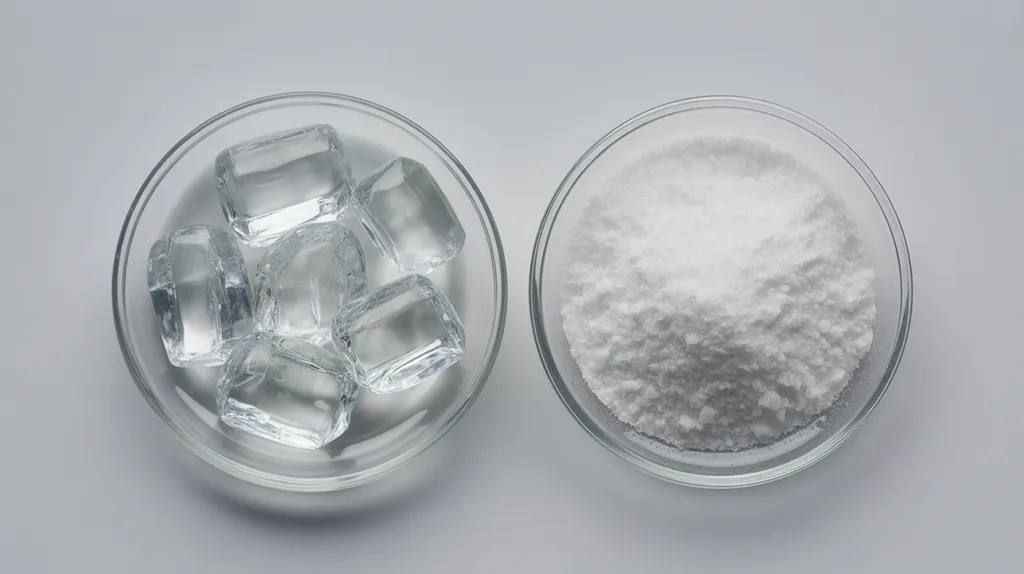
Sodium acetate trihydrate contains water of crystallization within its crystal structure. This hydrate form has thermal behavior that differs substantially from anhydrous sodium acetate.
The distinction is important because the name “sodium acetate” can refer to more than one physical form:
| Material | CAS number | Reported thermal value |
|---|---|---|
| Sodium acetate trihydrate | 6131-90-4 | Approximately 58°C |
| Anhydrous sodium acetate | 127-09-3 | Approximately 324°C |
The approximately 324°C value is associated with anhydrous sodium acetate and must not be substituted for the trihydrate value. The forms also have different molecular weights, water content, handling behavior, and application implications.
For a technical purchase specification, identifying only “sodium acetate” is insufficient when the process depends on thermal behavior. The specification should state:
- Sodium acetate trihydrate
- CAS 6131-90-4
- Solid hydrate form
- Grade and assay basis
- Applicable thermal specification or literature reference
A broader discussion of the two forms can be found in sodium acetate trihydrate vs anhydrous. The comparison should remain form-specific; data for anhydrous sodium acetate should not be transferred to the trihydrate.
What happens when sodium acetate trihydrate is heated and cooled?

The approximately 58°C value describes a principal transition reported for sodium acetate trihydrate. It does not describe every thermal event that may occur during heating and cooling.
A simplified phase-change sequence is:
- Initial solid hydrate: Sodium acetate trihydrate exists as a crystalline solid containing water of crystallization.
- Heating toward the transition region: The hydrate approaches its reported melting or solid-to-liquid transition near 58°C.
- Liquid or transformed state: The material can exist in a liquid state after heating through the relevant transition region.
- Cooling: The liquid may remain liquid below its equilibrium crystallization temperature if it becomes supercooled.
- Nucleation and crystallization: Once crystallization begins, sodium acetate trihydrate crystals form and heat is released.
Supercooling is a metastable condition. It means that a liquid remains below the temperature at which crystallization would normally be expected, without immediately forming crystals. Crystallization may begin after a nucleation event or trigger. The exact behavior depends on the material system, thermal history, impurities, water balance, and physical conditions.
Crystallization-based heat release is the reason sodium acetate trihydrate is relevant to some thermal-storage and reusable heating systems. The detailed energy aspect is separate from the melting-point question; see sodium acetate heat of crystallization for that topic.
Heating beyond the principal transition region can introduce another event: dehydration. Retrieved chemical reference sources associate heating above approximately 120°C with loss of water of crystallization and movement toward an anhydrous form. This value is approximate and method-dependent. It should not be described as the melting point of sodium acetate trihydrate.
Why reported melting points and ranges differ
Technical sources may report approximately 58°C, approximately 58–58.4°C, or a broader 56–64°C range. These values can appear inconsistent until their scope is examined.
Important reasons for variation include:
- Grade: A reagent, HPLC, technical, or other commercial grade may have different specification practices.
- Water content: The hydrate form depends on its water of crystallization and measured water content.
- Assay and impurities: Composition can affect the observed transition behavior.
- Thermal history: Previous heating, cooling, dehydration, or crystallization can influence the sample.
- Measurement method: The reported result may come from a literature reference, capillary measurement, thermal analysis, or another method.
- Heating rate and sample preparation: Thermal measurement conditions can affect the observed onset and completion of a transition.
- Reporting convention: One source may round a result to 58°C, while another may report a range.
The wording used by a source also matters:
| Reported wording | What it may represent | How to use it |
|---|---|---|
| Approximately 58°C | Rounded reference value | General technical orientation |
| 56–64°C | Literature range for a specified product or grade | Grade-specific reference |
| Approximately 58–58.4°C | More precise reported value | Source-specific comparison |
| Above approximately 120°C | Dehydration-related heating event | Not the melting point |
| Crystallization temperature | Cooling or nucleation behavior | Not automatically equivalent to melting |
Melting point, phase-transition temperature, dehydration temperature, crystallization onset, and application operating temperature are related but different quantities. A source should identify which quantity it reports before the value is used in process design or quality control.
What the melting point means for industrial specification and QA

A melting-point value is most useful when it is attached to the exact material identity and test scope. Before using sodium acetate trihydrate in a thermal or formulation process, QA and procurement teams should verify:
- Exact chemical name and CAS number
- Trihydrate versus anhydrous form
- Grade and intended application
- Assay basis
- Water-content or loss-on-drying information, where relevant
- Whether the thermal value is literature-based, typical, specified, or batch-tested
- Test method and thermal-analysis conditions, where available
- Whether the reported temperature refers to melting, a phase transition, dehydration, or crystallization onset
- Representative technical data or batch documentation for the supplied grade
A product literature value is not automatically a release specification. Likewise, a melting point alone does not establish application suitability, thermal-storage capacity, cycle life, or regulatory approval.
For an RFQ or technical review, a useful request is not simply “sodium acetate with a 58°C melting point.” A more precise request identifies the hydrate form, CAS number, grade, assay basis, required documentation, and the intended thermal function. The supplier’s value should then be reviewed against the stated method and conditions.
How the phase-change behavior relates to reusable heat packs
Sodium acetate trihydrate is relevant to crystallization-based heating systems because a liquid phase can sometimes be supercooled and later crystallized to release heat. The important sequence is not just “heat to 58°C.” It involves:
- Formation or maintenance of a liquid phase
- Cooling without immediate crystallization
- A nucleation event
- Crystallization of the hydrate
- Release of crystallization heat
The approximately 58°C melting or transition value does not by itself establish the heat output, discharge temperature, cycle life, or performance of a reusable heat-pack formulation. Those properties depend on the complete formulation, physical design, thermal history, and operating conditions.
Vanchor’s related page on sodium acetate trihydrate heat packs addresses the application context separately. It should not be used to infer universal performance for every sodium acetate trihydrate grade.
Key takeaways for interpreting sodium acetate trihydrate melting data
- The commonly reported sodium acetate trihydrate melting or principal transition temperature is approximately 58°C.
- A 56–64°C literature range is also reported for a specified HPLC product and should remain tied to that product and source scope.
- The trihydrate is CAS 6131-90-4; it is not interchangeable with anhydrous sodium acetate.
- Approximately 324°C refers to anhydrous sodium acetate, not sodium acetate trihydrate.
- Dehydration, melting, crystallization, and operating temperature are separate technical concepts.
- Before using the value as a process or purchasing requirement, verify the exact grade, hydrate form, test method, water-content basis, and supporting batch documentation.


Contact Us
In This Article
Related Posts
Индивидуальные упаковочные решения от поставщика безводного ацетата натрия в Китае
2026-09-23
Тенденции применения безводного ацетата натрия для специального химического производства
2026-09-23
Безводный ацетат натрия для дубления кожи: улучшает равномерность окрашивания
2026-09-22
Formic Acid 85% for Animal Feed Preservation: Moisture and Storage Stability Guide
2026-09-21


