



Potassium Formate Powder Manufacturer: What Buyers Should Check Before Ordering
By LIN
2026-09-01Related Posts
Индивидуальные упаковочные решения от поставщика безводного ацетата натрия в Китае
2026-09-23
Тенденции применения безводного ацетата натрия для специального химического производства
2026-09-23

Безводный ацетат натрия для дубления кожи: улучшает равномерность окрашивания
2026-09-22
Formic Acid 85% for Animal Feed Preservation: Moisture and Storage Stability Guide
2026-09-21
When buyers search for a potassium formate powder manufacturer, they are usually looking for a high-content solid product that can be stored, shipped and dissolved locally.
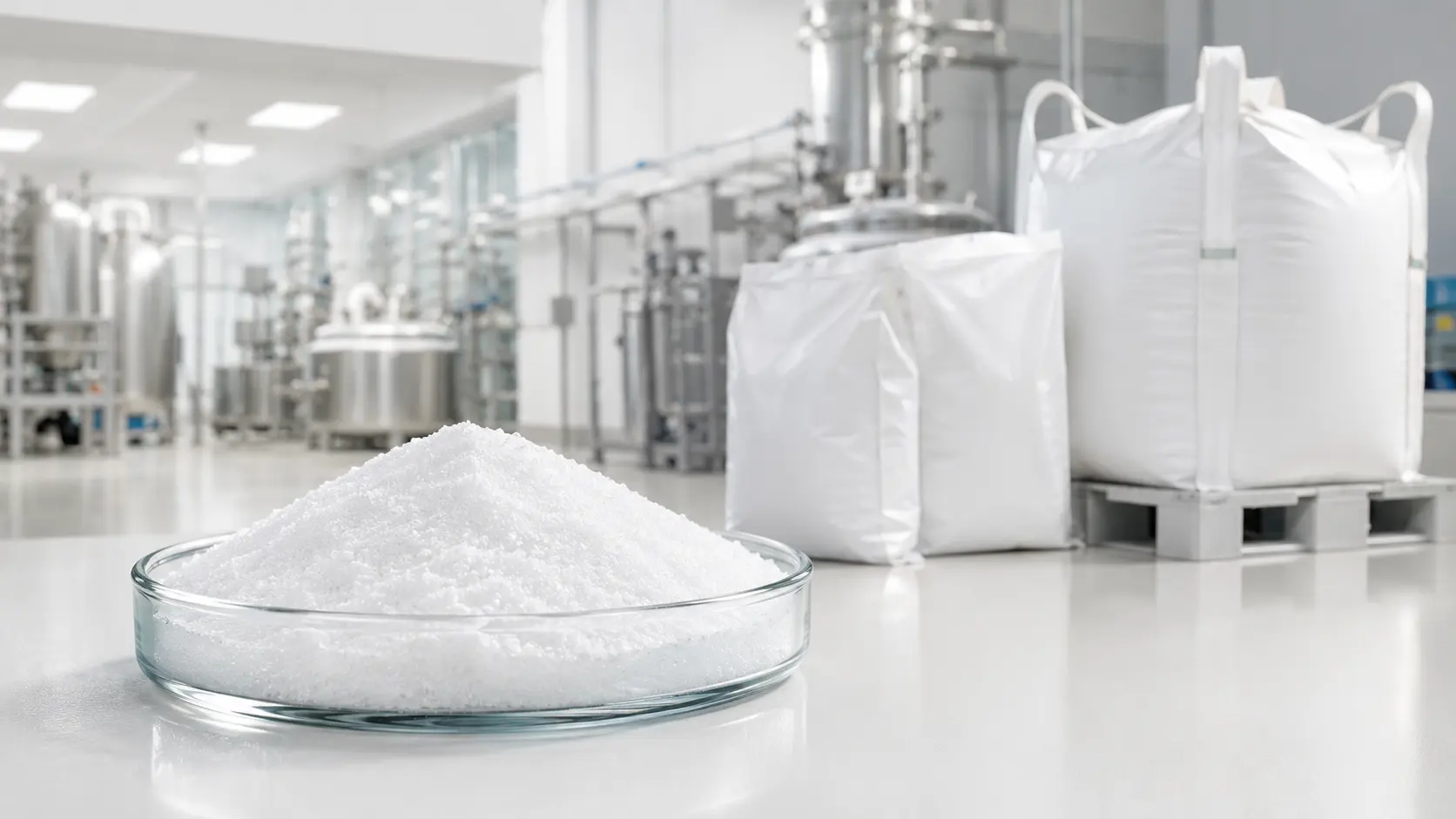
For many industrial users, this makes a lot of sense.
Compared with liquid potassium formate, solid material contains less water, which means more active potassium formate can be transported in the same shipment weight.
That can be useful for:
- Oilfield chemical companies
- Brine manufacturers
- Refrigeration-fluid producers
- Chemical distributors
- Deicing formulators
- Industrial blending plants
But solid potassium formate also brings its own handling issues.
The biggest one is moisture.
Potassium formate is hygroscopic, so if the packaging is poor or the warehouse is too humid, the material can absorb moisture and start to cake.
That doesn't always mean the product is chemically unusable, but nobody enjoys dealing with hard lumps when a blending plant is trying to make a solution quickly.
What Is Solid Potassium Formate?
Potassium formate has the chemical formula HCOOK and CAS number 590-29-4.
In solid form, it is normally supplied as a white crystalline material with high potassium formate content.
One common industrial grade is around 96% or higher assay.
The main advantage is simple:
there is much less water being transported compared with a 75% liquid solution.
For example:
- 1,000 kg of 75% liquid contains about 750 kg active potassium formate.
- 1,000 kg of 96% solid contains about 960 kg active potassium formate.
That difference can matter quite a lot in international freight.
Still, the customer needs to dissolve the solid after arrival.
So freight efficiency should always be compared with local processing cost.
Solid or Liquid: Which One Makes More Sense?
There is no universal answer.
| Factor | Solid Potassium Formate | 75% Liquid Solution |
|---|---|---|
| Active content | Higher | Lower |
| Water transported | Less | More |
| Local dissolution | Required | Usually not required |
| Pumping | After dissolution | Direct |
| Storage | Dry warehouse | IBC / tank |
| Main concern | Moisture and caking | Temperature and crystallization |
| Concentration flexibility | Very high | Good |
If your plant already has mixing tanks, agitation and good water control, solid potassium formate can be a very practical option.
If you want to unload and start pumping immediately, liquid is easier.
A good manufacturer should not push one grade for every customer.
The right answer depends on how the customer works.
Moisture Control Is the First Thing I Would Check
Solid potassium formate absorbs moisture from the air.
That makes packaging very important.
Poor moisture protection may lead to:
- Caking
- Sticky material
- Difficult bag discharge
- More manual handling
- Changes in apparent product condition
This is especially important in humid climates.
A bag may look perfect when it leaves the factory, then spend three weeks inside a container moving through a hot and humid port.
That is where packaging quality starts to show.
For solid potassium formate, I would ask the manufacturer about:
- Inner liner
- Outer bag material
- Heat sealing
- Moisture barrier
- Pallet wrapping
- Warehouse humidity
- Container moisture protection
These details are not very exciting, but they matter in real use.
What Should a Powder Manufacturer Test?
A buyer should not only ask for “96% potassium formate.”
The rest of the specification matters too.
| Test Item | Why It Matters |
|---|---|
| Potassium formate assay | Confirms active content |
| Moisture | Important for solid stability |
| Chloride | Important in corrosion-sensitive systems |
| Iron | Indicates contamination |
| Insoluble matter | Affects final solution clarity |
| Appearance | Quick incoming check |
| Batch number | Supports traceability |
For some customers, chloride and insoluble matter can be nearly as important as assay.
A product can technically meet the main purity requirement but still create more filtration work than expected.
That is why a real batch COA is more useful than a one-line quotation saying “high purity.”
Don't Assume “Powder” Means a Specific Particle Size
This is worth mentioning.
Some buyers use the word “powder” very loosely.
Others expect a very fine particle size.
Solid potassium formate is often supplied as crystalline material rather than an ultra-fine powder.
If particle size matters to your process, ask the manufacturer directly.
Do not assume.
Ask:
- Is it crystalline or fine powder?
- Is there a controlled particle-size range?
- Does the material normally contain small lumps?
- How does it flow from the bag?
For most applications, dissolution performance matters more than cosmetic particle size.
Still, if your feeding equipment is sensitive, this should be discussed before ordering.
Dissolution Is Usually Straightforward, but Process Control Still Matters
Potassium formate is highly soluble in water.
That makes it suitable for preparing concentrated brines.
A basic industrial process may look like this:
- Add suitable water to the mixing tank.
- Start agitation.
- Add potassium formate gradually.
- Allow the solid to dissolve completely.
- Check density or concentration.
- Adjust with water or additional potassium formate.
- Filter if required.
- Complete final QC.
Dumping a large amount of solid into a small volume of water all at once is normally not the smartest approach.
Even a very soluble salt can create local high-concentration zones or clumps during mixing.
Gradual addition usually gives better process control.
Water Quality Can Affect the Final Brine
The potassium formate may be high quality, but the water can still create problems.
Depending on the final application, dilution water may contain:
- Chloride
- Calcium
- Magnesium
- Iron
- Suspended solids
These can enter the final brine.
For oilfield clear brines or sensitive cooling systems, poor-quality water can partly undo the benefit of buying a controlled raw material.
So if the application is technical, test the dilution water too.
This is one of those things that is easy to overlook.
Then later everyone blames the potassium formate.
Why Insoluble Matter Matters After Dissolution
When solid potassium formate is dissolved, the buyer usually expects a clear solution.
If the material contains too much insoluble matter, you may see:
- Sediment
- Cloudiness
- Filter loading
- Tank deposits
- More cleanup work
For some general industrial uses, a small amount may not be a big issue.
For clear oilfield brines, it can be much more important.
So when comparing manufacturers, ask what the insoluble limit is and whether the product is routinely tested.
Packaging Should Match the Way You Use It
Common industrial solid packaging may include smaller moisture-resistant bags or larger bulk bags.
The right choice depends on your plant.
Smaller bags:
- Easier manual handling
- Easier for smaller batch production
- More packaging waste
Large bags:
- Better for high-volume plants
- Faster bulk feeding
- Require suitable lifting equipment
Before ordering, confirm:
- Net weight
- Inner liner
- Pallet quantity
- Bag dimensions
- Container loading
- Warehouse handling
A 25 kg bag and a 1,000 kg jumbo bag create very different operating requirements.
Storage Conditions Are Simple but Important
Solid potassium formate should normally be stored:
- In a dry warehouse
- Away from rain
- Away from open moisture sources
- In sealed original packaging
- On pallets
- With damaged bags separated quickly
Once a bag is opened, it should be used or resealed properly.
Leaving opened material exposed overnight in a humid blending room is asking for trouble.
Sometimes the basic things are the things that get ignored first.
Manufacturer vs Distributor
Buying directly from a manufacturer may offer:
- Better large-volume pricing
- Direct specification discussion
- Better traceability
- More stable repeat supply
A distributor may offer:
- Smaller quantities
- Local stock
- Faster delivery
- Easier local communication
For large regular orders, factory-direct supply often makes sense.
For occasional smaller purchases, local distribution may actually be easier.
Powder Manufacturer Comparison Table
| Question | Better Answer | Possible Warning Sign |
|---|---|---|
| What is the assay? | Gives clear specification | Only says “high purity” |
| How is moisture controlled? | Explains packaging and storage | No clear answer |
| Can you provide recent COA? | Yes | Only generic TDS |
| What is insoluble matter limit? | Gives measurable value | Doesn't test it |
| What packaging is available? | Gives exact sizes | Vague information |
| Is particle size controlled? | Gives clear answer | Makes unsupported claims |
| Can you support repeat orders? | Gives realistic capacity | Always says unlimited |
Frequently Asked Questions
What is potassium formate powder?
The term usually refers to solid crystalline potassium formate with high active content.
Is potassium formate really a powder?
It may be described commercially as powder, but many industrial products are crystalline solids rather than ultra-fine powders.
What is a common solid grade?
A high-content grade around 96% or above is commonly used industrially.
Is solid potassium formate cheaper than liquid?
Not always, but freight per active kilogram can be more efficient because less water is transported.
Does solid potassium formate dissolve easily?
Yes. It is highly soluble in water.
Can I make 75% solution from solid potassium formate?
Yes, with controlled industrial mixing and proper concentration calculation.
Why does solid potassium formate cake?
Usually because it absorbs moisture during storage or handling.
Is caked potassium formate unusable?
Not necessarily. If contamination has not occurred, it may still dissolve, but handling becomes more difficult.
Why is chloride important?
Trace chloride can matter in corrosion-sensitive applications.
Should I test the dilution water?
For technical oilfield or refrigeration applications, yes. Water quality can affect the final brine.
What documents should a manufacturer provide?
A recent COA, TDS and SDS should normally be available.
Should the COA match the shipment batch?
Yes, ideally.
Is insoluble matter important for solid product?
Yes, because it can remain as sediment or increase filtration load after dissolution.
What packaging is best?
That depends on your plant. Smaller bags suit manual handling, while jumbo bags suit high-volume blending systems.
What is the most important thing to check?
For solid potassium formate, I would look closely at assay, moisture control, insoluble matter and packaging.
Final Thoughts
Choosing a potassium formate powder manufacturer is not only about buying the highest assay number.
The product also has to arrive dry, flow reasonably well, dissolve cleanly and produce a consistent final solution.
For most industrial buyers, I would focus on:
purity, moisture control, chloride, insoluble matter, packaging and batch consistency.
If those things are controlled well, solid potassium formate is a very flexible raw material.
You can transport more active product, prepare different concentrations locally and use the same material across several industrial fluid systems.
But if packaging and moisture control are poor, even a good chemical can become unnecessarily difficult to use.


Contact Us
In This Article
Related Posts
Индивидуальные упаковочные решения от поставщика безводного ацетата натрия в Китае
2026-09-23
Тенденции применения безводного ацетата натрия для специального химического производства
2026-09-23
Безводный ацетат натрия для дубления кожи: улучшает равномерность окрашивания
2026-09-22
Formic Acid 85% for Animal Feed Preservation: Moisture and Storage Stability Guide
2026-09-21


