



Potassium Formate Brine Supplier: What Buyers Should Check Before Choosing One
By LIN
2026-09-01Related Posts
Индивидуальные упаковочные решения от поставщика безводного ацетата натрия в Китае
2026-09-23
Тенденции применения безводного ацетата натрия для специального химического производства
2026-09-23

Безводный ацетат натрия для дубления кожи: улучшает равномерность окрашивания
2026-09-22
Formic Acid 85% for Animal Feed Preservation: Moisture and Storage Stability Guide
2026-09-21
A potassium formate brine supplier is not simply selling a concentrated salt solution.
For oilfield and industrial users, the real concern is whether the brine can reach the required density, remain clear, stay stable at the expected temperature and arrive with consistent quality from one batch to the next.
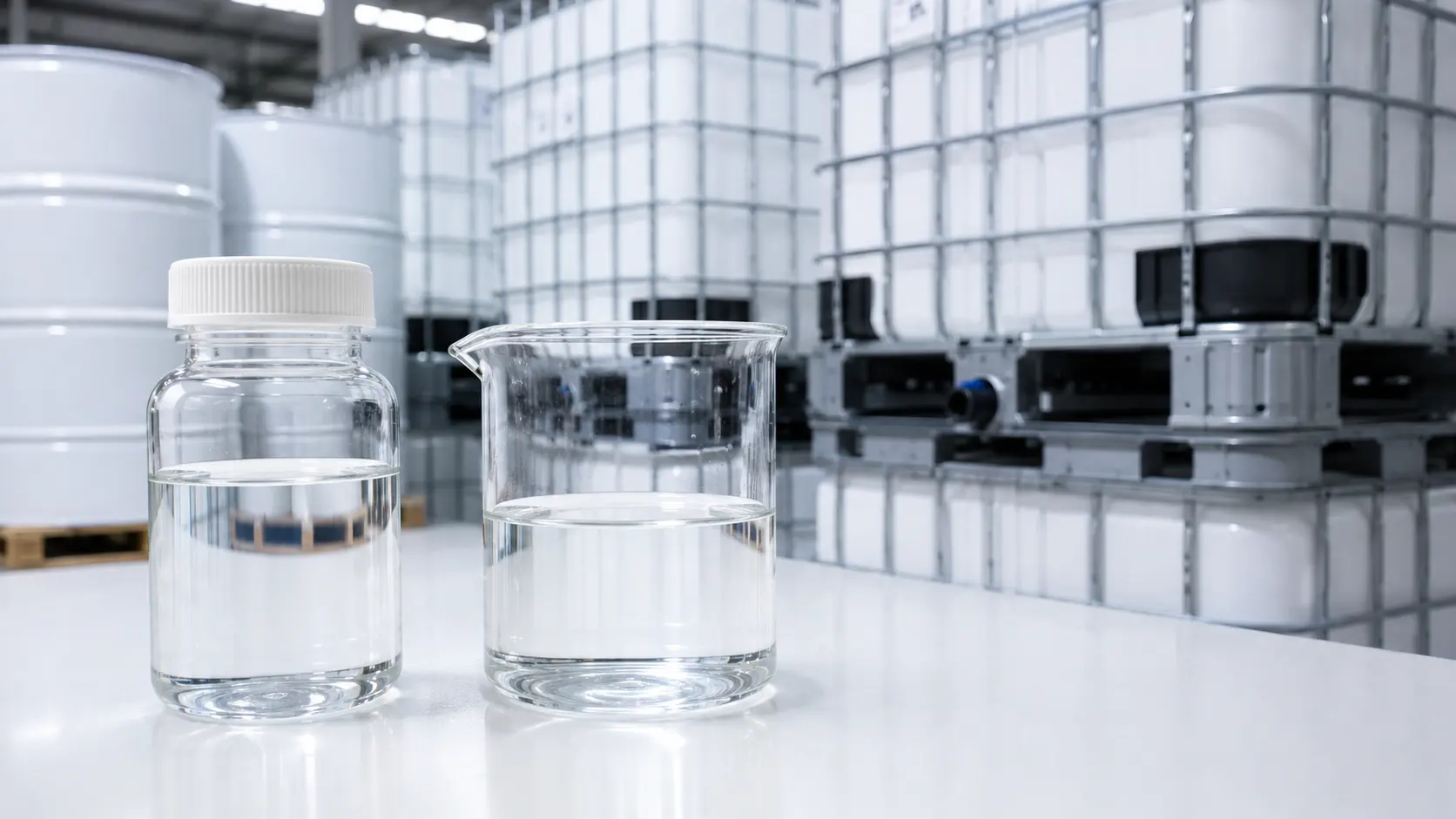
That is where supplier quality starts to matter.
Potassium formate brine is widely used in drilling, completion, workover and reservoir drill-in fluids. It is also used in some refrigeration and heat-transfer systems.
The reason is fairly simple: potassium formate is highly soluble in water and can produce relatively dense, clear brines without relying completely on suspended weighting solids.
But “high-density brine” does not automatically mean “good brine.”
The details matter.
What Is Potassium Formate Brine?
Potassium formate brine is an aqueous solution of potassium formate, HCOOK.
In industrial use, it may be supplied as a concentrated solution and then adjusted to a specific working density at the customer's plant or field location.
A concentrated 75% potassium formate solution typically has a density around 1.57–1.58 g/cm³ at room temperature, depending on exact concentration and measurement conditions.
For oilfield customers, this is useful because higher-density brines can help control well pressure while keeping the fluid relatively low in suspended solids.
That can be especially valuable in completion and reservoir-sensitive operations.
Why Buyers Use Potassium Formate Brine
Traditional high-density fluids can require suspended solids or other salts.
Potassium formate brine offers a different approach.
Typical reasons buyers choose it include:
- High water solubility
- Relatively high brine density
- Clear or low-solids fluid systems
- Good compatibility with formate-based drilling systems
- Useful low-temperature behavior when properly formulated
- Flexible concentration adjustment
In practice, the exact benefit depends on the complete fluid system.
Potassium formate is not the entire drilling fluid.
It is normally the base brine or an important component of the final formulation.
Density Is Usually the First Number Buyers Ask About
For oilfield brines, density is one of the most important parameters.
But one thing should be clear:
density depends on concentration and temperature.
A supplier should not give one density number without explaining the conditions.
| Item | Why It Matters |
|---|---|
| Concentration | Directly affects brine density |
| Temperature | Density changes with temperature |
| Purity | Can affect final fluid behavior |
| Dissolved solids | Influence density and fluid chemistry |
| Field dilution | Changes final working density |
For field use, density may be checked with standard brine or drilling-fluid equipment.
Still, density alone does not tell you everything about the quality of the potassium formate.
Two liquids can have similar density while containing different impurity levels.
Clear Brine Means Insoluble Matter Matters
One of the advantages of potassium formate systems is the ability to prepare clear or low-solids brines.
That means insoluble matter deserves attention.
If the raw material contains too much suspended or insoluble material, the customer may see:
- Higher filter loading
- Cloudy brine
- Tank sediment
- Plugging risk
- More cleanup work
- Extra filtration cost
For completion fluids, this can be especially important because the fluid may contact the reservoir directly.
Nobody wants unnecessary solids entering a formation-sensitive system.
A serious brine supplier should be able to provide a measurable insoluble-matter specification.
Chloride Is Another Important Point
Potassium formate is not a chloride salt.
That is one reason some users choose formate brine over traditional chloride-based systems.
Still, commercial potassium formate can contain trace chloride.
So statements such as “chloride-free” should be treated carefully.
For industrial purchasing, a numerical chloride limit is much more useful.
Why?
Because chloride can influence:
- Corrosion
- Metallurgy compatibility
- Completion-fluid design
- Long-term fluid stability
Different customers may accept different levels.
The supplier should understand that.
75% Liquid or Solid for Brine Preparation?
Potassium formate brine can be prepared from concentrated liquid or solid potassium formate.
| Factor | 75% Liquid Solution | High-Content Solid |
|---|---|---|
| Ready for pumping | Yes | No |
| Dissolution required | Usually no | Yes |
| Active content per ton | Lower | Higher |
| Freight efficiency | Lower | Better |
| Field preparation | Faster | More mixing needed |
| Concentration flexibility | Good | Very high |
| Storage concern | Cold crystallization | Moisture absorption |
For remote oilfield locations, liquid product can save preparation time.
For central brine plants with proper mixing systems, solid product may offer better transport efficiency.
There is no universal answer.
The best form depends on where the brine will be prepared.
Crystallization Temperature Should Not Be Ignored
High-density brines can have concentration-dependent crystallization behavior.
For oilfield applications, buyers may need to look at:
- TCT — True Crystallization Temperature
- PCT — Pressure Crystallization Temperature
- Expected surface temperature
- Downhole temperature
- Storage temperature
- Transportation conditions
This matters because a brine that looks fine in a warm warehouse may behave differently at a cold rig site.
One common mistake is assuming that the highest concentration always gives the best low-temperature performance.
That is not necessarily true.
The relationship between concentration and crystallization can be more complicated.
So the final working concentration should be designed around the actual operating environment.
Water Quality Affects the Final Brine
If concentrated potassium formate is diluted locally, the quality of the water matters.
Poor dilution water can introduce:
- Chloride
- Calcium
- Magnesium
- Iron
- Suspended solids
- Microbiological contamination
Then the customer may blame the potassium formate even though the problem came from the water.
For technically sensitive brines, test the dilution water before blending.
This is especially important when working with clear completion fluids.
Filtration Is Often Part of the Final Preparation
Even when the raw material is good, final brine filtration may still be required.
The filtration level depends on the application.
Completion operations may require tighter fluid cleanliness than general drilling-fluid preparation.
The final system may therefore include:
Potassium formate concentrate
→ dilution
→ additive blending
→ density adjustment
→ filtration
→ final QC
The supplier does not necessarily perform all of these steps.
But a good supplier should understand why the customer asks about clarity and insoluble matter.
Corrosion Should Be Evaluated as a System
Potassium formate is sometimes described too casually as “non-corrosive.”
That is not a safe general statement.
Corrosion depends on:
- Concentration
- pH
- Temperature
- Oxygen
- Chloride
- Metal type
- Fluid additives
- Inhibitor package
Carbon steel, stainless steel, copper alloys and aluminum may respond differently.
For long-term circulation or packer-fluid applications, corrosion testing may be needed with the actual metallurgy.
A raw-material supplier should avoid making blanket corrosion claims.
What Should Be on the COA?
A useful COA for potassium formate brine or concentrate may include:
| Parameter | Why Buyers Check It |
|---|---|
| Concentration | Confirms active content |
| Density | Supports field calculations |
| pH | Important for system chemistry |
| Chloride | Important for corrosion control |
| Iron | Indicates contamination |
| Insoluble matter | Important for clarity |
| Appearance | Quick incoming inspection |
| Batch number | Supports traceability |
The exact specification should be agreed before the order.
For larger oilfield projects, it is worth reviewing several recent COAs rather than just one.
That gives a better picture of batch consistency.
Supplier Reliability Matters in Oilfield Work
Oilfield schedules can change quickly.
A well may suddenly need more brine than expected.
If the supplier cannot respond, the cost of waiting can be much higher than the chemical price difference.
Before choosing a supplier, ask:
- What volume is normally in stock?
- What is the production lead time?
- Can emergency volume be supported?
- What packaging is available?
- Can the supplier support export shipment?
- Are COA, TDS and SDS available?
- Can repeat batches stay within the same specification?
For project work, supply reliability is part of product quality.
Frequently Asked Questions
What is potassium formate brine used for?
It is commonly used in drilling, completion, workover and reservoir drill-in fluid systems.
Is potassium formate brine a clear fluid?
It can be formulated as a clear or low-solids brine, depending on purity, additives and filtration.
What density can potassium formate brine reach?
Concentrated solutions can reach around 1.57–1.58 g/cm³ under typical room-temperature conditions, though final working density depends on concentration and temperature.
Can potassium formate brine replace bromide brine?
Sometimes, but not in every density range. Fluid selection depends on required density, crystallization, compatibility and cost.
Why is insoluble matter important?
Because unwanted solids can increase filtration load and create formation or equipment problems.
Is potassium formate brine chloride-free?
Potassium formate itself is not a chloride salt, but commercial products may contain trace chloride. Check the actual specification.
Can I prepare brine from solid potassium formate?
Yes. Solid potassium formate can be dissolved in suitable water to prepare the required concentration.
Is 75% liquid easier to use?
Usually yes, because it can be pumped and diluted directly.
Should I test dilution water?
For technical oilfield applications, yes. Poor water quality can affect the final brine.
What is TCT?
TCT means True Crystallization Temperature. It is used to evaluate crystallization behavior of high-density brines.
Is potassium formate non-corrosive?
Not automatically. Corrosion depends on the complete fluid system and operating conditions.
Should the final brine be filtered?
For many completion and clear-brine applications, filtration is an important preparation step.
What documents should a supplier provide?
A batch COA, TDS and SDS should normally be available.
Can potassium formate brine be reused?
In some operations, brine can be recovered and reconditioned, depending on contamination and fluid condition.
What is the most important thing when choosing a brine supplier?
For me, it is consistent purity plus reliable supply.
A good brine is only useful if the next batch behaves the same way and arrives when the project needs it.
Final Thoughts
Choosing a potassium formate brine supplier is not only about buying a high-density liquid.
You need to look at the whole picture:
density, clarity, chloride, insoluble matter, crystallization behavior, packaging, documents and delivery reliability.
For oilfield work, the brine may become a critical part of the fluid system.
That means consistency matters.
If the supplier can provide clean material, stable concentration, useful technical data and repeatable batches, the rest of the fluid design becomes much easier.


Contact Us
In This Article
Related Posts
Индивидуальные упаковочные решения от поставщика безводного ацетата натрия в Китае
2026-09-23
Тенденции применения безводного ацетата натрия для специального химического производства
2026-09-23
Безводный ацетат натрия для дубления кожи: улучшает равномерность окрашивания
2026-09-22
Formic Acid 85% for Animal Feed Preservation: Moisture and Storage Stability Guide
2026-09-21


