



Potassium Formate Deicing Chemical Supplier: Quality, Grades and Buying Guide
By LIN
2026-09-02Related Posts
Индивидуальные упаковочные решения от поставщика безводного ацетата натрия в Китае
2026-09-23
Тенденции применения безводного ацетата натрия для специального химического производства
2026-09-23

Безводный ацетат натрия для дубления кожи: улучшает равномерность окрашивания
2026-09-22
Formic Acid 85% for Animal Feed Preservation: Moisture and Storage Stability Guide
2026-09-21
Finding the right potassium formate deicing chemical supplier is not only about getting the lowest price per ton.
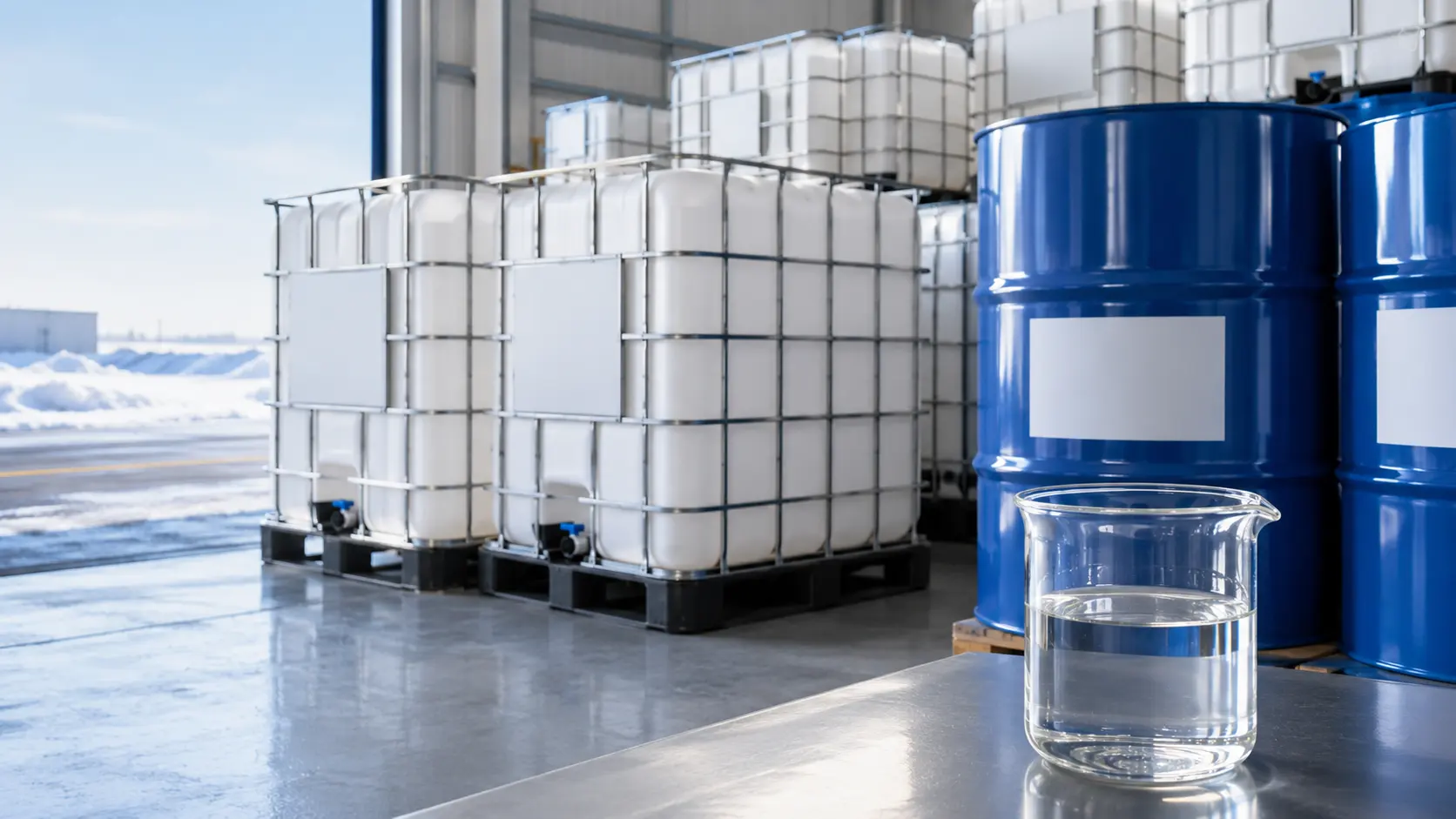
For manufacturers of road deicers, bridge anti-icing fluids, commercial winter-maintenance products and airport pavement deicers, the quality of potassium formate can directly affect concentration control, corrosion performance, storage stability and spray-system reliability.
A supplier therefore needs to offer more than a product labeled “75% potassium formate.”
Buyers should look at impurity control, batch consistency, technical documentation, packaging, production capacity and experience with winter-maintenance applications.
Potassium formate is highly soluble in water and can be supplied as either concentrated liquid or high-content solid material. Vanchor currently supplies Potassium Formate 75% Solution for formulated deicing and anti-icing products, as well as solid potassium formate for customers that prefer local solution preparation.
The right form depends on how the deicer manufacturer actually produces its finished product.
What Does a Potassium Formate Deicing Supplier Provide?
Potassium formate has the chemical formula HCOOK and CAS No. 590-29-4.
For deicing applications, suppliers commonly offer two main forms:
- Approximately 75% aqueous potassium formate solution
- ≥96% solid potassium formate
The liquid grade is useful when the customer wants fast pumping, metering and blending.
The solid grade provides more active potassium formate per ton shipped and allows the buyer to prepare its own solution concentrations.
Vanchor's current product pages list 75% liquid potassium formate for formulated deicing products and ≥96% solid potassium formate for customers requiring higher active content and flexible on-site dilution.
Liquid vs Solid Supply
| Factor | 75% Liquid | ≥96% Solid |
|---|---|---|
| Direct pumping | Yes | No |
| Dissolution required | No | Yes |
| Production speed | Faster | More preparation |
| Active content per ton | Lower | Higher |
| Freight efficiency | Lower | Higher |
| Concentration flexibility | Good | Very high |
| Typical buyer | Liquid deicer producer | Chemical blender |
There is no universal best option.
A local deicing-fluid plant may prefer liquid concentrate.
An international buyer shipping product thousands of kilometers may find solid material more economical.
Why Deicing Buyers Should Look Beyond Purity
Purity is important, but it is only one part of the specification.
A deicing formulation may also be affected by:
- Chloride
- Iron
- Insoluble matter
- pH
- Density
- Moisture
- Batch variation
This becomes particularly important when potassium formate is marketed as part of a low-chloride or non-chloride winter-maintenance product.
A buyer should not simply accept the phrase “chloride free.”
Instead, check the actual chloride limit in the specification or COA.
Important Purchasing Parameters
| Parameter | Why It Matters |
|---|---|
| Potassium formate assay | Confirms active chemical content |
| Density | Important for liquid concentration control |
| pH | Influences formulation and corrosion behavior |
| Chloride | Important for low-chloride positioning |
| Iron | Helps monitor raw-material consistency |
| Insoluble matter | Can affect pumps, filters and nozzles |
| Moisture | Important for solid material |
| Appearance | Useful incoming QC check |
| Batch consistency | Supports repeatable finished deicer production |
A technically good supplier should be able to discuss these parameters rather than only quoting purity.
Batch Consistency Matters for Commercial Deicer Production
Imagine a deicer manufacturer qualifies one batch of potassium formate.
The product performs well.
The company develops a working concentration, corrosion package and storage specification around that material.
Then the next shipment arrives with noticeably different impurity levels.
Now the formulation may need to be checked again.
That is why repeatability matters.
A supplier serving commercial deicing manufacturers should be able to maintain reasonably stable specifications from one shipment to another.
For regular seasonal orders, buyers may want to review several representative COAs rather than only one unusually good sample.
Vanchor's bulk purchasing guidance similarly highlights concentration, chloride, iron, insoluble matter, packaging, production capability and delivery reliability as relevant factors for large potassium formate orders.
TDS, COA and SDS Should Be Standard
A professional potassium formate deicing chemical supplier should normally be able to provide:
TDS — Technical Data Sheet
This gives standard or typical product information.
COA — Certificate of Analysis
This provides analytical results for a production batch or representative material.
SDS — Safety Data Sheet
This covers handling, storage and safety information.
For purchasing decisions, the COA deserves particular attention.
The TDS tells you what the product is designed to meet.
The COA tells you what a particular batch actually tested at.
For a new supplier, requesting a current sample COA before ordering a full container is sensible.
Does the Supplier Understand Deicing Applications?
A general industrial chemical trader may still supply good potassium formate.
However, a supplier familiar with deicing applications should understand why customers ask about:
- Working concentration
- Low-temperature behavior
- Chloride
- Crystallization
- Corrosion
- Spray systems
- Bulk liquid handling
For buyers developing liquid products, Vanchor's Potassium Formate Liquid Deicer guide covers potassium formate as a feedstock for road, bridge, industrial and other liquid deicing formulations.
A supplier does not need to design the customer's finished formulation.
But they should understand the difference between selling potassium formate raw material and selling a ready-to-use deicer.
That distinction becomes especially important in aviation.
Airport Deicing Requires Extra Care
Potassium formate can be used as raw material in airport pavement deicing and anti-icing products.
But standard industrial potassium formate should not automatically be marketed as an approved runway deicer.
The finished airport product needs to satisfy the applicable performance, corrosion and aviation requirements.
Vanchor's current potassium formate product page makes this distinction clearly: raw 75% potassium formate can be used as a base material for formulated deicers, while finished runway, taxiway or apron products must meet the applicable aviation requirements.
For customers developing aviation products, the related Potassium Formate for Airport Deicing page provides more application-specific purchasing information.
This is important when selecting a supplier.
If a supplier claims that ordinary industrial potassium formate is automatically “airport certified,” ask for the actual finished-product qualification.
Packaging Affects Total Cost
Potassium formate may be technically suitable but commercially inconvenient if the packaging does not fit the production plant.
Liquid options may include:
- IBC totes
- Flexitanks
- Bulk liquid shipment
Solid material may be supplied in:
- 25 kg bags
- Jumbo bags
- Other moisture-resistant packaging
The best option depends on order volume and local equipment.
For example, a customer using 100 tons per month may prefer bulk or flexitank deliveries rather than unloading hundreds of small containers.
A smaller specialty deicer producer may prefer IBCs because they are easier to store and meter.
For solid potassium formate, moisture protection matters because the material is hygroscopic.
Production Capacity Is Important Before Winter Starts
Deicing demand is seasonal.
That creates a procurement problem.
A supplier that normally has plenty of stock may become much busier once winter demand rises.
Commercial buyers should therefore discuss:
- Monthly production capacity
- Standard lead time
- Peak-season lead time
- Repeat-order availability
- Export schedule
- Port and container options
Buying the first shipment is usually easy.
Getting the third emergency shipment during a severe winter event can be more difficult.
For regular customers, annual or seasonal volume planning can reduce this risk.
Sample Testing Before Bulk Purchase
For a new supplier, testing a representative sample is worth doing.
A deicing-fluid manufacturer may check:
- Assay
- Density
- pH
- Chloride
- Iron
- Insoluble matter
- Dilution behavior
- Low-temperature performance
- Compatibility with corrosion inhibitors
The finished deicer can then be tested for:
- Freezing behavior
- Ice melting
- Ice penetration
- Corrosion
- Storage stability
- Spray performance
The supplier's raw material only needs to meet the agreed raw-material specification.
The finished-product manufacturer is responsible for proving that the actual deicer performs as intended.
Manufacturer or Trader?
Many buyers automatically prefer a potassium formate manufacturer.
That can make sense because direct manufacturing may offer:
- Better batch traceability
- More stable production planning
- Easier technical communication
- Better control of repeat specifications
- More flexibility on bulk orders
Still, “manufacturer” is not automatically equal to “good supplier.”
A distributor with strong inventory, QC and logistics can outperform a poorly organized factory.
The better approach is to evaluate the whole supply chain.
Supplier Qualification Checklist
| Question | What It Tells You |
|---|---|
| Are you manufacturer or distributor? | Supply-chain structure |
| What grades are regularly available? | Product consistency |
| Can you provide recent COAs? | QC transparency |
| Can chloride and insolubles be controlled? | Deicing suitability |
| What packaging is available? | Production fit |
| What is normal lead time? | Supply reliability |
| Can samples be provided? | Qualification support |
| What is monthly production capacity? | Bulk-order capability |
| Can repeat shipments meet the same spec? | Long-term consistency |
How to Request a Better Quote
Instead of sending:
Please quote potassium formate deicing chemical.
Try something more specific:
Product: Potassium Formate
Application: Liquid Deicing and Anti-Icing Formulation
Preferred Form: 75% Solution
Quantity: 100 MT
Packaging: IBC / Flexitank
Required Documents: COA, TDS and SDS
Key Requirements: Controlled chloride, iron and insoluble matter
End Use: Road, Bridge and Industrial Winter Maintenance
Destination: Rotterdam, Netherlands
For solid material:
Product: Potassium Formate ≥96%
Application: Local Deicing Solution Production
Quantity: 100 MT
Packaging: Jumbo Bags
This gives suppliers enough information to offer the correct grade and logistics arrangement.
Final Thoughts
Choosing a potassium formate deicing chemical supplier should involve more than comparing quotations.
A reliable supplier should provide:
- Stable concentration or purity
- Controlled impurities
- Consistent repeat batches
- COA, TDS and SDS documentation
- Suitable liquid or solid packaging
- Reliable seasonal supply
- Experience with bulk international delivery
For deicing manufacturers, raw-material consistency is especially important because the potassium formate becomes part of a larger finished formulation.
The cheapest ton of chemical is not always the cheapest ton of finished deicer.
A slightly better-controlled raw material can save time in QC, formulation adjustment and production later.
That is usually where a good supplier creates value.
FAQ
What should I look for in a potassium formate deicing chemical supplier?
Check assay, chloride, iron, insoluble matter, batch consistency, technical documentation, packaging, production capacity and delivery reliability.
Should deicer manufacturers buy 75% liquid or 96% solid potassium formate?
Liquid is easier for direct pumping and formulation. Solid provides higher active content per ton and may improve freight efficiency for long-distance shipping.
What documents should a supplier provide?
Buyers should normally request a current TDS, SDS and representative or batch-specific COA.
Is industrial potassium formate automatically a finished deicer?
No. Potassium formate is commonly used as raw material, while the finished deicing fluid still needs formulation and performance testing.
Can potassium formate be supplied for airport deicer production?
Yes, but aviation pavement products have additional requirements. Raw potassium formate should not automatically be described as a qualified runway deicer.
Should buyers request samples before bulk ordering?
Yes. Sample testing helps confirm raw-material quality and compatibility with the customer's actual deicing formulation.


Contact Us
In This Article
Related Posts
Индивидуальные упаковочные решения от поставщика безводного ацетата натрия в Китае
2026-09-23
Тенденции применения безводного ацетата натрия для специального химического производства
2026-09-23
Безводный ацетат натрия для дубления кожи: улучшает равномерность окрашивания
2026-09-22
Formic Acid 85% for Animal Feed Preservation: Moisture and Storage Stability Guide
2026-09-21


