



Potassium Formate Airport Deicer Manufacturer: Quality, Standards and Buying Guide
By LIN
2026-09-02Related Posts
Индивидуальные упаковочные решения от поставщика безводного ацетата натрия в Китае
2026-09-23
Тенденции применения безводного ацетата натрия для специального химического производства
2026-09-23

Безводный ацетат натрия для дубления кожи: улучшает равномерность окрашивания
2026-09-22
Formic Acid 85% for Animal Feed Preservation: Moisture and Storage Stability Guide
2026-09-21
Choosing a potassium formate airport deicer manufacturer requires more technical checking than sourcing an ordinary road deicing chemical.
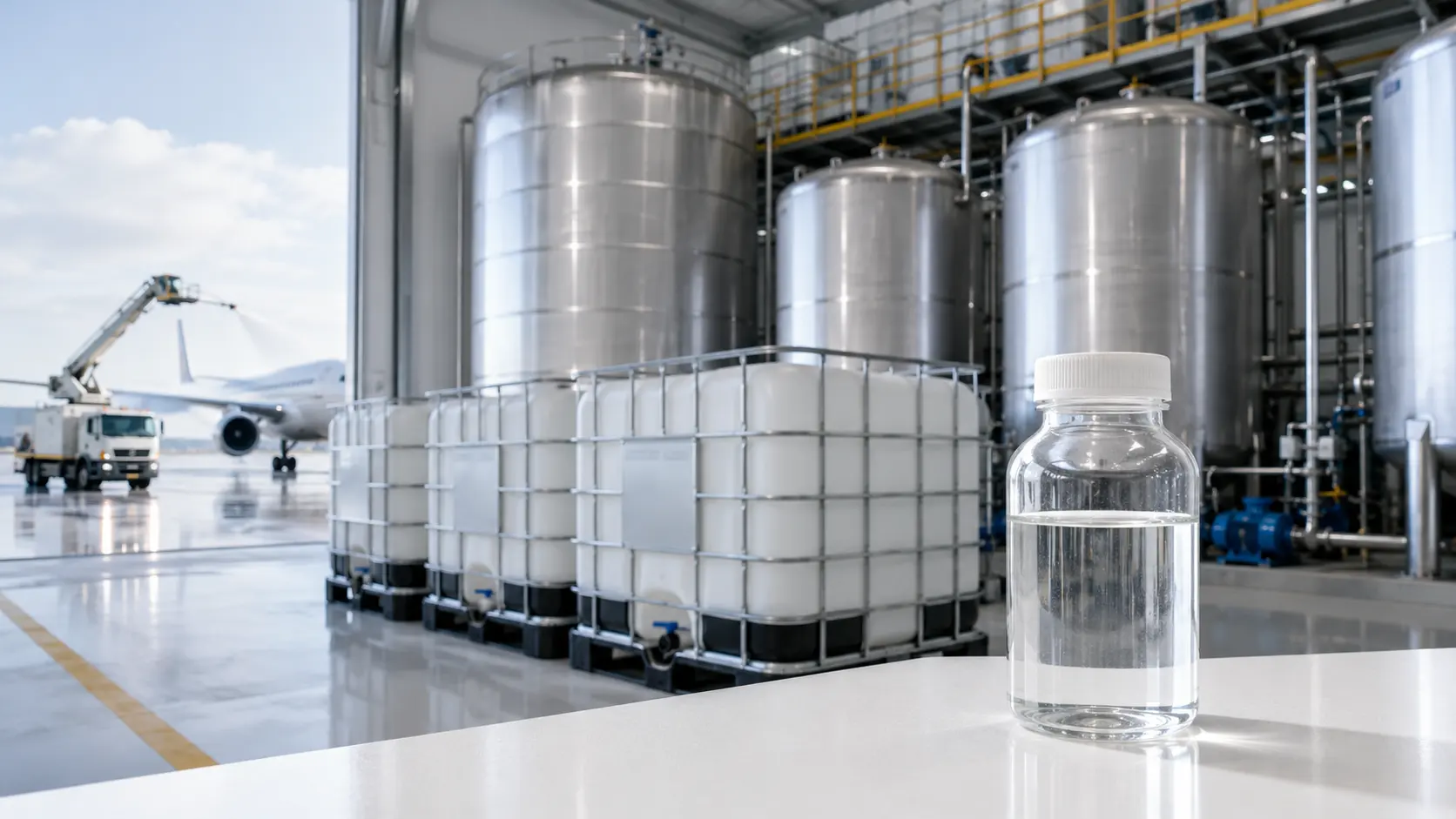
Airport pavement is a demanding application.
The product needs to remove or prevent ice effectively, but it may also be exposed to runway lighting, ground-support equipment, pavement materials and aircraft-related components. Because of this, airports and runway-fluid formulators usually care about much more than potassium formate concentration alone.
Raw-material consistency, chloride control, corrosion performance, storage stability and aviation qualification all matter.
There is also one important distinction buyers should understand from the beginning:
A potassium formate manufacturer and a finished airport runway deicer manufacturer are not necessarily the same company.
A chemical manufacturer may produce concentrated potassium formate as the active raw material. A specialist runway-deicer manufacturer then formulates, inhibits, tests and qualifies the finished aviation product.
That distinction is especially important when SAE AMS 1435 compliance is required.
What Does a Potassium Formate Airport Deicer Manufacturer Supply?
Potassium formate has the chemical formula HCOOK and CAS No. 590-29-4.
For airport deicing formulations, the raw material is commonly supplied as concentrated liquid potassium formate.
Vanchor's Potassium Formate 75% Solution is supplied as a concentrated aqueous product with a listed typical density of approximately 1.57–1.58 g/cm³ at 25°C. The company positions it as feedstock for formulated deicing and anti-icing products rather than automatically as a certified ready-to-use runway fluid.
This is technically the right approach.
The raw-material manufacturer controls parameters such as:
- Potassium formate concentration
- Density
- pH
- Chloride
- Iron
- Insoluble matter
- Batch consistency
The runway-deicer formulator controls the performance of the finished product.
Raw Material vs Finished Airport Deicer
| Potassium Formate Manufacturer | Finished Runway Deicer Manufacturer |
|---|---|
| Produces potassium formate feedstock | Produces complete runway fluid |
| Controls assay and impurities | Controls final formulation |
| Supplies COA, TDS and SDS | Performs finished-product qualification |
| May supply 75% concentrate | Selects final working concentration |
| Does not automatically certify runway use | May qualify product to SAE AMS 1435 |
| Focuses on bulk chemical consistency | Focuses on aviation performance |
For airport buyers, confusing these two roles can lead to misleading product claims.
Why Potassium Formate Is Used in Airport Deicing Fluids
Potassium formate is highly soluble in water and works as a freezing-point depressant.
When properly formulated and applied to airport pavement, it can help:
- Melt frost and thin ice
- Penetrate bonded ice
- Reduce ice-to-pavement adhesion
- Support mechanical snow removal
- Prevent strong ice bonding during anti-icing operations
Its liquid form is also convenient for airport spray equipment.
Another major reason for its use is that potassium formate is formate-based rather than chloride-based.
Airports generally have stronger reasons than ordinary road networks to limit chloride exposure around sensitive infrastructure and equipment.
Still, potassium formate should not simply be marketed as “non-corrosive.”
The complete runway formulation needs corrosion and material-compatibility testing.
SAE AMS 1435 Is Important for Liquid Runway Products
In the United States, current FAA guidance recommends liquid runway deicing and anti-icing products meeting the latest SAE AMS 1435 requirements.
FAA Engineering Brief No. 108, dated January 9, 2026, specifically lists potassium formate-based fluids among liquid deicing/anti-icing chemistries covered by the recommended SAE specification.
SAE currently lists AMS1435E, revised March 12, 2024, as the current liquid runway deicing/anti-icing material specification.
This means an airport-fluid buyer should ask:
Does the finished deicer meet SAE AMS 1435?
rather than:
Is your potassium formate raw material AMS 1435?
The second question mixes up raw-material quality with finished-product performance.
Vanchor also makes this distinction on its Potassium Formate for Airport Deicing page, positioning potassium formate as a raw material for airport deicing formulations rather than claiming the base chemical itself is the finished approved runway product.
Ice Melting Is Not the Only Performance Test
Airport deicer manufacturers have to consider more than freezing point.
Runway performance can involve:
- Ice melting
- Ice penetration
- Ice undercutting
- Anti-icing behavior
- Storage stability
- Corrosion
- Material compatibility
SAE AS6170 provides a standardized method for comparing the relative ice-melting capacity of runway deicing products.
SAE also revised AS6211A in January 2026 to provide a controlled method for evaluating relative ice-penetration performance over time.
This is important because a chemical sitting on top of the ice is not enough.
Operationally, the fluid needs to work toward the pavement interface and help break the bond so mechanical equipment can remove the frozen layer efficiently.
What Should Buyers Check in the Raw Potassium Formate?
A runway-fluid manufacturer needs a repeatable raw material.
If one shipment has noticeably different concentration or impurity levels from the next, the finished formulation may also change.
Raw-Material Supplier Checklist
| Parameter | Why It Matters |
|---|---|
| Potassium formate content | Confirms active ingredient |
| Density | Supports liquid concentration QC |
| pH | Influences formulation behavior |
| Chloride | Important for low-chloride positioning |
| Iron | Helps monitor contamination and consistency |
| Insoluble matter | Protects filters and spray systems |
| Appearance | Useful incoming inspection |
| Batch consistency | Supports repeatable deicer production |
| COA | Confirms actual batch results |
| TDS / SDS | Supports technical and safety review |
Vanchor's current 75% product page lists COA, SDS and TDS availability and identifies deicing-chemical manufacturers among its target customers.
For an airport-fluid producer, reviewing several representative COAs can be more useful than looking at only one ideal sample.
Batch Consistency Matters More Than Marketing Terms
A supplier may describe its product as:
- Aviation grade
- Airport grade
- Premium potassium formate
- Deicing grade
Those terms sound useful, but they are not a substitute for numerical specifications.
The buyer should compare actual limits.
For example, two suppliers may both offer “75% potassium formate,” while one has tighter control over chloride, insoluble material and concentration variation.
That difference may become important once corrosion inhibitors and other formulation components are added.
A good manufacturer should be comfortable discussing specifications, not just repeating the words “high purity.”
Liquid Potassium Formate Is Usually Convenient for Deicer Plants
A concentrated liquid product is particularly useful for manufacturers already operating liquid blending systems.
Advantages include:
- Direct pumping
- Metered dosing
- No solid dissolution stage
- Faster production
- Lower dust exposure
- Easier continuous blending
Vanchor notes that its 75% potassium formate can be transferred, metered and blended through compatible industrial liquid-handling systems without requiring on-site powder dissolution.
For more detail on liquid formulation applications, buyers can also review the Potassium Formate Liquid Deicer guide.
The disadvantage is obvious: liquid product includes water, so freight efficiency is lower than shipping high-content solid potassium formate.
The best option depends on production equipment and transport distance.
Storage Temperature Needs Attention
One slightly counterintuitive issue with concentrated potassium formate is crystallization.
A chemical used for winter deicing may still require controlled storage when it is kept as a highly concentrated raw material.
Vanchor currently recommends storing its concentrated 75% liquid in sealed compatible containers, keeping it above 10°C and preventing crystallization.
This does not mean the finished runway fluid only works above 10°C.
The concentrated feedstock and the finished deicing formulation are different solutions.
A manufacturer may dilute and reformulate the concentrate to achieve the required low-temperature performance.
That distinction should be discussed before bulk winter deliveries.
Environmental Information Is Part of Airport Purchasing
Airport deicing chemicals eventually become part of snowmelt and runoff.
FAA guidance recommends that airport operators obtain environmental information from deicing-product suppliers, including data such as:
- Biodegradability
- BOD
- COD
- pH
- Hazardous components
- Remaining inert materials
This helps airports manage discharge and environmental reporting.
Potassium formate has real-world airport use. For example, published research from Oslo Airport Gardermoen describes potassium formate being used to deice runways and taxiways while the airport also managed groundwater and deicer dispersion concerns.
So environmental performance should be managed, not just advertised.
How to Evaluate a Potassium Formate Manufacturer
Before approving a new supplier, ask practical questions:
- Do you manufacture potassium formate directly?
- What liquid concentrations do you produce regularly?
- Can you provide recent COAs?
- What are your limits for chloride, iron and insoluble matter?
- Can you maintain the same specification across repeat orders?
- What bulk packaging is available?
- What is your peak-season production capacity?
- Can you provide samples for formulation testing?
- Can you support export documentation?
- Do you understand that the finished runway fluid requires separate aviation qualification?
The last question matters.
A supplier that claims its ordinary industrial raw material is automatically an “FAA-approved runway deicer” should be examined carefully.
How to Request a Quote
A useful RFQ may look like this:
Product: Potassium Formate
Application: Airport Runway Deicer Manufacturing
Preferred Form: 75% Liquid Concentrate
Quantity: 100 MT
Packaging: IBC / Flexitank / Bulk
Required Documents: COA, TDS and SDS
Key Requirements: Controlled chloride, iron and insoluble matter
End Use: Raw Material for SAE AMS 1435 Runway Deicing/Anti-Icing Formulation
This gives the potassium formate manufacturer useful technical context without incorrectly making them responsible for the qualification of somebody else's finished deicer.
Final Thoughts
Choosing a potassium formate airport deicer manufacturer starts with understanding what is actually being purchased.
If you are buying potassium formate raw material, focus on:
- Concentration
- Impurity control
- Batch consistency
- Technical documents
- Bulk logistics
- Production reliability
If you are buying a finished runway deicer, then additional aviation-performance qualification becomes essential.
Potassium formate is a proven active chemistry for liquid runway deicing formulations, and current FAA guidance recognizes potassium formate-based products meeting SAE AMS 1435.
But the distinction remains important:
A good potassium formate manufacturer makes reliable raw material.
A good airport deicer manufacturer turns that raw material into a qualified aviation formulation.
For professional airport buyers, knowing which one you need is the first step toward choosing the right supplier.
FAQ
Is potassium formate used to manufacture airport runway deicers?
Yes. Potassium formate is used as an active raw material in liquid runway deicing and anti-icing formulations.
Does potassium formate itself need SAE AMS 1435 approval?
SAE AMS 1435 applies to finished liquid runway deicing/anti-icing products. Raw potassium formate is a formulation ingredient rather than automatically a qualified finished deicer.
What should airport-deicer manufacturers check when buying potassium formate?
Important parameters include assay, density, pH, chloride, iron, insoluble matter, batch consistency and current COA, TDS and SDS documentation.
Why is batch consistency important?
Variations in raw-material chemistry can affect the repeatability of the finished deicer formulation, especially when corrosion inhibitors and other additives are used.
Can 75% potassium formate be applied directly to an airport runway?
It should not automatically be treated as a certified runway deicer. The finished formulation must meet applicable aviation performance and material requirements.
What is the current liquid runway deicer SAE specification?
SAE currently lists AMS1435E, revised March 12, 2024, for liquid runway deicing and anti-icing products.


Contact Us
In This Article
Related Posts
Индивидуальные упаковочные решения от поставщика безводного ацетата натрия в Китае
2026-09-23
Тенденции применения безводного ацетата натрия для специального химического производства
2026-09-23
Безводный ацетат натрия для дубления кожи: улучшает равномерность окрашивания
2026-09-22
Formic Acid 85% for Animal Feed Preservation: Moisture and Storage Stability Guide
2026-09-21


