



Potassium Formate Deicing Agent: How It Works, Applications and Formulation Considerations
By LIN
2026-09-02Related Posts
Индивидуальные упаковочные решения от поставщика безводного ацетата натрия в Китае
2026-09-23
Тенденции применения безводного ацетата натрия для специального химического производства
2026-09-23

Безводный ацетат натрия для дубления кожи: улучшает равномерность окрашивания
2026-09-22
Formic Acid 85% for Animal Feed Preservation: Moisture and Storage Stability Guide
2026-09-21
A potassium formate deicing agent is used as an active freezing-point depressant in liquid deicing and anti-icing formulations.
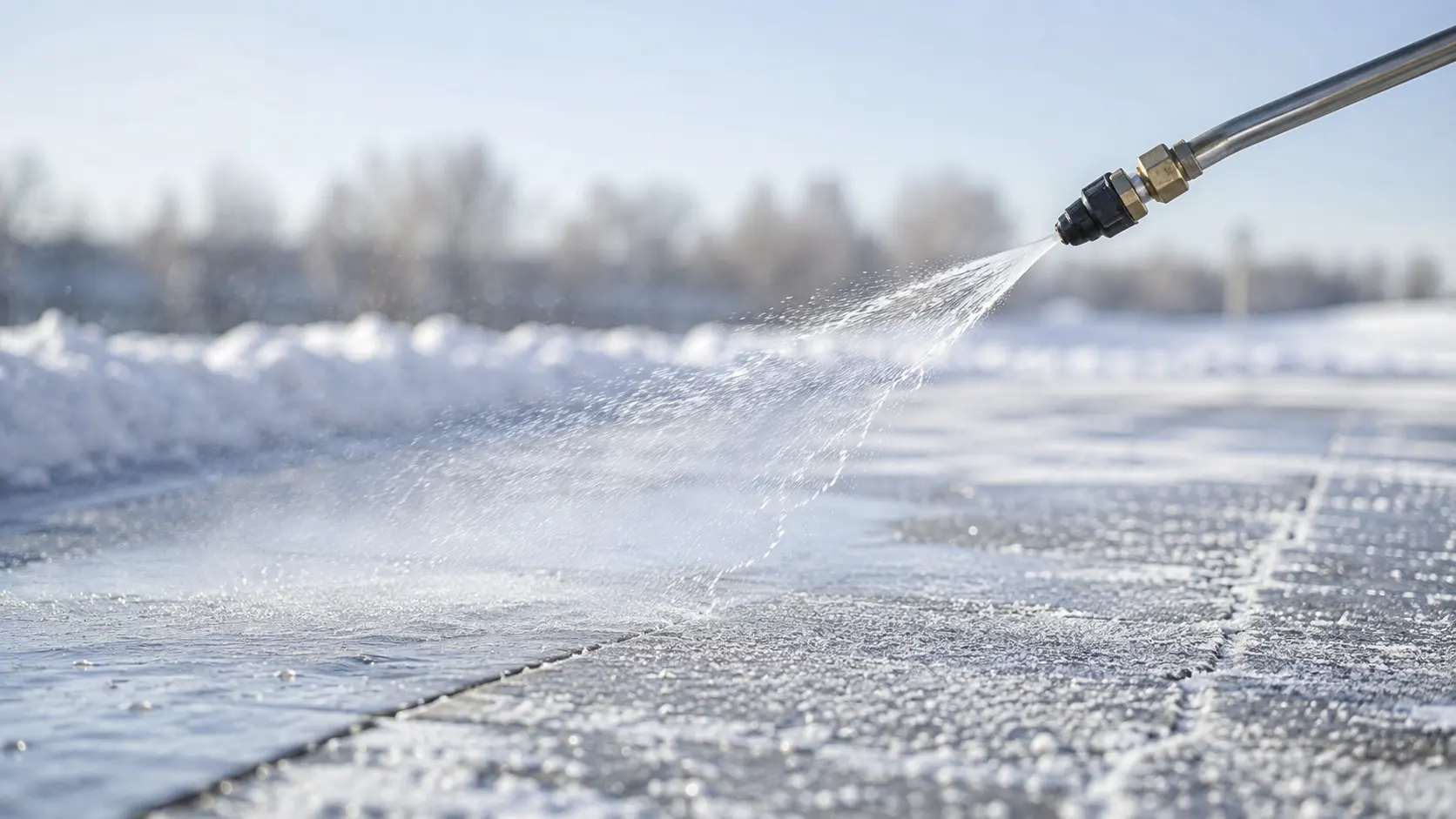
Its job is fairly straightforward: when potassium formate is dissolved in water, it lowers the freezing point of the solution. Applied to pavement before or after freezing conditions begin, the liquid can help prevent strong ice bonding, soften existing ice and make mechanical snow or ice removal easier.
That makes potassium formate useful in winter-maintenance formulations for:
- Roads
- Bridges
- Industrial yards
- Logistics centers
- Parking areas
- Selected airport pavement applications
Potassium formate is especially interesting when formulators want a non-chloride active ingredient and a product that can be delivered efficiently as a liquid spray.
However, the raw potassium formate chemical and the finished deicing agent are not exactly the same thing.
Concentration, corrosion-control additives, water quality, low-temperature behavior and final application standards all affect the finished product.
What Is Potassium Formate?
Potassium formate is the potassium salt of formic acid.
Its chemical formula is HCOOK, and its CAS number is 590-29-4.
It is highly soluble in water, which is one of the most useful properties for liquid deicing formulations.
EPA technical information identifies potassium formate as a highly water-soluble formate salt used as a freezing-point depressant in deicing applications.
Commercial potassium formate may be supplied as:
- 75% concentrated aqueous solution
- ≥96% solid potassium formate
- Customized liquid feedstock for blending
Vanchor currently supplies both 75% liquid and ≥96% solid potassium formate, including material intended for formulated deicing applications.
How Does Potassium Formate Work as a Deicing Agent?
Pure water freezes near 0°C under normal atmospheric conditions.
When potassium formate is dissolved into the water, the dissolved ions interfere with normal ice-crystal formation and reduce the solution's freezing point.
This allows the liquid phase to remain stable at temperatures below the normal freezing point of water.
When sprayed over an icy surface, the potassium formate solution can penetrate around the ice-pavement interface and gradually weaken the bond.
The result may include:
- Easier snow removal
- Faster frost removal
- Reduced ice adhesion
- Delayed refreezing
- Improved anti-icing performance
The actual result depends on concentration, pavement temperature, weather conditions and application rate.
There is no useful universal statement such as:
Potassium formate works down to exactly -XX°C.
That number depends on the finished formulation.
Deicing Agent vs Anti-Icing Agent
The same potassium formate chemistry can support two slightly different winter-maintenance strategies.
Deicing
The product is applied after ice or frost has already formed.
Its purpose is to loosen or melt the existing frozen layer.
Anti-Icing
The product is applied before freezing or before strong ice bonding occurs.
This helps prevent the ice from sticking strongly to pavement in the first place.
FAA guidance notes that anti-icing normally uses less material than waiting until conditions require full deicing.
Application Comparison
| Method | When Applied | Main Goal |
|---|---|---|
| Deicing | After freezing | Remove or weaken existing ice |
| Anti-icing | Before / early in storm | Prevent strong ice bonding |
| Mechanical clearing | During accumulation | Remove snow and slush |
| Combined program | Before and during storm | Reduce chemical and mechanical demand |
For many commercial sites, anti-icing is the more efficient use of potassium formate.
Once thick compacted ice has developed, much more chemical may be needed.
Why Use Potassium Formate Instead of Chloride?
Road salt remains dominant because it is inexpensive and widely available.
Sodium chloride and calcium chloride can be very effective winter-maintenance materials.
Potassium formate normally competes where the buyer has additional priorities beyond low chemical cost.
One of those priorities is avoiding chloride-based chemistry.
Chloride exposure can contribute to corrosion of:
- Vehicles
- Reinforced concrete
- Structural steel
- Metal equipment
- Electrical systems
Potassium formate is based on the formate ion rather than chloride.
This can reduce chloride-related exposure.
However, this does not mean a potassium formate formulation should automatically be described as non-corrosive.
A finished deicing agent may still affect metals and other materials depending on:
- Concentration
- pH
- Impurity profile
- Inhibitor package
- Exposure duration
So final formulations should still undergo appropriate corrosion testing.
Potassium Formate vs Other Deicing Agents
| Deicing Agent | Chemical Type | Common Strength |
|---|---|---|
| Potassium formate | Formate | Liquid non-chloride formulation |
| Potassium acetate | Acetate | Common airport liquid deicer |
| Sodium formate | Formate | Common solid deicing chemistry |
| Sodium chloride | Chloride | Low cost and broad road use |
| Calcium chloride | Chloride | Strong low-temperature road deicing |
There is no single best deicing agent for every surface.
Potassium formate usually makes the most sense where:
- Liquid application is preferred
- Non-chloride chemistry is valuable
- Infrastructure corrosion is an important concern
- Automated anti-icing systems are used
- Low-temperature fluid performance matters
For ordinary municipal roads, cheaper chloride salts may still be the practical choice.
Potassium Formate in Airport Deicing Formulations
Potassium formate has an established role in aviation pavement deicing formulations.
Current FAA guidance states that recommended liquid airfield deicing and anti-icing products may include potassium formate-based fluids meeting SAE AMS 1435 requirements.
But this needs careful wording.
A drum, IBC or tanker containing industrial 75% potassium formate solution should not automatically be described as an approved airport runway deicer.
FAA guidance published in January 2026 specifically warns airports that simply mixing or brining raw deicing materials does not automatically create a product that meets airfield requirements.
For airport use, the finished formulation may need to demonstrate:
- Deicing performance
- Anti-icing performance
- Corrosion behavior
- Storage stability
- Pavement compatibility
- Aircraft-material compatibility
- Applicable SAE compliance
The potassium formate supplier provides the active raw material.
The deicer manufacturer qualifies the finished formulation.
Why Liquid Potassium Formate Is Attractive
Potassium formate is often used in liquid winter-maintenance systems.
Liquid formulations can be applied through:
- Spray trucks
- Fixed bridge systems
- Automated roadway systems
- Airport spray equipment
- Industrial-site spraying systems
Compared with granular products, liquid application can provide more uniform surface coverage.
It can also be easier to meter accurately.
For anti-icing, this is particularly useful because the chemical can be applied as a thin controlled layer before ice develops.
75% Liquid vs 96% Solid
A deicing-agent manufacturer can buy potassium formate in either liquid or solid form.
| Factor | 75% Liquid | ≥96% Solid |
|---|---|---|
| Direct pumping | Yes | No |
| Dissolution required | No | Yes |
| Active material per ton | Lower | Higher |
| Freight efficiency | Lower | Higher |
| Production speed | Faster | More processing |
| Concentration adjustment | By dilution | Highly flexible |
| Storage | Tank / IBC | Dry warehouse |
Vanchor describes its 75% potassium formate as concentrated feedstock for manufacturing liquid deicing and anti-icing products. Its ≥96% solid grade offers greater active content per shipment and allows manufacturers to prepare their own working concentrations.
If a plant already has dissolution tanks and good water-quality control, solid material may reduce freight cost.
If the plant wants to unload and immediately begin liquid blending, 75% solution is easier.
Concentration Controls Performance
The raw potassium formate concentration should not be confused with the final working concentration.
A manufacturer may purchase 75% solution and then dilute it according to:
- Target freezing point
- Minimum pavement temperature
- Spray-system requirements
- Viscosity
- Cost
- Corrosion performance
The optimum concentration therefore depends on the application.
More active chemical is not automatically better.
An overly concentrated product may increase raw-material cost without producing a proportional field benefit.
The final formulation should be tested at realistic winter temperatures.
Environmental Considerations
Formate deicers are often selected partly because formate chemistry is biodegradable and has been considered as an alternative to some older airfield deicing materials.
EPA guidance lists potassium formate among alternative airfield deicing and anti-icing materials and notes favorable biodegradability characteristics.
Still, biodegradable does not mean environmentally irrelevant.
EPA also notes that formate-containing deicers can consume dissolved oxygen during degradation and may affect aquatic environments at sufficient concentrations.
Winter-maintenance planning should therefore still consider:
- Runoff collection
- Chemical application rate
- Drainage systems
- Surface-water exposure
- Wastewater treatment
- Local discharge requirements
Using the correct amount of deicer is usually better than assuming an environmentally preferable product can be used without limits.
What Should Deicing-Agent Manufacturers Test?
A finished potassium formate deicing formulation may need much broader testing than the raw chemical.
Typical Evaluation Areas
| Test Area | Why It Matters |
|---|---|
| Potassium formate concentration | Controls active content |
| Freezing/crystallization point | Defines low-temperature window |
| pH | Affects stability and corrosion |
| Corrosion testing | Protects equipment and infrastructure |
| Ice-melting performance | Measures deicing effectiveness |
| Anti-icing performance | Measures prevention of bonding |
| Storage stability | Checks long-term liquid consistency |
| Material compatibility | Important for metals and pavement |
| Environmental data | Supports runoff management |
For aviation formulations, applicable SAE requirements become particularly important.
What Should Buyers Ask a Potassium Formate Supplier?
A practical RFQ could include:
Product: Potassium Formate
Application: Deicing Agent Formulation
Preferred Form: 75% Liquid
Quantity: 80 MT
Packaging: IBC / Flexitank
Required Documents: COA, TDS and SDS
Key Requirements: Controlled chloride, iron and insoluble matter
End Use: Road and Bridge Anti-Icing
For an aviation-formulation manufacturer:
End Use: Raw Material for SAE AMS 1435 Liquid Runway Deicer Formulation
This distinction helps the supplier understand the required level of QC and documentation.
Final Thoughts
A potassium formate deicing agent works primarily by lowering the freezing point of water and helping prevent or weaken ice bonding.
Its main advantages include:
- High water solubility
- Good suitability for liquid formulations
- Effective anti-icing use
- Non-chloride formate chemistry
- Flexible concentration adjustment
It can be used as an active ingredient for roads, bridges, logistics facilities, industrial areas and properly qualified aviation pavement deicing products.
But potassium formate raw material is only the starting point.
The finished deicing agent still needs the right concentration, corrosion behavior, low-temperature performance and application strategy.
Good winter maintenance comes from chemistry plus formulation plus correct application.
Not just from putting more salt on the pavement.
FAQ
What is potassium formate used for in deicing?
It is used as a freezing-point depressant in liquid deicing and anti-icing formulations for paved surfaces.
How does potassium formate prevent ice?
Dissolved potassium formate lowers the freezing point of water and can reduce the strength of the bond between ice and pavement.
Is potassium formate chloride-free?
Potassium formate itself is a formate salt rather than a chloride salt. Finished-product impurities and corrosion performance should still be checked.
Is potassium formate better than road salt?
It depends on the application. Road salt is cheaper, while potassium formate may be attractive where liquid anti-icing and reduced chloride exposure are more important.
Can potassium formate be used at airports?
Yes, potassium formate-based liquid formulations can be used for airport pavement deicing, but the finished product should meet applicable aviation requirements such as SAE AMS 1435 where required.
Should buyers choose liquid or solid potassium formate?
Liquid is easier for immediate formulation and pumping. Solid provides higher active content per shipment and more flexibility for local solution preparation.


Contact Us
In This Article
Related Posts
Индивидуальные упаковочные решения от поставщика безводного ацетата натрия в Китае
2026-09-23
Тенденции применения безводного ацетата натрия для специального химического производства
2026-09-23
Безводный ацетат натрия для дубления кожи: улучшает равномерность окрашивания
2026-09-22
Formic Acid 85% for Animal Feed Preservation: Moisture and Storage Stability Guide
2026-09-21


