



Potassium Formate Anti-Icing Fluid: Performance, Applications and Formulation Guide
By LIN
2026-09-02Related Posts
Индивидуальные упаковочные решения от поставщика безводного ацетата натрия в Китае
2026-09-23
Тенденции применения безводного ацетата натрия для специального химического производства
2026-09-23

Безводный ацетат натрия для дубления кожи: улучшает равномерность окрашивания
2026-09-22
Formic Acid 85% for Animal Feed Preservation: Moisture and Storage Stability Guide
2026-09-21
A potassium formate anti-icing fluid is a liquid winter-maintenance formulation applied before or during the early stages of freezing conditions to reduce the formation of strongly bonded ice on pavement.
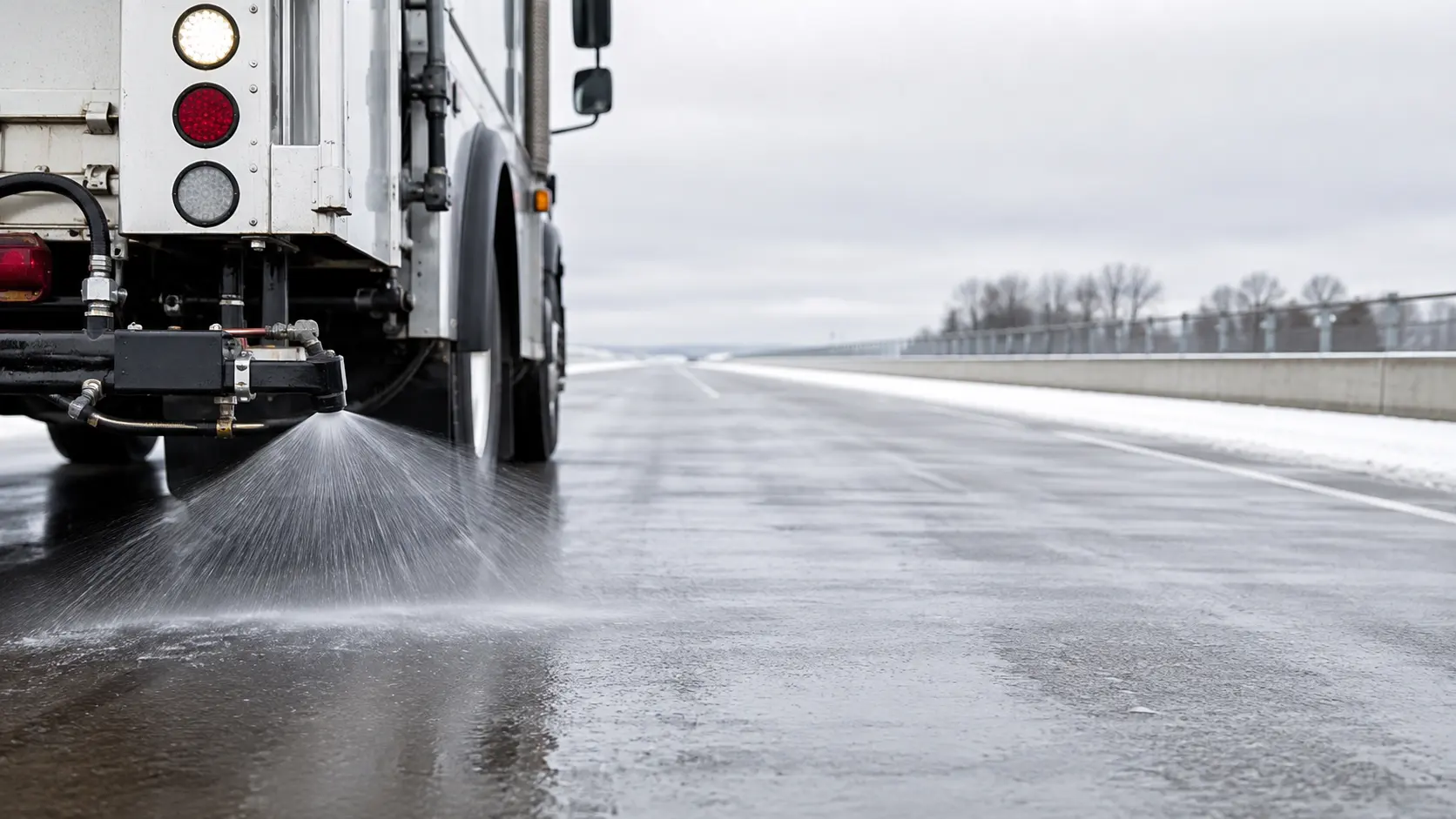
That is the main difference between anti-icing and traditional deicing.
Deicing reacts to ice that is already there.
Anti-icing tries to stop that strong ice-pavement bond from developing in the first place.
For roads, bridges, industrial areas and airport pavements, this preventive approach can make later snow and ice removal easier and may reduce the total quantity of chemical required. Current FAA guidance also notes that anti-icing operations can use less product than deicing operations when properly applied.
Potassium formate is well suited to liquid anti-icing formulations because it is highly water soluble, can remain in concentrated aqueous solution and provides non-chloride formate chemistry.
But the correct formulation and application timing are just as important as the chemical itself.
What Is Potassium Formate Anti-Icing Fluid?
Potassium formate, chemical formula HCOOK, is the potassium salt of formic acid.
For winter maintenance, it is dissolved in water and used as the active freezing-point-depressing component of a liquid formulation.
The finished anti-icing fluid may also contain:
- Corrosion inhibitors
- pH-control components
- Water
- Performance additives
- Application-specific stabilizers
The exact composition depends on the target surface and operating requirements.
Main Functions
| Function | Practical Benefit |
|---|---|
| Freezing-point depression | Helps liquid remain unfrozen below 0°C |
| Ice-bond prevention | Reduces adhesion between ice and pavement |
| Liquid spreading | Allows even spray coverage |
| Pre-treatment | Can be applied before freezing |
| Non-chloride chemistry | Reduces reliance on chloride salts |
| Rapid surface wetting | Helps create a protective brine layer |
The anti-icing fluid does not usually prevent every snowflake or ice crystal from forming.
Its more realistic job is to stop frozen precipitation from bonding tightly to the pavement.
That makes later plowing, sweeping or deicing easier.
Anti-Icing vs Deicing
These terms are sometimes used as if they mean the same thing.
They don't.
Anti-Icing
Anti-icing is preventive.
The fluid is applied before ice bonds strongly to the pavement.
Deicing
Deicing is corrective.
The chemical is applied after ice has already formed and needs to be melted or loosened.
| Factor | Anti-Icing | Deicing |
|---|---|---|
| Timing | Before or early in freezing | After ice forms |
| Objective | Prevent strong bonding | Remove existing ice |
| Chemical demand | Often lower | Often higher |
| Mechanical removal | Easier afterward | May require more effort |
| Weather monitoring | Very important | Important |
| Typical fluid strategy | Thin preventive application | Heavier treatment as needed |
FHWA winter-maintenance guidance emphasizes applying anti-icing treatments in advance of freezing and adjusting chemical rates according to pavement temperature, precipitation and local conditions.
Timing really matters.
Spray too early under unsuitable conditions and traffic or runoff may remove much of the chemical.
Spray too late and you are already doing deicing.
How Does Potassium Formate Prevent Ice Bonding?
When potassium formate dissolves in water, the dissolved ions lower the freezing point of the liquid.
A thin layer of potassium formate solution on pavement can therefore remain liquid under conditions where untreated water would freeze.
When snow, frost or freezing moisture reaches that treated surface, the chemical helps maintain a thin brine layer between the frozen material and pavement.
This can reduce bonding and make removal easier.
Performance depends on:
- Potassium formate concentration
- Pavement temperature
- Air temperature
- Precipitation
- Application rate
- Traffic
- Dilution from water or snow
For this reason, the lowest operating temperature should be determined from the finished anti-icing formulation, not from potassium formate raw material alone.
Why Potassium Formate Is Useful for Liquid Anti-Icing
One of potassium formate's strongest practical advantages is its high water solubility.
That makes it suitable for liquid systems using:
- Spray trucks
- Bridge spray systems
- Fixed automated systems
- Airport pavement equipment
- Industrial spraying equipment
Liquid application can give relatively uniform coverage and allows dosing to be controlled precisely.
For preventive treatment, this is useful because only a relatively thin chemical layer may be needed.
A granular chemical does not always stay exactly where it lands.
Liquid can be distributed more evenly over a target area.
Potassium Formate for Bridge Anti-Icing
Bridge decks often freeze before nearby road surfaces.
The reason is simple: cold air can circulate above and below the deck.
This makes bridges good candidates for preventive anti-icing systems.
A potassium formate-based fluid may be sprayed before expected:
- Frost
- Freezing fog
- Light snow
- Freezing precipitation
Fixed spraying systems can be connected to pavement and weather sensors so fluid is applied when conditions indicate icing risk.
Useful Anti-Icing Locations
| Location | Why Preventive Treatment Helps |
|---|---|
| Bridge decks | Freeze earlier than surrounding roads |
| Ramps | Higher accident risk during icing |
| Intersections | Frequent braking and turning |
| Tunnel entrances | Rapid temperature changes |
| Industrial yards | Important vehicle and worker access |
| Loading areas | Need continuous logistics operations |
| Airport pavement | Requires rapid snow/ice management |
Application rates should still be based on the actual product and site conditions.
More fluid does not automatically produce better anti-icing.
Potassium Formate vs Chloride Anti-Icing Brines
Sodium chloride brine is widely used for roadway anti-icing because it is cheap and readily available.
Potassium formate occupies a more specialized position.
| Factor | Potassium Formate | Sodium Chloride Brine |
|---|---|---|
| Liquid anti-icing use | Yes | Yes |
| Chloride based | No | Yes |
| Raw-material cost | Higher | Lower |
| Corrosion concerns | Still requires testing | Chloride exposure is a major concern |
| Specialized infrastructure use | Attractive | Common road use |
| Airport formulation potential | Yes, when qualified | Generally not the preferred aviation chemistry |
For large highway networks, sodium chloride may remain the economical choice.
Potassium formate is more likely to be considered where buyers put greater value on:
- Non-chloride chemistry
- Specialized infrastructure
- Corrosion management
- Aviation formulation
- Controlled liquid application
There is no need to claim potassium formate should replace every road salt application.
It should be used where its advantages justify the additional cost.
Potassium Formate Anti-Icing Fluid for Airports
Potassium formate has an established role in airport pavement anti-icing.
Current FAA guidance states that recommended liquid runway deicing/anti-icing products include potassium formate-based fluids meeting the applicable SAE AMS 1435 specification.
This wording is important.
It does not mean that any 75% industrial potassium formate solution can be purchased and sprayed directly on a runway as an approved product.
The finished formulation needs to meet the applicable aviation requirements.
FAA Engineering Brief No. 108, issued January 9, 2026, specifically warns that simply converting or mixing raw deicing materials into a liquid does not automatically create a compliant airfield deicing/anti-icing product.
For airport applications, finished fluid qualification may address:
- Freezing performance
- Corrosion
- Pavement compatibility
- Material compatibility
- Storage stability
- Application behavior
- Environmental information
The potassium formate supplier provides the active raw chemical.
The anti-icing fluid manufacturer is responsible for the finished formulation.
Runway Anti-Icing Fluid Is Not Aircraft Anti-Icing Fluid
This distinction is extremely important.
A potassium formate-based runway anti-icing fluid is intended for pavement.
Aircraft anti-icing fluids applied directly to wings and aircraft surfaces are a different product category.
They use different chemistry, performance specifications and holdover-time requirements.
FAA documentation also warns that some runway deicing chemicals containing organic salts can interact negatively with thickened aircraft anti-icing fluids if contamination occurs.
So these two products should never be treated as interchangeable.
Potassium formate runway fluid = pavement treatment.
Aircraft Type I/II/III/IV fluid = aircraft surface treatment.
That distinction should also be clear in marketing materials.
Concentration and Dilution
Potassium formate anti-icing fluids need the correct working concentration.
A manufacturer may start with a concentrated 75% potassium formate solution and dilute it according to the final formulation.
The target concentration depends on:
- Required freezing point
- Pavement-temperature range
- Spray-system design
- Cost
- Viscosity
- Corrosion performance
Using the highest possible concentration is not always necessary.
If a lower concentration provides enough freezing protection for the expected conditions, it may offer better chemical economy.
Field performance should drive concentration selection.
Storage Stability Matters
Anti-icing fluids may sit in tanks for much of the winter season.
The formulation therefore needs good storage stability.
Buyers should consider:
- Crystallization temperature
- Low-temperature pumpability
- Precipitation
- Tank compatibility
- pH stability
- Contamination
- Long-term appearance
A concentrated solution that begins crystallizing inside a storage tank can block filters, pumps and spray nozzles.
The actual storage temperature should therefore be included when formulating a potassium formate anti-icing fluid.
Corrosion Still Needs Testing
Potassium formate is non-chloride chemistry, but that does not mean the finished fluid is automatically non-corrosive.
Corrosion performance depends on:
- Potassium formate purity
- pH
- Inhibitor package
- Temperature
- Metal type
- Contact time
- Contaminants
For infrastructure and aviation applications, the finished formulation should be tested against the relevant materials.
Do not base a corrosion claim only on the fact that the product contains no chloride as its primary active salt.
Liquid or Solid Potassium Formate?
Anti-icing-fluid manufacturers can purchase potassium formate as concentrated liquid or high-content solid material.
Supply-Form Comparison
| Factor | 75% Liquid | ≥96% Solid |
|---|---|---|
| Direct pumping | Easy | Requires dissolution |
| Production speed | Faster | Additional processing |
| Active chemical per ton | Lower | Higher |
| Freight efficiency | Lower | Higher |
| Concentration flexibility | By dilution | Very flexible |
| Best suited for | Liquid blending plants | Plants with dissolution systems |
Liquid concentrate is convenient when production speed matters.
Solid product may be commercially attractive for long-distance transport where the manufacturer already has good dissolution equipment.
What Should Buyers Specify?
A useful RFQ might state:
Product: Potassium Formate
Application: Anti-Icing Fluid Manufacturing
Preferred Form: 75% Liquid Concentrate
Quantity: 80 MT
Packaging: IBC / Flexitank
Required Documents: COA, TDS and SDS
Key Requirements: Controlled chloride, iron and insoluble matter
End Use: Bridge and Road Anti-Icing Fluid
For aviation formulation:
End Use: Raw Material for SAE AMS 1435 Runway Deicing/Anti-Icing Fluid
This makes the intended regulatory and technical requirements much clearer.
Final Thoughts
A potassium formate anti-icing fluid is most valuable when it is used preventively.
Rather than trying to melt a thick layer of ice after it develops, the fluid helps create conditions where ice cannot bond as strongly to the pavement in the first place.
Its main advantages include:
- High water solubility
- Liquid application
- Freezing-point depression
- Non-chloride chemistry
- Controlled preventive treatment
- Suitability for specialized runway formulations
But good anti-icing performance depends on timing.
It depends on pavement temperature.
It depends on concentration.
And it depends on applying the correct amount before conditions become difficult.
The chemistry matters, but good winter-maintenance decisions matter just as much.
FAQ
What is potassium formate anti-icing fluid?
It is a liquid formulation containing potassium formate that is applied before or during early freezing conditions to reduce ice bonding to pavement.
What is the difference between anti-icing and deicing?
Anti-icing is preventive and is applied before strong ice bonding occurs. Deicing removes or loosens ice after it has already formed.
Is potassium formate suitable for bridge anti-icing?
Yes. Liquid potassium formate formulations can be used in preventive bridge and roadway anti-icing programs when properly formulated and applied.
Can potassium formate anti-icing fluid be used on airport runways?
Yes, qualified potassium formate-based liquid products are recognized for runway deicing/anti-icing. For U.S. airfields, applicable products should meet SAE AMS 1435 requirements.
Is runway anti-icing fluid the same as aircraft anti-icing fluid?
No. Runway fluids treat pavement, while aircraft anti-icing fluids are formulated specifically for aircraft surfaces and follow different specifications.
Is potassium formate anti-icing fluid non-corrosive?
Not automatically. Potassium formate avoids chloride as the primary active salt, but the finished formulation still requires appropriate corrosion and materials-compatibility testing.


Contact Us
In This Article
Related Posts
Индивидуальные упаковочные решения от поставщика безводного ацетата натрия в Китае
2026-09-23
Тенденции применения безводного ацетата натрия для специального химического производства
2026-09-23
Безводный ацетат натрия для дубления кожи: улучшает равномерность окрашивания
2026-09-22
Formic Acid 85% for Animal Feed Preservation: Moisture and Storage Stability Guide
2026-09-21


