



Potassium Formate Cooling Fluid: Performance, Applications and Selection Guide
By LIN
2026-09-02Related Posts
Индивидуальные упаковочные решения от поставщика безводного ацетата натрия в Китае
2026-09-23
Тенденции применения безводного ацетата натрия для специального химического производства
2026-09-23

Безводный ацетат натрия для дубления кожи: улучшает равномерность окрашивания
2026-09-22
Formic Acid 85% for Animal Feed Preservation: Moisture and Storage Stability Guide
2026-09-21
A potassium formate cooling fluid is an aqueous potassium formate solution used to transport heat in industrial cooling, refrigeration and low-temperature circulation systems.
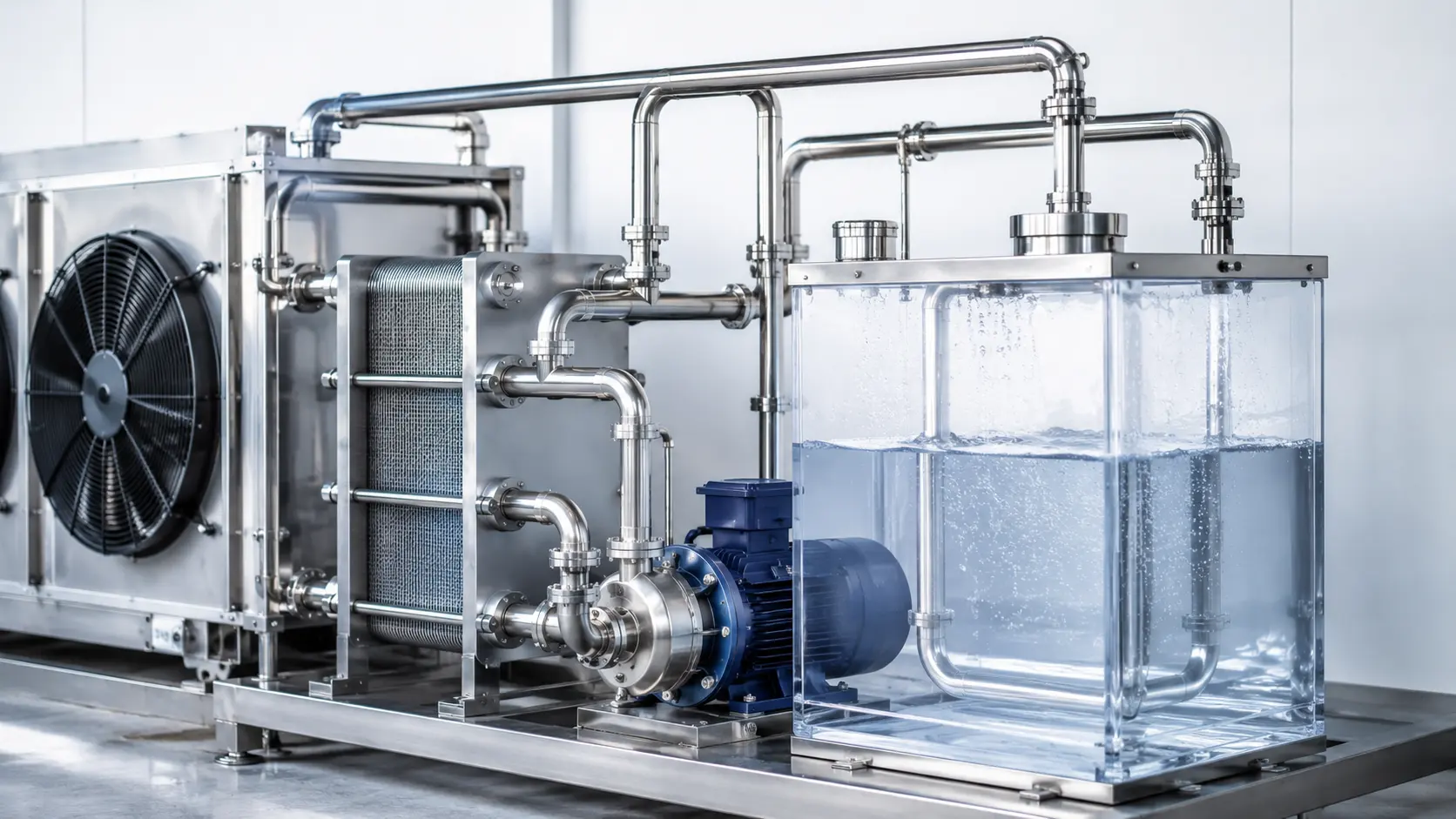
In most cases, it works as a secondary fluid rather than a primary refrigerant.
The central refrigeration plant cools the potassium formate solution through a heat exchanger. Pumps then circulate the fluid through process equipment, cold rooms or other cooling loads before returning it to the refrigeration plant.
ASHRAE describes fluids used this way as secondary coolants, heat-transfer fluids, brines or secondary refrigerants. Potassium formate is recognized as one of the less widely used secondary-coolant chemistries.
For manufacturers formulating industrial cooling fluids, Potassium Formate 75% Solution can be used as concentrated feedstock and adjusted to the required working concentration. Vanchor currently lists industrial refrigeration, cold storage, food-processing refrigeration, HVAC secondary circuits and process cooling among its potential applications.
The important part is choosing the right final concentration.
More potassium formate is not automatically better.
What Is Potassium Formate Cooling Fluid?
Potassium formate is the potassium salt of formic acid.
Its basic chemical information includes:
| Property | Typical Information |
|---|---|
| Chemical Name | Potassium Formate |
| Formula | HCOOK |
| CAS Number | 590-29-4 |
| Molecular Weight | Approx. 84.12 g/mol |
| Fluid Type | Aqueous salt solution |
| Common Supply Concentrate | Approx. 75% |
| Main Role | Secondary cooling and heat transfer |
A commercial working fluid may contain more than potassium formate and water.
Depending on the system, the final formulation may also include:
- Corrosion inhibitors
- pH-control additives
- Stabilizing components
- Other compatible treatment chemicals
That means a 75% potassium formate concentrate should generally be viewed as raw material for making the cooling fluid, not automatically as the final fluid itself.
How Does Potassium Formate Cooling Fluid Work?
A typical indirect cooling loop can be simplified as:
Refrigeration plant → heat exchanger → potassium formate fluid → cooling load → return line
The fluid is cooled centrally and pumped through the system.
As it passes through heat exchangers or cooling coils, it absorbs thermal energy from:
- Refrigerated rooms
- Production equipment
- Process streams
- Storage areas
- Industrial machinery
It then returns to the central cooling system where the absorbed heat is removed.
Unlike the primary refrigerant, the secondary cooling fluid normally stays liquid and changes temperature without undergoing an evaporation-condensation cycle.
Why Use Potassium Formate for Industrial Cooling?
A good cooling fluid needs more than a low freezing point.
It also needs manageable viscosity, useful heat-transfer properties and reliable pumping behavior.
Potassium formate has several characteristics that make it worth considering.
Low-Temperature Operation
Dissolving potassium formate in water changes the solution's freezing and crystallization behavior.
This allows suitably formulated fluids to operate below the freezing point of ordinary water.
Relatively Low Viscosity
Low-temperature viscosity is one of the major reasons potassium formate is compared with glycol-based fluids.
Research published in the International Journal of Refrigeration found potassium formate solutions had clearly lower viscosity than traditional aqueous alcohol and glycol solutions under the studied conditions. Although their volumetric heat capacity was lower, the reduced viscosity helped keep pumping-power demand competitive.
This matters in long industrial piping systems.
Lower viscosity can help reduce:
- Pressure loss
- Pumping energy
- Hydraulic resistance
- Oversizing of pumps and pipes
Useful Thermal Performance
The same research identified good thermodynamic properties as one of the advantages of potassium formate as a secondary refrigeration fluid.
The real comparison, however, should consider several properties together.
Important Cooling-Fluid Properties
| Property | Effect on the System |
|---|---|
| Crystallization point | Determines low-temperature limit |
| Viscosity | Influences pumping energy |
| Density | Affects hydraulic calculations |
| Specific heat | Determines heat-carrying capacity |
| Thermal conductivity | Influences heat exchanger performance |
| Concentration | Changes most physical properties |
| pH | Important for corrosion control |
A fluid with excellent freeze protection but extremely high viscosity may not produce the most efficient system.
Cooling-fluid selection is always a balance.
Concentration Should Match the Operating Temperature
One of the most common mistakes is choosing cooling fluid based only on maximum available concentration.
That is backwards.
The system temperature should come first.
ASHRAE recommends selecting a secondary coolant with a freezing point below the lowest temperature the fluid will experience, while also considering materials compatibility, safety and economics.
A practical selection sequence is:
- Determine the minimum operating temperature.
- Add an appropriate safety margin.
- Select the required potassium formate concentration.
- Check viscosity at that temperature.
- Check thermal performance.
- Calculate pumping requirements.
- Verify materials compatibility.
Vanchor's Potassium Formate Heat Transfer Solution guide also notes that concentration affects crystallization temperature, density, viscosity, specific heat, thermal conductivity and pumping performance.
So concentration should be engineered.
It should not be chosen simply because 75% concentrate is available.
Is 75% Potassium Formate Ready to Use?
Not necessarily.
Vanchor currently positions its 75% potassium formate as concentrated raw material for secondary cooling and heat-transfer fluids. The concentrate can be diluted to obtain the required freezing behavior, viscosity and heat-transfer performance.
This approach offers practical production advantages:
- Direct liquid pumping
- Accurate metering
- Rapid dilution
- No powder-dissolution step
- Convenient bulk blending
One metric ton of nominal 75% solution contains approximately 750 kg of potassium formate.
The final cooling fluid may then be diluted and conditioned according to the system design.
Potassium Formate Cooling Fluid vs Glycol
Ethylene glycol and propylene glycol are widely used industrial cooling fluids.
Potassium formate provides another option.
| Factor | Potassium Formate | Glycol |
|---|---|---|
| Chemistry | Aqueous formate salt | Aqueous organic glycol |
| Sub-zero use | Yes | Yes |
| Low-temperature viscosity | Often relatively low | Can rise considerably |
| Market familiarity | More specialized | Very common |
| Corrosion control | Usually required | Usually required |
| Non-flammable aqueous system | Yes | Formulation dependent |
| Best choice | System dependent | System dependent |
Glycol remains a practical choice for many installations.
It is familiar, widely available and supported by many commercial inhibitor packages.
Potassium formate becomes more interesting when low-temperature pumpability and hydraulic efficiency are particularly important.
The comparison should always be made at the actual operating temperature.
Room-temperature viscosity figures can be misleading for a system running at -25°C.
Potassium Formate vs Calcium Chloride Cooling Brine
Calcium chloride brine has a long history in industrial refrigeration.
It is often inexpensive.
However, its chloride chemistry can create corrosion-management concerns in some systems.
Potassium formate uses formate rather than chloride as its primary active ion.
That can make it attractive where reducing chloride exposure is desirable.
Still, potassium formate should not automatically be described as non-corrosive.
Both fluids need appropriate materials evaluation and corrosion control.
Corrosion Control Is Part of the Formulation
Industrial cooling loops may contain:
- Carbon steel
- Stainless steel
- Copper
- Brass
- Aluminum
- Valves
- Pumps
- Gaskets
- Elastomer seals
The finished fluid has to remain compatible with the complete system.
Vanchor specifically recommends testing the final potassium formate heat-transfer formulation against metals, seals, pumps and other equipment materials.
Depending on the installation, the working fluid may require:
- Corrosion inhibitors
- Controlled pH
- Routine concentration testing
- Periodic fluid analysis
A low-chloride chemistry does not remove the need for maintenance.
Common Applications
Potassium formate cooling fluids can be considered in several low-temperature systems.
Cold Storage
Large freezer warehouses can distribute cooling from one central plant to multiple refrigerated areas.
Food Processing
Secondary fluid loops can carry cooling around production facilities while keeping the primary refrigerant more centralized.
Industrial Process Cooling
Manufacturing equipment, reactors or process streams may require stable below-zero cooling.
Refrigerated Logistics
Long piping runs make pumping efficiency particularly important.
Ice Rinks
Secondary fluids can circulate through extensive piping below the ice surface.
HVAC Secondary Circuits
Specialized HVAC applications may require freeze protection beyond ordinary chilled-water systems.
Vanchor also identifies cold storage, food processing, industrial cooling, refrigerated logistics and process-temperature control among potential potassium formate applications.
What Should Buyers Check?
When sourcing potassium formate for cooling-fluid formulation, review more than price.
Important purchasing parameters include:
| Parameter | Why It Matters |
|---|---|
| Potassium formate concentration | Establishes formulation basis |
| Density | Useful for incoming QC |
| pH | Important for fluid conditioning |
| Chloride | Relevant to corrosion management |
| Iron | Helps monitor consistency |
| Insoluble matter | Protects pumps and filters |
| Batch consistency | Supports repeat production |
| COA | Confirms actual batch quality |
| TDS | Provides technical information |
| SDS | Supports handling and storage |
For long-term industrial applications, stable repeat quality often matters more than a small difference in purchase price.
How to Request a Quote
A useful inquiry could look like:
Product: Potassium Formate
Application: Industrial Cooling Fluid
Preferred Form: 75% Aqueous Solution
Quantity: 100 MT
Packaging: IBC / Flexitank / Bulk
Required Documents: COA, TDS and SDS
Minimum Operating Temperature: -25°C
End Use: Cold Storage / Process Cooling
Key Requirements: Stable concentration and controlled impurities
Providing the operating temperature gives the supplier useful technical context.
For refrigeration-focused systems, buyers can also review Vanchor's Potassium Formate 75% Solution Guide for additional information on dilution, refrigeration applications and formulation testing.
Final Thoughts
A potassium formate cooling fluid can provide an effective secondary liquid for industrial refrigeration and low-temperature process cooling.
Its main advantages can include:
- Sub-zero operation
- Relatively low viscosity
- Useful thermal performance
- High water solubility
- Convenient liquid formulation
- Non-chloride active chemistry
But the most concentrated fluid is not automatically the best fluid.
Operating temperature, crystallization behavior, viscosity, specific heat, pump energy and corrosion control all need to be considered together.
Potassium formate provides the chemical foundation.
The final cooling fluid should be engineered around the actual system.
FAQ
What is potassium formate cooling fluid?
It is an aqueous potassium formate solution used to carry heat in industrial refrigeration and low-temperature circulation systems.
Is potassium formate cooling fluid a refrigerant?
It usually acts as a secondary coolant. The primary refrigerant produces the cooling, while potassium formate transports that cooling through the system.
Why use potassium formate instead of glycol?
Potassium formate can offer attractive low-temperature viscosity and pumping characteristics. The better choice depends on temperature, equipment and overall system economics.
Can 75% potassium formate be used directly?
Not necessarily. It is generally better treated as concentrated feedstock and diluted according to the required operating conditions.
Does potassium formate cooling fluid require corrosion inhibitors?
Depending on system metallurgy and operating conditions, the finished formulation may require suitable corrosion inhibitors and pH control.
Where is potassium formate cooling fluid used?
Potential applications include cold storage, food processing, industrial refrigeration, refrigerated logistics, process cooling, ice rinks and specialized HVAC systems.


Contact Us
In This Article
Related Posts
Индивидуальные упаковочные решения от поставщика безводного ацетата натрия в Китае
2026-09-23
Тенденции применения безводного ацетата натрия для специального химического производства
2026-09-23
Безводный ацетат натрия для дубления кожи: улучшает равномерность окрашивания
2026-09-22
Formic Acid 85% for Animal Feed Preservation: Moisture and Storage Stability Guide
2026-09-21


