



Potassium Formate Airport Runway Deicing Fluid: Performance, Standards and Application Guide
By LIN
2026-09-02Related Posts
Индивидуальные упаковочные решения от поставщика безводного ацетата натрия в Китае
2026-09-23
Тенденции применения безводного ацетата натрия для специального химического производства
2026-09-23

Безводный ацетат натрия для дубления кожи: улучшает равномерность окрашивания
2026-09-22
Formic Acid 85% for Animal Feed Preservation: Moisture and Storage Stability Guide
2026-09-21
A potassium formate airport runway deicing fluid is a liquid winter-maintenance product used to remove frost and ice from airport pavement or prevent frozen precipitation from bonding strongly to runways and taxiways.
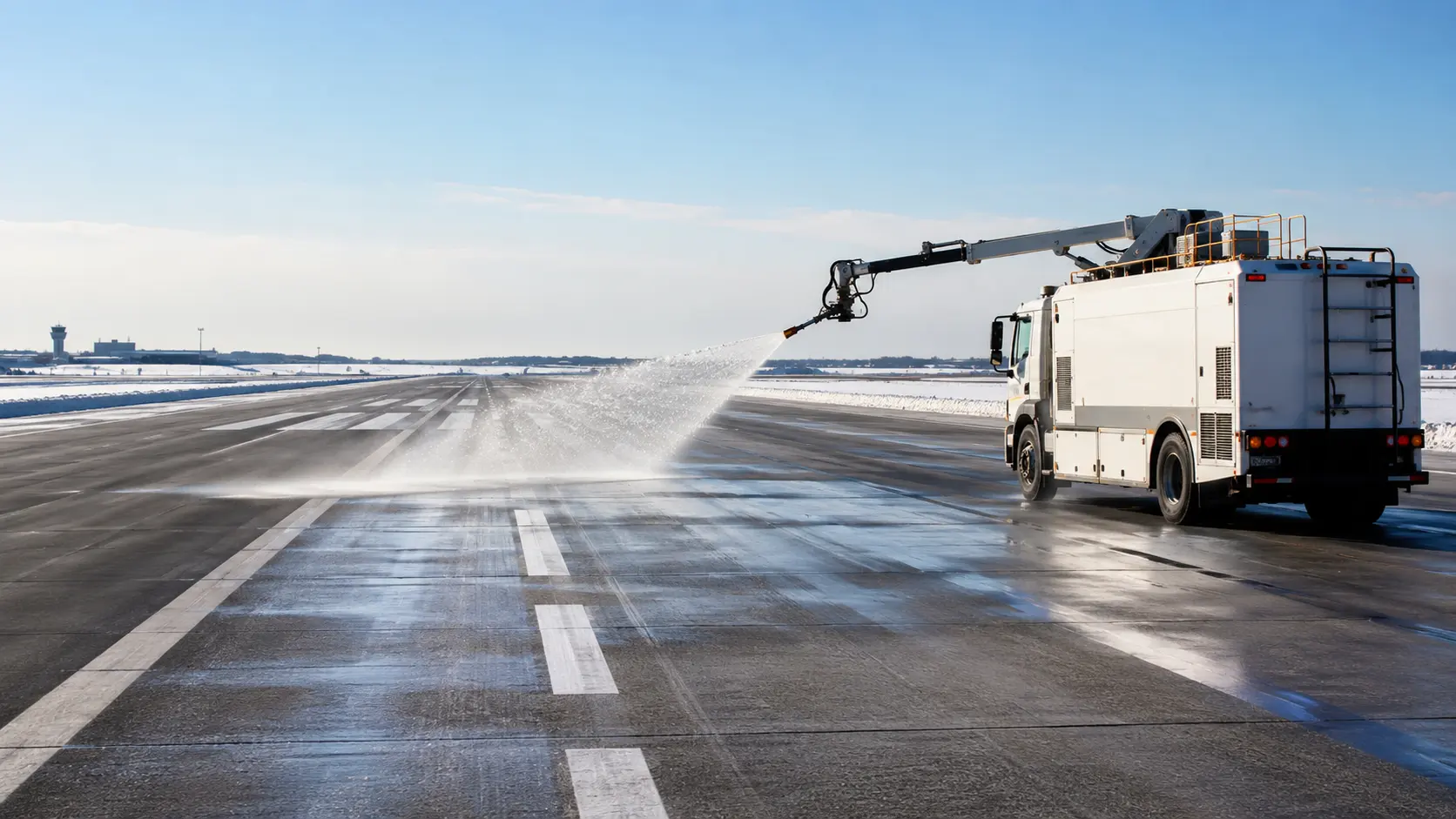
Airport deicing is different from normal road deicing.
An airport needs to restore safe pavement conditions quickly, but the chemical may also contact runway lighting, ground-support equipment and materials carried onto aircraft by tires and spray.
This means performance alone is not enough.
A runway fluid also needs appropriate corrosion control, material compatibility, storage stability and aviation qualification.
Potassium formate is well suited to liquid runway formulations because it is highly soluble in water and provides non-chloride formate chemistry. Current FAA guidance specifically recognizes potassium formate-based fluids meeting SAE AMS 1435 among recommended liquid airfield deicing and anti-icing products.
How Does Potassium Formate Runway Deicing Fluid Work?
Potassium formate has the chemical formula HCOOK.
When dissolved in water, it lowers the freezing point of the liquid.
Once applied to an icy runway, the solution can penetrate the frozen layer and help create a liquid interface between ice and pavement.
This can:
- Weaken ice adhesion
- Melt thin frost and ice
- Support mechanical sweeping and plowing
- Reduce refreezing under suitable conditions
- Help prevent strong ice bonding when applied in advance
In airport operations, completely melting all accumulated snow with chemicals is rarely the only objective.
A major benefit is making the frozen layer easier for snow-removal equipment to clear.
That can reduce the time needed to restore runway availability.
Deicing and Anti-Icing Are Different Operations
Potassium formate runway fluids can normally support both strategies.
Deicing is reactive.
The chemical is applied after frost or ice is already present.
Anti-icing is preventive.
The product is applied before or during the early part of a weather event so that ice does not bond as strongly to the pavement.
| Factor | Deicing | Anti-Icing |
|---|---|---|
| Timing | After ice forms | Before strong ice bonding |
| Main purpose | Remove or weaken ice | Prevent strong adhesion |
| Chemical demand | Usually higher | Often lower |
| Mechanical removal | Frequently required | Usually easier afterward |
| Weather monitoring | Important | Especially important |
For an airport with good weather forecasting and pavement-temperature monitoring, anti-icing can be more efficient than waiting for a difficult layer of ice to form.
Why Potassium Formate Is Used on Airport Pavement
Chloride salts such as sodium chloride and calcium chloride are common on public roads because they are inexpensive and effective.
Airport operators have different concerns.
Chloride exposure can create corrosion issues around:
- Aircraft
- Runway lighting
- Electrical systems
- Ground equipment
- Steel components
- Reinforced infrastructure
Potassium formate is based on the formate ion rather than chloride.
That makes it attractive as part of aviation pavement formulations where chloride exposure is undesirable.
However, this should not be simplified into the claim that potassium formate is completely non-corrosive.
Airport runway fluids still require material and corrosion testing.
SAE has even published a dedicated information report on the effect of alkali-metal runway deicers, including potassium formate, on aircraft electrical wiring and interconnection systems.
In aviation, compatibility matters just as much as chemistry.
SAE AMS 1435 Is a Key Specification
For the U.S. market, one of the most important references is SAE AMS 1435.
FAA Engineering Brief No. 108, issued on January 9, 2026, states that recommended liquid airfield deicing and anti-icing products include glycol-based, potassium acetate-based and potassium formate-based fluids meeting SAE AMS 1435.
The current SAE listing shows AMS1435E, revised March 12, 2024, covering liquid runway deicing and anti-icing products.
This creates a very important commercial distinction:
Potassium formate raw material is not automatically a compliant runway deicing fluid.
A chemical company may supply concentrated potassium formate.
A runway-fluid manufacturer must formulate and qualify the finished product according to the applicable aviation requirements.
Raw Material vs Finished Airport Fluid
| Potassium Formate Raw Material | Finished Runway Fluid |
|---|---|
| Active chemical feedstock | Complete deicing/anti-icing formulation |
| Controlled by chemical specification | Controlled by performance specification |
| May be concentrated | Final concentration is application-specific |
| COA, TDS and SDS are central | Additional aviation testing is required |
| Not automatically AMS 1435 qualified | Can be qualified to AMS 1435 |
| Supplier controls raw-material QC | Formulator controls finished-fluid performance |
This distinction should be clear on supplier websites.
Ice Penetration Performance Matters
Runway deicing products are not evaluated only by freezing point.
How quickly the product penetrates ice also matters operationally.
SAE revised AS6211A in January 2026 to provide a standardized method for evaluating the relative ice-penetration capability of runway deicing and anti-icing products used with AMS1431 and AMS1435 systems.
This makes sense from an airport-operations perspective.
A deicer needs to reach the pavement beneath an ice layer in a practical amount of time.
Important finished-fluid performance areas can therefore include:
- Ice penetration
- Ice melting
- Anti-icing performance
- Freezing-point behavior
- Pumpability
- Application rate
- Surface residue
A potassium formate assay by itself cannot tell an airport how quickly the finished product will penetrate runway ice.
That has to be tested on the formulation.
Material Compatibility Needs Special Attention
Potassium formate-based runway fluids have useful environmental and operational properties, but aviation history also shows why material qualification is necessary.
FAA technical material has documented concerns involving alkali formate and acetate runway deicers and aircraft carbon brakes. Potassium-containing salts can contribute to catalytic oxidation of carbon brake materials under certain conditions.
Other research has investigated potential effects of pavement deicing products on:
- Aluminum
- Cadmium-plated components
- Electrical wiring
- Landing-gear areas
- Runway-lighting infrastructure
These concerns do not mean potassium formate should not be used.
They explain why the aviation industry requires tested finished formulations rather than allowing any industrial brine to be sprayed on an airfield.
Runway Fluid Is Not Aircraft Deicing Fluid
This is another important distinction.
A potassium formate airport runway deicing fluid is intended for pavement such as:
- Runways
- Taxiways
- Appropriate airside paved areas
Aircraft deicing fluids are applied directly to:
- Wings
- Fuselage surfaces
- Tail surfaces
Aircraft Type I, II, III and IV fluids follow different technical standards.
Runway potassium formate should therefore never be marketed as an aircraft-wing deicing fluid.
They are two completely separate product categories.
Concentration and Formulation
Potassium formate may be supplied as a concentrated aqueous solution and then adjusted by the runway-fluid formulator.
The ideal final concentration depends on:
- Minimum pavement temperature
- Required ice penetration
- Freezing-point performance
- Spray equipment
- Viscosity
- Corrosion-control package
- Cost
Using the most concentrated potassium formate possible is not necessarily the best answer.
More concentration means more active chemical, but the finished product must still pump, spray, store and perform properly.
The correct concentration should therefore be based on finished-fluid testing.
Storage and Pumpability
Airport snow and ice operations can change quickly.
The fluid has to be ready when the weather turns.
A finished potassium formate runway fluid should therefore be checked for:
- Low-temperature pumpability
- Crystallization
- Storage stability
- Precipitation
- Tank compatibility
- Filter blockage
- Spray-nozzle performance
A fluid that performs well on ice but crystallizes in a storage line is not a useful airport product.
The raw potassium formate concentrate and the final runway formulation may also have very different low-temperature characteristics.
Do not confuse the two.
Environmental Management Still Matters
Formate-based deicers are biodegradable and are often selected partly for environmental reasons.
But biodegradation still consumes oxygen.
Large amounts of deicing chemical entering surface water or groundwater can therefore create environmental loading.
A published study on Oslo Airport, for example, describes the use of potassium formate on runways and taxiways while also discussing groundwater and runoff management around the airport.
Airports should therefore consider:
- Application rate
- Drainage
- Runoff collection
- BOD and COD
- Groundwater protection
- Wastewater treatment
An environmentally preferable chemical still needs responsible application.
What Should Airport-Deicer Manufacturers Check in Potassium Formate Raw Material?
The final aviation qualification belongs to the finished fluid, but raw-material consistency still matters.
Raw-Material Purchasing Checklist
| Parameter | Why It Matters |
|---|---|
| Potassium formate content | Confirms active material |
| Density | Supports liquid concentration QC |
| pH | Influences finished formulation |
| Chloride | Relevant to corrosion-control goals |
| Iron | Important for consistency and appearance |
| Insoluble matter | Helps protect filters and spray systems |
| Batch consistency | Supports repeatable formulation |
| COA | Confirms actual batch quality |
| TDS | Provides technical product information |
| SDS | Supports safe handling and storage |
For aviation-related supply, repeated batch consistency is especially valuable.
A manufacturer does not want to re-engineer its runway formulation every time a new potassium formate shipment arrives.
How to Request a Quote
A useful RFQ might read:
Product: Potassium Formate
Application: Airport Runway Deicing Fluid Manufacturing
Preferred Form: Concentrated Liquid Solution
Quantity: 100 MT
Packaging: IBC / Flexitank / Bulk
Required Documents: COA, TDS and SDS
Key Requirements: Controlled chloride, iron and insoluble matter
End Use: Raw Material for SAE AMS 1435 Runway Deicing/Anti-Icing Formulation
This wording makes the commercial responsibility clear.
The supplier provides a controlled chemical feedstock.
The runway-fluid manufacturer develops and qualifies the finished aviation product.
Final Thoughts
A potassium formate airport runway deicing fluid can provide a useful combination of liquid application, freezing-point depression, ice penetration and non-chloride formate chemistry.
These properties make potassium formate a strong raw-material option for airport pavement winter-maintenance products.
But aviation applications require more than good chemistry.
The finished fluid has to be evaluated for:
- Deicing performance
- Anti-icing performance
- Ice penetration
- Corrosion
- Material compatibility
- Storage stability
- Environmental management
- Applicable SAE requirements
The most important purchasing point is probably the simplest one:
Industrial potassium formate is a raw material. A qualified airport runway deicing fluid is a finished aviation product.
Keeping that distinction clear makes the technical claims more accurate and the product much easier for professional airport buyers to understand.
FAQ
Is potassium formate used in airport runway deicing fluids?
Yes. FAA guidance recognizes potassium formate-based liquid runway deicing and anti-icing products meeting applicable SAE AMS 1435 requirements.
What is the current SAE standard for liquid runway deicers?
SAE currently lists AMS1435E, revised March 12, 2024, for liquid runway deicing and anti-icing products.
Is concentrated potassium formate automatically approved for airport use?
No. The potassium formate may be used as raw material, but the finished runway fluid must meet applicable aviation performance and qualification requirements.
Is potassium formate runway fluid the same as aircraft deicing fluid?
No. Runway fluid treats pavement, while aircraft deicing and anti-icing fluids are specifically formulated for direct use on aircraft surfaces.
Why is ice penetration important?
A runway deicer must penetrate an ice layer and reach the pavement interface so the bond can be weakened. SAE AS6211A provides a standardized method for comparing ice-penetration performance.
What should buyers request from a potassium formate supplier?
Buyers should normally request COA, TDS and SDS documents together with data on assay, density, pH, chloride, iron, insoluble matter and batch consistency.


Contact Us
In This Article
Related Posts
Индивидуальные упаковочные решения от поставщика безводного ацетата натрия в Китае
2026-09-23
Тенденции применения безводного ацетата натрия для специального химического производства
2026-09-23
Безводный ацетат натрия для дубления кожи: улучшает равномерность окрашивания
2026-09-22
Formic Acid 85% for Animal Feed Preservation: Moisture and Storage Stability Guide
2026-09-21


