



How to Read a Chemical COA: Assay, Impurities, Lot Data, and Acceptance Limits
By Tonmoy
2026-09-11Related Posts
Индивидуальные упаковочные решения от поставщика безводного ацетата натрия в Китае
2026-09-23
Тенденции применения безводного ацетата натрия для специального химического производства
2026-09-23

Безводный ацетат натрия для дубления кожи: улучшает равномерность окрашивания
2026-09-22
Formic Acid 85% for Animal Feed Preservation: Moisture and Storage Stability Guide
2026-09-21
A chemical Certificate of Analysis (COA) is a lot-specific quality record. To read one correctly, first confirm the exact chemical, grade, form, and lot number. Then review each reported result with its unit, test method, and applicable specification limit.
A practical COA review follows this sequence:
- Match the COA to the product and shipment.
- Confirm the lot or batch number.
- Interpret assay, impurities, and other test results using the stated basis and units.
- Compare each result with the correct minimum, maximum, or range.
- Resolve missing, mismatched, or unclear information before approving the lot.
A COA can support a quality decision, but it does not by itself prove regulatory approval, end-use suitability, or compliance for every application.
Start with the COA header: identify the exact chemical and lot
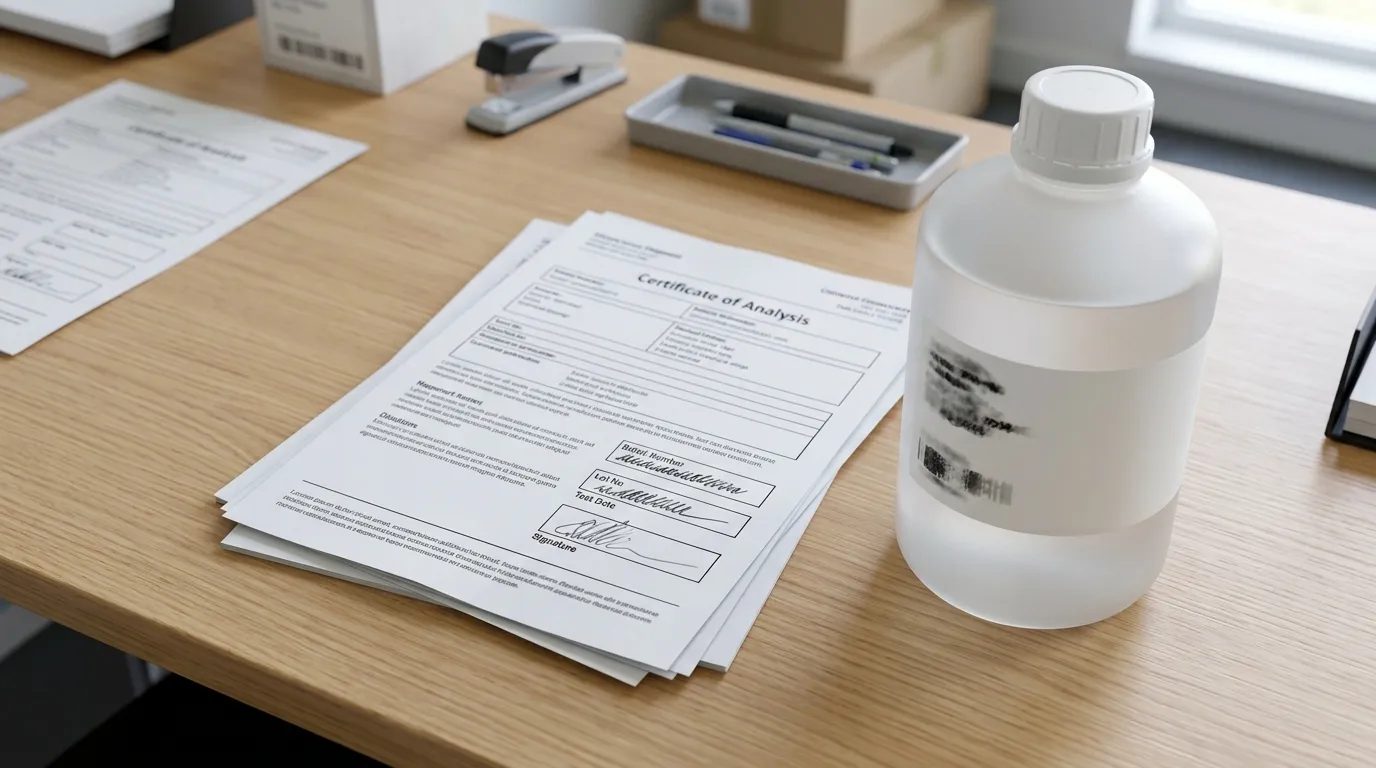
Before reviewing assay or impurity values, verify that the document belongs to the material being purchased or received.
| COA field | What it identifies | What to compare | Risk if missing or mismatched |
|---|---|---|---|
| Product name | The chemical or commercial material tested | Purchase order, label, and specification | The document may concern a different material |
| CAS number, where applicable | A chemical identity reference | Purchase documents and technical records | Similar names may refer to different substances or forms |
| Grade | The intended quality level or specification category | Approved grade and customer requirement | Results may not apply to the required grade |
| Physical form | Solid, solution, hydrate, anhydrous form, or another supplied form | Label, packing documents, and purchase order | Data may be transferred incorrectly between forms |
| Lot or batch number | The specific production or shipment unit tested | Container label and receiving records | The COA may not represent the material received |
| Test or issue date | When testing or document release occurred | Supplier documentation and internal requirements | The timing and relevance of the result may be unclear |
| COA or document number | An administrative reference | Supplier record or document-control system | Traceability may be more difficult |
The lot or batch number is particularly important. A COA for the correct product but a different lot does not establish the quality of the lot received. The product name, grade, and packaging may look identical while the batch-specific test result is different.
The COA number itself is usually a document-control reference. Its format varies between suppliers and does not independently prove product quality. Similarly, a signature or authorization supports document accountability but does not replace review of the actual results and specifications.
For cross-border purchasing, the COA is one part of the wider document package. The broader chemical procurement from China process may also involve purchase specifications, shipping records, safety documents, and receiving controls.
Read assay without confusing it with concentration or active content
Assay or purity is a reported quality attribute, but its exact meaning depends on the chemical, grade, analytical method, and stated basis.
Do not automatically treat the following terms as interchangeable:
| Term | What it may describe | What must be checked |
|---|---|---|
| Assay or purity | The measured amount or proportion of the specified chemical under a defined method | Analytical method, basis, unit, and applicable specification |
| Concentration | The amount of a substance in a solution or mixture | Mass %, volume %, molar concentration, or another stated basis |
| Active content | The quantity of the component considered active in a product or formulation | Definition of “active,” calculation basis, and product form |
| Product-as-supplied strength | The composition of the material as delivered | Whether the value applies to the supplied solution, solid, blend, or another form |
For example, a percentage reported on a dry basis is not automatically comparable with a percentage reported on an as-supplied basis. Likewise, the assay of a chemical component should not be used as a dosage or formulation concentration without a defined calculation basis.
When reviewing an assay result, check:
- The exact test name.
- The result and unit.
- Whether the result is minimum, maximum, typical, or an actual measured value.
- The sample or calculation basis.
- The analytical method.
- The specification limit that applies to the product and grade.
A high assay value alone does not establish food, feed, pharmaceutical, drinking-water, or other regulated-use suitability. Those decisions require evidence tied to the exact product, application, jurisdiction, and applicable date or standard.
Interpret impurities and other reported tests in context

A COA may list impurities or supporting quality attributes such as moisture, pH, insoluble matter, color, density, or other product-specific tests. The fields vary by chemical, grade, form, and customer specification. There is no universal impurity list or universal limit that applies to every industrial chemical.
Read each row across the document:
- Identify the test or impurity.
- Note the actual result.
- Confirm the unit and sample basis.
- Check the test method.
- Locate the applicable minimum, maximum, or range.
- Determine whether the result meets that defined criterion.
A result without its unit or method may be difficult to interpret. Two results with the same numerical value may not be comparable if they were obtained using different methods or reported on different bases.
What do ND, below LOQ, minimum, maximum, and typical mean?
| COA notation | General meaning | What to verify |
|---|---|---|
| ND | Not detected under the stated test conditions or reporting convention | Detection or reporting limit and method |
| Below LOQ | Below the laboratory’s limit of quantification | The stated LOQ and whether the specification uses the same basis |
| Minimum | The result must meet or exceed a lower limit | Unit, basis, and applicable grade |
| Maximum | The result must not exceed an upper limit | Unit, basis, and applicable grade |
| Range | The result must fall between defined lower and upper values | Whether the endpoints are inclusive and what method applies |
| Typical | An expected or representative value rather than necessarily a release limit | The actual acceptance criterion |
“Not detected” does not necessarily mean absolute zero. It generally means that the substance was not detected under the method and reporting limit used for that test. The meaning of “below LOQ” also depends on the method and laboratory convention. Detection-limit terminology should therefore remain attached to the result rather than being treated as a universal statement about the material.
For a more detailed explanation of units, reporting limits, and analytical interpretation, see this chemical quality control resource if your review requires broader QA context.
Compare every result with the correct acceptance limit
The central question is not whether a number looks high or low. It is whether the actual result satisfies the applicable specification for that exact product, grade, form, and use.
| COA situation | Interpretation | Appropriate next step |
|---|---|---|
| Result falls within a defined range | The result appears consistent with that stated criterion | Continue the buyer’s normal review |
| Result is below a maximum | The result meets that upper-limit criterion | Confirm other required tests |
| Result is above a minimum | The result meets that lower-limit criterion | Confirm other required tests |
| Result is outside the stated limit | The result does not meet that criterion as written | Route through the applicable nonconformance or supplier-review process |
| No specification is shown | Conformity cannot be determined from the result alone | Obtain the applicable specification or clarification |
| Unit or method does not match the purchase requirement | Direct comparison may be invalid | Request clarification before making a release decision |
| Only a “pass” statement is shown | The document may not provide enough detail for independent review | Request the underlying results and limits where required |
A minimum and a maximum are not interchangeable. A typical value is not automatically an acceptance limit. A result can also appear acceptable until its basis or unit is checked.
For example, a percentage result cannot be compared responsibly with another percentage unless the reader knows whether both values use the same basis, such as mass percent, volume percent, dry basis, or product-as-supplied basis. If the COA and purchase specification use different units or methods, do not make an unsupported conversion.
Acceptance limits may be product-, grade-, form-, customer-, application-, or jurisdiction-specific. The article can explain how to compare a result with a limit, but it cannot determine conformity without the applicable specification.
Use a receiving workflow before approving the lot

A COA review is most useful when it connects directly to receiving and quality records.
- Match the product identity.
Compare the product name, chemical identity, CAS where applicable, grade, and physical form with the purchase order, container label, and approved specification.
- Match the lot or batch.
Confirm that the COA lot number corresponds to the label and shipment being received. Do not rely on a generic COA or a document for another batch.
- Review the required tests.
Check the assay, impurity, moisture, pH, insoluble-matter, or other tests required for that specific product and grade.
- Check result details.
Record the actual result, unit, basis, test method, and any detection or reporting limit that affects interpretation.
- Compare with the applicable limits.
Determine whether each result meets the defined minimum, maximum, or range. Do not compare a result with an assumed industry average.
- Check document control.
Review the issue or test date, document number, authorization, and issuing function where those fields are relevant to your quality process.
- Resolve exceptions.
If the COA is missing, generic, incomplete, assigned to the wrong lot, unclear in its units, or outside specification, document the issue and follow the buyer’s established review process.
- Retain the record.
Keep the COA with the relevant receiving, lot, and quality records according to the organization’s document-control requirements.
Common exceptions include:
- The COA shows the correct chemical but the wrong lot number.
- The supplier provides a product-level COA rather than a batch-specific document.
- The grade or physical form is not stated.
- The result is shown without a unit or method.
- A “pass” statement appears without the underlying limits.
- An impurity is reported as ND without a detection or reporting limit.
- The COA uses a different basis from the purchase specification.
- One or more required tests are absent.
A missing or unclear COA does not automatically establish that the material is unacceptable, but it does mean that the available evidence may be insufficient for the intended decision. The final disposition should follow the buyer’s own quality and purchasing process.
Know what a COA does not prove
A COA, SDS, and TDS serve different purposes.
| Document | Primary purpose | What it does not establish by itself |
|---|---|---|
| COA | Reports quality-test results for a defined lot or batch | Complete hazard information, universal regulatory approval, or suitability for every end use |
| SDS | Provides hazard, handling, storage, emergency, and safety information | Batch-specific assay or conformity with a purchase specification |
| TDS | Provides technical, physical, or application-related information | The actual test result for the lot being received |
Read COA vs SDS vs TDS for a fuller comparison of these documents.
A COA does not, by itself, prove that a chemical is suitable for food, feed, pharmaceutical, drinking-water, environmental, or another regulated application. Such conclusions require evidence for the exact product, grade, application, jurisdiction, and current regulatory framework.
Similarly:
- High assay does not automatically establish end-use approval.
- An SDS is not proof of food, feed, or pharmaceutical suitability.
- A company management-system certificate is not automatically product certification.
- A catalog listing is not proof of in-house manufacture.
- A supplier’s general statement is not a substitute for a lot-specific result where lot-specific evidence is required.
The COA should therefore be used for the quality questions it actually addresses. Safety questions belong primarily to the SDS, technical or application questions may require a TDS or other technical evidence, and regulatory questions require the applicable authority or compliance documentation.
A final COA review checklist for procurement and QA
Before approving a chemical lot, confirm the following.
Identity and traceability
- Chemical name and identity match the purchase requirement.
- CAS number is consistent where applicable.
- Grade is clearly stated and correct.
- Physical form is correct, including solid, solution, hydrate, or anhydrous distinctions.
- Lot or batch number matches the container and shipment.
- Relevant test, issue, or release date is present.
Results and methods
- Required tests are listed.
- Actual results are shown where your process requires them.
- Units and calculation bases are clear.
- Assay is not being confused with concentration or active content.
- Impurity results include the relevant reporting or detection information.
- Test methods are identified where they affect comparability.
Acceptance limits
- Each result has an applicable minimum, maximum, or range.
- The result and limit use compatible units and bases.
- Typical values are not being treated as release limits.
- ND or below-LOQ results are interpreted with their stated limits.
- Any out-of-specification result is identified and controlled.
Document control
- The COA is specific to the lot under review.
- The document is complete and legible.
- The issuing function or laboratory is identified where relevant.
- Authorization or approval is present where required by the buyer’s process.
- The COA is retained with the appropriate receiving and quality records.
When information is missing, useful supplier questions include:
- Can you provide a COA for the exact lot shipped?
- Which grade and physical form does the COA cover?
- What test method and reporting limit support this result?
- Which specification or customer limit was used?
- Can you clarify the unit, basis, date, or missing test?
These questions address documentation gaps without assuming that every chemical requires the same COA format.
The most reliable approach is to align the COA with the purchase specification before approving the lot. Confirm the same chemical identity, grade, form, units, methods, and acceptance criteria are being compared. If they do not align, request clarification before making a release decision. For broader supplier evaluation, documentation capability can be considered alongside the other criteria explained in how to choose a chemical supplier.


Contact Us
In This Article
Related Posts
Индивидуальные упаковочные решения от поставщика безводного ацетата натрия в Китае
2026-09-23
Тенденции применения безводного ацетата натрия для специального химического производства
2026-09-23
Безводный ацетат натрия для дубления кожи: улучшает равномерность окрашивания
2026-09-22
Formic Acid 85% for Animal Feed Preservation: Moisture and Storage Stability Guide
2026-09-21


