



COA vs SDS vs TDS: Which Chemical Document Answers Which Buyer Question?
By Tonmoy
2026-09-12Related Posts
Индивидуальные упаковочные решения от поставщика безводного ацетата натрия в Китае
2026-09-23
Тенденции применения безводного ацетата натрия для специального химического производства
2026-09-23

Безводный ацетат натрия для дубления кожи: улучшает равномерность окрашивания
2026-09-22
Formic Acid 85% for Animal Feed Preservation: Moisture and Storage Stability Guide
2026-09-21
When reviewing an industrial chemical, each document answers a different question:
| Document | Main buyer question | Evidence level |
|---|---|---|
| TDS — Technical Data Sheet | Does this product or grade appear technically suitable for my application? | Product- or grade-level information |
| SDS — Safety Data Sheet | How should this substance or mixture be handled, stored, and managed safely? | Hazard and safety information |
| COA — Certificate of Analysis | Did this specific batch or lot meet the agreed specification? | Batch-level test results |
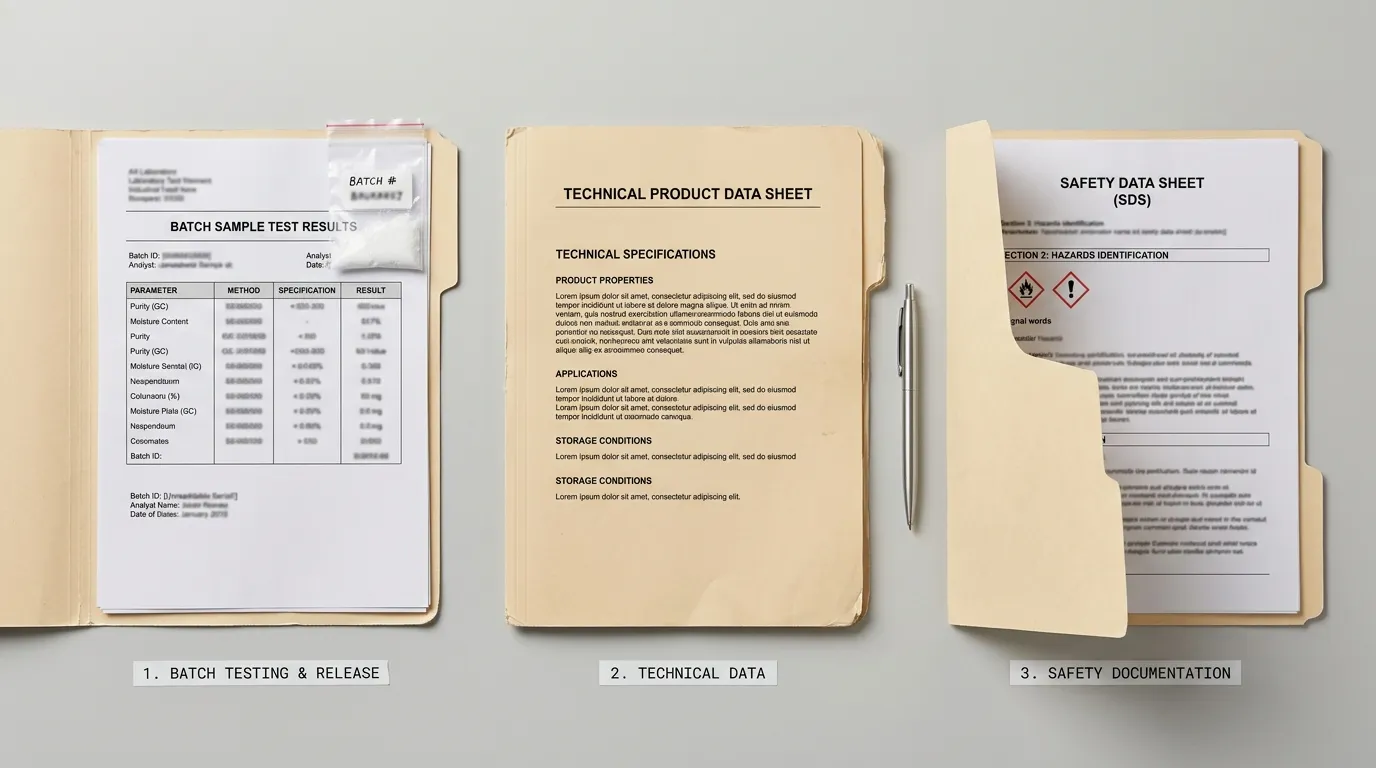
A TDS helps with technical selection. An SDS supports hazard communication and safe handling. A COA supports quality review of a particular shipment or production batch.
These documents are complementary, not interchangeable. A COA does not replace a TDS or SDS, and an SDS does not establish that a product is technically suitable for a formulation or process.
What a COA tells a chemical buyer
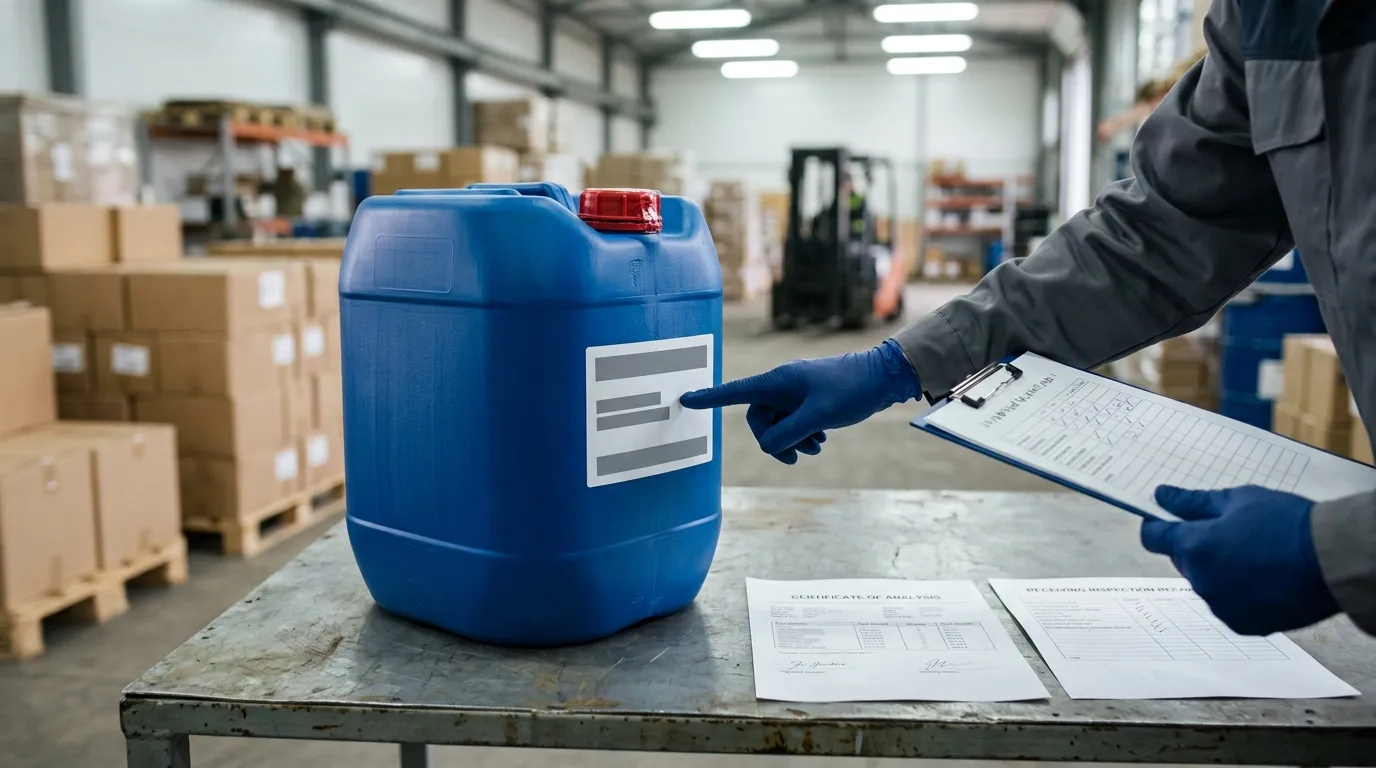
A Certificate of Analysis reports test results for a specific production batch or lot. It is therefore the document most closely associated with incoming quality verification.
A buyer or QA team typically uses a COA to compare:
- The product name and grade
- The batch or lot number
- The agreed specification limits
- The reported test results
- The units and test parameters
- The supplied product or physical form
- Any applicable document date, revision, or authorization information
The most important check is whether the COA matches the material actually being purchased or received. The batch or lot number on the COA should correspond with the shipment documentation, packaging, labels, or other controlled records.
A COA can show that a reported batch result conforms to specified limits. It does not, by itself, provide the complete technical context needed for application selection, nor does it provide the hazard, storage, or emergency information normally found in an SDS.
COA content varies by product, grade, supplier, contract, and specification. The presence of a result on a COA should not be treated as universal regulatory approval or proof of suitability for every application.
What a TDS tells a chemical buyer
A Technical Data Sheet describes the technical characteristics of a product or grade. Formulation, procurement, and technical teams use it to assess whether the material appears compatible with a process or application.
Depending on the supplier and product, a TDS may include:
- Technical properties
- Specification information
- Typical values
- Physical or chemical characteristics
- Stated application areas
- Product handling information relevant to technical use
- Test or measurement details
The TDS is generally a product- or grade-level document. It is not normally a report of the measured results for the particular batch being delivered.
This distinction matters when a TDS includes typical values. A typical value describes the product information supplied for technical reference; it should not automatically be treated as the result for every batch. If a buyer needs to verify the delivered batch, the relevant evidence is the COA matched to that batch.
The TDS must also be read against the exact product identity. A TDS for one grade, physical form, concentration, hydrate or anhydrous form, or supplied-product basis should not be transferred to another product variant without confirmation.
For example, a technical team considering chemicals for a coatings formulation may use the TDS to screen technical fit, then confirm the exact grade and supplied form before proceeding. Application-specific information, such as construction coatings chemicals, should not be assumed to apply to every chemical grade or formulation.
A TDS does not replace an SDS. Technical suitability and safe handling are separate questions.
What an SDS tells a chemical buyer
A Safety Data Sheet communicates hazard and safety information for a substance or mixture. It is used by EHS, warehouse, operations, logistics, transport, and emergency-response personnel, as well as by procurement and technical teams that need to screen handling requirements.
An SDS commonly addresses matters such as:
- Hazard identification
- Safe handling and storage
- Exposure controls and personal protective information where applicable
- First-aid measures
- Fire-fighting measures
- Accidental-release measures
- Stability and reactivity
- Toxicological information
- Disposal and transport-related information where relevant
SDS documents commonly follow a 16-section structure in GHS-aligned systems. The exact legal requirements, document language, classification rules, and update obligations can vary by jurisdiction and by the exact substance or mixture.
Before using an SDS, confirm that it identifies the correct:
- Chemical or mixture
- Product name
- Concentration or composition basis where relevant
- Physical form
- Supplier or responsible entity
- Revision or issue information
An SDS should not be used as a substitute for a TDS when the question concerns formulation fit, technical properties, or application performance. It should also not be treated as proof of food, feed, pharmaceutical, drinking-water, or other regulatory suitability.
“MSDS” is a related older term still encountered in chemical documentation. “SDS” is the current term commonly used in GHS-aligned documentation, although terminology and legal requirements may differ by market.
Why one document cannot replace the other two
The difference between COA, SDS, and TDS is not simply the document title. It is the type and scope of evidence each document provides.
A COA does not replace a TDS
A COA normally reports results for a defined batch. It may confirm that selected parameters were within agreed limits, but it does not necessarily explain the product’s full technical profile, intended applications, or formulation considerations.
Use the TDS to evaluate technical fit. Use the COA to review the delivered batch.
A TDS does not replace an SDS
A TDS may describe technical properties and applications, but it is not the primary document for hazard communication, emergency response, storage precautions, or safe handling instructions.
Use the SDS for safety-related questions, even when the TDS appears technically complete.
An SDS does not replace a TDS
An SDS may identify hazards and handling requirements without providing the technical information needed to select a grade or assess a formulation.
A product can require specific handling controls while still needing a separate technical review for the intended process.
A COA does not replace an SDS
A batch test result does not explain what to do in the event of exposure, a spill, fire, or incompatible storage. Those questions belong to the SDS and applicable site procedures.
The practical distinction is:
- TDS: Is it technically suitable?
- SDS: How must it be handled safely?
- COA: Does this batch meet the agreed specification?
A practical document-review sequence for chemical purchasing

The exact review process depends on the buyer’s quality system, contract, application, and destination market. A practical sequence is:
- Confirm the product identity and scope.
Check the chemical or product name, grade, physical form, concentration basis, and intended use. Make sure the documents refer to the same product variant.
- Review the TDS for technical fit.
Compare the stated technical properties and specification context with the requirements of the formulation or process. Distinguish typical values from guaranteed or batch-specific results.
- Review the SDS for safety and logistics.
Confirm that the SDS matches the actual substance or mixture. Review hazard information, handling, storage, emergency response, and other information relevant to the destination and use jurisdiction.
- Match the COA to the shipment.
Compare the batch or lot number on the COA with the physical shipment and associated commercial records. Review the reported results against the agreed specification.
- Resolve discrepancies before acceptance.
Clarify mismatched product identities, missing batch links, inconsistent units, unexplained revisions, or results outside the agreed limits before treating the documentation as complete.
This three-document review is part of a broader chemical procurement from China process when sourcing from China. However, documentation review does not eliminate the need to define the required grade, specification, application, and destination-market requirements in the purchasing process.
For organizations that evaluate samples before approving a supplier or product, documentation can be considered alongside the chemical sample approval process. The sample process and the document review answer related but different questions: one concerns evaluation of the sample or proposed material, while the other concerns the scope and identity of the supplied documentation.
What to verify before approving a chemical document set
Use the following checks as a practical review aid.
Identity and document control
- Is the chemical or product name consistent across the TDS, SDS, COA, packaging, and purchase records?
- Does the grade and physical form match the order?
- Are the concentration basis, active-content basis, or supplied-product basis clear where relevant?
- Are document revision or issue details available?
- Are the units used consistently?
Technical review
- Does the TDS address the properties relevant to the intended application?
- Are the listed values identified as typical values, specification limits, or another category?
- Is the TDS applicable to the exact grade and form being purchased?
- Has technical suitability been reviewed separately from batch acceptance?
Safety review
- Does the SDS identify the correct substance or mixture?
- Are handling, storage, emergency, and hazard sections relevant to the intended use?
- Have destination-specific legal and logistics requirements been checked separately where necessary?
- Has anyone assumed that the SDS itself proves application approval or regulatory suitability?
Quality review
- Does the COA identify the same batch or lot as the shipment?
- Are the reported results compared with the agreed specification?
- Are the units and test parameters clear?
- Are missing, inconsistent, or unexplained results resolved before acceptance?
The three documents can be reviewed together, but they should retain their separate evidentiary roles. A complete document set supports a more controlled decision; it does not automatically guarantee technical suitability, regulatory compliance, or acceptance in every application.
Related document terms buyers may encounter
Buyers may also encounter terms such as MSDS and COC.
MSDS is a related term for SDS and may still appear in older supplier or purchasing records. For current review, confirm that the document is the applicable safety document for the exact substance or mixture and destination market.
COC may refer to a Certificate of Conformity or another supplier-defined document. Its meaning and evidentiary scope should be confirmed from the document, contract, or quality agreement rather than assumed from the abbreviation alone. A COC should not automatically be treated as identical to a COA.
The simplest decision rule is:
- Use the TDS to assess technical fit.
- Use the SDS to assess safe handling and hazard information.
- Use the COA to assess the conformity of the identified batch.
Reviewing all three gives procurement, QA, technical, and operations teams a clearer basis for deciding whether the documentation matches the product, the application, and the shipment.


Contact Us
In This Article
Related Posts
Индивидуальные упаковочные решения от поставщика безводного ацетата натрия в Китае
2026-09-23
Тенденции применения безводного ацетата натрия для специального химического производства
2026-09-23
Безводный ацетат натрия для дубления кожи: улучшает равномерность окрашивания
2026-09-22
Formic Acid 85% for Animal Feed Preservation: Moisture and Storage Stability Guide
2026-09-21


