



Potassium Formate Bulk Price: A Practical Guide for Industrial Buyers
By LIN
2026-09-01Related Posts
Индивидуальные упаковочные решения от поставщика безводного ацетата натрия в Китае
2026-09-23
Тенденции применения безводного ацетата натрия для специального химического производства
2026-09-23

Безводный ацетат натрия для дубления кожи: улучшает равномерность окрашивания
2026-09-22
Formic Acid 85% for Animal Feed Preservation: Moisture and Storage Stability Guide
2026-09-21
When purchasing potassium formate in large quantities, the price discussion becomes quite different from buying a few bags or a laboratory sample.
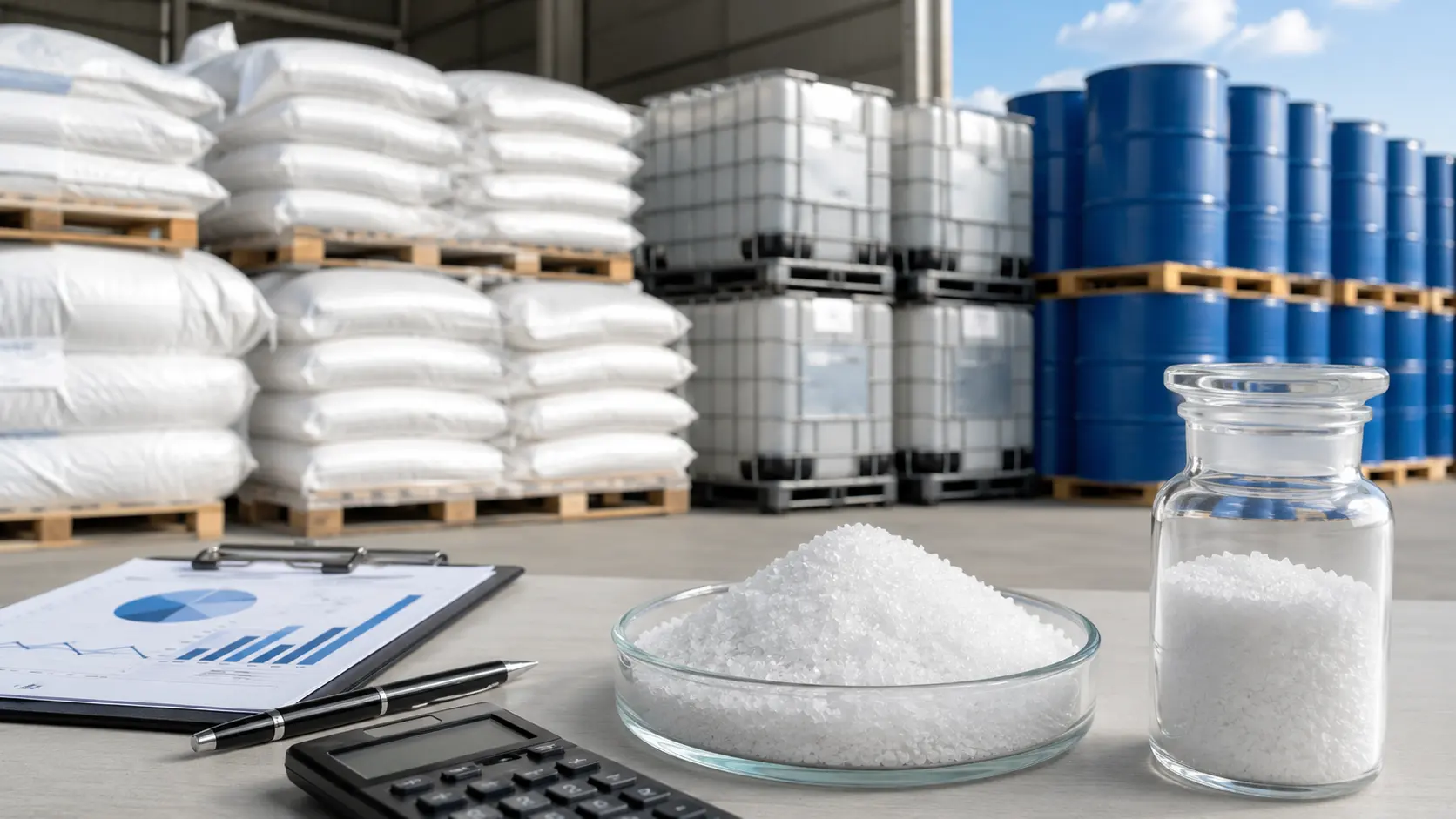
A buyer searching for potassium formate bulk price is normally not asking for the price of 25 kg. They may be planning a 10-ton order, a full container, several containers, or even a yearly supply contract.
And this is where things get a little more complicated.
The lowest price per ton is not always the lowest purchasing cost. Packaging, concentration, container loading, freight, payment terms and product consistency all influence what you actually pay in the end.
For oilfield companies, chemical distributors, deicing fluid producers and industrial formulators, understanding these details can save much more money than simply negotiating another $10 or $20 per ton.
What Does “Bulk” Mean When Buying Potassium Formate?
There isn't one fixed definition.
For some suppliers, 1 metric ton may already qualify as a bulk order. For established chemical manufacturers, however, bulk business usually means quantities closer to:
- 5–10 MT
- 20–25 MT
- One full container load
- Multiple containers
- Monthly or annual supply contracts
The price structure normally becomes more competitive as the quantity increases because production planning, packaging and transportation costs are spread over a larger shipment.
That said, quantity alone doesn't determine the final offer.
A buyer purchasing 100 tons of a special specification may still pay more than another customer purchasing 20 tons of a standard industrial grade.
Typical Bulk Purchasing Levels
| Purchase Level | Typical Buyer | Main Price Consideration |
|---|---|---|
| Below 1 MT | Laboratory or trial buyer | Small-order handling cost |
| 1–5 MT | Initial industrial testing | Packaging and LCL freight |
| 10–25 MT | Regular industrial user | Container utilization |
| 25–100 MT | Distributor or large plant | Volume discount and logistics |
| 100+ MT/year | Long-term contract buyer | Annual pricing and supply stability |
For buyers who expect regular demand, it is worth mentioning estimated annual volume when requesting a quotation.
A supplier may quote differently for a one-time 20 MT order and a customer who plans to purchase 300 MT during the year.
Potassium Formate Bulk Price Depends on Concentration
The first thing a supplier needs to know is what form of potassium formate you need.
The two common commercial options are:
Potassium Formate 75% Solution
and
Potassium Formate 96% Solid
These products should not be compared directly only by price per ton.
A 75% solution contains approximately 75% potassium formate by weight, with the remaining portion mainly being water. A 96% solid grade contains much more active material in each ton shipped.
So if the solid material is more expensive per ton, that does not necessarily mean it is more expensive for your process.
You need to look at the active chemical content.
Comparing Bulk 75% Liquid and 96% Solid
| Factor | 75% Potassium Formate Solution | 96% Potassium Formate Solid |
|---|---|---|
| Physical form | Liquid | Solid |
| Active content | Around 75% | Around 96% |
| Common handling | Pumping and liquid storage | Bag handling and dissolution |
| Shipping efficiency | More water transported | More active chemical per ton |
| Processing | Usually ready for liquid formulation | May require dissolution |
| Typical use | Oilfield brine, heat transfer, deicing | Blending, distribution, brine preparation |
For a plant that already has dissolution tanks and mixing equipment, solid potassium formate may provide better transportation efficiency.
For another customer that wants a ready-to-use liquid feed, the 75% solution can be much more convenient.
This is why an experienced procurement team usually compares cost per active ton, not only cost per shipment ton.
Why Full Container Orders Usually Get Better Pricing
International chemical logistics strongly favor full-container purchasing.
When you ship only a few tons, LCL charges, warehouse handling and documentation can make the freight cost per ton rather painful.
With a full container, loading becomes more efficient.
The supplier can also plan production and packaging more easily. Less handling is required, and the export process becomes simpler.
This usually creates more room for price negotiation.
But there is one thing buyers sometimes forget: ask how much material can actually be loaded into one container.
A quote that looks $30 cheaper per ton may not be a better deal if the packaging results in poor container utilization.
Always compare:
Product price + packaging + loading quantity + ocean freight.
That's the real number.
Packaging Has a Bigger Impact Than It Seems
For bulk potassium formate, packaging depends heavily on whether the material is liquid or solid.
Liquid potassium formate may be supplied in IBC tanks, drums or other suitable bulk containers.
Solid material is normally packed in moisture-resistant industrial bags, depending on the supplier and customer requirement.
Packaging affects more than appearance.
It influences:
- Packaging material cost
- Net weight per container
- Forklift handling
- Warehouse storage
- Loading time
- Unloading method
- Moisture protection
- Possible product loss
Suppose Buyer A requests a special small package for every shipment while Buyer B accepts standard bulk packaging. Buyer B will normally have more room to negotiate the unit price.
If you're purchasing for internal industrial use rather than resale, standard factory packaging is often the more economical choice.
FOB Price Is Not the Same as Landed Cost
This one sounds obvious, but it causes plenty of confusion in international chemical purchasing.
A FOB potassium formate bulk price tells you what the product costs when delivered to the export port under the agreed FOB terms.
It doesn't tell you the final cost after the material reaches your warehouse.
Depending on the destination, you may also need to consider:
- Ocean freight
- Insurance
- Import duties
- Customs clearance
- Port charges
- Inland transportation
- Local handling
- Storage
For buyers in distant markets, freight changes can sometimes have a larger impact than small movements in the factory price.
So when comparing Chinese potassium formate suppliers, ask for both FOB and CIF/CFR options when appropriate.
It gives you another reference point.
How to Calculate the Real Bulk Cost
A simple purchase comparison can be surprisingly useful.
Imagine two suppliers:
Supplier A offers a slightly cheaper FOB price.
Supplier B is $15 per ton more expensive.
At first glance, Supplier A wins.
But Supplier B can load more net product per container, uses packaging that works better with your warehouse, and provides a more competitive shipping route.
Suddenly Supplier B may have the lower landed cost.
For bulk chemicals, purchasing decisions should ideally be based on:
Landed Cost per Usable Ton
For potassium formate, you can go one step further and calculate:
Landed Cost per Ton of Active Potassium Formate
That gives a much fairer comparison between 75% liquid and high-purity solid material.
Raw Material Prices Affect Bulk Quotations
Potassium formate does not exist in its own little price bubble.
Its production cost is connected with upstream raw materials, energy, processing and packaging.
Changes in potassium-related feedstocks or formic acid costs can eventually affect potassium formate production costs.
Energy also matters, especially for processing and concentration.
Because chemical costs move, suppliers normally provide quotation validity periods.
A price you received two months ago may no longer be available today.
For large projects, this is especially important.
If you're preparing a tender that will not be awarded for another three months, tell the supplier. Otherwise, you might be comparing quotations that were never intended to remain valid for that long.
Can Annual Contracts Reduce Potassium Formate Prices?
Potentially, yes.
Long-term purchasing gives manufacturers better visibility into production demand.
Instead of receiving a random inquiry for “20 tons sometime next month,” the supplier can plan for something like:
- 25 MT in January
- 50 MT in March
- 50 MT in June
- 25 MT in September
That is much easier to work with.
Annual contracts may provide benefits such as:
- Better volume negotiation
- More stable supply
- Priority production planning
- Reserved packaging
- Easier logistics planning
- Reduced risk during busy periods
However, locking in one fixed price for a very long time is not always practical when upstream costs are moving.
Some industrial buyers instead negotiate a pricing mechanism or review the price periodically.
Cheap Potassium Formate Can Become Expensive
This is especially true for oilfield applications.
Potassium formate is frequently selected for drilling, completion and workover fluids where density, solubility and impurity control matter.
If the material has inconsistent quality, the saving on the purchase price can disappear very fast.
A bulk buyer should review more than the potassium formate content.
Depending on the application, useful parameters can include:
- Potassium formate concentration
- Density
- pH
- Chloride
- Carbonate
- Iron
- Insoluble matter
- Moisture
- Appearance
Batch-to-batch consistency also matters for regular production.
A $20-per-ton saving sounds nice until one off-spec batch creates a much larger processing problem.
So yes, price is important. But it isn't the whole story.
What Should You Include in a Bulk RFQ?
A detailed RFQ usually gets a more useful response and reduces the amount of back-and-forth email.
Potassium Formate Bulk RFQ Checklist
| Information | Example |
|---|---|
| Required product | Potassium Formate |
| Concentration | 75% solution |
| Grade | Oilfield / Industrial |
| Order quantity | 25 MT |
| Annual demand | Approx. 300 MT |
| Packaging | IBC |
| Destination | Rotterdam |
| Trade term | FOB / CIF |
| Application | Completion brine |
| Required documents | COA, SDS, TDS |
| Target schedule | Shipment within 30 days |
If you are buying for drilling or completion fluids, include any impurity limits that are important to your formulation.
The more accurate your RFQ is, the more useful the quotation will be.
How to Compare Potassium Formate Bulk Suppliers
For bulk chemical procurement, I would normally compare five things.
First, the specification.
Second, the actual bulk price.
Third, packaging and loading efficiency.
Fourth, documentation and quality consistency.
And finally, delivery capability.
A supplier offering a very attractive price but constantly delaying shipments may not be a very economical supplier in real life.
For international customers, experience with chemical exports is also useful. COA, SDS, packaging information and shipping documents should be available without a lot of confusion.
Vanchor supplies potassium formate for industrial applications, including oilfield fluid systems and other technical formulations. Bulk buyers can request specifications, packaging options, COA, SDS, TDS and quotations according to required concentration, quantity and destination.
When Is the Best Time to Request a Bulk Quote?
If you need material urgently, request a quotation as soon as the technical specification is confirmed.
For regular purchases, it is better to ask before you are completely out of stock.
That gives you time to:
- Compare suppliers
- Review documentation
- Test samples
- Confirm shipping schedules
- Negotiate payment terms
- Reserve production
Chemical procurement done at the last minute is rarely the cheapest.
When your purchasing team is under pressure to ship immediately, negotiating power gets smaller.
Final Thoughts
The potassium formate bulk price is not simply a number printed beside “USD/MT.”
For serious industrial purchasing, the real calculation includes concentration, active content, order volume, packaging, container loading, freight and product consistency.
For a full-container or contract purchase, compare quotations using the same specification, packaging and Incoterm.
More importantly, calculate the landed cost.
A supplier that looks slightly more expensive at the factory gate may actually be cheaper once the material reaches your production site.
For bulk potassium formate buyers, that is the number that really counts.
FAQ
What quantity is considered a bulk potassium formate order?
There is no universal rule, but industrial bulk purchases commonly range from several tons to full-container or multi-container orders. Larger annual requirements may also qualify for contract pricing.
Is bulk potassium formate cheaper per ton?
Usually, larger orders have a lower unit cost because production, packaging and export handling become more efficient. The actual saving depends on grade, packaging and shipping terms.
Should I buy 75% liquid or 96% solid in bulk?
It depends on your process. Liquid is convenient for direct fluid formulation, while solid offers more active potassium formate per ton shipped and can improve freight efficiency.
Can suppliers offer a better price for annual contracts?
Often they can provide more competitive commercial terms when annual demand is clear. Long-term volume also makes production and logistics planning easier for both sides.
What documents should I request before a bulk order?
Request at least a COA, SDS and technical specification or TDS. For critical applications, confirm impurity limits and consider testing a sample before the first large shipment.


Contact Us
In This Article
Related Posts
Индивидуальные упаковочные решения от поставщика безводного ацетата натрия в Китае
2026-09-23
Тенденции применения безводного ацетата натрия для специального химического производства
2026-09-23
Безводный ацетат натрия для дубления кожи: улучшает равномерность окрашивания
2026-09-22
Formic Acid 85% for Animal Feed Preservation: Moisture and Storage Stability Guide
2026-09-21


