



Potassium Formate Industrial Refrigeration Fluid: Performance and System Selection Guide
By LIN
2026-09-01Related Posts
Индивидуальные упаковочные решения от поставщика безводного ацетата натрия в Китае
2026-09-23
Тенденции применения безводного ацетата натрия для специального химического производства
2026-09-23

Безводный ацетат натрия для дубления кожи: улучшает равномерность окрашивания
2026-09-22
Formic Acid 85% for Animal Feed Preservation: Moisture and Storage Stability Guide
2026-09-21
A potassium formate industrial refrigeration fluid is an aqueous salt solution used as a secondary coolant in indirect refrigeration and low-temperature industrial cooling systems.
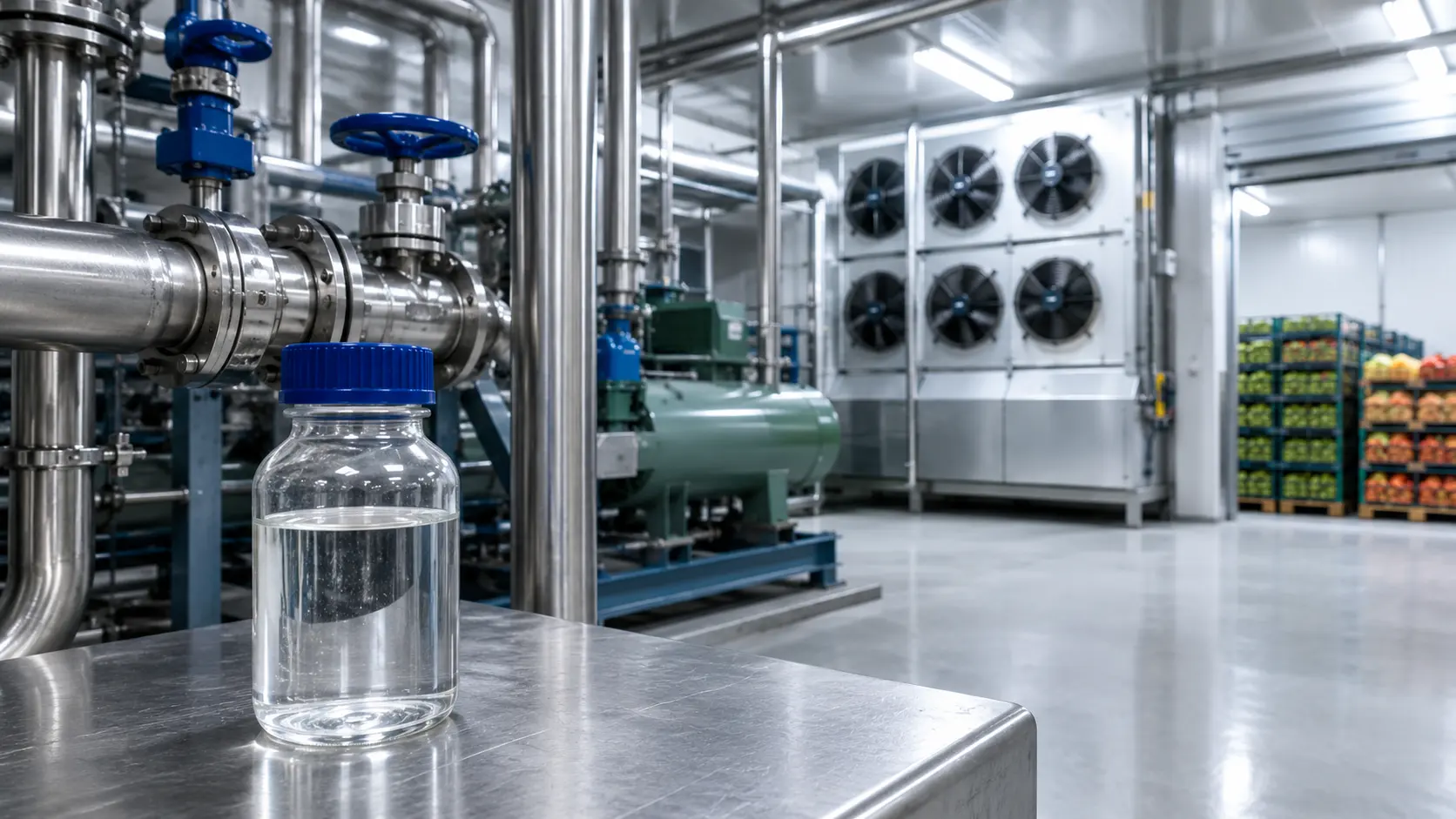
Instead of circulating the primary refrigerant throughout an entire factory or cold-storage facility, a refrigeration plant can cool a potassium formate solution and pump it through a secondary loop to the required cooling loads.
Potential applications include:
- Cold-storage warehouses
- Food-processing plants
- Industrial process cooling
- Refrigerated logistics centers
- Ice-rink refrigeration
- Production temperature control
- Low-temperature circulation systems
ASHRAE defines secondary coolants as liquids cooled by a refrigerant and then used to transfer heat without changing phase. These fluids are also known as heat-transfer fluids, brines or secondary refrigerants. Potassium formate is recognized as one of the less widely used secondary-coolant chemistries.
How Does Potassium Formate Work in Industrial Refrigeration?
A typical indirect refrigeration system operates as:
Primary refrigeration plant → heat exchanger → potassium formate fluid → process or cold room → return loop
The potassium formate fluid:
- Is cooled in the chiller or heat exchanger.
- Circulates through insulated piping.
- Absorbs heat from the process or refrigerated area.
- Returns to the refrigeration plant.
- Releases the absorbed heat and repeats the cycle.
Unlike the primary refrigerant, the potassium formate fluid normally remains in the liquid phase throughout circulation.
Why Use Potassium Formate in Industrial Refrigeration?
Sub-Zero Operation
Plain water provides excellent thermal performance but freezes near 0°C.
Dissolving potassium formate in water lowers the solution's freezing or crystallization temperature, allowing it to circulate in systems operating below the freezing point of water.
ASHRAE recommends selecting a secondary coolant with a freezing point at least about 3 K below, and preferably around 8 K below, the lowest temperature to which the coolant will be exposed.
The exact potassium formate concentration should therefore be selected around the system's actual minimum temperature.
Relatively Low Viscosity
Low-temperature viscosity is one of the most important refrigeration-fluid properties.
If viscosity becomes too high:
- Pump power increases
- Pressure drop rises
- Flow may decrease
- Larger piping may be required
- Heat-transfer performance can suffer
Published research specifically evaluating aqueous potassium formate as a secondary refrigerant found substantially lower viscosity than traditional aqueous alcohol and glycol systems under the studied conditions.
This can be particularly valuable in industrial systems with long circulation loops.
Heat-Transfer Performance
A refrigeration fluid must balance several properties:
- Thermal conductivity
- Specific heat
- Density
- Viscosity
Research on potassium formate reported good thermal conductivity and relatively low viscosity. However, its volumetric heat capacity can be lower than some conventional alternatives, which may require higher mass flow for the same temperature difference. The lower viscosity can help keep pumping-power demand competitive.
This means potassium formate should be evaluated using the complete thermal and hydraulic system, rather than only its freezing point.
Industrial Refrigeration Applications
Cold Storage
A central refrigeration plant can distribute cooling to multiple rooms through a potassium formate secondary loop.
Applications may include:
- Frozen-food warehouses
- Chilled storage
- Distribution centers
- Refrigerated loading areas
Vanchor currently lists cold-storage warehouses among possible applications for Potassium Formate 75% in heat-transfer and refrigeration fluids.
Food Processing
Secondary refrigeration can be used in:
- Chilled processing rooms
- Production lines
- Process heat exchangers
- Refrigerated storage
Using a secondary loop can allow the primary refrigerant circuit to remain more concentrated around the refrigeration plant.
Industrial Process Cooling
Factories may require controlled low temperatures for:
- Manufacturing equipment
- Chemical processes
- Production lines
- Process vessels
- Industrial heat exchangers
Vanchor currently identifies industrial cooling and process-temperature control among relevant potassium formate applications.
Refrigerated Logistics
Large cold-chain facilities can distribute cooling across multiple refrigerated zones from a centralized plant.
Ice Rinks
Secondary coolant systems can circulate low-temperature fluid through piping beneath the ice surface. ASHRAE specifically identifies ice rinks as an application area for secondary cooling systems.
Potassium Formate 75% as Refrigeration-Fluid Feedstock
Vanchor currently supplies Potassium Formate 75% Solution as a concentrated aqueous product for oilfield fluids, heat-transfer systems, deicing fluids, refrigeration systems and industrial chemical processing.
Current published typical information includes:
| Property | Typical Information |
|---|---|
| Concentration | Approx. 75% by weight |
| Appearance | Clear or nearly colorless liquid |
| Specific Gravity | Approx. 1.57 at 20°C |
| Solubility | Completely miscible / highly soluble in water |
| CAS Number | 590-29-4 |
Vanchor notes that the actual specification should be confirmed using the current TDS and batch-specific COA.
A nominal 75% solution contains approximately:
750 kg potassium formate per metric ton of solution.
Why 75% Is Not Automatically the Operating Concentration
The concentrated product is normally treated as a formulation feedstock.
Changing potassium formate concentration changes:
- Crystallization temperature
- Viscosity
- Density
- Specific heat
- Thermal conductivity
- Pumping requirements
Vanchor specifically states that concentrated potassium formate can be diluted to achieve the required freezing point, viscosity and heat-transfer performance.
A better design sequence is:
Minimum system temperature → freeze-protection margin → working concentration → viscosity and thermal calculations → system testing
Potassium Formate vs Glycol Refrigeration Fluids
Propylene glycol and ethylene glycol are common secondary refrigeration fluids.
| Factor | Potassium Formate | Glycol Systems |
|---|---|---|
| Chemistry | Aqueous formate salt | Aqueous glycol |
| Sub-zero operation | Yes | Yes |
| Low-temperature viscosity | Relatively low in comparative research | Can increase significantly |
| Thermal conductivity | Favorable | Concentration-dependent |
| Pumping requirement | Can be attractive | Strongly affected by viscosity |
| Corrosion inhibitors | May be required | Usually required |
Research comparing potassium formate with traditional alcohol and glycol fluids found good thermodynamic properties, lower viscosity, low toxicity and non-flammability as important advantages under the studied conditions.
However, potassium formate is not automatically the best option for every plant.
Selection should consider:
- Temperature range
- System metallurgy
- Pump energy
- Heat-exchanger design
- Safety requirements
- Lifecycle cost
Potassium Formate vs Traditional Chloride Brine
Calcium chloride and sodium chloride solutions have historically been common refrigeration brines.
Potassium formate differs because its primary anion is formate rather than chloride.
This can be useful where operators want to reduce reliance on chloride-based brines, but potassium formate should not be described as universally non-corrosive.
The finished fluid still requires corrosion and material-compatibility evaluation.
Corrosion Control
Industrial refrigeration loops may contain:
- Carbon steel
- Stainless steel
- Copper
- Brass
- Aluminum
- Pumps
- Valves
- Elastomers and seals
ASHRAE states that secondary coolants must be compatible with system materials at the temperatures and pressures encountered.
Vanchor likewise recommends testing complete potassium formate refrigeration formulations for:
- Corrosion
- Pump compatibility
- Seal and elastomer compatibility
- Storage stability
- Long-term concentration stability
Corrosion inhibitors may be required depending on equipment and operating conditions.
Why Chloride Control Matters
Although potassium formate itself is not a chloride salt, commercial material may contain trace chloride.
Vanchor identifies chloride as an important parameter for heat-transfer applications because excessive levels can increase corrosion risk.
A purchasing specification may therefore include:
- Potassium formate concentration
- Maximum chloride
- Iron
- Insoluble matter
- pH
- Density
These limits should be verified by a batch-specific COA.
Water Quality for Dilution
Dilution water may introduce:
- Chloride
- Calcium
- Magnesium
- Iron
- Suspended solids
These contaminants may contribute to:
- Corrosion
- Scaling
- Deposits
- Heat-exchanger fouling
Vanchor recommends using clean dilution water and testing the final solution after blending rather than relying only on theoretical calculations.
Concentrate Storage vs Working-Fluid Freeze Protection
These two issues should not be confused.
Vanchor notes that some highly concentrated 75% potassium formate solutions can have a crystallization or salt-out temperature around 5–8°C, depending on concentration and composition.
This refers to the concentrated feedstock.
After dilution to the engineered refrigeration-fluid concentration, crystallization behavior changes.
Cold-storage facilities should therefore verify both:
Raw-material storage requirements
and
Finished working-fluid crystallization temperature
What Industrial Refrigeration Engineers Should Check
Before specifying potassium formate fluid, evaluate:
- Minimum operating temperature
- Required freeze-protection margin
- Working concentration
- Viscosity at minimum temperature
- Density
- Specific heat
- Thermal conductivity
- Pumping power
- System metallurgy
- Corrosion-inhibitor requirements
ASHRAE notes that secondary systems introduce both an additional heat-transfer step and pumping-energy consumption, making fluid viscosity and heat-transfer properties important to overall system efficiency.
What Buyers Should Request
When purchasing potassium formate for industrial refrigeration-fluid formulation, request:
- Current technical specification
- Batch-specific COA
- TDS
- SDS
- Chloride limit
- Density data with temperature
- Crystallization information
- Storage requirements
- Packaging options
- Supply lead time
Vanchor currently lists drums, IBC tanks, ISO tanks, road tankers and customized bulk delivery among possible packaging formats for its 75% solution.
For an accurate inquiry, provide:
Minimum operating temperature
Industrial application
Required working concentration
System metallurgy
Target chloride limit
Quantity
Packaging
Destination
Frequently Asked Questions
What is potassium formate industrial refrigeration fluid?
It is an aqueous potassium formate solution used as a secondary coolant to transport cooling in industrial refrigeration and low-temperature circulation systems.
Is potassium formate a primary refrigerant?
Normally no. It usually serves as a pumped secondary fluid rather than undergoing the compression and phase-change cycle of the primary refrigerant.
Why use potassium formate instead of glycol?
Its relatively low viscosity and useful thermal conductivity can be attractive in low-temperature systems, although total thermal, hydraulic and economic performance must be calculated.
Can Potassium Formate 75% be used directly?
Not necessarily. Vanchor identifies 75% solution as a concentrate that can be diluted to achieve the required freezing point, viscosity and heat-transfer performance.
Does potassium formate refrigeration fluid require corrosion inhibitors?
Depending on system metallurgy and operating conditions, corrosion inhibitors and other additives may be required.
Where can it be used?
Potential applications include cold storage, food processing, industrial cooling, refrigerated logistics, ice rinks and process-temperature control.
Conclusion
A potassium formate industrial refrigeration fluid can provide an effective secondary cooling medium for:
Cold storage
Food processing
Industrial refrigeration plants
Process cooling
Refrigerated logistics
Low-temperature circulation systems
Its main technical appeal lies in the combination of sub-zero capability, relatively low viscosity and useful heat-transfer performance.
Reliable system design still depends on selecting the correct working concentration, crystallization point, viscosity, specific heat, thermal conductivity, pumping conditions and corrosion-control package.
For industrial refrigeration-fluid formulation, Potassium Formate 75% Solution can serve as a concentrated feedstock that is diluted and conditioned according to the requirements of the actual refrigeration plant.


Contact Us
In This Article
Related Posts
Индивидуальные упаковочные решения от поставщика безводного ацетата натрия в Китае
2026-09-23
Тенденции применения безводного ацетата натрия для специального химического производства
2026-09-23
Безводный ацетат натрия для дубления кожи: улучшает равномерность окрашивания
2026-09-22
Formic Acid 85% for Animal Feed Preservation: Moisture and Storage Stability Guide
2026-09-21


