



Potassium Formate HVAC Coolant: Low-Temperature Secondary Cooling Guide
By LIN
2026-09-01Related Posts
Индивидуальные упаковочные решения от поставщика безводного ацетата натрия в Китае
2026-09-23
Тенденции применения безводного ацетата натрия для специального химического производства
2026-09-23

Безводный ацетат натрия для дубления кожи: улучшает равномерность окрашивания
2026-09-22
Formic Acid 85% for Animal Feed Preservation: Moisture and Storage Stability Guide
2026-09-21
A potassium formate HVAC coolant is an aqueous potassium formate solution used as a secondary heat-transfer fluid in selected hydronic cooling, refrigeration and low-temperature HVAC circulation systems.
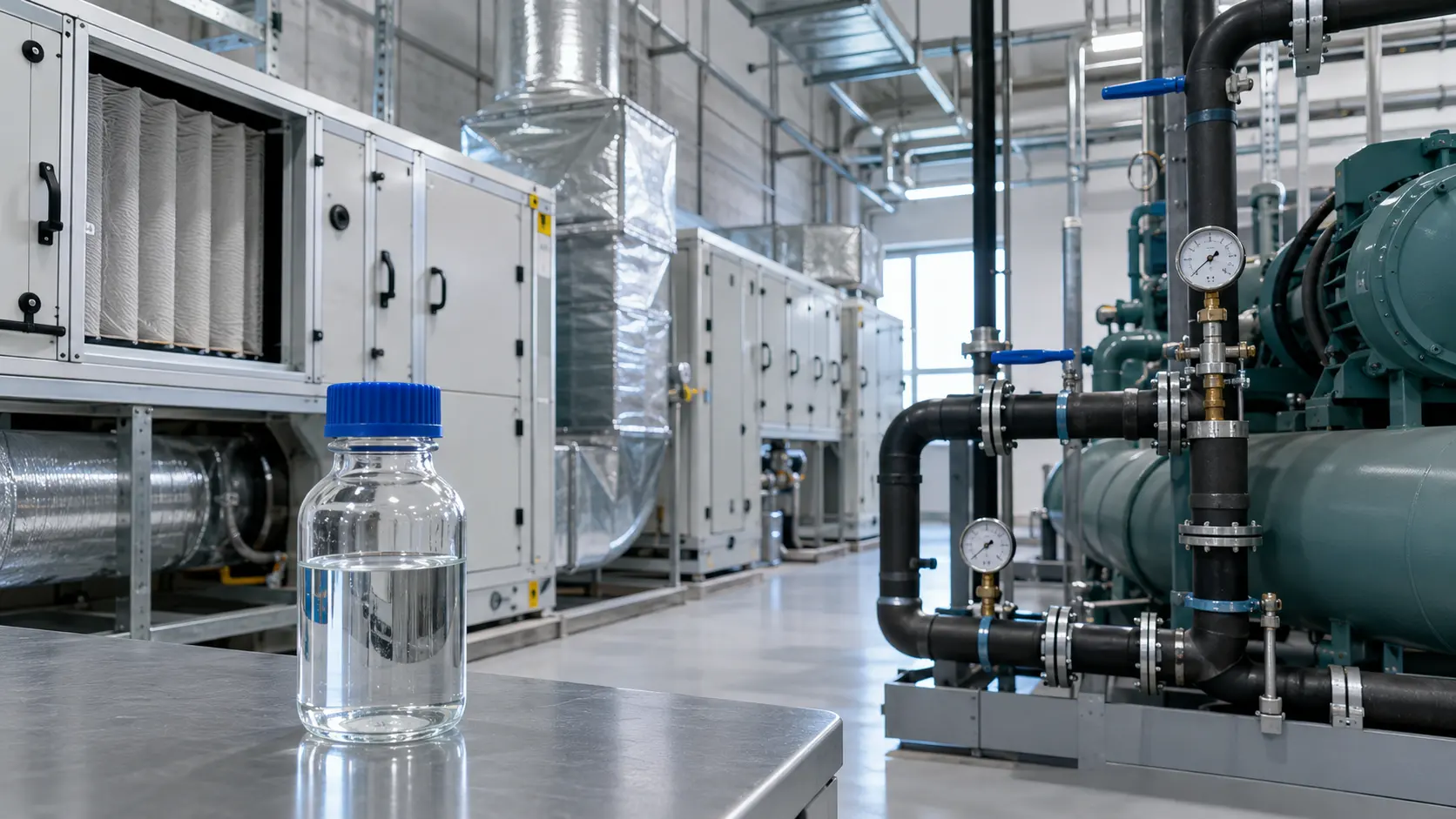
Rather than acting as the primary refrigerant inside a compressor cycle, potassium formate is normally cooled through a heat exchanger and then circulated through piping to transport cooling to the required load.
ASHRAE describes these fluids as secondary coolants, also known as heat-transfer fluids, brines or secondary refrigerants. Potassium formate is recognized as a less widely used secondary-coolant chemistry.
What Is Potassium Formate HVAC Coolant?
Potassium formate is the potassium salt of formic acid.
| Property | Typical Information |
|---|---|
| Chemical Name | Potassium Formate |
| Formula | HCOOK |
| CAS Number | 590-29-4 |
| Common Concentrate | 75% aqueous solution |
| Fluid Role | Secondary coolant |
| Typical System | Hydronic / indirect cooling loop |
| Main Function | Freeze protection and heat transfer |
Vanchor currently identifies HVAC secondary circuits, industrial refrigeration, process cooling and low-temperature circulation as potential applications for Potassium Formate 75% Solution.
A finished HVAC coolant may contain:
- Potassium formate
- Water
- Corrosion inhibitors
- pH-control components
- Other compatible additives
Therefore, concentrated potassium formate should generally be treated as a formulation raw material, not automatically as a finished inhibited HVAC coolant.
How Does It Work in an HVAC Secondary Loop?
A typical indirect system may operate as:
Chiller/refrigeration plant → heat exchanger → potassium formate loop → cooling load → return
The potassium formate coolant:
- Is cooled at the central plant.
- Circulates through pumps and piping.
- Absorbs heat from the load.
- Returns to the heat exchanger.
- Releases the absorbed heat.
ASHRAE defines secondary coolants as fluids that gain or lose heat while remaining in the same phase.
This distinguishes potassium formate coolant from primary refrigerants that undergo evaporation and condensation.
Why Consider Potassium Formate for HVAC?
Sub-Zero Freeze Protection
Water is an excellent heat-transfer fluid but freezes near 0°C.
Adding potassium formate lowers the freezing or crystallization temperature of the solution, allowing it to operate in circuits exposed to lower temperatures.
This can be useful in:
- Low-temperature HVAC loops
- Outdoor hydronic circuits
- Process cooling
- Cold-storage HVAC systems
- Freeze-protected secondary circuits
ASHRAE recommends that a secondary coolant have a freezing point at least approximately 3 K below, and preferably about 8 K below, the lowest temperature it may encounter.
Low-Temperature Viscosity Matters
Viscosity directly affects HVAC pumping performance.
A more viscous fluid can cause:
- Higher pressure drop
- Increased pump energy
- Lower flow
- Larger pump requirements
- Reduced heat-transfer coefficient
ASHRAE emphasizes that viscosity affects both heat transfer and pressure drop and that pumping-energy costs must be considered when selecting a secondary coolant.
This is particularly important in long building loops or industrial HVAC installations.
Potassium Formate 75% as HVAC Coolant Feedstock
Vanchor currently supplies Potassium Formate 75% Solution and identifies it as a concentrated raw material for preparing secondary cooling and heat-transfer fluids, including HVAC secondary circuits.
Perstorp also commercially identifies Potassium Formate 75% for secondary heat-transfer-fluid applications.
A nominal 75% solution contains approximately:
750 kg potassium formate per metric ton of solution
Advantages of liquid concentrate include:
- Direct pumping
- Accurate metering
- Easy dilution
- Fast blending
- No powder-dissolution stage
- Convenient bulk handling
Is 75% Potassium Formate Used Directly?
Not necessarily.
The working concentration should be selected according to the HVAC system's actual requirements.
Changing potassium formate concentration affects:
- Freeze protection
- Crystallization temperature
- Density
- Viscosity
- Specific heat
- Thermal conductivity
- Pumping requirements
A practical design process is:
Minimum system temperature → freeze-protection margin → required concentration → thermal and hydraulic verification
Using the maximum available concentration is not automatically the most efficient solution.
Potassium Formate vs Glycol HVAC Coolant
Ethylene glycol and propylene glycol are far more common in conventional HVAC hydronic systems.
Potassium formate offers a different chemistry and should be evaluated as an alternative for selected applications.
| Factor | Potassium Formate | Glycol |
|---|---|---|
| Base chemistry | Aqueous formate salt | Aqueous glycol |
| Freeze protection | Yes | Yes |
| Hydronic circulation | Possible | Very common |
| Concentration design | Required | Required |
| Pumping impact | Property-dependent | Property-dependent |
| Corrosion inhibitors | May be required | Usually required |
ASHRAE identifies ethylene glycol and propylene glycol among the common secondary coolants, while potassium formate is considered less widely used.
Therefore, potassium formate should not be presented as a universal replacement for glycol.
The comparison should consider:
- Operating temperature
- Viscosity
- Specific heat
- Thermal conductivity
- Pump energy
- System metallurgy
- Fluid cost
- Maintenance requirements
Heat Transfer and Pumping Must Be Evaluated Together
A coolant with excellent freeze protection is not automatically the best HVAC fluid.
Important parameters include:
Viscosity
Affects pressure drop and pump power.
Specific Heat
Determines how much thermal energy the coolant can carry.
Density
Influences hydraulic calculations.
Thermal Conductivity
Influences heat-exchanger performance.
Flow Rate
Must provide sufficient heat transport while remaining within pump and piping limits.
ASHRAE specifically notes that secondary coolant selection requires balancing heat-transfer coefficients and pressure drop rather than optimizing a single property.
Corrosion Control
HVAC secondary loops may contain:
- Carbon steel
- Stainless steel
- Copper
- Brass
- Aluminum
- Pumps
- Valves
- Gaskets
- Elastomers
ASHRAE states that the selected secondary coolant must be compatible with system materials at the pressures and temperatures encountered.
Vanchor also recommends that the finished potassium formate heat-transfer formulation include appropriate corrosion control and be tested against system metals, pumps and seals.
Potassium formate should therefore not automatically be described as non-corrosive.
Chloride Control
Potassium formate is a formate salt rather than a chloride salt.
However, commercial material may still contain trace chloride impurities.
For long-life HVAC systems, buyers may specify:
- Potassium formate assay
- Maximum chloride
- Iron
- Insoluble matter
- pH
- Density
These parameters should be supported by a batch-specific COA.
Water Quality for Dilution
Dilution water becomes part of the final HVAC coolant.
Poor-quality water may introduce:
- Chloride
- Calcium
- Magnesium
- Iron
- Suspended solids
Potential consequences include:
- Corrosion
- Scaling
- Deposits
- Heat-exchanger fouling
For critical hydronic systems, the final mixture should be checked after dilution.
Where Could Potassium Formate HVAC Coolant Be Used?
Potential applications include:
Low-Temperature Hydronic Cooling
Secondary circuits requiring freeze protection below the practical range of plain water.
Industrial HVAC Systems
Facilities combining building cooling with process-temperature control.
Cold-Storage HVAC
Refrigerated buildings using secondary cooling loops.
Outdoor Circuits
Systems where piping or coils can be exposed to freezing ambient conditions.
Thermal Storage and Specialized Cooling
Selected secondary systems where salt-based coolant properties are technically suitable.
ASHRAE notes that secondary coolants are relevant across hydronic heating and cooling, thermal storage, geothermal and freeze-protection applications, although fluid selection must be system-specific.
What HVAC Engineers Should Check
Before specifying potassium formate coolant, evaluate:
- Minimum fluid temperature
- Required freeze-protection margin
- Working concentration
- Crystallization temperature
- Viscosity at operating temperature
- Specific heat
- Thermal conductivity
- Pumping power
- System metallurgy
- Corrosion-inhibitor requirements
The final decision should be based on whole-system performance rather than concentration alone.
What Buyers Should Request
For potassium formate HVAC coolant formulation, request:
- Product specification
- Potassium formate concentration
- Density with test temperature
- pH
- Chloride specification
- COA
- TDS
- SDS
- Storage information
- Packaging options
Also provide the supplier with:
Minimum operating temperature
HVAC application
Target working concentration
System metallurgy
Quantity
Packaging
Destination
Potassium Formate for HVAC Cooling From Vanchor
Vanchor currently supplies Potassium Formate 75% Solution as a concentrated raw material for secondary heat-transfer fluids and specifically identifies:
- HVAC secondary circuits
- Industrial refrigeration
- Cold-storage systems
- Process cooling
- Low-temperature circulation systems.
The concentrated liquid can be pumped, metered and diluted according to the final coolant specification.
The final HVAC formulation should still be designed around the actual temperature range, hydraulic conditions, material compatibility and corrosion requirements.
Frequently Asked Questions
What is potassium formate HVAC coolant?
It is an aqueous potassium formate solution used as a secondary heat-transfer fluid in selected HVAC and low-temperature hydronic cooling systems.
Is potassium formate a refrigerant?
Normally it acts as a secondary coolant rather than the primary refrigerant in the compressor cycle.
Can potassium formate replace glycol in HVAC systems?
It can be evaluated as an alternative in selected systems, but glycol remains more common. Engineers should compare thermal properties, viscosity, pump energy, compatibility and lifecycle cost.
Can Potassium Formate 75% be used directly?
Not necessarily. It is typically used as concentrated feedstock and adjusted to the working concentration required by the system.
Why is viscosity important?
ASHRAE notes that viscosity influences both heat transfer and pressure drop, directly affecting pump energy and system efficiency.
Does potassium formate HVAC coolant require corrosion inhibitors?
Depending on the metals, water quality and operating conditions, suitable corrosion control may be required.
Conclusion
A potassium formate HVAC coolant can be considered for specialized secondary cooling applications requiring:
Sub-zero freeze protection
Hydronic circulation
Industrial HVAC cooling
Cold-storage systems
Process cooling
Low-temperature secondary loops
Its suitability depends on more than freeze protection.
HVAC engineers should evaluate working concentration, crystallization temperature, viscosity, specific heat, thermal conductivity, pump energy, system metallurgy and corrosion control before selecting the fluid.
For formulation, Potassium Formate 75% Solution can serve as a concentrated raw material that is diluted and inhibited according to the actual HVAC secondary-loop requirements.


Contact Us
In This Article
Related Posts
Индивидуальные упаковочные решения от поставщика безводного ацетата натрия в Китае
2026-09-23
Тенденции применения безводного ацетата натрия для специального химического производства
2026-09-23
Безводный ацетат натрия для дубления кожи: улучшает равномерность окрашивания
2026-09-22
Formic Acid 85% for Animal Feed Preservation: Moisture and Storage Stability Guide
2026-09-21


