



Potassium Formate Factory: What Buyers Should Check Before Placing an Order
By LIN
2026-09-01Related Posts
Индивидуальные упаковочные решения от поставщика безводного ацетата натрия в Китае
2026-09-23
Тенденции применения безводного ацетата натрия для специального химического производства
2026-09-23

Безводный ацетат натрия для дубления кожи: улучшает равномерность окрашивания
2026-09-22
Formic Acid 85% for Animal Feed Preservation: Moisture and Storage Stability Guide
2026-09-21
When buyers search for a potassium formate factory, they are usually trying to get closer to the real production source.
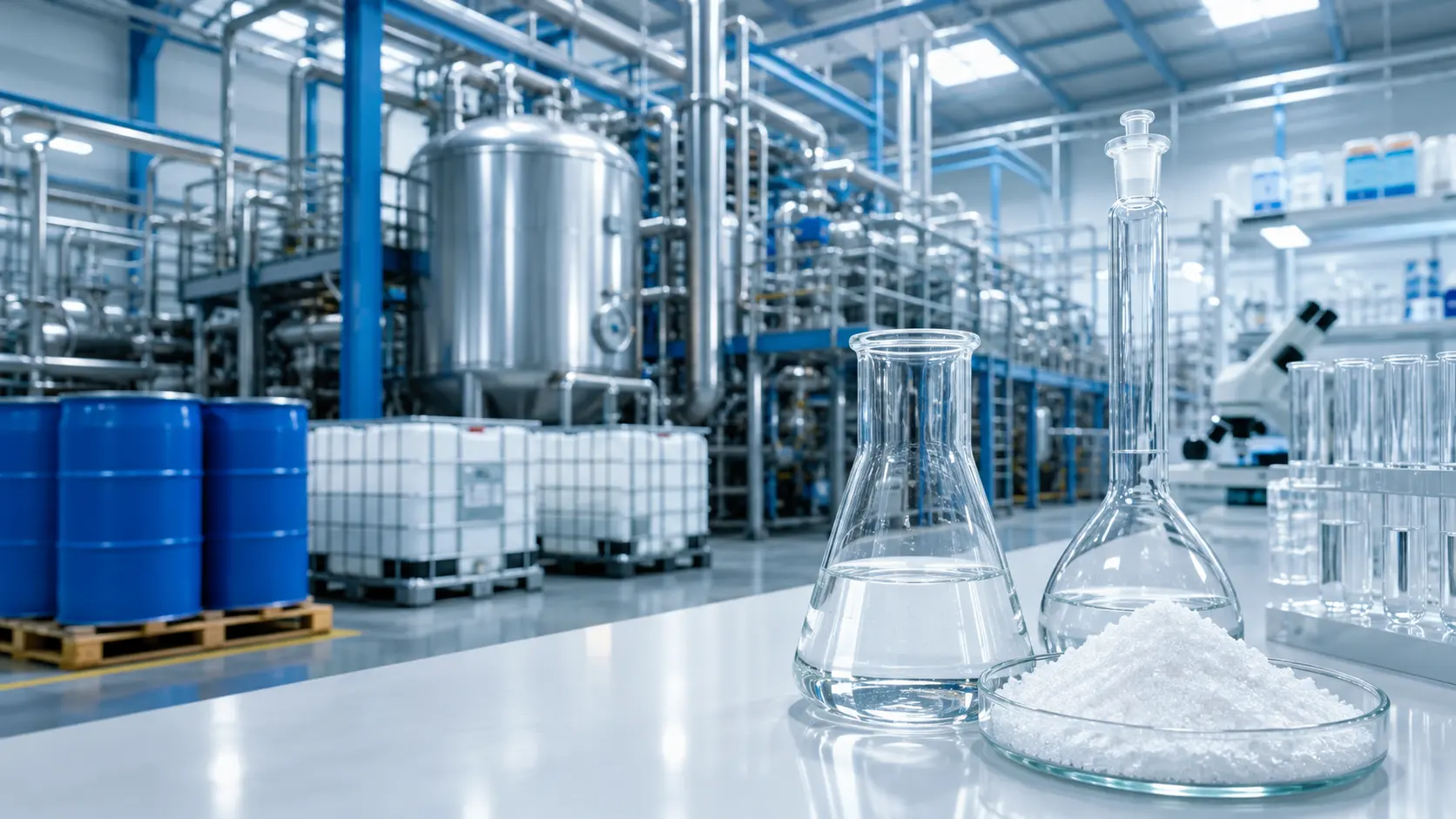
That makes sense.
Buying directly from a factory can mean better pricing, clearer quality control and easier communication when technical questions come up. But there is one thing worth saying first: having a factory does not automatically mean the product is better.
A reliable potassium formate factory is really about how well the production process is controlled.
For industrial customers, the important question is not only:
“Can you produce potassium formate?”
It is:
“Can you produce the same potassium formate quality every time?”
That second question is much more important when the material is going into oilfield fluids, refrigeration systems, deicing formulations or other industrial processes.
What Does a Potassium Formate Factory Actually Produce?
Potassium formate, chemical formula HCOOK, CAS 590-29-4, is normally supplied in two common industrial forms:
- Concentrated potassium formate solution
- High-content solid potassium formate
A 75% liquid solution is convenient for customers that already use pumps, tanks and liquid blending systems.
Solid potassium formate is often preferred when the buyer wants to prepare the final concentration locally or reduce the amount of water being transported.
The two products may come from the same manufacturer, but the production and handling requirements are not exactly the same.
| Factor | 75% Potassium Formate Solution | High-Content Solid |
|---|---|---|
| Product form | Concentrated liquid | Crystalline solid |
| Handling | Pumps and tanks | Dry material handling |
| Local dissolution | Usually not needed | Required |
| Freight efficiency | Lower active content per ton | Higher active content |
| Storage | IBC or tank | Dry warehouse |
| Main concern | Concentration and crystallization | Moisture and caking |
A serious factory should understand these differences clearly.
Raw Materials Come First
Most buyers pay attention to the finished product.
The factory has to start earlier than that.
Raw-material quality can influence:
- Chloride
- Iron
- Color
- Insoluble matter
- Final concentration
- Batch consistency
If raw materials change too much, the finished product can also move outside the normal range.
This is why incoming raw-material inspection is important.
A well-managed factory should not simply receive a truckload of material and send it directly into production without checking anything.
At least basic incoming QC should be done according to the factory's internal control plan.
It sounds like a small detail, but it tells you quite a lot about how the manufacturer works.
Production Control Is More Important Than Factory Size
Buyers often ask:
How large is your factory?
or:
What is your annual production capacity?
Both are reasonable questions.
But a big factory can still produce inconsistent material.
Production control matters more.
A simplified potassium formate production process may look like this:
Raw materials
→ reaction
→ concentration adjustment
→ purification
→ filtration
→ quality testing
→ packaging
→ warehouse release
Every stage has something that can go wrong.
For example, if filtration is poor, insoluble matter may be higher.
If concentration control is unstable, density may change from batch to batch.
If tanks or pipelines are not properly maintained, iron contamination may increase.
That is why a factory should not be judged only by how many reactors you can see in a photo.
Concentration Control Matters for Liquid Product
For 75% potassium formate solution, concentration is one of the main quality points.
It influences:
- Density
- Viscosity
- Dilution calculations
- Storage behavior
- Final formulation
A typical 75% potassium formate solution has a density around 1.57–1.58 g/cm³, depending on temperature and exact concentration.
The temperature part is important.
Density measured at 20°C should not be compared directly with a value measured under different conditions without checking the reference.
This is one of those small technical details that good factories normally understand very well.
A buyer can also use density as a quick incoming QC check, but laboratory assay is still useful when concentration accuracy is important.
Solid Potassium Formate Has Different Quality Problems
Solid potassium formate looks easier to handle at first.
No liquid tanks. No pumps. No IBC valves.
But it has its own problems.
Potassium formate is hygroscopic, which means it can absorb moisture from the air.
If storage or packaging is poor, the material may:
- Become damp
- Cake
- Become harder to handle
- Show changes in apparent weight or condition
That doesn't necessarily mean the chemical has become unusable, but it does make handling more difficult.
So a factory producing solid potassium formate should pay attention to moisture-resistant packaging and proper warehouse conditions.
What Should the Factory Test?
For industrial orders, buyers should ask which parameters are tested for each batch.
Common items include:
| Test Item | Why It Matters |
|---|---|
| Assay / concentration | Confirms active potassium formate |
| Density | Important for liquid QC |
| pH | Affects downstream formulation |
| Chloride | Important in corrosion-sensitive systems |
| Iron | Indicates metallic contamination |
| Insoluble matter | Important for clear fluid applications |
| Appearance | Quick visual check |
| Moisture | Important for solid grades |
Not every customer needs exactly the same limits.
An oilfield customer may have stricter requirements than a general industrial customer.
The important thing is that the factory can explain what it tests and how the results are controlled.
COA Should Match the Real Batch
This sounds obvious, but it's worth checking.
A proper Certificate of Analysis should correspond to the actual batch being shipped.
The process should normally look something like this:
- Production batch is completed.
- A batch number is assigned.
- A representative sample is taken.
- The laboratory performs testing.
- The results are reviewed.
- The batch is approved for shipment.
- The COA shows the same batch information.
This creates traceability.
If a customer reports a problem later, the manufacturer can go back to the production and QC records.
Without traceability, everyone is basically guessing.
Factory Cleanliness Is Not Just About Appearance
Potassium formate is an industrial chemical, so nobody expects a pharmaceutical clean room.
Still, production cleanliness matters.
Rust, dust, old product residue and cross-contamination can increase:
- Iron
- Insoluble matter
- Color
- Foreign particles
If you ever visit a potassium formate factory, don't only look at the main production equipment.
Take a look at:
- Pipelines
- Storage tanks
- Filters
- Filling area
- Packaging area
- Warehouse
These areas often tell you more about everyday factory management than the reception room does.
Packaging Should Be Part of Factory QC
A good product can still arrive in poor condition if packaging is bad.
For liquid potassium formate, check:
- IBC condition
- Valve sealing
- Cap sealing
- Net weight
- Pallet condition
- Label information
For solid potassium formate, check:
- Inner liner
- Moisture protection
- Bag sealing
- Pallet wrapping
- Warehouse humidity
Factories that export regularly usually pay more attention to this because international transport can be rough.
A package may be moved several times before reaching the final customer.
Can the Factory Handle Repeat Orders?
This becomes very important once the first trial order works.
A factory may easily produce 20 tons.
What happens when the customer later needs 100 tons per month?
Before starting a long-term supply relationship, buyers can ask:
- What is normal monthly output?
- What is peak-season lead time?
- Is there finished-product stock?
- How are raw materials secured?
- What happens during equipment maintenance?
- Can production be scheduled for contract customers?
You don't need the factory to promise unlimited capacity.
In fact, a supplier that says “no problem” to every volume is sometimes more worrying than reassuring.
Realistic planning is better.
Factory vs Trading Company
A common question is whether buyers should purchase directly from a factory.
There is no simple answer.
A factory may offer:
- Closer production communication
- Better batch traceability
- More direct technical support
- Better pricing for large orders
A trading company may offer:
- Smaller minimum order
- Faster local service
- Mixed product sourcing
- Flexible payment or logistics
Both models can work.
The real issue is whether the supplier can control quality and solve problems when something goes wrong.
Questions Worth Asking a Potassium Formate Factory
Before confirming a large order, I would ask questions like:
- Which potassium formate grades do you normally produce?
- Which parameters are tested for every batch?
- Can you provide a recent COA?
- How is chloride controlled?
- How is insoluble matter tested?
- How are liquid products stored?
- How is solid material protected from moisture?
- How long are batch samples retained?
- Can the batch be traced back to production records?
- What is your normal production lead time?
The answers don't need to be complicated.
Actually, clear and simple answers are often a good sign.
Frequently Asked Questions
What is a potassium formate factory?
It is a manufacturing facility that produces potassium formate in liquid, solid or both forms for industrial applications.
Is buying directly from a factory always cheaper?
Not always. Order size, freight, payment terms and export service can affect the final price.
What is the common liquid potassium formate grade?
75% solution is a common concentrated industrial grade.
Can a factory produce solid potassium formate?
Yes. High-content solid potassium formate is commonly supplied for local dissolution and industrial formulation.
Why is chloride important?
Trace chloride can matter in corrosion-sensitive oilfield, refrigeration and other industrial systems.
Why should I check insoluble matter?
High insoluble matter can increase filtration load and contribute to deposits.
Should every batch have a COA?
For professional industrial supply, a batch-specific COA is strongly recommended.
Does factory size guarantee quality?
No. Process control and QC discipline are more important than factory size alone.
Can potassium formate solution crystallize during storage?
Yes, concentrated solution may crystallize under unsuitable low-temperature storage conditions.
Is solid potassium formate sensitive to humidity?
Yes. It is hygroscopic and should be protected from moisture.
Should I visit the factory before ordering?
For large or long-term contracts, a factory audit can be useful, but good documentation and sample testing can also provide valuable information.
What is the most important thing to check in a factory?
For long-term purchasing, I would say batch consistency.
A factory that can produce the same specification repeatedly is usually much more valuable than one that only produces one impressive sample.
Final Thoughts
A good potassium formate factory is not just a place with production equipment.
It is a complete system involving raw materials, production control, laboratory testing, packaging and traceability.
For buyers, the best factory is usually not the one with the biggest number on its brochure.
It is the one that can produce the right specification, provide a real batch COA, package the product properly and then repeat the same quality on the next order.
That's what makes industrial purchasing easier.
And once a supplier reaches that level, the relationship normally becomes much simpler too.


Contact Us
In This Article
Related Posts
Индивидуальные упаковочные решения от поставщика безводного ацетата натрия в Китае
2026-09-23
Тенденции применения безводного ацетата натрия для специального химического производства
2026-09-23
Безводный ацетат натрия для дубления кожи: улучшает равномерность окрашивания
2026-09-22
Formic Acid 85% for Animal Feed Preservation: Moisture and Storage Stability Guide
2026-09-21


