



Formic Acid 85% for Leather Tanning: Pickling pH Control and Acid Penetration
By Vanchorsc
2026-09-21Related Posts
Индивидуальные упаковочные решения от поставщика безводного ацетата натрия в Китае
2026-09-23
Тенденции применения безводного ацетата натрия для специального химического производства
2026-09-23

Безводный ацетат натрия для дубления кожи: улучшает равномерность окрашивания
2026-09-22
Formic Acid 85% for Animal Feed Preservation: Moisture and Storage Stability Guide
2026-09-21
At Vanchor, we supply Formic Acid 85% for Leather Tanning for leather pickling and process acidification. Its performance depends on how acid concentration, residual alkalinity, salt concentration and drum conditions work together.
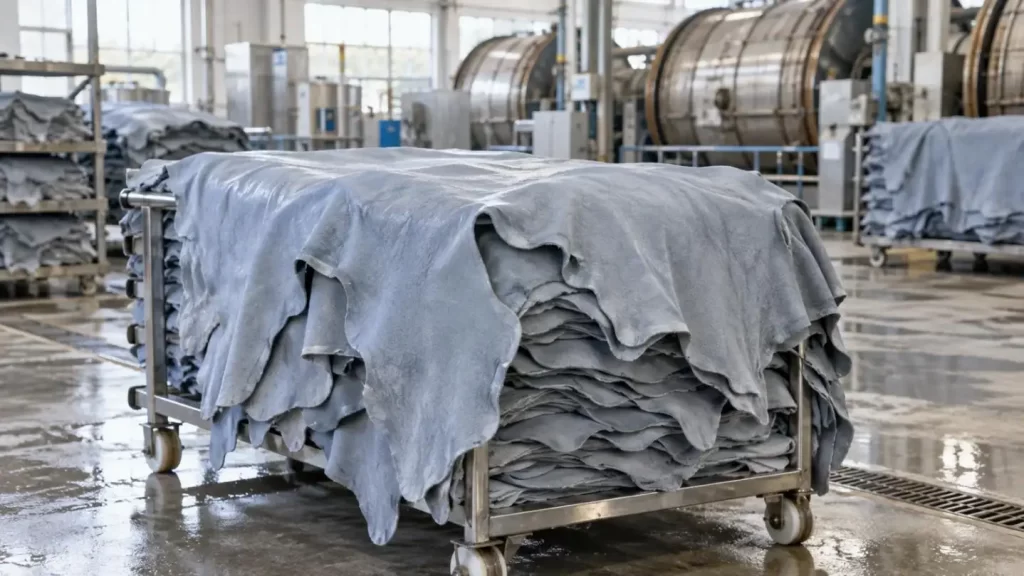
There is an important distinction to be made between bath pH and through-section acidification. Baths have been known to reach their desired pH despite pelt sections not being sufficiently acidified. Surface exposure while the problem of penetration remains unresolved can be a consequence of the indiscriminate addition of acid.
Before Changing Acid Dosage, Identify the Cause of Uneven Pickling
For most circumstances of conventional chrome tanning, evaluate both the incoming pelts and the distribution of acid.
| Problem Observed | Possible Causes | Approach To Be Followed Before Changing pH |
| Thick sections do not acidify uniformly | Remaining alkali, section thickness variations, short time of contact | Determine deliming uniformity in cross-sections |
| Bath pH drops slowly | Increased neutralization, wrong assay or delivery of acid | Examine pelts and the actual mass of acid |
| Swelling and damaging the grain occurs locally | Excessive contact of concentrated acid with the grain | Check the salt in the baths |
| Scaling causes deterioration, especially after the batch has been increased | Changes in the loading, turnover or dosing time | Check drum mixing and sampling in the production stage |
| One of the new suppliers may have an excess of active acid in its product and this may result in an increased rate of consumption | Changes in other steps which occur simultaneously | Compare, under controlled conditions, the effect of using a measured assay |
Damage caused to the grain should be investigated and should not be attributed automatically to unsuitable acid.
Understand Acid Demand, Diffusion and Swelling
Product Assay Does Not Define the Pickling Endpoint
The concentration in Formic Acid 85% for Leather Tanning identifies the commercial solution. It does not define the working-bath concentration or recommended percentage on pelt weight.
Active HCOOH mass = Delivered product mass × Measured HCOOH mass fraction.
Thus, 100 kg at 85.0% assay contains 85 kg HCOOH. Always state whether dosage percentages refer to delimed pelt weight or another agreed basis. For volumetric metering, apply density at the relevant temperature.
Residual Alkalinity Controls Demand; Thickness Influences Penetration
Formic acid can neutralize any remaining alkali and convert collagen to its ionized form. This means there will be:
• Limited inter-batch acid demand on individual pieces. However,
• Longer sections will have longer diffusion lengths.
• Poor mixing can result in the measured bath being uneven with uneven exposed local conditions.
• Conventional pickling is affected by the presence of salts in the bath.
A bath pH only measures the acidity of the bath. So, having a pH of 7.0 in two different baths does not guarantee equal pickling performance.
Compare Acid Systems Before Selecting the Dosing Program
When choosing Formic Acid 85% for Leather Tanning, retain the trade-offs between chemistry and process control.
| Alternatives | Technical Difference | Decision Requirement |
| Formic acid alone vs. formic–sulfuric blends | Different acidification profiles and chemical costs | Compare penetration, swelling and downstream tanning; avoid equal-mass substitution |
| Staged vs. continuous addition | Discrete mixing periods vs. sustained controlled feed | Verify local distribution and pump accuracy |
| Fixed recipe vs. pH-assisted dosing | Predetermined input vs. response to measured conditions | Apply dose limits and mixing delays; retain cross-section checks |
| Conventional salt vs. low-salt pickling | Established swelling control vs. reduced salt input | Validate the complete low-salt formulation |
| Conventional vs. low float | Different dilution and mechanical mixing conditions | Requalify addition rate, loading and temperature |
| 85% vs. higher concentration | Different active-acid and water inputs | Normalize cost and dosage by assay; check equipment compatibility |
Published tanning examples illustrate different acid combinations and operating sequences; they should be treated as specific process evidence rather than universal recipes. Tanning Process Examples
Match Formic Acid 85% to the Production Drum
Establish a Reproducible Batch Record
For Formic Acid 85% for Leather Tanning, record the variables needed to explain deviations:
• Pelts: Species, thickness range, weighing basis and deliming condition.
• Float: Added, retained and dilution water.
• Salt: Actual bath concentration, distinguished from addition percentage.
• Acid: Batch assay, delivered mass, dilution basis and addition schedule.
• Drum: Loading, operating program, temperature and mixing intervals.
• Inspection: pH sampling time, location and cross-section results.
Do not convert conductivity directly into sodium chloride concentration without validating the relationship in the actual mixed bath.
Revalidate Changes in Thickness or Float
A low-float recipe increases sensitivity to carried-over water and localized dosing. Likewise, a program validated on thinner skins cannot establish penetration time for thick bovine pelts.
Pickling prepares the pelt for chrome penetration. Subsequent basification promotes fixation; faster acidification does not automatically increase chromium uptake.
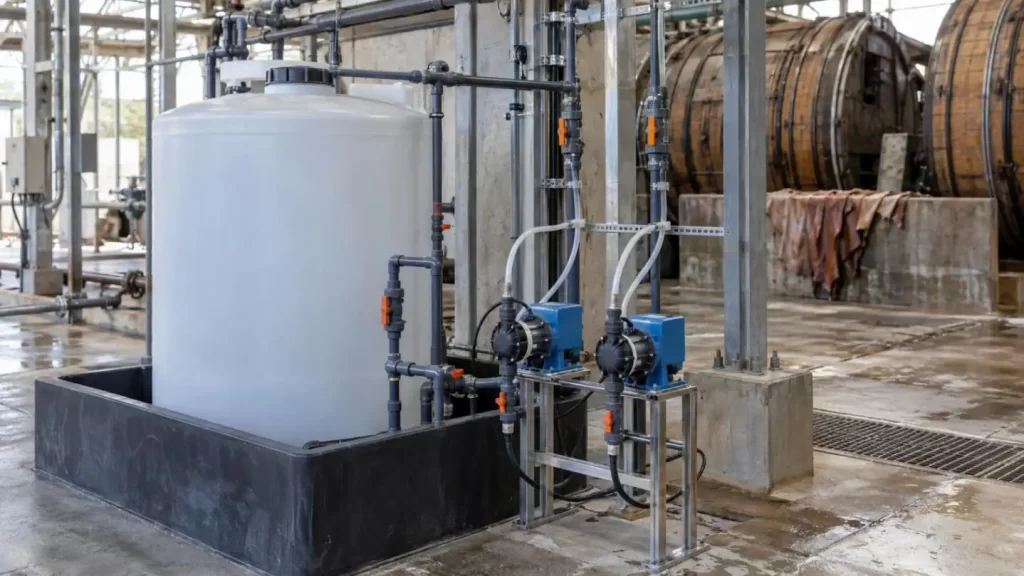
Install and Maintain Consistent Acid Delivery
Confirm pump heads, seals, hoses and storage materials against compatibility data for the actual concentration and temperature.
The dosing arrangement should provide:
• Controlled dilution under the current SDS and site procedure.
• An addition point supporting rapid dispersion.
• Protection against siphoning or uncontrolled flow.
• Representative pH measurement away from the acid stream.
• Maximum-dose limits and appropriate mixing delays.
Check delivered pump mass against its setting, inspect connections, and clean and calibrate probes. A drifting electrode can trigger unnecessary acid addition. Concentrated formic acid remains hazardous despite its classification as a weak acid.
Verify the Endpoint with the Correct Test
Combine bath records with cross-section inspection at representative thick locations. Indicator staining offers a qualitative assessment within its transition range, not a precise internal pH map.
ISO 4045 measures aqueous leather-extract pH and difference figure; it does not prescribe an online pickling endpoint. ISO 4045
Verify subsequent chrome penetration and agreed leather properties. Review ZDHC product evidence, LWG facility status and management-system certificates within their respective scopes.
Purchase Formic Acid 85% Against Verified Requirements
Our 85% specifications include clear and colorless water-soluble HCOOH with a CAS number 64-18-6. The COA and SDS are available and have packaging of either 250 kg drums or 1,200 kg IBCs for flexible packaging.
Our manufacturing capacity includes a 50,000 m² facility and 20,000 tons of annual production for formic acid. The supply capacity fulfills a part of the customer need while application qualification continues.
Factors to analyze in order to reach an agreement: assay limits, relevant impurities, acceptable analytical techniques, retained samples, and the acceptance of trials. Cost of active acid versus loss of time consuming processing, discards, and wastewater treatment.
Leather tanning, we suggest 85 percent Formic acid. Vanchor, include qualities, and specifications pertinent to the pelts along with your acceptance criteria for closing specifications and sample approval for the bulk purchase.
FAQs
Q1. Does Vanchor Supply Formic Acid 85% for Leather Tanning?
Yes. Vanchor supplies Formic Acid 85% for leather pickling and pH adjustment before tanning. Application suitability should be confirmed against your pelt characteristics, acid system and production conditions.
Q2. What Are the Main Specifications of Vanchor’s Formic Acid 85%?
Vanchor offers an 85% concentration, chemical formula HCOOH and CAS number 64-18-6. The product is a clear, colorless liquid miscible with water. Confirm the contractual assay range and relevant impurity limits before ordering.
Q3. Can Vanchor Provide a COA and SDS?
Yes. Vanchor provides COA and SDS documents upon request. Request the batch-specific COA for quality assessment and the applicable SDS for handling, storage and transport information.
Q4. What Packaging Options Does Vanchor Offer?
Listed options include 25 kg, 35 kg and 250 kg plastic drums, plus 1,200 kg IBCs. ISO tank shipments may be arranged for suitable bulk orders, subject to shipping approval. Confirm availability for your destination and unloading facilities.
Q5. Can Buyers Request Samples Before Bulk Purchasing?
Yes. Vanchor offers samples. Confirm availability, quantity and shipping arrangements, then evaluate the sample under representative pickling conditions before approving bulk supply.


Contact Us
In This Article
Related Posts
Индивидуальные упаковочные решения от поставщика безводного ацетата натрия в Китае
2026-09-23
Тенденции применения безводного ацетата натрия для специального химического производства
2026-09-23
Безводный ацетат натрия для дубления кожи: улучшает равномерность окрашивания
2026-09-22
Formic Acid 85% for Animal Feed Preservation: Moisture and Storage Stability Guide
2026-09-21


