



Chemical Pre-Shipment Inspection Checklist for Bulk and Packaged Orders
By Tonmoy
2026-09-12Related Posts
Индивидуальные упаковочные решения от поставщика безводного ацетата натрия в Китае
2026-09-23
Тенденции применения безводного ацетата натрия для специального химического производства
2026-09-23

Безводный ацетат натрия для дубления кожи: улучшает равномерность окрашивания
2026-09-22
Formic Acid 85% for Animal Feed Preservation: Moisture and Storage Stability Guide
2026-09-21
A chemical pre-shipment inspection should confirm that the shipment matches the agreed purchase order and specification before release. The core checks are:
- Chemical identity, grade or form, batch, and quantity
- Product evidence, including the applicable COA and sampling records
- Packaging condition, labels, seals, and traceability
- SDS and other shipment documents for the exact product
- Bulk loading or packaged-order readiness
- Inspection findings, corrective actions, and final release status
The exact checklist must be adapted to the chemical, grade or form, package type, transport mode, destination, purchase contract, and agreed inspection plan. A generic checklist cannot establish every chemical’s acceptance criteria or regulatory requirements.
Start with the release-gate checklist

Use the following checkpoints as a practical framework. The “evidence required” column is as important as the physical inspection itself: a shipment should not be released solely because the packaging appears acceptable.
| Release checkpoint | Evidence to review | Bulk-order focus | Packaged-order focus | Hold condition |
|---|---|---|---|---|
| Order and specification | Purchase order, contract, approved specification | Confirm product and quantity basis | Confirm product, package type, and package count | Shipment cannot be matched to the approved order |
| Identity and grade/form | Product markings, batch records, specification | Confirm the material transferred or loaded is the ordered chemical | Match package markings to the ordered chemical | Identity, grade, or form is unclear |
| Batch and quantity | Batch records, quantity record, weighing or measurement record | Verify the agreed bulk measurement basis | Reconcile package count and recorded weights | Quantity or lot traceability is incomplete |
| Product evidence | COA, sample record, agreed test results | Confirm sample represents the inspected bulk lot | Confirm sample and COA correspond to the package lot | Evidence does not match the inspected lot |
| Packaging and labels | Packaging specification, photographs, labels, seal record | Check vessel, tank, IBC, or transfer arrangement as applicable | Check bags, drums, IBCs, closures, markings, and damage | Leakage, damage, missing identification, or incorrect packaging |
| Shipment documents | SDS, invoice, packing list, inspection report, applicable transport documents | Match bulk quantity and loading records | Match package count, lot, and marks | Documents conflict with the physical shipment |
| Loading and release | Loading record, seal record, inspection report | Confirm loading evidence and seal details where required | Confirm shipment is ready for dispatch | Open discrepancy has no approved disposition |
Industrial inspection services commonly describe pre-shipment inspection as a conformity check covering areas such as quantity, packing, loading, documentation, and reporting. These checks should remain tied to the buyer’s agreed requirements rather than treated as a universal chemical standard. TÜV Rheinland’s pre-shipment inspection overview provides a general industrial reference for this scope.
Prepare the inspection against the correct order and specification
Before the inspection begins, define what the shipment must conform to. The inspection team should work from the latest approved documents, not from an informal product description or an outdated quotation.
Confirm the following:
- Purchase order and contract reference
- Exact chemical identity
- Agreed grade or form
- Applicable assay, concentration, active-content, or other specification basis
- Package type and quantity
- Batch or lot identification requirements
- Required product tests and test methods
- Required documents
- Inspection timing and sampling arrangement
- Release, hold, correction, and reinspection procedure
The inspection criteria should be based on the purchase order, contract, approved specification, packaging requirements, and applicable destination or transport requirements. If the buyer expects an independent laboratory test, that requirement should be agreed before shipment preparation rather than assumed after the goods are loaded.
Inspection should take place when representative goods are available and before shipment release. However, there is no single timing rule that applies to every chemical order. Bulk transfer, packaged production, sampling availability, and the contract’s inspection plan may all affect the appropriate timing.
For broader sourcing controls, buyers can review the chemical procurement from China process separately from this final shipment inspection stage.
Verify chemical identity, grade, batch traceability, and quantity
A visual inspection cannot confirm that the correct chemical was supplied. Product identity and traceability must be checked across the physical shipment and its records.
Chemical identity and grade/form
Match the following wherever they appear:
- Product name
- Exact chemical form
- Grade designation
- Batch or lot number
- Package or bulk-unit marking
- Purchase-order reference
- Applicable specification reference
Preserve distinctions such as solid versus solution, hydrate versus anhydrous form, and concentration basis. Do not treat a product name alone as sufficient identification when different grades or forms may exist.
The inspection record should state which product and lot were examined. It should not use a generic description such as “industrial chemical” when the purchase order identifies a more specific chemical or grade.
Batch and lot traceability
Confirm that the batch or lot number on the product matches:
- The COA or batch record
- Sample labels
- Package markings or bulk records
- The inspection report
- Photographs or other inspection evidence
If a sample is collected, its label should identify the inspected lot and the date of sampling. A test result from a different batch cannot be used as direct evidence for the inspected shipment.
Quantity verification
Quantity must be verified using the basis agreed in the purchase order. Depending on the transaction, that may involve package count, net mass, gross mass, volume, or another documented measurement basis.
Do not interchange:
- Gross and net quantity
- Mass and volume
- Product-as-supplied quantity and active content
- Weight percentage and volume percentage
- Package count and confirmed chemical quantity
For bulk chemicals, the measurement method, equipment, records, and acceptable tolerance should be agreed in advance. The checklist should not prescribe one universal gauging, weighing, or transfer method for all bulk shipments.
For packaged orders, reconcile the number of bags, drums, IBCs, or other units with the packing list and inspection record. Any unexplained difference should be recorded before release.
Check product evidence, sampling, and acceptance criteria
Product evidence should be linked to the exact chemical, grade or form, and inspected batch.
COA verification
Check that the COA, where required, corresponds to:
- The exact product identity
- The ordered grade or form
- The inspected batch or lot
- The stated specification
- The relevant units
- The reported test methods or basis
- The issuing party and document reference
A COA is batch-linked evidence. It should not automatically be presented as universal product approval, regulatory approval, or proof of suitability for a particular application.
The buyer should also confirm which properties are required for release and which test methods apply. Without an agreed specification and method, the presence of a COA does not by itself define whether the shipment conforms.
Sampling and laboratory testing
Sampling should follow the approved inspection-test plan. The plan should define, where relevant:
- Which lots or units are sampled
- Where samples are taken
- How samples are identified and sealed
- Which properties are tested
- Which method is used
- Which acceptance limits apply
- Who reviews the result
- What happens if results are inconclusive or nonconforming
General pre-shipment inspection guidance often discusses random sampling and AQL-based approaches. Those concepts should not be treated as automatically suitable for every chemical shipment. Chemical risk, product uniformity, package configuration, contract requirements, and the purpose of testing all affect the appropriate method.
Do not insert a universal AQL value, sample size, or acceptance percentage unless it has been established for the exact order and inspection plan.
Vanchor’s procurement-page material has described possible activities such as product sampling and independent laboratory testing, but those statements should be understood as site-stated process context rather than a guarantee that every order receives every activity.
Use separate checks for bulk and packaged chemical orders
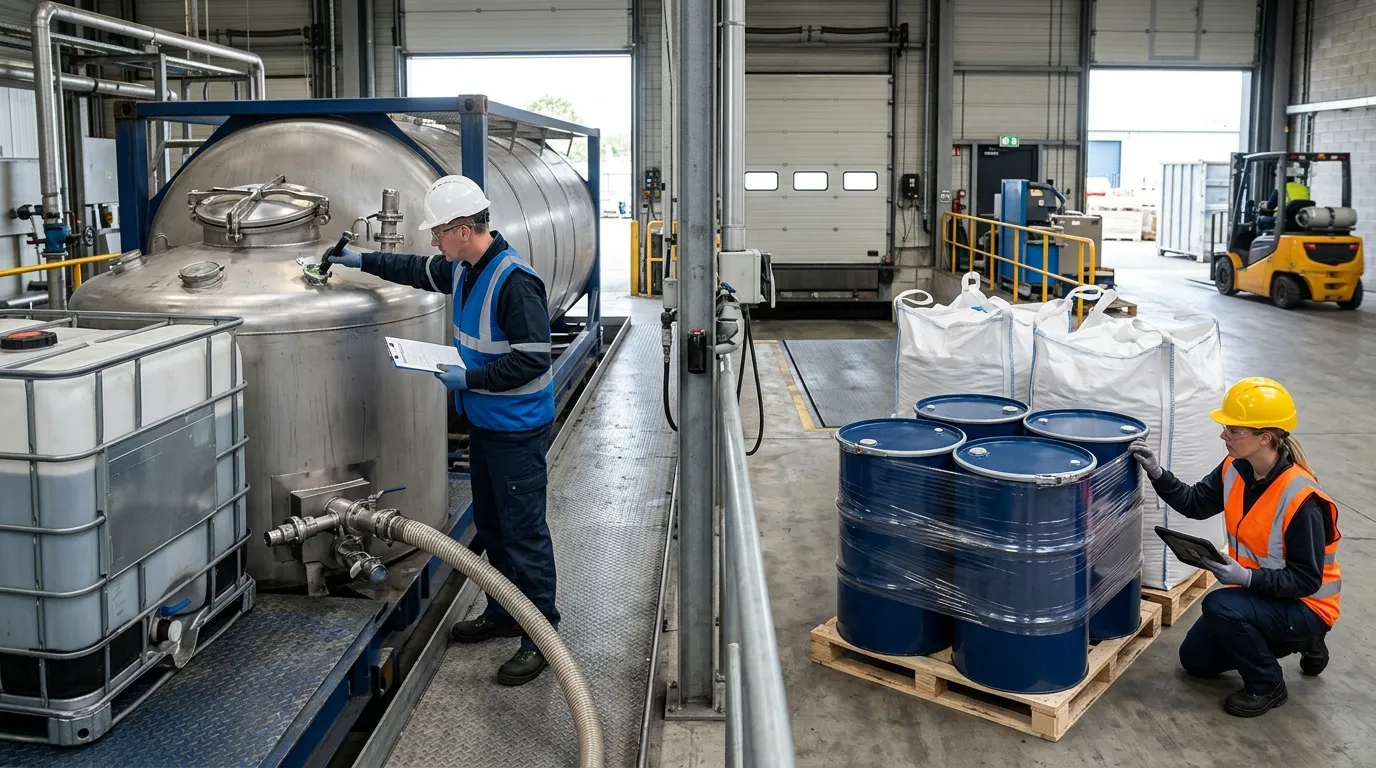
Bulk and packaged shipments share several control points, but the physical inspection priorities are different.
| Checkpoint | Bulk chemical order | Packaged chemical order |
|---|---|---|
| Quantity | Verify the agreed measurement basis and supporting record | Reconcile unit count, recorded weights, and packing list |
| Traceability | Link the bulk quantity or transfer record to the batch or lot | Match each package group or pallet to its lot markings |
| Physical unit | Inspect the applicable tank, vessel, IBC, or transfer arrangement | Inspect bags, drums, IBCs, closures, pallets, or other specified units |
| Sampling | Confirm that the sample represents the agreed bulk lot | Confirm that samples are traceable to the selected package lot |
| Packaging condition | Check the agreed bulk containment and loading condition | Check leakage, damage, deformation, closure condition, and contamination indicators where relevant |
| Labels and marks | Verify bulk identification and required shipment marks | Verify product name, batch, quantity, handling marks, and shipping marks |
| Loading evidence | Review transfer or loading records and seal details where required | Review loading records, package count, and seal details where required |
| Release record | Record quantity, batch, loading, and inspection evidence together | Record package count, lot, condition, photographs, and document matches |
Additional checks for bulk orders
For a bulk order, define the measurement and transfer procedure before inspection. The checklist may need to identify:
- The bulk container or transport unit
- The inspected chemical and batch
- Quantity basis and measurement record
- Transfer or loading record
- Sampling location and sample identification
- Condition of the applicable containment system
- Seal number and photographs where required
The exact procedure depends on the chemical, equipment, transport mode, and contract. Do not assume that the same measurement or sampling method applies to liquid, solid, or solution products.
Additional checks for packaged orders
For packaged orders, verify:
- Number of packages
- Package type and size
- Package closures
- Visible damage or leakage
- Package and pallet identification
- Batch or lot markings
- Net and gross quantity records
- Required labels and shipping marks
- Seal or wrapping condition where applicable
Packaging observations should be recorded against the approved packaging requirement. A package that looks intact may still have the wrong label, wrong lot, or wrong quantity record.
Verify packaging, labels, seals, and loading readiness
Packaging inspection connects product conformity with transport readiness. Check the package or bulk unit against the approved order requirement, not against a generic assumption about chemical packaging.
Look for:
- Correct package type
- Correct package quantity or size
- Visible damage, leakage, or deformation
- Compromised closures
- Contamination or foreign material indicators
- Correct product and batch markings
- Required shipping marks
- Seal number, where a seal is part of the agreed inspection scope
- Photographic evidence of relevant conditions
Labels and marks should correspond to the exact product and supplied form. Dangerous-goods marks, handling labels, declarations, and other transport information depend on the chemical, transport mode, destination, and applicable jurisdiction. They should not be generalized across all chemical shipments.
A final loading check may confirm that the shipment is ready for dispatch, but it is not necessarily a complete container-loading inspection. For more detailed loading controls, refer to the chemical container loading inspection resource.
Vanchor material for one potassium-formate context mentions activities including packaging inspection, loading supervision, and seal verification. That is product-specific, site-stated information and should not be generalized to every Vanchor chemical order.
Reconcile the document set before shipment release
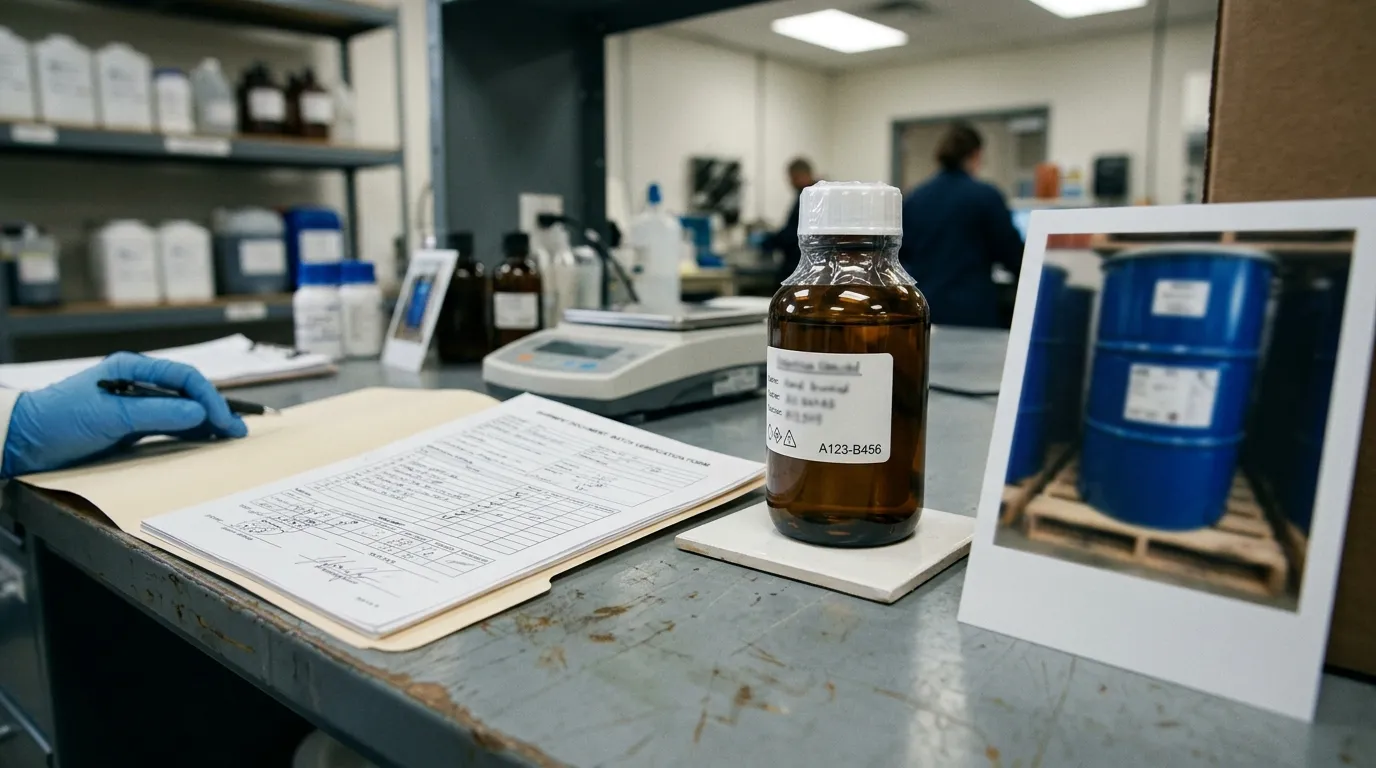
Document inspection should compare the paperwork with the physical shipment. Confirming that a file exists is not enough if its product name, batch, quantity, or form does not match the goods.
Depending on the order and destination, the document set may include:
| Document or record | Match against | Inspection question |
|---|---|---|
| Purchase order and invoice | Ordered product and quantity | Do the commercial details identify the correct shipment? |
| Packing list | Packages, marks, and quantity | Does the listed package count match the physical order? |
| COA | Product, grade/form, and batch | Does the COA correspond to the inspected lot? |
| SDS | Exact chemical and supplied form | Is the SDS applicable to the product being shipped and current for the intended use? |
| Inspection report | Physical findings and evidence | Are discrepancies, photographs, samples, and results recorded? |
| Quantity or loading record | Bulk or packaged shipment | Does the record support the stated quantity and loading status? |
| Seal record | Container or shipment identification | Does the recorded seal match the shipment? |
| Applicable transport or customs documents | Product, route, and jurisdiction | Are the required documents present for this shipment? |
Vanchor’s export-documentation material lists examples such as invoices, packing lists, SDS, COA, dangerous-goods declarations, and customs documents. These should be treated as site-stated examples, not as a universal document set for every chemical, route, or destination.
For a document-specific review, use the chemical export documentation checklist. Exact requirements remain dependent on the chemical, transport mode, destination, and current jurisdictional rules.
An SDS describes hazard and handling information for the applicable product and jurisdiction. It does not by itself establish food, feed, pharmaceutical, drinking-water, or formulation suitability.
Record findings and decide: release, hold, correction, or reinspection
A pre-shipment inspection is useful only when findings lead to a controlled decision. Use a defined workflow:
- Record the observation. Identify the product, batch or lot, package or bulk unit, location, document, and inspection date.
- Compare it with the requirement. State which purchase-order, specification, packaging, or document requirement applies.
- Classify the finding. Mark it as conforming, requiring correction, or unresolved.
- Place the shipment on hold when necessary. Hold release when identity, quantity, traceability, packaging, documentation, or loading condition cannot be reconciled.
- Document corrective action. Identify what must be corrected and who must provide evidence.
- Reinspect when required. Record the follow-up result and final disposition.
A useful inspection report should preserve, where applicable:
- Shipment and purchase-order reference
- Exact product identity and grade/form
- Batch or lot number
- Package or bulk-unit reference
- Quantity and measurement record
- Sample identification
- Test results or COA reference
- Photographs
- Document discrepancies
- Loading and seal information
- Final release, hold, correction, or reinspection status
The release decision should follow the agreed inspection procedure. There is no universal rejection threshold that can be applied to every chemical shipment.
Know what a pre-shipment inspection does not prove
A PSI confirms only what was inspected, against the requirements and evidence available at that time. It does not automatically prove:
- Universal product safety
- Regulatory approval in every destination
- Food, feed, pharmaceutical, drinking-water, or application suitability
- Conformity beyond the inspected lot, sample, time, and scope
- Product condition throughout subsequent transport
- In-house manufacturing by a supplier
- Current stock, future availability, or guaranteed supply
- Guaranteed process performance
Different documents answer different questions. An SDS is not a product approval certificate. A COA is not universal approval. A company management-system certificate is not automatically product certification. A catalog listing is not proof of in-house manufacture.
This distinction is particularly important when buyers use inspection as part of a broader chemical quality control process. PSI is one control point within procurement and quality assurance; it does not replace product qualification, regulatory review, application testing, or contract management.
Final pre-shipment release checklist
Before releasing a bulk or packaged chemical order, confirm that:
- The exact chemical identity matches the purchase order.
- The grade or form is correct.
- Batch or lot numbers are traceable across the shipment and documents.
- Quantity is verified using the agreed basis.
- The COA and sample records correspond to the inspected lot.
- Sampling and testing follow the approved inspection plan.
- Packaging matches the specified type and condition.
- Labels and shipping marks match the product and shipment documents.
- SDS and other required documents apply to the exact product and destination.
- Bulk loading or packaged-unit records are complete.
- Seal information is recorded where required.
- All discrepancies have a documented disposition.
- The inspection report states release, hold, correction, or reinspection status.
This checklist should be aligned with the exact purchase order, product documentation, inspection plan, package configuration, transport mode, and destination requirements before use.


Contact Us
In This Article
Related Posts
Индивидуальные упаковочные решения от поставщика безводного ацетата натрия в Китае
2026-09-23
Тенденции применения безводного ацетата натрия для специального химического производства
2026-09-23
Безводный ацетат натрия для дубления кожи: улучшает равномерность окрашивания
2026-09-22
Formic Acid 85% for Animal Feed Preservation: Moisture and Storage Stability Guide
2026-09-21


