



Calcium Formate for Cold Weather Concrete: Dosage, Mix Compatibility and Strength Control
By Vanchorsc
2026-09-20Related Posts
Индивидуальные упаковочные решения от поставщика безводного ацетата натрия в Китае
2026-09-23
Тенденции применения безводного ацетата натрия для специального химического производства
2026-09-23

Безводный ацетат натрия для дубления кожи: улучшает равномерность окрашивания
2026-09-22
Formic Acid 85% for Animal Feed Preservation: Moisture and Storage Stability Guide
2026-09-21
Selecting Calcium Formate for Cold Weather Concrete requires more than choosing an addition rate. The mix must retain its placement window, develop sufficient early strength and satisfy later-age performance requirements under the actual curing temperature.
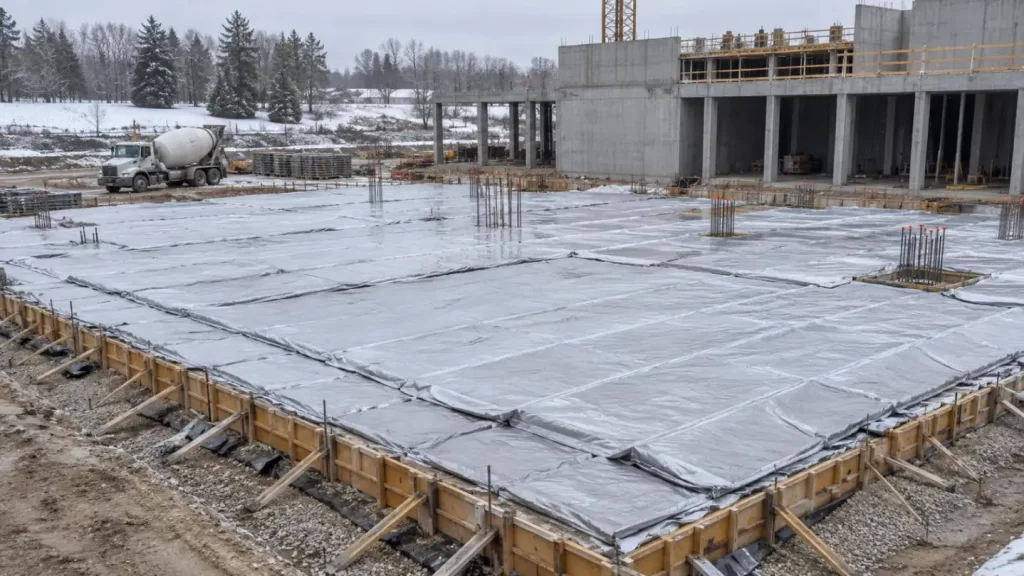
At Vanchor, we supply construction calcium formate with a assay of ≥98%. For mix design, that specification supports material selection; the working dosage must be established using the project’s cement, supplementary cementitious materials (SCMs) and admixtures. Vanchor Product Specifications
1. Define the Required Strength Before Selecting the Dosage
A winter mix should have measurable acceptance criteria:
• Placement: Required slump after transport and pumping.
• Finishing: Acceptable bleeding and setting times.
• Production: Specified stripping strength and achievement time.
• Protection: Concrete temperature and strength conditions for withdrawing insulation.
• Acceptance: Specified later-age strength and durability.
Record ambient, discharge, placement and in-place temperatures. Thin sections and exposed corners may cool faster than the locations used for routine measurements.
When concrete remains workable but misses stripping strength, investigate strength development. When it stiffens before placement, investigate dosage, temperature, admixture compatibility and delivery time.
2. Distinguish Accelerated Hydration from Protection Against Freezing
Calcium Formate for Cold-Weather Concrete has the ability to promote early cement hydration, but that result is highly dependent on the binder chemistry and temperature. Stiffening and the onset of compressive strength may not happen simultaneously, and advancement of stiffening does not ensure strength sufficient to carry load.
The governing relationship is:
Dosage × Binder Composition × Temperature History → Workability and Strength Development.
Higher dosage does not necessarily produce a proportionate strength increase. It may shorten the placement window without delivering the required production benefit.
Accelerators also do not eliminate freezing risk or replace protected curing. NRMCA’s 3.5 MPa early-freezing protection reference must not be treated as a universal stripping, loading or repeated freeze–thaw criterion. NRMCA Cold Weather Guidance
3. Compare Alternatives at Equivalent Performance
Evaluate Calcium Formate for Cold Weather Concrete against alternatives using the same temperature conditions and required strength deadline.
| Technical Comparison | Principal Trade-Off | Decision Criterion |
| Calcium formate vs calcium chloride | Acceleration and cost versus chloride restrictions | Reinforcement, prestressing and total chloride limits |
| Calcium formate vs other non-chloride accelerators | Different setting, strength and compatibility responses | Concrete trials at project temperature |
| Raw calcium formate vs formulated accelerator | Formulation flexibility versus packaged performance support | Plant capability and validation responsibility |
| Accelerator addition vs binder adjustment | Dosage change versus cement/SCM redesign | Early strength, durability and approval requirements |
| Higher dosage vs improved insulation | Chemical cost versus reduced heat loss | Time to target strength and total operating cost |
| Powder dosing vs pre-dissolution | Dry-feed control versus solution preparation | Dispersion, water accounting and equipment reliability |
Do not compare liquid blends and concentrated powders at equal commercial-product mass. Compare validated consumption per cubic metre.
4. Establish a Dosage Window for the Actual Binder
State the Calculation Basis
Every dosage should identify:
• Cement mass or total cementitious-material mass.
• Commercial-product mass or active calcium formate mass.
• Dry-basis or as-received assay.
For 350 kg/m³ binder, an illustrative 1.0% active dosage and 98% as-received assay:
Commercial product = 350 × 0.01 ÷ 0.98 = 3.57 kg/m³.
This demonstrates calculation only. It is not a recommended field dosage. Dry-basis assay requires moisture correction.
Test Compatibility and Performance Together
For Calcium Formate for Cold Weather Concrete, establish a control and multiple dosage levels within a supplier-supported trial range.
| Test Area | Measurements | What the Results Resolve |
| Fresh concrete | Initial and delivery-time slump, bleeding, air content | Placement and finishing suitability |
| Setting | Initial and final set under defined temperature | Available construction window |
| Early strength | Project-critical ages and time to release strength | Stripping or production scheduling |
| Later performance | 7- and 28-day strength; longer ages where needed | Retained strength development |
| Compatibility | PCE, air entrainer, cement and SCM combinations | Formulation sensitivity |
| Thermal response | Surface and internal temperature histories | Transferability to actual sections |
Maintain the specified water–binder ratio. Account for aggregate moisture and solution water; uncontrolled water addition to restore slump undermines the comparison.
Cement-source changes, revised SCM proportions or different admixture formulations require renewed compatibility assessment. Net-paste or mortar results alone cannot approve structural concrete.
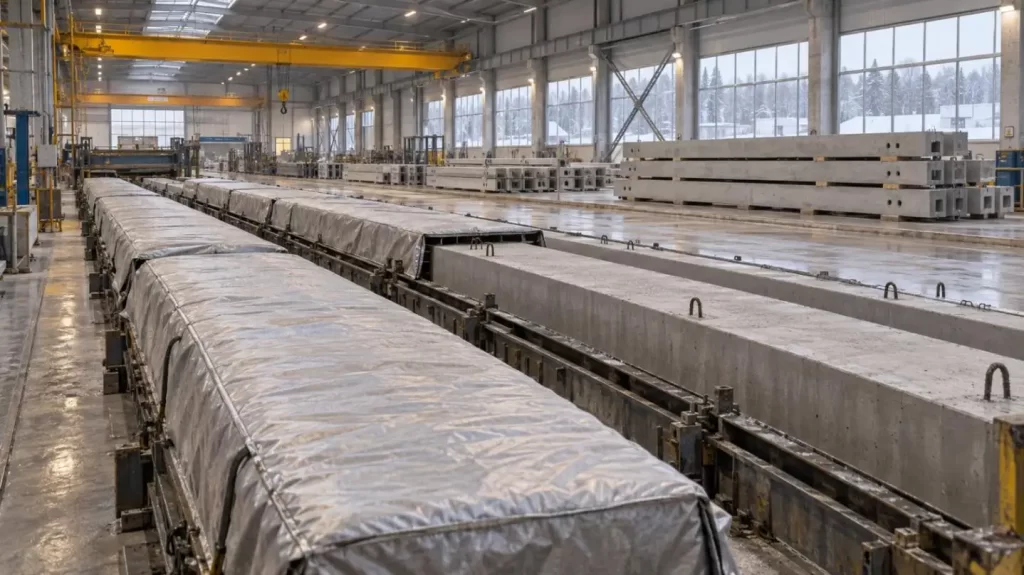
5. Repeatability in Dosing and Curing
Powder needs to be accurately weighed and dispersed properly so that successful powder addition can occur. Powder needs to be stable in various concentrations, temperatures, and storage conditions for pre-dissolution.
Production controls shall include the following:
• Verification that powder feeders do not have build-up, bridging, or excess moisture.
• Verification that the addition of the powder is sequenced correctly with respect to the other admixtures.
• Removal of pre-dissolution water from the total batch water.
• Prior preparation of contact surfaces with no ice and the proper conditions.
• Maintenance of control sensors, insulation, and heating systems.
• Gradual removal of protection (covers & shields) under approved release criteria.
A plant trial should reproduce transport, pumping and overnight protection conditions before routine production.
6. Verify the Evidence Used for Release
A COA verifies raw-material characteristics; it does not establish accelerator classification or concrete performance.
ASTM C494/C494M identifies Type C accelerating and Type E water-reducing/accelerating admixtures. Compliance requires applicable performance evidence. ASTM C494/C494M
Follow your given methods for setting, strength, slump, and air testing. User appropriate specifications for winter construction. Estimates for maturity must be calibrated for your mixture and mix design before they can be used.
Discern between standard-cured acceptance specimens and evidence of in-place stripping or loading. Evaluate the durability of each exposure while maintaining the first strength assessment.
7. Specify Calcium Formate by Batch Quality and Installed Cost
Our construction grade is Ca(HCOO)₂, CAS 544-17-2, ≥98% assay. Vanchor offers customized purity and packaging, which can help meet the needs of the particular customer and plant.
For Calcium Formate for Cold Weather Concrete, request assay basis, moisture, chloride and insoluble limits, COA, TDS, SDS and batch traceability. "Non-chloride" chemistry does not guarantee no chloride impurities.
Compare validated dosages, delivered prices, heating costs, testing costs and time, and how quickly the sample will be approved and notified of a material change before a bulk supply agreement is made.
When you have Vanchor's binder and have a specific temperature and strength target, send our team the information. Based on that information, we can agree on documentation for a controlled production trial.
FAQs
Q1. What calcium formate specification does Vanchor list for construction applications?
Vanchor offers construction calcium formate with an assay of ≥98%, CAS number 544-17-2 and the chemical formula Ca(HCOO)₂. Confirm the assay basis and batch-specific results before calculating dosage. Vanchor Product Specifications
Q2. How should buyers determine the dosage of Vanchor calcium formate for cold weather concrete?
Establish the dosage through trials using the project’s cement, SCMs, admixtures and curing temperatures. Clearly specify whether the percentage refers to cement or total binder mass, and whether it represents commercial product or active calcium formate.
Q3. What project information should buyers send Vanchor before requesting a quotation?
Provide binder composition, binder content, water–binder ratio, expected concrete temperatures, transport duration and target strength deadline. Include estimated purchase volume, delivery destination and packaging requirements.
Q4. Can Vanchor calcium formate replace insulation or heated curing?
No. Calcium formate may support early hydration, but it does not remove the need for appropriate thermal protection. Establish curing and protection measures according to actual concrete temperatures and project requirements.
Q5. Can Vanchor calcium formate be used with PCE superplasticizers and air-entraining admixtures?
Compatibility must be confirmed for the specific combination. Test slump retention, setting time, air content and strength under project conditions before approving the mix for production.


Contact Us
In This Article
Related Posts
Индивидуальные упаковочные решения от поставщика безводного ацетата натрия в Китае
2026-09-23
Тенденции применения безводного ацетата натрия для специального химического производства
2026-09-23
Безводный ацетат натрия для дубления кожи: улучшает равномерность окрашивания
2026-09-22
Formic Acid 85% for Animal Feed Preservation: Moisture and Storage Stability Guide
2026-09-21


