



Acetic Acid Density vs Concentration: A Practical Conversion Guide for Buyers
By Tonmoy
2026-09-04Related Posts
Индивидуальные упаковочные решения от поставщика безводного ацетата натрия в Китае
2026-09-23
Тенденции применения безводного ацетата натрия для специального химического производства
2026-09-23

Безводный ацетат натрия для дубления кожи: улучшает равномерность окрашивания
2026-09-22
Formic Acid 85% for Animal Feed Preservation: Moisture and Storage Stability Guide
2026-09-21
An acetic acid density concentration chart is useful for estimating the mass or volume of an aqueous acetic acid solution—but only when the concentration basis, temperature, and units are defined.
For most industrial calculations, the practical reference is acetic acid concentration by mass percentage (wt% or w/w) versus solution density. Once density is known, you can estimate volume from mass or mass from volume:
- Mass = density × volume
- Volume = mass ÷ density
Reference values should be used for preliminary calculations. For batch release, formulation approval, custody transfer, or other specification-sensitive work, confirm the value against the applicable supplier TDS, product specification, or batch COA.
Acetic acid density concentration chart at 20°C
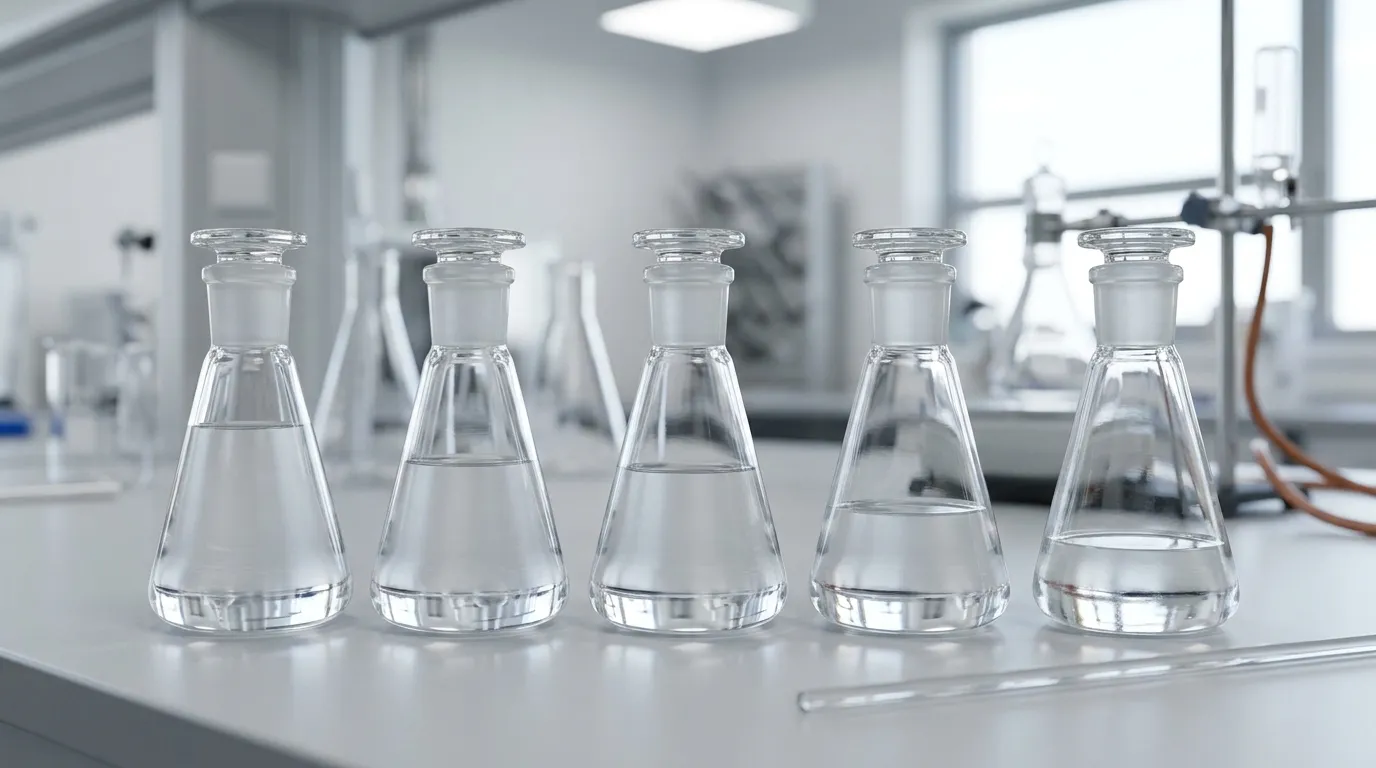
The following selected values are reported for aqueous acetic acid solutions at 20°C. Concentration is expressed as weight percent of acetic acid in the total solution, and density is shown in g/mL. A value in g/mL is numerically equivalent to the same value in g/cm³.
| Acetic acid concentration, wt% | Reference density at 20°C, g/mL |
|---|---|
| 1 | 0.9996 |
| 5 | 1.0052 |
| 10 | 1.0121 |
| 20 | 1.0250 |
| 30 | 1.0369 |
| 40 | 1.0474 |
| 50 | 1.0562 |
| 60 | 1.0673 |
These values are reference data for aqueous solutions, not a Vanchor product specification. The underlying table is available from Engineering ToolBox’s density reference for aqueous organic-acid solutions.
The chart shows the general relationship: adding acetic acid to water changes the solution density, but the change should not be treated as a simple linear conversion across the entire concentration range. Temperature also affects density. A value measured or tabulated at 20°C should not automatically be used for a product measured at another temperature.
For a broader explanation of concentration terminology, see Vanchor’s acetic acid concentration guide.
What concentration basis does the chart use?
The chart uses mass percent, also written as wt% or w/w:
\[ \text{Mass percent} = \frac{\text{mass of acetic acid}}{\text{total mass of solution}} \times 100 \]
For example, a solution described as 20 wt% acetic acid contains 20 units of acetic acid by mass in every 100 units of total solution mass. The remaining mass is primarily the solvent, normally water, unless the product specification states otherwise.
The word “percentage” alone is not sufficiently precise for technical purchasing or formulation work. A specification should identify whether it refers to:
| Concentration basis | Meaning | Typical unit | Directly interchangeable with the chart? |
|---|---|---|---|
| Mass percent | Mass of acetic acid divided by total solution mass | wt%, w/w | Yes |
| Molarity | Moles of acetic acid per litre of solution | mol/L or M | No |
| Molality | Moles of acetic acid per kilogram of solvent | mol/kg | No |
| Volume percent | Acetic acid volume relative to total solution volume | vol%, v/v | No |
This distinction matters when a request says “6% acetic acid” or asks for the density of a “2 M solution.” The first statement is incomplete unless the percentage basis is given. The second uses molarity, so it cannot be read directly from a wt% chart without additional information and assumptions.
Do not convert between mass percent and molarity by simply replacing one unit with another. The conversion requires the molecular weight, the solution density, the defined temperature, and a consistent basis.
How to convert acetic acid solution mass and volume
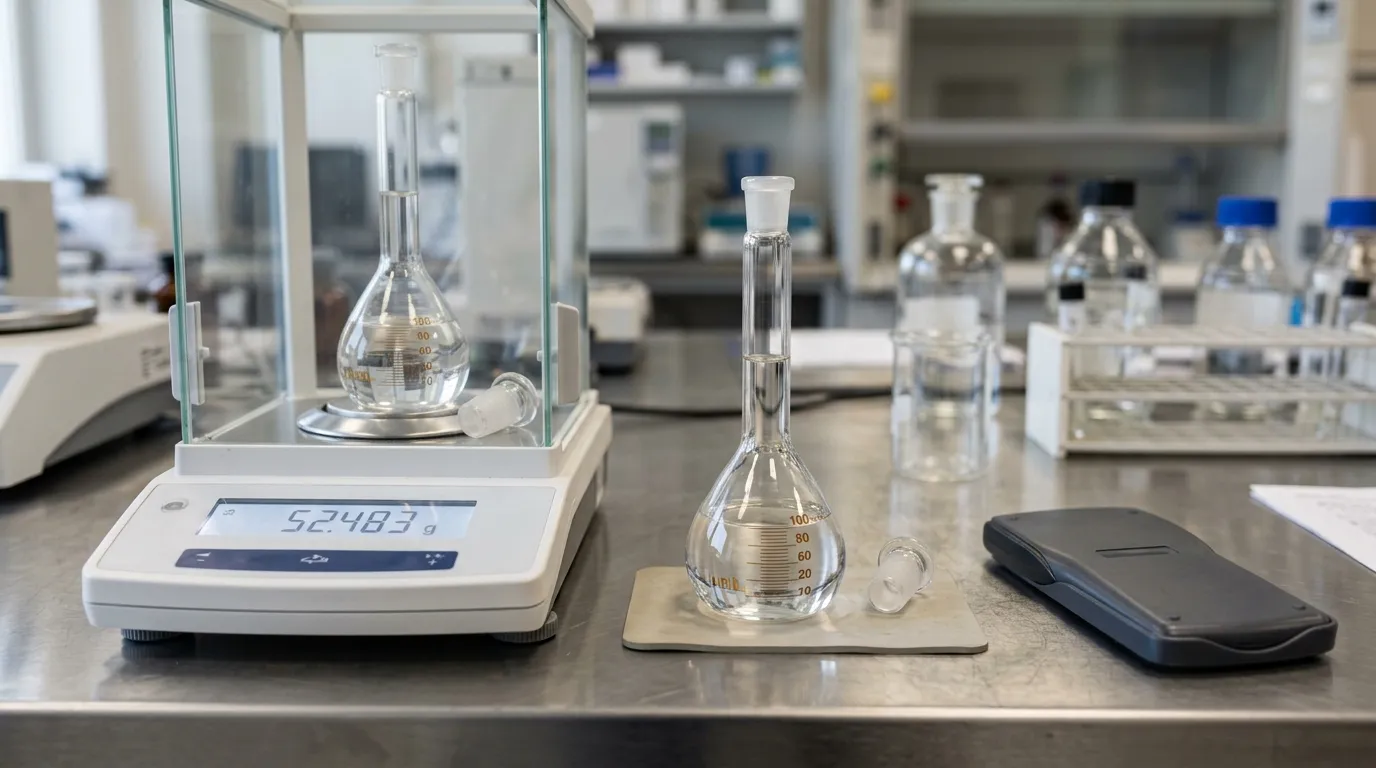
Density expresses the relationship between mass and volume:
\[ \rho = \frac{m}{V} \]
Where:
- \(\rho\) = density
- \(m\) = mass
- \(V\) = volume
The two practical rearrangements are:
\[ m = \rho \times V \]
\[ V = \frac{m}{\rho} \]
Use compatible units. For example:
- g/mL × mL = g
- kg/L × L = kg
- g ÷ g/mL = mL
Illustrative conversion example
Suppose a preliminary calculation uses a 20 wt% acetic acid solution with a reference density of 1.0250 g/mL at 20°C. To estimate the volume corresponding to 500 kg of solution:
- Convert the density to compatible units:
1.0250 g/mL is numerically equivalent to 1.0250 kg/L.
- Apply the volume formula:
\[ V = \frac{m}{\rho} \]
\[ V = \frac{500\ \text{kg}}{1.0250\ \text{kg/L}} \]
\[ V \approx 487.8\ \text{L} \]
The estimated volume is therefore approximately 488 L under the stated reference conditions.
This is an illustrative calculation based on a reference density. It is not a measured result for a particular commercial batch. If the calculation affects formulation release, inventory reconciliation, invoicing, or transfer documentation, replace the reference value with the exact product density and temperature basis from the applicable documentation.
If the task is dilution rather than simple mass–volume conversion, a glacial acetic acid dilution calculator may be a more appropriate follow-up resource.
Why density does not convert linearly across all concentrations
A common error is to assume that density can be scaled directly from concentration. For example, multiplying the density of a 10 wt% solution by five does not produce the density of a 50 wt% solution.
The relationship between concentration and density depends on the composition of the solution and the measurement conditions. In practice:
- Density values must be tied to a temperature.
- Concentration must use a defined basis.
- Different reference tables may use different data sources or measurement conditions.
- Interpolation between nearby values is an estimate, not a substitute for a product measurement.
- Extrapolation beyond the documented concentration range is less defensible than interpolation.
- A density value alone does not establish assay, purity, grade, or regulatory suitability.
When using a chart, keep the concentration and temperature attached to the value. A density of 1.0250 g/mL is incomplete technical information unless the reader also knows what solution concentration and temperature it represents.
How to handle glacial and high-concentration acetic acid values
Glacial acetic acid refers to the high-concentration form of acetic acid rather than a dilute aqueous solution. Its density must be interpreted separately from the lower-concentration entries in an aqueous-solution chart.
High-concentration calculations require particular care because:
- The concentration may be stated as a minimum assay, a typical value, or a defined mass percentage.
- The density may be reported at a specified reference temperature.
- Different tables may not agree at the same nominal concentration.
- A product’s specification may use a test method or tolerance that is not stated in a general reference table.
- Pure or near-pure acetic acid data should not automatically be transferred to a commercial solution with a different assay or composition.
For this reason, do not use a generic chart as the final density specification for a high-concentration product. Confirm the following before using the value in a critical calculation:
- Product concentration or assay basis
- Reference temperature
- Density units
- Test method, if stated
- Applicable tolerance
- Product grade and form
- TDS or product specification
- Batch or lot information, where relevant
A general chart can support preliminary estimation, but it does not establish that a particular 80%, 99.5%, or custom-concentration product has a specific density. Vanchor’s custom acetic acid concentration page may be relevant when discussing a required concentration, but product-specific density and documentation should still be confirmed for the exact material being purchased.
Buyer verification checklist before using a density value
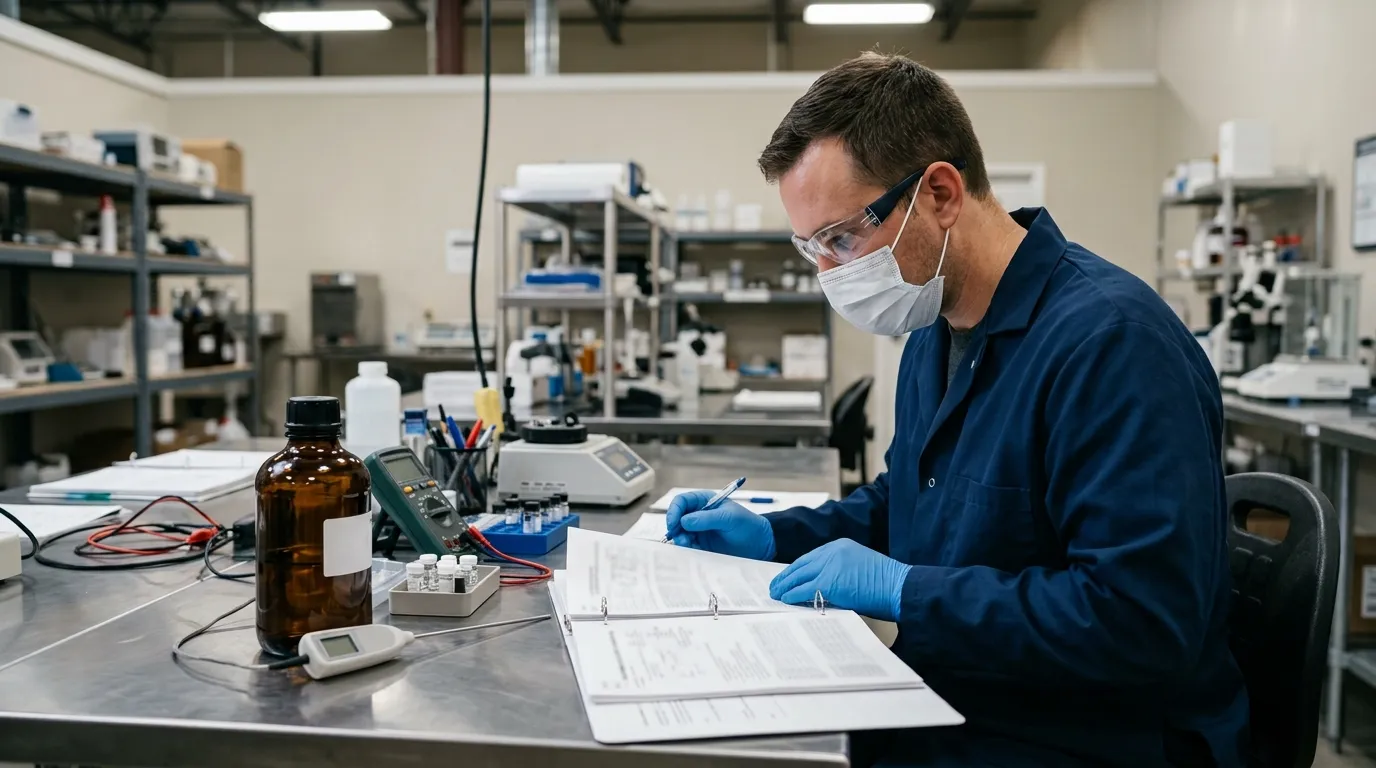
Before using an acetic acid density value in a purchasing, QA, or formulation calculation, check:
- Chemical identity: Confirm that the material is acetic acid, also called ethanoic acid, rather than another acetate or acid.
- Physical form: Distinguish an aqueous solution from glacial or high-concentration acetic acid.
- Concentration basis: Confirm whether the value is wt%, molarity, molality, or volume percentage.
- Concentration status: Check whether the specification is a minimum, maximum, typical, or nominal value.
- Temperature: Identify the temperature associated with the density.
- Units: Confirm whether density is reported in g/mL, g/cm³, kg/L, or another unit.
- Test method: Review the stated measurement method when the calculation is specification-sensitive.
- Grade: Confirm the applicable industrial or other defined grade rather than assuming that all acetic acid products are interchangeable.
- Documentation: Request or review the applicable TDS, product specification, and COA where required.
- Batch relevance: For release or acceptance decisions, determine whether the value applies to the specific lot.
This checklist does not mean that every supplier provides every document for every product. It is a way to identify which information is needed before a reference density becomes a purchasing or process-control input.
When the chart is useful—and when it is not
A reference chart is useful for:
- Preliminary mass-to-volume estimates
- Early formulation calculations
- Tank, drum, or container planning
- Approximate logistics and inventory calculations
- Comparing solution densities at defined concentrations
- Preparing a technical RFQ or specification question
It should not be used alone for:
- Batch release
- Product acceptance where density tolerance matters
- Custody-transfer or invoice calculations
- Final formulation approval
- Regulatory or application approval
- Proving concentration, purity, or grade
- Establishing suitability for food, feed, pharmaceutical, or drinking-water use
For product-specific purchasing, compare the required concentration and documentation with the exact product listing rather than treating the reference chart as a specification. For example, Vanchor’s acetic acid solution 10 80 page may provide a relevant product follow-up, but the chart values in this guide should not be presented as that product’s certified density unless the exact product documentation states them.
The practical rule is simple: use the acetic acid density concentration chart for a qualified estimate, and use the exact supplier documentation for a decision that depends on the actual product.


Contact Us
In This Article
Related Posts
Индивидуальные упаковочные решения от поставщика безводного ацетата натрия в Китае
2026-09-23
Тенденции применения безводного ацетата натрия для специального химического производства
2026-09-23
Безводный ацетат натрия для дубления кожи: улучшает равномерность окрашивания
2026-09-22
Formic Acid 85% for Animal Feed Preservation: Moisture and Storage Stability Guide
2026-09-21


